

HyperComply Alternatives
HyperComply automates security questionnaire response, but it is one option in a crowded category. This independent roundup compares the main alternatives by fit, format coverage, AI accuracy, support model, and pricing shape, so you can shortlist the one that matches your program rather than the loudest brand.
Quick answer: which should you choose?
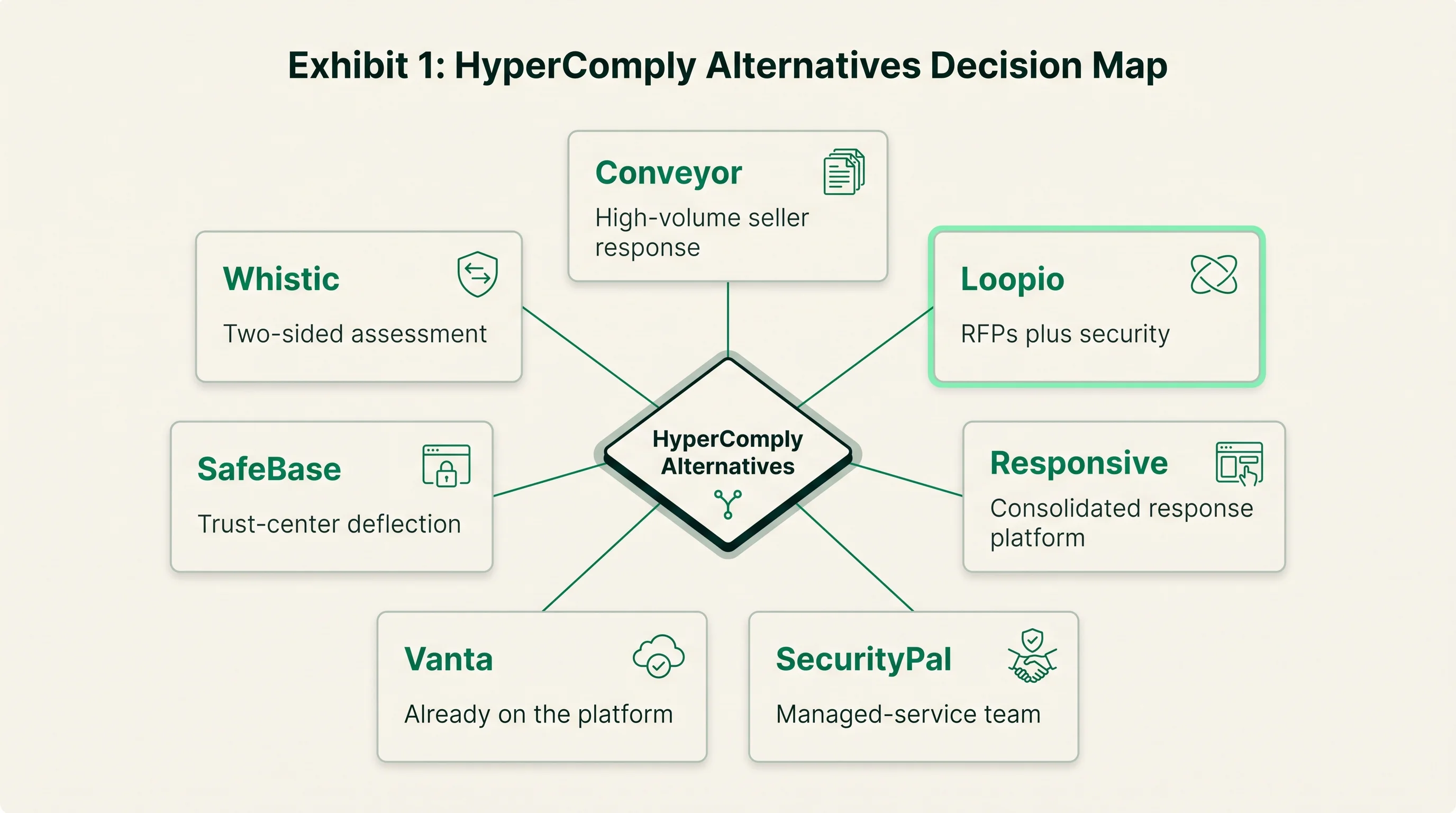
There is no single best HyperComply alternative, so choose by fit rather than reputation. HyperComply itself fits teams that want focused security questionnaire automation with AI-assisted drafting and a managed-service option; an alternative wins when your priorities sit elsewhere, such as heavy portal volume, trust-center deflection, broader RFP work, or compliance you already run in another platform.
The category splits into a few shapes. Some tools are pure questionnaire automation built around an answer library and AI drafting. Some lead with a public trust center designed to deflect questionnaires before they arrive. Some bundle questionnaire response into a wider compliance or RFP platform. Each shape fits a different buyer.
The deciding factors are consistent across every option: your annual review volume, the formats your buyers send, which team owns the response work, and your budget model. Match the tool to the program you actually run.
- High seller-side questionnaire volume: look first at Conveyor, Responsive, or SecurityPal.
- Deflection through a public trust center: look at SafeBase or Whistic.
- RFP plus security response in one tool: look at Loopio or Responsive.
- Compliance already running in a platform: look at Vanta's questionnaire features.
If the category is new to you, start with our explainer on what security questionnaire automation is, then return to shortlist these options.
Why do buyers look for HyperComply alternatives?
Buyers usually shortlist alternatives for one of five concrete reasons, not because HyperComply is broadly weak. HyperComply is a real, established product in the security questionnaire automation category, with AI-assisted drafting and a managed-service offering it markets directly. Teams move on when their needs drift away from what any single tool centers on.
The most common triggers cluster around fit, cost, and operational detail rather than headline features. SecurityScorecard acquired HyperComply, which is worth noting because acquisitions can change roadmap, packaging, and pricing over time, and some buyers re-evaluate when their vendor changes hands.
- Price and packaging: HyperComply pricing is quote-based rather than published, and some teams want a different cost shape, such as a managed-service retainer, a per-seat license, or a cheaper entry tier.
- Format coverage: buyers with heavy portal, Excel, CAIQ, or SIG volume want to confirm a tool handles their exact mix, since coverage depth varies between products.
- AI accuracy and citations: teams that have been burned by confident but wrong AI answers want to test drafting quality and whether the tool cites the evidence behind each answer.
- Support and service model: some teams want a hands-on managed service that completes questionnaires for them, while others want self-serve software with strong onboarding instead.
- Fit and lock-in: a tool may not match the team that owns the work, or a buyer may want a trust center, RFP coverage, or a compliance platform the current tool does not provide.
None of these triggers means HyperComply is the wrong choice for everyone. They mean a different tool may fit your specific volume, formats, budget, and owner better. The rest of this guide maps the main alternatives to those triggers.
The main alternatives, at a glance
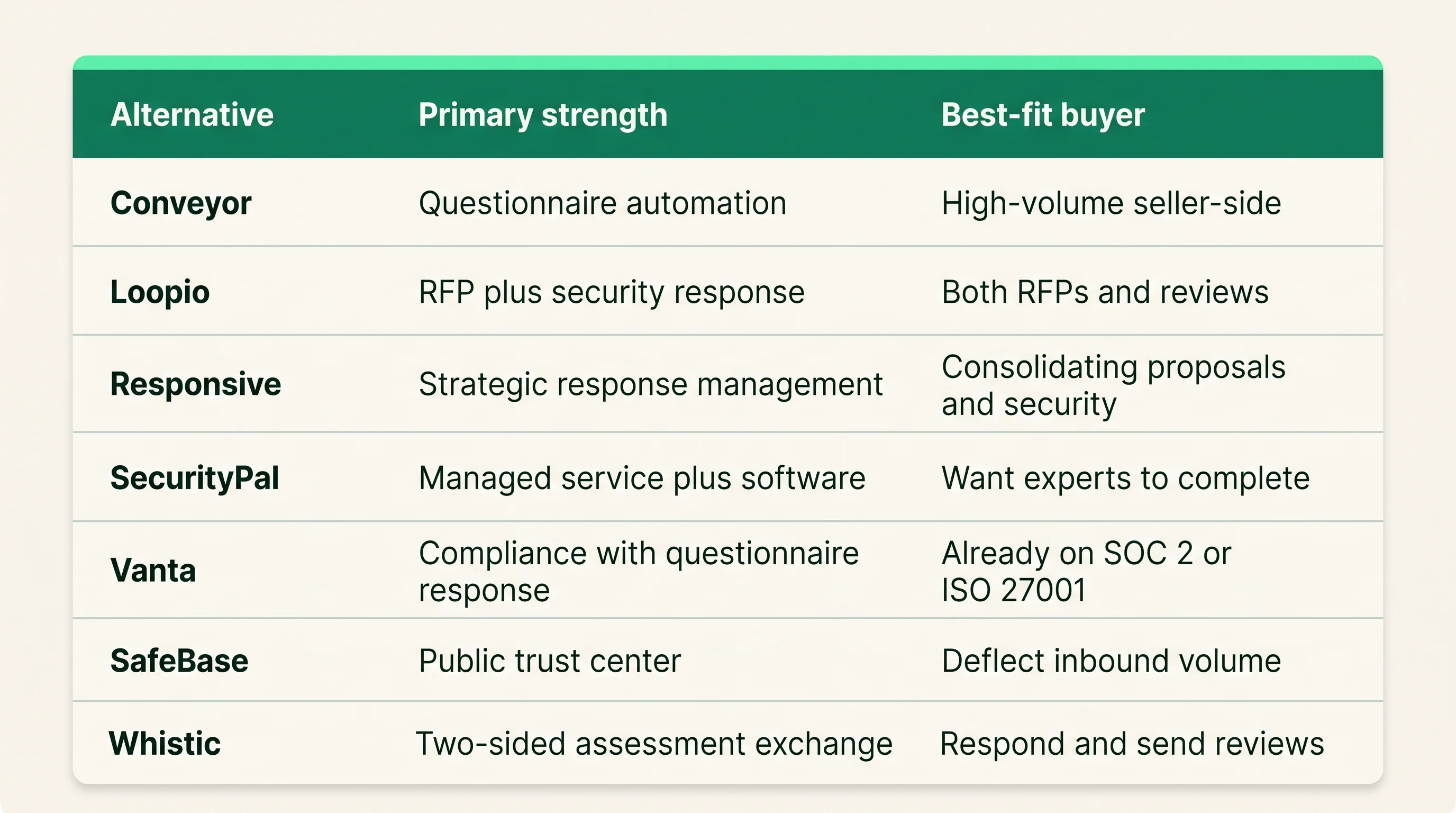
The fastest way to compare alternatives is by primary strength and best-fit buyer. The table below names the main options in the category, using capability-level distinctions we can defend rather than specific feature claims that change between releases. Treat every strength as vendor-reported and verify it on each vendor's current docs.
| Alternative | Primary strength (vendor-reported) | Best-fit buyer |
|---|---|---|
| Conveyor | Questionnaire automation with answer library and AI drafting | Seller-side teams with high recurring questionnaire volume |
| Loopio | Response management across RFPs and security questionnaires | Teams that answer both RFPs and security reviews from one library |
| Responsive | Strategic response management across RFP, RFI, and security | Larger orgs consolidating proposal and security response |
| SecurityPal | Managed service plus software for questionnaire completion | Teams wanting experts to complete questionnaires, not just tooling |
| Vanta | Compliance automation with questionnaire response added | Teams already running SOC 2 or ISO 27001 in Vanta |
| SafeBase | Public trust center built to deflect questionnaires | Customer trust teams reducing inbound questionnaire volume |
| Whistic | Vendor-security exchange and two-sided assessment | Programs that both respond to and send security reviews |
A few rows deserve a closer read. Conveyor, Responsive, and Loopio overlap heavily on the core answer-library-plus-AI workflow, so the dividing line is scope: Conveyor stays focused on security response, while Responsive and Loopio extend into RFP and proposal work. SecurityPal is the clearest managed-service contrast, useful when you want people to do the work, not just a tool. SafeBase and Whistic sit slightly apart because they lead with deflection and a published profile rather than questionnaire completion. Vanta fits when questionnaire response is one feature inside a compliance platform you already use.
The pattern holds across the category: most tools share an answer library and AI drafting at the core, and diverge on what surrounds it. Hold that distinction through the next section, because it explains most of the fit differences. For a wider view of who plays in the space, see our security questionnaire automation vendor landscape.
How do the HyperComply alternatives differ on the criteria that matter?
The alternatives differ most on six criteria that shortlisters actually weigh. Positioning rarely decides a deal; execution on these dimensions does. Score each finalist against your own program rather than the vendor's marketing.
| Criterion | What to compare | Why it matters |
|---|---|---|
| Answer library | How answers stay current and who governs edits | A stale library produces confident, wrong answers |
| AI accuracy and citations | Whether drafts cite the evidence behind each answer | Uncited AI shifts review burden back to your experts |
| Format coverage | Excel, portal autofill, CAIQ, SIG, custom forms | Coverage gaps force manual work the tool was meant to remove |
| Review and approval | How edits are gated before answers go out | Weak controls let unreviewed claims reach buyers |
| Integrations | CRM, SSO, knowledge base, ticketing connectors | Poor fit adds copy-paste between your existing systems |
| Pricing model | Quote-based, managed-service, or per-seat shape | The cost shape, not list price, drives total cost |
On answer library quality, every serious option stores approved, evidence-linked answers and reuses them, so the question is not whether the library exists but how cleanly it stays current. Conveyor, Loopio, and Responsive center their value here; SecurityPal layers a managed team on top; SafeBase and Whistic feed a trust center or profile from the same kind of library.
On AI accuracy and citations, treat every vendor's claim as vendor-reported and verify it on current docs. The capability to test is whether the AI cites the source behind each draft answer, because a tool that drafts without citations pushes verification back onto your sales engineers and GRC analysts. Our explainer on how enterprise buyers evaluate questionnaire automation tools covers what to probe.
On format coverage, confirm the exact mix your buyers send. Most tools handle Excel and standardized formats like CAIQ and SIG through the library, but portal autofill and unusual custom forms are where coverage varies, so test your real questionnaires. On pricing model, the difference is structural: SecurityPal's managed service is a different cost shape from a self-serve license, and most vendors quote rather than publish rates. For the full range of cost structures, see our breakdown of questionnaire automation pricing models.
Which alternative fits which buyer
Match the alternative to your dominant workflow and the team that owns it. Because the tools overlap on core response, the deciding factor is what surrounds that core and which problem you are buying toward. Use the lines below as a starting shortlist, then test the finalists on real questionnaires.
- Choose Conveyor when seller-side questionnaire volume is high and you want a focused tool built around an answer library and AI drafting, with a sales engineer or GRC team owning recurring response.
- Choose Loopio when your team answers both RFPs and security questionnaires and wants one response library serving sales proposals and security reviews together.
- Choose Responsive when a larger organization is consolidating proposal, RFI, and security response, and a single strategic response platform across departments matters more than a security-only tool.
- Choose SecurityPal when you want experts to complete questionnaires for you, not just software, and a managed-service model fits your budget and headcount better than a self-serve license.
- Choose Vanta when you already run SOC 2 or ISO 27001 in its platform and want questionnaire response as a feature next to existing compliance, rather than adopting a separate dedicated tool.
- Choose SafeBase when deflection is the goal, a customer trust team owns the work, and you measure success by fewer inbound questionnaires through a polished public trust center.
- Choose Whistic when your program sits on both sides of the review and you want a reusable vendor-security profile inside an exchange that also supports assessing your own third parties.
These are fits, not verdicts. A high-volume seller-side team that also runs a trust center might shortlist both Conveyor and SafeBase and decide on execution. The point is to start from the problem you own, not the brand you have heard of most. To compare the broader category surfaces, browse the security questionnaire automation category hub.
How should you evaluate HyperComply alternatives yourself?
Run a short, structured evaluation rather than trusting any roundup, including this one. The goal is to see how each finalist performs on your actual questionnaires, with your evidence, and with the team that will own the tool. Two or three finalists is enough; more than that dilutes the test.
Work through this checklist with each shortlisted tool.
- Trial with a real questionnaire: send each tool one Excel form and one portal or CAIQ/SIG questionnaire you have already completed, so you can compare output against a known-good baseline.
- Score on the criteria table: rate each option on answer library, AI accuracy and citations, format coverage, review controls, integrations, and pricing model, using the same scale across vendors.
- Check AI citations: confirm that drafted answers point to evidence you trust, and flag any confident answer the tool cannot source.
- Confirm format and integration scope on current docs: capability and connector lists shift between releases, so verify them rather than relying on a comparison written at one point in time.
- Model your real volume against the pricing shape: a managed service, a per-seat license, and a quote-based platform behave very differently at your annual review count.
- Check references: ask each vendor for a customer with your volume and format mix, and ask that reference about onboarding effort and library upkeep.
The hidden cost across every option is library quality. No AI layer outperforms the approved answers behind it, so whichever tool you pick, plan for the work of curating and maintaining that source content. Score the finalists against your own program, then decide. For a structured framework, use our buyer-evaluation explainer alongside the category hub.
How this article was reviewed
Sources reviewed
- HyperComply product pages and documentationVendor-reported. Capability, support-model, and pricing claims should be verified on the vendor's current docs and confirmed in a quote, not treated as independent fact.
- Conveyor, Loopio, Responsive, SecurityPal, Vanta, SafeBase, and Whistic product pages and docsVendor-reported. Each vendor's strength, format coverage, AI accuracy, integration, and pricing claims should be verified on that vendor's current docs and confirmed in a quote, not treated as independent fact.
- AICPA - SOC 2Primary source for what a SOC 2 report attests, commonly cited as evidence in questionnaire answers.
- ISO/IEC 27001Primary source for the information security management standard referenced in answer libraries.
- Cloud Security Alliance - CAIQPrimary source for the CAIQ format, one of the standardized questionnaires these tools support.
- Shared Assessments - SIGPrimary source for the SIG questionnaire format referenced in format-coverage comparison.
FAQ
Why do security teams switch away from HyperComply?
Teams switch when their needs drift from what HyperComply centers on, not because it is broadly weak. Common reasons are a different pricing shape, deeper coverage for specific formats like portals or CAIQ and SIG, a different support model such as a hands-on managed service, or a need HyperComply does not cover, such as a public trust center, RFP response, or a compliance platform. SecurityScorecard acquired HyperComply, and some buyers re-evaluate after an acquisition changes roadmap or packaging.
What are the top complaints buyers have about HyperComply?
The most common buyer concerns are fit and cost rather than a single broken feature. Buyers cite quote-based pricing that is hard to compare without a sales call, uncertainty about coverage for their exact questionnaire formats, and the usual category-wide worry about AI accuracy and whether drafted answers cite their sources. These are vendor-evaluation questions to test directly, not independent findings, so trial HyperComply on your own questionnaires before drawing conclusions.
What is the most direct competitor to HyperComply?
Conveyor is the closest like-for-like competitor, because both focus on seller-side security questionnaire automation built around an answer library and AI drafting. Responsive and Loopio compete closely too, though they extend further into RFP and proposal response. SecurityPal competes on a different axis with a managed-service model. The most direct competitor for your program depends on whether you want pure questionnaire software, broader response management, or a managed service.
What HyperComply alternative works best for small security teams?
Small teams usually fit best with a tool that minimizes the work they personally own. A managed service like SecurityPal can suit a small team that lacks headcount to complete questionnaires, while a focused self-serve tool like Conveyor suits a small team that wants to keep control with strong automation. If the team already runs compliance in Vanta, its questionnaire features may avoid adding a second tool. Match the choice to whether you want to do the work or hand it off, and confirm entry-tier pricing in a quote.
What HyperComply alternative is designed for enterprise questionnaire volume?
For high enterprise volume, look at Conveyor, Responsive, and SecurityPal first. Conveyor and Responsive are built around a governed answer library and AI drafting that scale across many recurring questionnaires, with Responsive extending into RFP and RFI response for larger organizations. SecurityPal adds a managed team for volume you cannot staff internally. SafeBase and Whistic help at scale differently, by deflecting questionnaires through a trust center or reusable profile. Test each on your real volume and formats before committing.