

Security Questionnaire Automation Pricing Models Explained
Security questionnaire automation is priced four main ways: per-seat, per-questionnaire, tiered packages, and usage-based AI metering, often bundled into a wider trust platform. The model you pick decides whether cost scales with your team, your deal volume, or your AI usage.
What are security questionnaire automation pricing models?
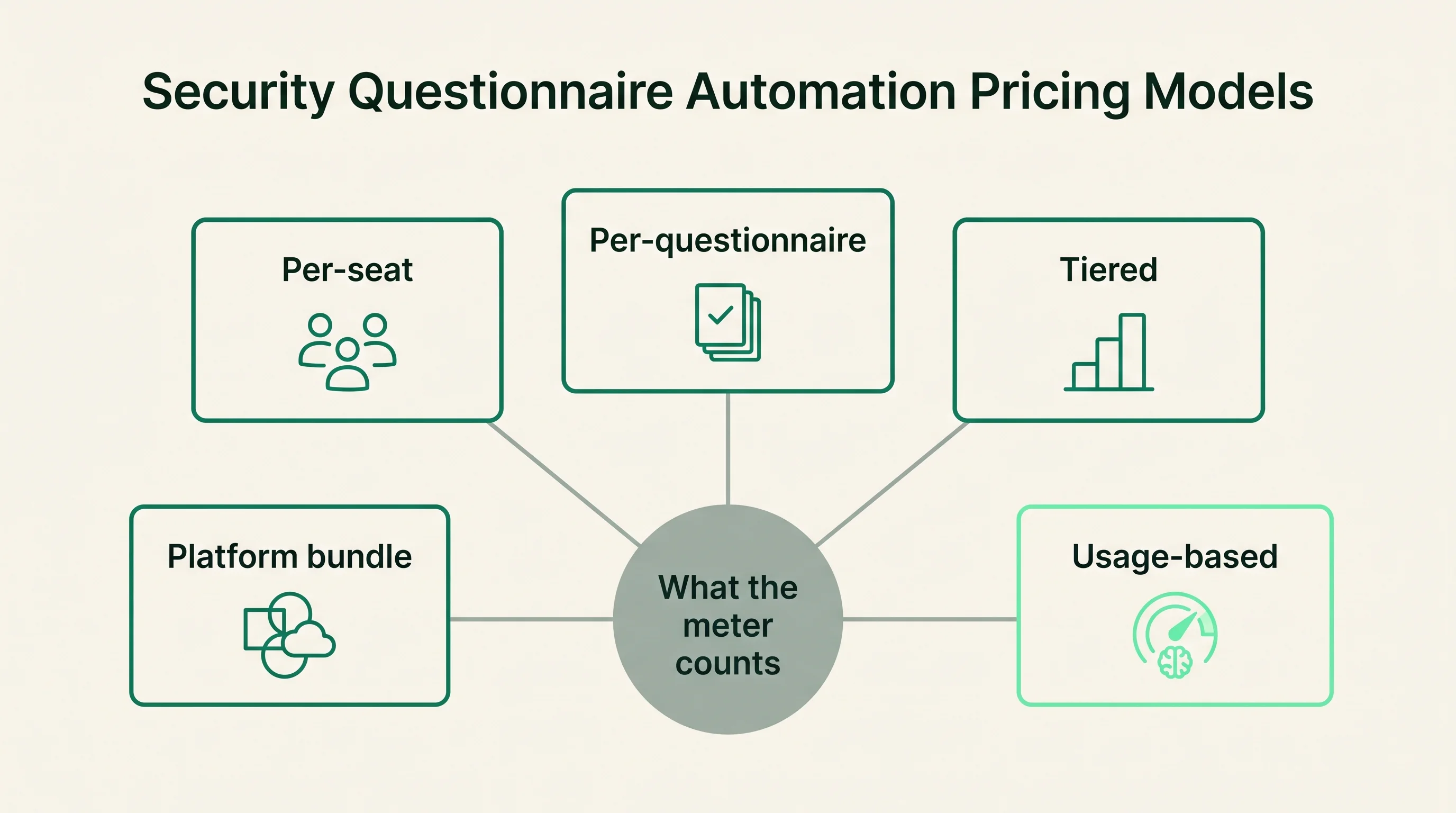
Security questionnaire automation pricing models are the billing structures vendors use to charge for software that drafts answers to vendor security reviews. There are five common patterns: per-seat, per-questionnaire, tiered packages, usage-based AI metering, and platform bundles. The model determines what you pay for and how the bill grows as your team, your deal volume, or your AI usage grows.
A security questionnaire is the structured set of security questions a buyer sends a vendor before a deal, and automation software answers it from a maintained answer library. If that workflow is new to you, start with our explainer on what security questionnaire automation is, then come back to compare how it is priced.
The five models differ in one thing: what the meter counts.
- Per-seat: counts licensed users
- Per-questionnaire: counts completed or processed questionnaires
- Tiered: counts which feature package you buy
- Usage-based: counts AI activity, such as answers generated or questions processed
- Platform bundle: charges a flat fee for a suite that includes questionnaire automation
The people who own this decision are usually procurement and vendor risk, working with the GRC (governance, risk, and compliance) team that runs the tool and the security or sales engineering leaders whose throughput the tool is meant to improve. Procurement owns the contract; the team that lives in the product owns whether the model fits the work.
How does each pricing model work?
Each pricing model meters a different unit, and that unit decides how your cost scales. Per-seat tracks people, per-questionnaire tracks activity, tiered tracks features, usage-based tracks AI consumption, and platform pricing folds the whole thing into one suite fee. Knowing the unit tells you in advance which direction your bill will move.
The mechanics break down cleanly:
- Per-seat charges a fixed price for every licensed user. Cost rises when you add GRC analysts, sales engineers, or subject-matter experts who need accounts, and stays flat no matter how many questionnaires they process.
- Per-questionnaire charges per completed or processed review, sometimes as a credit pack. Cost rises with deal volume and questionnaire inflow, and stays flat regardless of headcount.
- Tiered packages group features and limits into named plans, often Starter, Growth, and Enterprise. You buy a tier, and cost steps up when you cross a usage cap or need a gated feature such as single sign-on, an API, or a trust center.
- Usage-based meters AI work directly, such as the number of answers generated, questions matched, or documents processed. Cost tracks how heavily you lean on the AI drafting layer.
- Platform bundles set one flat fee for a suite where questionnaire automation is a module beside a trust center, an answer library, and sometimes compliance automation.
Most vendors mix these. A common shape is a tiered base plan priced partly on seats, with AI usage either capped by tier or metered above an included allowance. The point is to read a quote as a combination, not a single label.
Why does the security questionnaire automation pricing model matter?
The pricing model matters because it decides whether your cost tracks the value you get or drifts away from it. A model that meters the wrong unit either overcharges you for capacity you do not use or punishes the exact activity you bought the tool to increase. The questionnaire workflow it supports is high-leverage: a stalled security review can block a signed contract, pull subject-matter experts off other work, and let answers drift out of date, so the tool earns its cost by removing repeat effort.
The risk is a mismatch between how you work and what the meter counts.
| If your reality is | A poor-fit model is | Because |
|---|---|---|
| Few users, high questionnaire volume | Per-seat | You pay for seats while the high-volume work runs uncapped, which is good, but a per-questionnaire vendor might quote you less |
| Many users, low questionnaire volume | Per-questionnaire | Every occasional reviewer needs to touch the tool, and per-review pricing penalizes a workflow that is mostly light usage |
| Spiky, deal-driven inflow | Usage-based with no cap | A busy quarter produces a bill you did not forecast |
| You only need questionnaire response | Platform bundle | You pay for a trust center and compliance modules you will not use |
The practical lesson is to match the meter to your dominant cost driver. A team whose pain is volume should resist per-seat framing; a team whose pain is coordination across many occasional reviewers should resist per-questionnaire framing.
How do the pricing models compare?
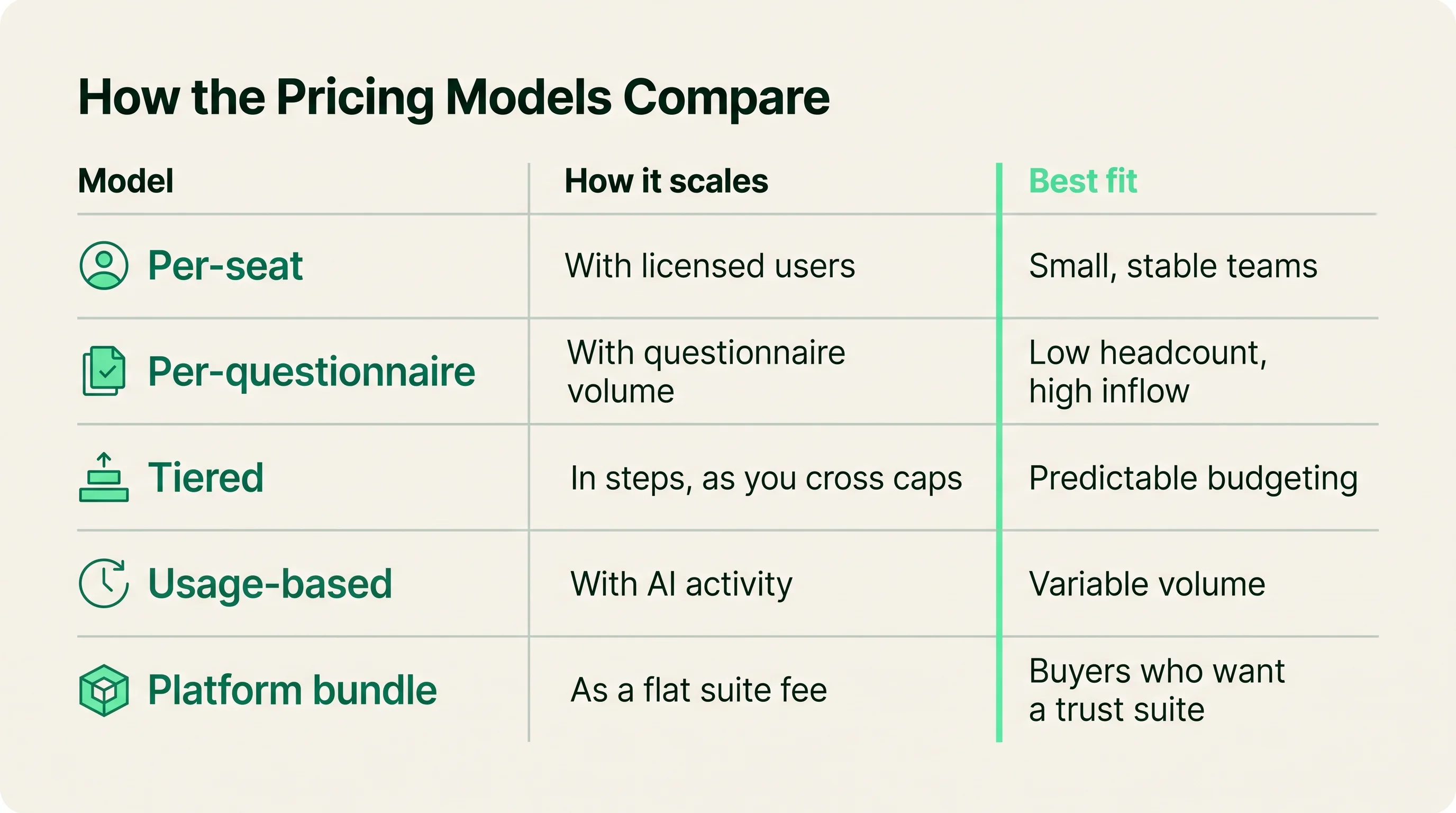
The five models compare on three things buyers care about: how the cost scales, how predictable the annual bill is, and who each one fits. No model is best in the abstract; the right one is the one whose meter matches your dominant cost driver.
| Model | How it scales | Best fit |
|---|---|---|
| Per-seat | With the number of licensed users | Small, stable teams with steady volume |
| Per-questionnaire | With questionnaire and deal volume | Low headcount, high inflow |
| Tiered | In steps, as you cross caps or need features | Teams that want predictable budgeting |
| Usage-based | With AI activity, such as answers generated | Variable volume, willing to track usage |
| Platform bundle | As a flat suite fee | Buyers who also want a trust center and GRC tooling |
Predictability and value-alignment pull in opposite directions. Per-seat and tiered pricing give you a number you can budget a year ahead, but they can charge for capacity you never use. Per-questionnaire and usage-based pricing track real activity, so you pay roughly in proportion to value, but a busy quarter makes the annual figure harder to forecast.
Platform bundling sits apart because it changes the question. Instead of asking what a questionnaire module costs, you are asking what an entire trust and compliance suite costs, with questionnaire automation as one part of it. That can be efficient if you need the other parts and wasteful if you do not.
Where pricing sits next to the trust platform
Questionnaire automation pricing rarely stands alone, because the feature increasingly ships inside a wider trust or GRC platform. A vendor may price the questionnaire module as a line item beside a trust center, an answer library, and compliance automation, or fold all of it into a single suite fee. Where the line falls changes what you are really comparing.
The adjacent surfaces that show up in the same quote are worth naming, because each one can be a separate charge.
| Surface | What it does | Pricing effect |
|---|---|---|
| Questionnaire automation | Answers inbound security reviews | The module you are evaluating |
| Trust center | Publishes proof so buyers self-serve and send fewer questionnaires | Often a separate tier or add-on |
| Answer library | Stores approved, evidence-linked answers | Usually included, but seat or storage limits can apply |
| Compliance automation | Monitors controls for SOC 2, ISO 27001, and similar | A larger module that can dwarf the questionnaire cost |
The market splits along these lines. Conveyor, SafeBase, and Whistic center on questionnaires and trust centers, so their pricing usually maps to that workflow. Vanta and Drata lead with compliance automation, where questionnaire response is one module inside a broader platform, which can make the questionnaire piece harder to price on its own. Loopio and Responsive came from RFP response, so their pricing reflects a response-management suite that also covers security questionnaires. These distinctions are vendor-reported positioning, and the practical point is that two quotes labeled the same can cover very different scopes. The same adjacency runs through third-party risk management, which is the buyer-side program these questionnaires feed.
What are the tradeoffs of each questionnaire automation pricing model?
Each model buys you something and costs you something, so the choice is about which tradeoff you can live with. The honest summary is that predictable models cost forecasting accuracy in exchange for possible overpayment, and activity-based models cost forecasting accuracy in exchange for tighter value alignment.
What each model gives you:
- Per-seat: simple to budget, easy to reason about, and it does not penalize high questionnaire volume
- Per-questionnaire: you pay roughly for what you process, which suits lean teams with heavy inflow
- Tiered: a clear upgrade path and a predictable annual number
- Usage-based: cost tracks real AI consumption, so light users pay less
- Platform bundle: one contract, one renewal, and shared data across trust center, library, and compliance
What each model costs you:
- Per-seat: you pay for occasional reviewers who barely log in, and seat creep raises the bill quietly
- Per-questionnaire: a busy quarter spikes the cost, and you may hesitate to run borderline reviews through the tool
- Tiered: the feature you need can sit one tier up, forcing a larger jump than your usage justifies
- Usage-based: the hardest model to forecast, and an uncapped meter can surprise you
- Platform bundle: you may pay for modules you do not use, and unbundling later is hard
There is a point where dedicated software is not worth any pricing model. A company that receives a handful of questionnaires a year does not need a license; a shared document of approved answers and a careful reviewer will do. Automation earns its cost when volume is high enough that the same subject-matter experts are repeatedly pulled into near-identical work.
How to compare total cost across vendors
Compare total cost by modeling your real annual volume against each vendor's meter, not by comparing list prices. List prices describe different units, so a per-seat number and a per-questionnaire number are not comparable until you convert both to your actual usage. Build one usage profile and run every quote through it.
Use a consistent checklist so each vendor is scored on the same inputs.
| Cost factor | What to model | Why it matters |
|---|---|---|
| Seats | Every user who needs an account, including occasional SME reviewers | Seat-based vendors bill on this; underestimating it understates cost |
| Questionnaire volume | Realistic annual inflow, including portals and standardized CAIQ and SIG formats | Per-questionnaire and capped tiers turn on this number |
| AI usage | Expected answers generated or questions processed | Usage-based and metered tiers price this directly |
| Bundled modules | Whether you actually need the trust center and compliance pieces | Bundles charge for them whether you use them or not |
| Implementation and onboarding | One-time setup, library migration, and training fees | These sit outside the recurring price and are often negotiable |
Watch for the costs that do not appear on the headline price: overage fees once you pass a tier cap, charges for premium formats or portal autofill, fees for additional integrations, and annual uplift at renewal. Ask each vendor to quote against your usage profile, and treat every published figure as a starting point for negotiation rather than a fixed rate. When you are ready to build a shortlist, start from the security questionnaire automation category hub and compare Conveyor against a response-suite vendor such as Loopio to see how the same workflow is priced from two different starting points.
How this article was reviewed
Sources reviewed
- AICPA - SOC 2Primary source for what a SOC 2 report attests, relevant where compliance automation is bundled with questionnaire pricing.
- ISO/IEC 27001Primary source for the information security management standard cited as evidence in answer libraries.
- Cloud Security Alliance - CAIQPrimary source for the CAIQ format, one of the standardized questionnaire types that affects format-coverage pricing.
- Shared Assessments - SIGPrimary source for the SIG questionnaire format referenced in volume and format considerations.
- Vendor product and pricing documentation (Conveyor, Loopio, Responsive, Vanta, SafeBase, Whistic, Drata)Pricing structure and positioning claims are vendor-reported and should be confirmed in a quote against your own usage, not treated as independent fact.
FAQ
What are the main security questionnaire automation pricing models?
There are five common models: per-seat, per-questionnaire, tiered packages, usage-based AI metering, and platform bundles that fold questionnaire automation into a trust or compliance suite. Each meters a different unit, which decides whether your cost scales with users, questionnaire volume, AI activity, or a flat suite fee. Most vendors mix two or more of these in a single quote.
Is per-seat or per-questionnaire pricing better for security questionnaire automation?
Neither is better in the abstract; the right one depends on your dominant cost driver. Per-seat fits small, stable teams with steady volume, while per-questionnaire fits lean teams with high deal-driven inflow. Model your real annual seats and questionnaire count, then pick the meter that charges you in proportion to the value you get.
Why is security questionnaire automation pricing often bundled into a platform?
The feature increasingly ships inside a wider trust or GRC platform, so questionnaire automation is sold as one module beside a trust center, an answer library, and compliance automation. Vendors like Vanta and Drata lead with compliance, which can make the questionnaire piece a line item rather than a standalone price. Bundling is efficient if you need the other modules and wasteful if you do not.
What hidden costs should buyers check in questionnaire automation pricing?
Look past the headline price for overage fees when you cross a tier cap, charges for portal autofill or premium formats, fees for extra integrations, one-time implementation and library-migration costs, and annual price uplift at renewal. These sit outside the list price and often decide the real total. Ask each vendor to quote against your actual usage profile so the extras surface before you sign.
How should a buyer compare total cost across questionnaire automation vendors?
Build one usage profile that captures your seats, annual questionnaire volume, expected AI usage, and the modules you actually need, then run every vendor's quote through it. List prices describe different units and are not comparable until you convert them to your real usage. Treat every published figure as a starting point for negotiation, not a fixed rate.