

Loopio vs. Security Questionnaire Automation
Loopio is a broad response-management platform that handles RFPs, proposals, and questionnaires from one shared library. Dedicated security questionnaire automation focuses on the security-review job: CAIQ, SIG, evidence linking, trust centers, and security-tuned AI. They overlap at the answer library but optimize for different work, so the right choice depends on who owns the responses and what you answer most.
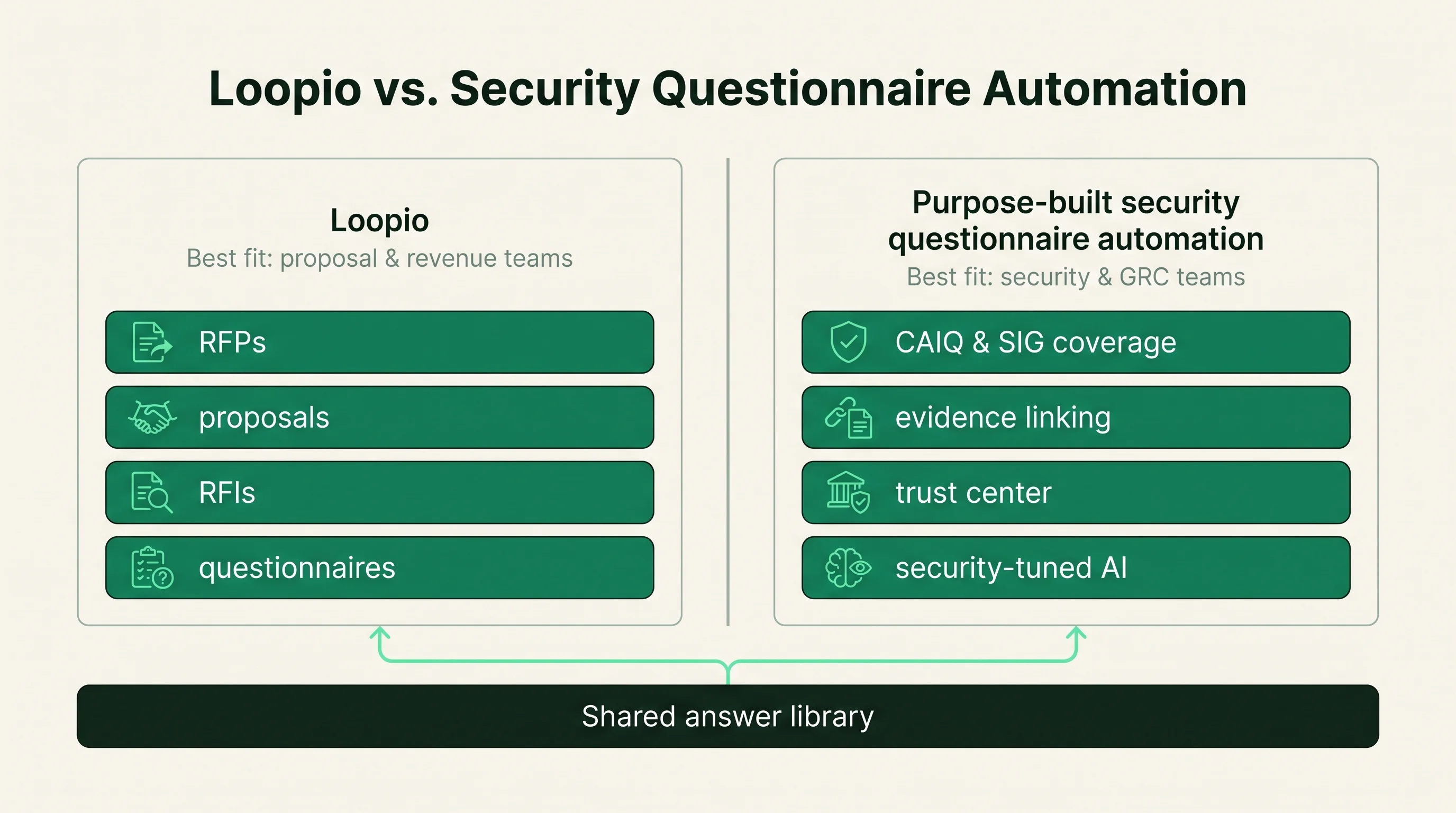
Quick answer: Loopio vs. Security Questionnaire Automation
Loopio fits a proposal or revenue team that needs one platform to answer RFPs, proposals, and questionnaires from a shared library, while dedicated security questionnaire automation fits a security or GRC team whose bottleneck is inbound security reviews. Both run on the same core idea, a reusable library of approved answers, but they optimize for different work. The deciding factor is who owns the responses and what your team answers most.
Loopio is a response-management platform. Its strength is breadth: it pulls answers from one content library to serve RFPs, RFIs, proposals, and security questionnaires, which is why it shows up in sales and proposal workflows as often as security ones. Loopio includes questionnaire capability, but questionnaires are one job among several it is built to handle.
Dedicated security questionnaire automation is narrower on purpose. It centers on the security-review workflow: importing a CAIQ or SIG, drafting answers grounded in approved content, linking SOC 2 and ISO 27001 evidence, routing to subject-matter experts, and returning the response in the buyer's format or portal. That focus produces depth on security specifics that a broad suite does not always match.
The choice depends on your team, your formats, and your volume. If mixed RFPs and questionnaires flow through one proposal team, Loopio's shared library is the advantage. If a security team is stalled on inbound reviews in security-specific formats, a purpose-built tool fits better. Loopio specifics in this guide are vendor-reported and worth verifying on current Loopio documentation. For the core concept, see our explainer on what security questionnaire automation is.
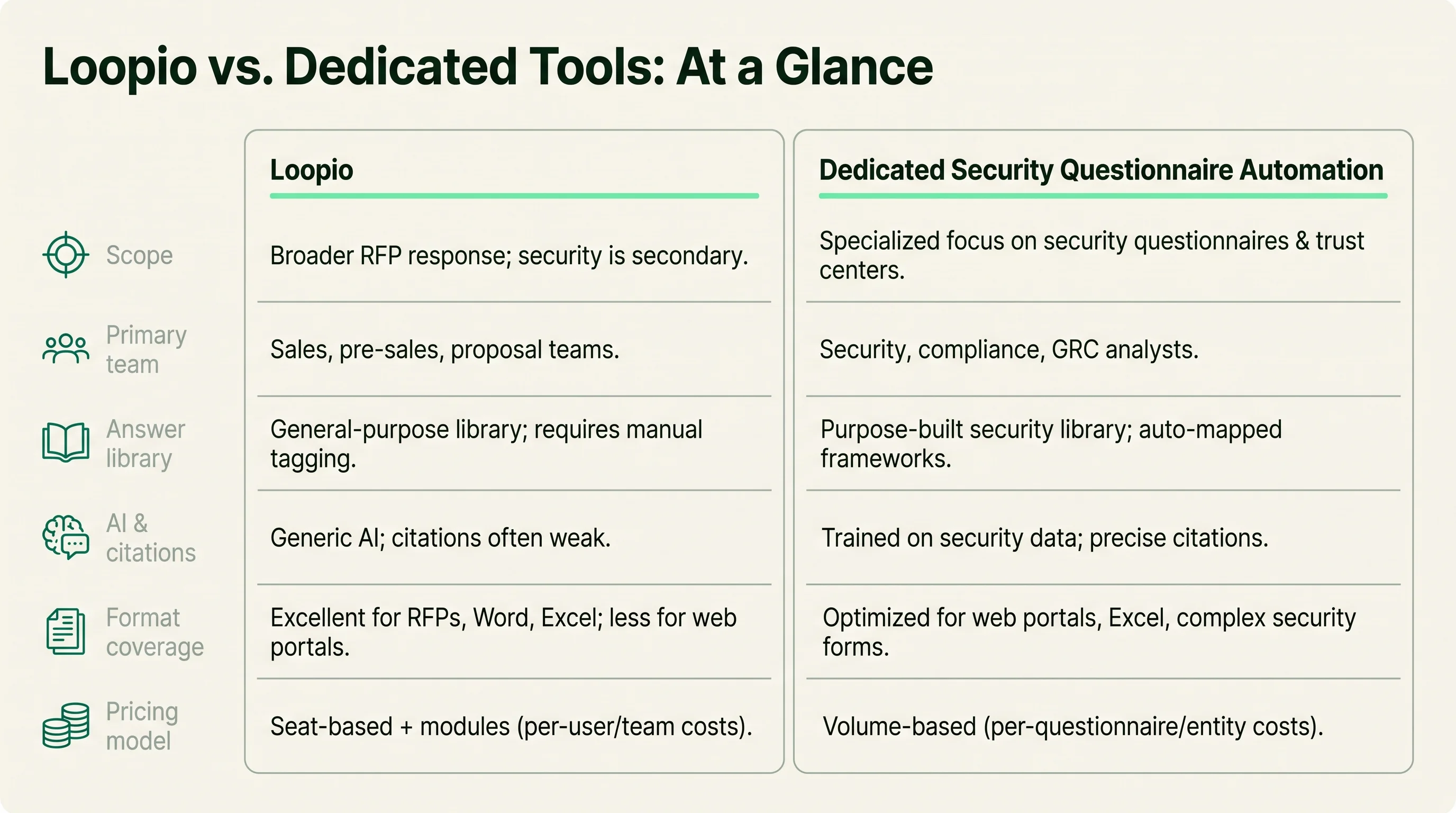
Loopio vs. Security Questionnaire Automation: at a glance
The two approaches share an answer-library backbone but diverge on scope and the team they serve. Loopio optimizes for cross-content response management across RFPs, proposals, and questionnaires, while dedicated tools optimize for accurate, evidence-backed security answers. The table below compares them on the criteria buyers shortlist on. Loopio entries are vendor-reported; confirm them on current documentation.
| Criterion | Loopio | Dedicated Security Questionnaire Automation |
|---|---|---|
| Scope | RFPs, proposals, RFIs, questionnaires | Security reviews and questionnaires |
| Primary team | Proposal, sales, revenue | Security, GRC, sales engineer |
| Answer library | Shared across all response types | Tuned for cited security answers |
| AI accuracy and citations | Content-tuned for response drafting | Security-tuned, grounds answers in evidence |
| Format coverage | Broad RFP and questionnaire formats | CAIQ, SIG, portals, spreadsheet autofill |
| Evidence and trust center | Library and content focus | Evidence linking and trust-center reuse |
| Pricing model | Response-management platform tier | Per-seat, per-questionnaire, or volume tiers |
Read this table as a starting point, not a verdict. Loopio spans several response types on purpose, so a single row rarely captures the full picture, and capability claims shift between releases. Confirm current scope in a demo against your own CAIQ, SIG, and questionnaire files. For a deeper look at the criteria enterprise buyers weigh, see our guide on how enterprise buyers evaluate security questionnaire automation tools, and for related products, the security questionnaire automation category hub.
Where Loopio is stronger
Loopio is stronger wherever one team answers many kinds of buyer questions from a single content base. The product is built for response management across RFPs, RFIs, proposals, and questionnaires, so a proposal or revenue team can reuse the same approved answers no matter which document a buyer sends. When questionnaires are one part of a broader response workload, that breadth is the advantage.
The concrete strengths, all vendor-reported and worth confirming on current documentation, cluster around cross-content response management:
- Shared answer library: one maintained content base feeds RFPs, proposals, and questionnaires, so the same approved answer serves several response types without duplicate libraries.
- Proposal project management: assignment, deadlines, and contributor workflows sized for large RFPs with many sections and owners.
- Sales and revenue fit: tooling aimed at proposal and revenue teams that respond across a pipeline, not only at security reviews.
- Content collaboration: subject-matter experts and sales maintain reusable answers together, with review and update workflows around the library.
- Established category presence: Loopio is a recognized response-management vendor, which matters for buyers consolidating tools.
There is also a consolidation argument. If a single team handles mixed RFPs and security questionnaires, one platform can reduce duplicate content, contracts, and context-switching. Loopio's questionnaire capability covers many security questions from that shared library. For how Loopio compares to peer suites, see our records on Loopio vs. Responsive and Conveyor vs. Loopio.
The honest limit is depth on security specifics. A broad response suite answers questionnaires well, but it is not built around security-review formats, structured evidence linking, and security-tuned review the way a dedicated tool is. If your workload spans response types, that breadth fits. Treat any claim of full security-format parity as vendor-reported and test it against your real CAIQ or SIG files in a trial.
Where Security Questionnaire Automation is stronger
Dedicated security questionnaire automation is stronger wherever the security answer has to be accurate, evidence-backed, and in a security-specific format. The product is built around one workflow: take an inbound security review, draft answers grounded in approved content, link the supporting evidence, route to the right subject-matter expert, and return the response in the buyer's format. That focus produces depth on security content that a broad response suite rarely matches.
The concrete strengths cluster around the security-review job:
- Format coverage: native handling for CAIQ, SIG, custom security spreadsheets, and buyer portals, including portal autofill that maps stored answers into third-party systems.
- Evidence linking: approved answers tied to SOC 2 reports, ISO 27001 certificates, and other artifacts, so a response carries its proof rather than pointing at a vague claim.
- Security-tuned AI: drafting designed to ground answers in approved content and cite the source, which matters more for an audited security claim than for proposal copy.
- SME review controls: routing and approval built around security questions, so a CISO or sales engineer signs off on what is actually accurate.
- Trust center reuse: a maintained library that can feed a self-serve trust center, deflecting repeat questions before they become a questionnaire.
There is also a risk argument. A wrong security answer is not just sloppy, it can become a compliance or contractual problem, so the workflow is tuned for accuracy and accountability over breadth. Tools such as Conveyor and SecurityPal are built around this security-review job. For whether AI can answer these safely, see our analysis of whether AI can safely answer security questionnaires, and for the broader category, the AI security questionnaire tools hub.
The honest limit is scope. A dedicated tool answers security reviews well, but it is not designed to manage a full RFP, coordinate a large proposal team, or assemble a branded sales document. If security reviews are your bottleneck, that focus is the point. Test each tool against your real questionnaires before you commit.
Pricing and implementation differences
The two approaches price and deploy around the team that owns the work, not around a single shared meter. Loopio prices as a response-management platform sized for a proposal or revenue team. Dedicated security questionnaire automation often prices around response volume and the people answering security reviews. Neither model is cheaper in the abstract; the cost depends on which job you actually run. Loopio pricing specifics are vendor-reported, so verify them on current Loopio documentation.
The pricing models break down by owner:
- Loopio: typically a platform or tier sized for the response team, where a shared library and project management across RFPs, proposals, and questionnaires are the core value. Confirm the current model and tiers on Loopio's own pricing page.
- Security questionnaire automation: commonly per-seat, per-questionnaire, or tiered around response volume, so cost tracks how many reviews you process and how many people answer them.
- Spanning suites: a bundle where questionnaire and proposal modules share one library, priced as a broader suite rather than a single point tool.
Implementation effort splits the same way. A Loopio rollout centers on loading and organizing a shared content library, setting up proposal and questionnaire workflows, and onboarding the contributors who maintain answers across response types. A dedicated tool's rollout centers on curating a security answer library, linking evidence, connecting a CRM or knowledge base, and tuning SME review routing for security reviews.
The shared step is the same in both: the library is the asset, and a tool is only as good as the approved content inside it. The one-platform-or-two math turns on overlap. If one team and one library serve both RFPs and security questionnaires, Loopio can reduce duplicate libraries and contracts. If a separate security team owns the review workflow, a focused tool often fits better than a suite that is broad across response types but lighter on security depth. Without inventing figures, price each option against your real usage. For the underlying models, see our breakdown of security questionnaire automation pricing models.
Which one should you choose?
Choose based on who owns the responses and what your team answers most, not on which option sounds broader. If a proposal or revenue team handles mixed RFPs and questionnaires from one library, Loopio fits. If a security or GRC team is stalled on inbound reviews in security-specific formats, dedicated questionnaire automation fits. Verify Loopio specifics on current documentation before you commit either way.
Choose Loopio when:
- A proposal, sales, or revenue team owns the response work across RFPs, RFIs, proposals, and questionnaires.
- You want one shared content library feeding several response types to avoid duplicate libraries.
- Proposal project management, contributor coordination, and deadlines across a pipeline are part of the job.
- Security questionnaires are one input among many rather than the dominant workload.
- Consolidating response tools and contracts outweighs deep security-format depth.
Choose dedicated security questionnaire automation when:
- Inbound security reviews are stalling signed contracts and pulling subject-matter experts off other work.
- Your formats are security-specific: CAIQ, SIG, custom security spreadsheets, and buyer portals that need autofill.
- Accurate, evidence-linked answers, citations, and SME review controls are your top criteria.
- Security, GRC, or a sales engineer owns the response work.
- A trust center that deflects repeat questions would cut inbound volume.
Verify before you commit. Test each option against your real CAIQ, SIG, and questionnaire files in a demo, and confirm that a broad suite is genuinely strong on security depth rather than assuming parity with a focused tool. Treat Loopio capability and pricing claims as vendor-reported until you confirm them on current Loopio documentation. To build a shortlist, read our guide on how enterprise buyers evaluate security questionnaire automation tools and start from the security questionnaire automation category hub.
How this article was reviewed
Sources reviewed
- Loopio product pages and documentationLoopio capability, format-coverage, and pricing claims in this article are vendor-reported and evolving; verify current scope and pricing on Loopio's own documentation before purchase.
- AICPA - SOC 2Primary source for what a SOC 2 report attests, the evidence a security questionnaire response links to.
- ISO/IEC 27001Primary source for the information security management standard referenced in security answer libraries.
- Cloud Security Alliance - CAIQPrimary source for the CAIQ format, one of the security-specific questionnaire types format coverage is measured against.
- Shared Assessments - SIGPrimary source for the SIG questionnaire format referenced in security format coverage.
FAQ
Is Loopio or dedicated security questionnaire automation better for answering security reviews?
Neither is universally better; the right choice depends on the team and the workload. Loopio is better when a proposal or revenue team answers mixed RFPs, proposals, and questionnaires from one shared library. Dedicated security questionnaire automation is better when a security or GRC team is bottlenecked on inbound reviews in security-specific formats like CAIQ and SIG with cited evidence. Verify Loopio capabilities on current documentation before deciding.
What problem does Loopio solve for security questionnaire teams?
Loopio gives teams one response-management platform and a shared answer library to handle RFPs, proposals, and questionnaires together, which reduces duplicate content and context-switching when the same team answers several document types. For security questionnaires specifically, it drafts and reuses answers from that library. These capabilities are vendor-reported, so confirm current security-format coverage and evidence handling on Loopio's own documentation.
Who is the ideal customer for Loopio?
Loopio fits a proposal, sales, or revenue team that responds across a pipeline of RFPs, RFIs, proposals, and questionnaires from one content library. It suits buyers who want to consolidate several response types into a single platform rather than run a separate tool per document type. A security team whose only job is inbound security reviews may get more depth from a purpose-built questionnaire tool. Verify fit against your real workload in a demo.
How does Loopio automate security questionnaire responses?
Loopio draws on its shared answer library to draft and reuse responses, then routes them through review workflows, the same way it handles RFP and proposal content. This covers many security questions from approved content. What a broad suite typically does less of is deep, native security-format coverage, structured evidence linking to SOC 2 or ISO 27001 artifacts, and security-tuned review. Treat these distinctions as vendor-reported and test them against your real CAIQ or SIG files.
What does Loopio cost for a mid-market security team, and how long does implementation take?
Loopio prices as a response-management platform sized for the response team rather than per security questionnaire, but specific figures and tiers are vendor-reported and change, so confirm current pricing on Loopio's own page. Implementation centers on loading and organizing the shared content library, configuring workflows, and onboarding contributors, so timelines depend on library size and how many response types you enable. A focused security tool's rollout instead centers on curating a security answer library, linking evidence, and tuning SME review.