

How Enterprise Buyers Evaluate Security Questionnaire Automation Tools
A practical evaluation guide for buyers comparing questionnaire automation vendors, trust centers, RFP response tools, and GRC platforms.
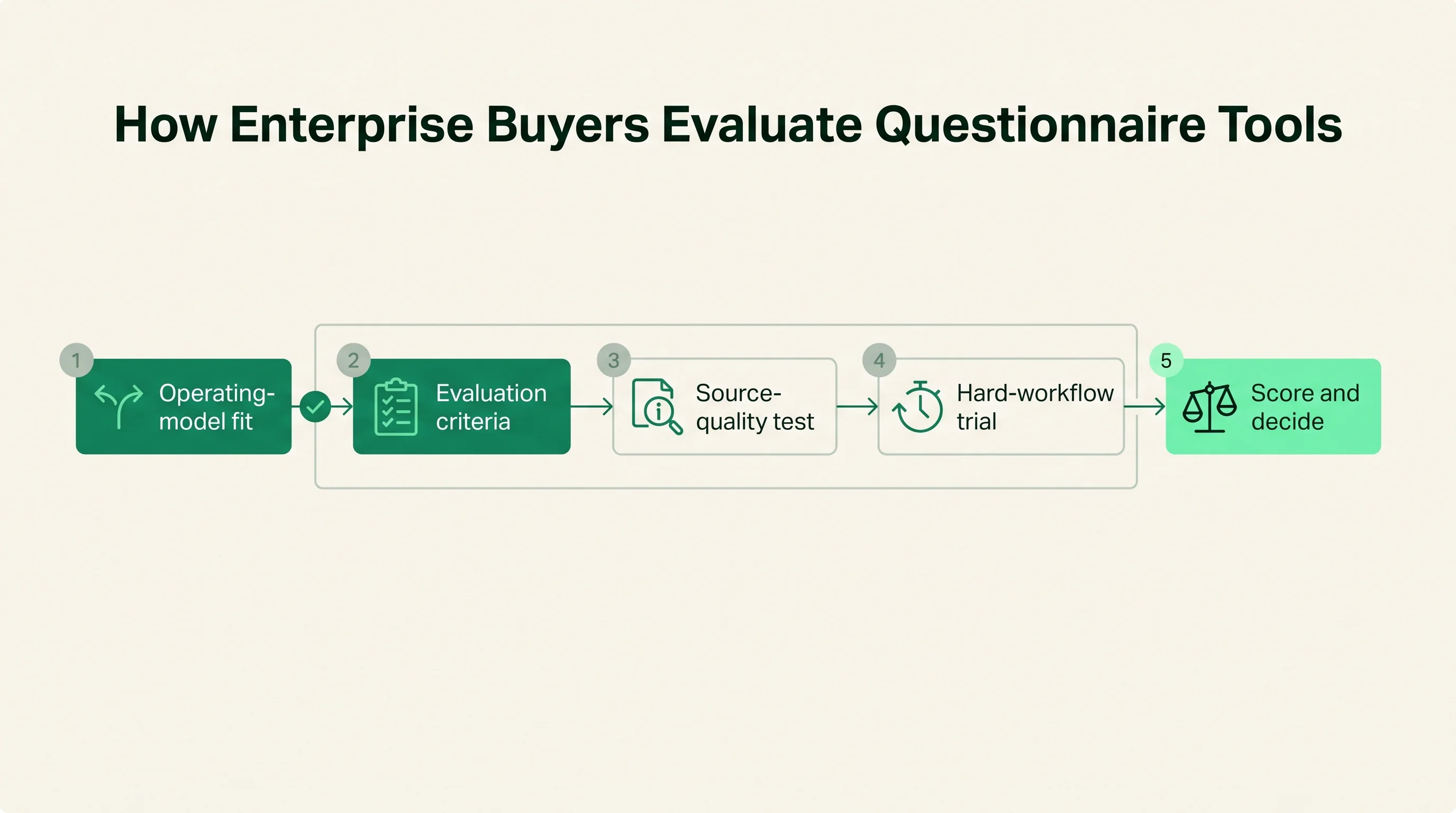
Why start security questionnaire automation evaluation with operating-model fit?
The first evaluation decision is which operating model fits your team, because a feature comparison cannot rescue a model mismatch. Security questionnaire automation tools cluster around a few different jobs, and a tool optimized for one job will underperform on another no matter how strong its feature list looks in a demo.
Three model questions sort the market before you compare any single capability:
- Are you mainly answering inbound security questionnaires as a seller, or assessing other vendors as a buyer? Seller-side automation and buyer-side third-party risk management are different products with overlapping vocabulary.
- Do you want software your own team operates, or a managed service where a vendor team drafts answers for you? This is the managed service versus software-only split, and it changes who you hire and what you pay for.
- Is questionnaire response a standalone function, or one feature inside a broader compliance or trust platform you already run?
The answers move different vendors onto your shortlist. Conveyor, Loopio, and Responsive position as software-only response platforms. SecurityPal and HyperComply emphasize managed or human-in-the-loop service alongside software (vendor-reported). Vanta and SafeBase position questionnaire response as part of a wider trust or compliance suite. Whistic spans seller-side response and buyer-side assessment. These are positioning distinctions, not rigid boundaries, and several vendors offer more than one model, so confirm current scope rather than assuming.
Get this layer right first. A team that needs surge capacity will be frustrated by a self-serve tool with no staffing, and a staffed GRC team that wants control will resent paying a service to sit between them and the buyer. For the foundational definition of the category, see what security questionnaire automation is, then browse the security questionnaire automation category to see how the vendors group.
What are the security questionnaire automation evaluation criteria?
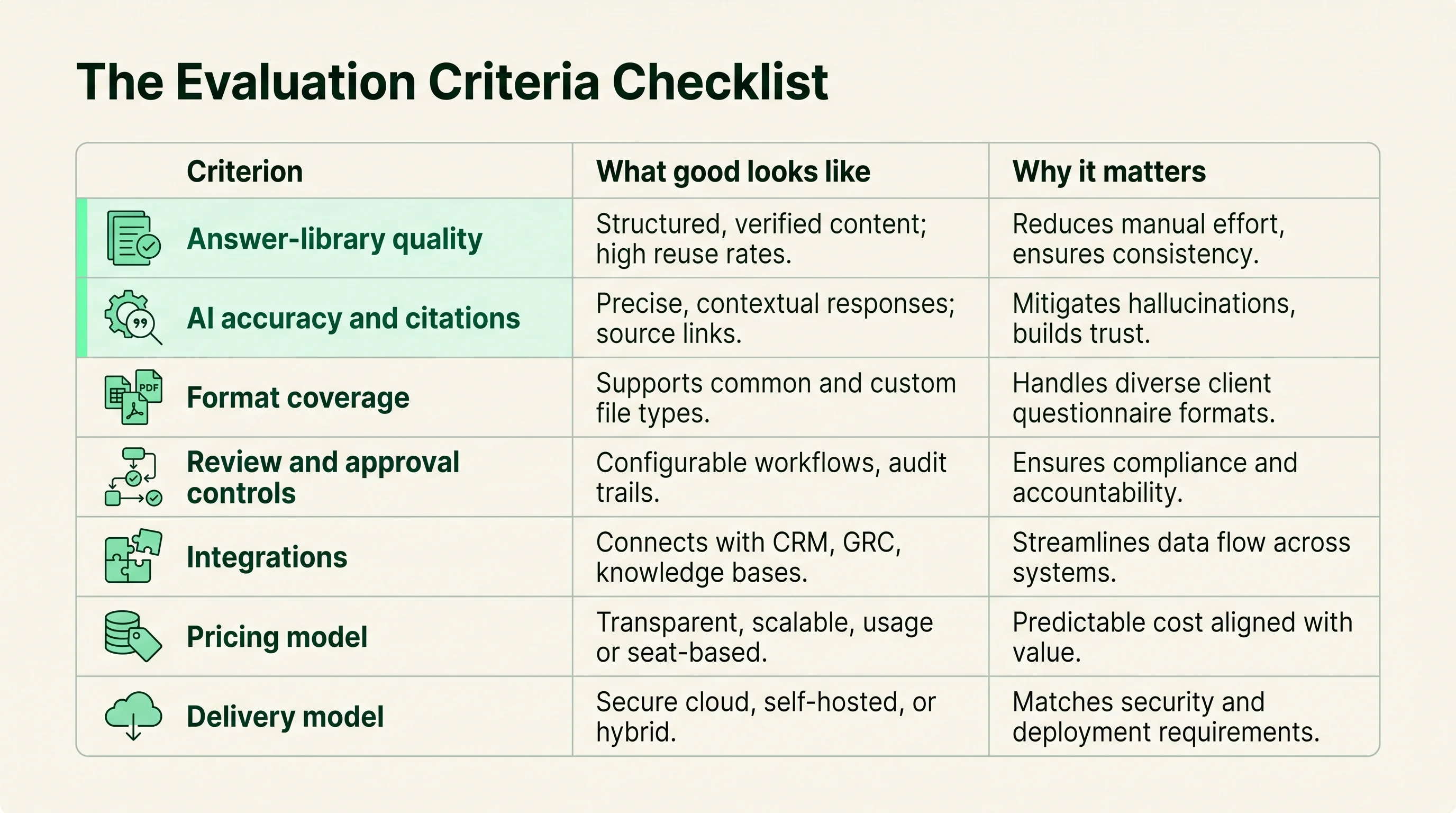
Once the operating model is set, evaluate every finalist against the same fixed criteria so comparisons are honest. The seven criteria below are the ones that decide whether a tool reduces questionnaire work or just moves it around. Rank them by weight for your own workflow before you score vendors, because no tool leads on all seven and the ranking is what makes the tradeoffs visible.
The table maps each criterion to what good looks like and why it matters. Capability descriptions reflect how vendors position these features and should be confirmed against your own requirements during a trial.
| Criterion | What good looks like | Why it matters |
|---|---|---|
| Answer-library quality | A structured, deduplicated library of approved answers with owners, evidence links, and review dates, not a flat pile of past responses | The library is the asset that compounds; a weak one means you re-answer the same questions forever |
| AI accuracy and citations | Drafts cite the source answer or document they came from, and the tool abstains or flags low confidence instead of guessing | Uncited drafts force full manual review, which erases the time savings the AI promised |
| Format coverage | Native handling of Excel, web portals, CAIQ, SIG, and custom forms without manual re-keying | Format wrangling is where teams lose hours; a gap here shifts work back to humans |
| Review and approval controls | Roles, approval steps, audit trail, and the ability to lock answers a CISO or SME has signed off | Wrong answers reach buyers without review gates, which is a security and trust risk |
| Integrations | Connections to your CRM, knowledge base, document storage, evidence systems, and SSO | Disconnected tools create copy-paste work and stale answers; integration keeps the library current |
| Pricing model | A model that matches your volume pattern, whether per-seat, per-questionnaire, or tiered, with clear overage terms | Mismatched pricing punishes either growth or slow periods; the model matters more than the headline number |
| Delivery model | A clear answer on software-only versus managed, and who owns and can export the answer library | Delivery model determines staffing, control, and whether you keep your library if you leave |
Two criteria deserve extra scrutiny. The approved answer library is the durable asset; everything else accelerates work around it, but a thin or vendor-locked library leaves you with little when the contract ends. AI accuracy is the headline claim, and the only credible version cites its sources, so weigh accuracy and citations together rather than trusting a percentage. The next sections turn these criteria into a test you can run and a score you can defend.
How do you test an AI questionnaire tool’s answer-source quality?
Test whether the AI cites its sources, not just whether it produces fluent answers, because fluency without citation is the most expensive kind of false confidence. A draft that reads well but cannot tell you where the claim came from still requires a human to verify every line, which removes most of the time savings the tool was bought for.
The source-quality test is simple to run during a trial:
- Give the tool a question you know the correct answer to, then check whether the draft cites the specific approved answer or document it drew from.
- Ask a question your library does not cover, and watch whether the tool abstains or flags low confidence rather than inventing a plausible answer.
- Change a detail in your environment, such as a control that is now in place that was not before, and see whether the tool surfaces the stale source or quietly repeats the old answer.
What separates strong tools is behavior at the edges. A grounded system ties each generated answer to a source in your library and declines to answer when it has no source, a pattern often described as cite-or-abstain. A weaker system fills gaps with confident text that has no backing, which is where wrong answers reach buyers.
Treat every accuracy figure as vendor-reported until your own test confirms it. A claim like high single-digit accuracy means little without knowing the test set, the question difficulty, and whether the measure counts uncited answers as correct. For how to interrogate these numbers, read our guide on how to compare accuracy claims, which covers the methodology questions that turn a marketing percentage into something you can verify.
Test the hard workflow with your own questionnaire
Run the trial on your own hardest questionnaire and your own answer history, because demo data is curated to make any tool look accurate. The gap between a polished demo and your real workflow is where most disappointing purchases come from, so the trial has to reproduce the work that actually slows your team down.
Use a consistent protocol across every finalist so the comparison is fair:
1. Pick a real questionnaire you recently completed, ideally a long one in an awkward format such as a buyer portal or a custom Excel sheet with merged cells. 2. Load a representative slice of your existing answers, including a few you know are outdated, so you can see whether the tool catches staleness. 3. Have the person who normally does this work, a GRC analyst or sales engineer, run it end to end while you time the stages: intake, drafting, review, and export. 4. Count how many AI drafts were usable as-is, how many needed edits, and how many were wrong or uncited. 5. Push the finished questionnaire back out in the buyer's required format and confirm it imports cleanly on their side. 6. Record where humans had to intervene and why, because that intervention is the real cost the tool did not remove.
The stages that expose weak tools are intake and export, not drafting. Most tools draft acceptably on common frameworks like SOC 2 and ISO 27001. Fewer handle a messy portal or a non-standard SIG variant without manual re-keying, and that re-keying is exactly the work you are trying to eliminate.
Run the same questionnaire through every finalist with the same operator. Identical inputs make the differences attributable to the tool, and the timed stages give you the hard numbers the scoring step needs.
How to score vendors and compare commercial reality
Score each finalist on a weighted rubric tied to your ranked criteria, so the decision rests on evidence from your trial rather than on the strongest sales narrative. A rubric also forces the buying committee to agree on weights before anyone falls in love with a demo, which is when objectivity is easiest to lose.
Build the score in three steps:
- Assign a weight to each of the seven criteria so the weights sum to one hundred, with the heaviest weight on whatever removes the most friction from your workflow.
- Rate each finalist one to five on each criterion using the trial evidence, not the sales deck.
- Multiply, sum, and compare. The weighting is where your priorities show up, so a team drowning in portal formats should weight format coverage heavily and let it move the result.
Then layer commercial reality on top of the capability score, because the best-performing tool is not a buy if the pricing model fights your volume pattern. Pricing structure matters more than the headline number.
| Commercial question | What to confirm |
|---|---|
| Pricing model | Per-seat, per-questionnaire, or tiered, and which matches your volume curve |
| Overage and growth terms | What happens when volume spikes or seats grow mid-contract |
| Implementation cost and time | Whether onboarding is a flat setup or an open-ended services engagement |
| Library ownership and export | Whether you can export your answer library and keep it if you leave |
| Renewal and lock-in | How price escalates at renewal and how hard migration would be |
Model each quote against your real annual volume rather than comparing list prices, since the same sticker can be cheap or expensive depending on how the vendor counts usage. For the mechanics of each structure, see our breakdown of pricing models. The tool that wins should win on your weighted score and survive the commercial table, not on demo polish alone.
What are the red flags when evaluating questionnaire automation tools?
Certain patterns reliably separate marketing from substance, and spotting them early saves a wasted trial. None of these is automatically disqualifying, but each one warrants a direct question and a documented answer before you advance a vendor.
Watch for these signals during demos and procurement:
- An accuracy percentage with no methodology behind it. Ask for the test set, the question difficulty, and whether uncited answers counted as correct. A vendor that cannot explain the number is quoting marketing, not measurement.
- AI that is on by default with no abstain behavior. A tool that always produces an answer, even when it has no source, will eventually send a confident wrong answer to a buyer.
- No clear path to export your answer library. If you cannot take your approved answers with you, the library is the vendor's asset, not yours, and switching cost is being engineered in.
- A demo that only uses the vendor's sample data. Insist on running your own questionnaire; reluctance here usually means the tool performs worse on real inputs.
- Format coverage described in general terms. Make them import your actual awkward portal or Excel file rather than accepting a claim that all formats are supported.
- Review and approval treated as an afterthought. Without roles, an audit trail, and the ability to lock signed-off answers, a wrong answer can reach a buyer with no gate.
- Pricing that hides overage and renewal terms. Volume-based models can escalate quickly, so get the growth and renewal math in writing before you sign.
The common thread is unverifiable claims. A credible vendor shows its work: it explains its accuracy methodology, demonstrates abstain behavior, runs your questionnaire, and puts ownership and pricing terms in writing. Treat anything you cannot verify as a question to resolve.
Who should be on the questionnaire automation buying committee?
Put the people who do the work and the people who bear the risk on the committee, because a tool chosen without both fails in practice or in procurement. Security questionnaire response touches several functions, and each brings a veto that matters at a different stage.
The roles that belong on the committee and what each evaluates:
- GRC or security operations owner: runs the trial, judges answer-library quality and AI accuracy, and will live with the tool daily. This person should have the heaviest voice on capability.
- Sales engineer or solutions team: feels the speed of response on live deals and judges whether the tool actually unblocks sales cycles rather than adding a step.
- CISO or security leadership: owns the accuracy and trust risk, since a wrong answer to a buyer is their exposure, and signs off on review and approval controls.
- Procurement: owns pricing model, overage terms, and renewal, and confirms the commercial reality holds up against your real volume.
- A subject-matter expert (SME): represents the people who get pulled in to answer hard technical questions, and judges whether the tool reduces those interruptions.
The friction the tool is meant to fix usually lives between these roles, where sales keeps asking security the same questions and SMEs get interrupted for answers that should already be in the library. A committee that includes all of them surfaces that friction during evaluation instead of after purchase.
Keep the committee small enough to decide. One owner per function is usually enough, with the GRC owner driving the trial and the CISO and procurement holding the risk and commercial vetoes. Agree on the criteria weights as a group before the trials start, so the final score reflects shared priorities rather than whoever argues hardest at the end.
How this article was reviewed
Sources reviewed
- AICPA - SOC 2Primary source for what a SOC 2 report attests, a control framework most questionnaire automation tools answer against.
- ISO/IEC 27001Primary source for the information security management standard referenced in answer libraries and questionnaires.
- Cloud Security Alliance - CAIQPrimary source for the CAIQ format, one of the standardized questionnaire types covered under format coverage.
- Shared Assessments - SIGPrimary source for the SIG questionnaire format referenced under format coverage.
- NIST Cybersecurity FrameworkPrimary source for the NIST framework referenced when buyers map answer libraries to control families.
- Vendor product and positioning documentation (Conveyor, Loopio, Responsive, SecurityPal, HyperComply, Vanta, SafeBase, Whistic)Operating-model and capability claims for named vendors are vendor-reported and should be confirmed against current product scope and contract terms, not treated as independent fact.
FAQ
What are the most important criteria for evaluating security questionnaire automation tools?
The seven criteria that decide outcomes are answer-library quality, AI accuracy with citations, format coverage across Excel, portals, CAIQ, and SIG, review and approval controls, integrations, pricing model, and delivery model. No tool leads on all seven, so rank them by weight for your own workflow before comparing vendors. The two that deserve the most scrutiny are answer-library quality, because it is the asset that compounds, and AI accuracy with citations, because uncited drafts force full manual review and erase the time savings.
How should I run a trial of a security questionnaire automation tool?
Run the trial on your own hardest questionnaire and your own answer history, not the vendor's demo data, which is curated to make any tool look accurate. Have the person who normally does the work run it end to end while you time intake, drafting, review, and export. Count how many AI drafts were usable as-is, how many needed edits, and how many were wrong or uncited. Watch intake and export most closely, because format wrangling is where weak tools fall down, and run the same questionnaire through every finalist with the same operator so the differences are attributable to the tool.
How do I compare AI accuracy claims between vendors?
Treat every accuracy percentage as vendor-reported until your own test confirms it, and weigh accuracy together with citations rather than alone. Ask for the test set, the question difficulty, and whether uncited answers counted as correct, because a high number on easy questions means little. In your trial, check whether the tool cites the specific source for each draft and whether it abstains when it has no source instead of inventing a plausible answer. A tool that cites and abstains is more trustworthy than one with a higher unsourced percentage.
Who should be involved in choosing a security questionnaire automation tool?
The buying committee should include the GRC or security operations owner who runs the tool daily, a sales engineer who feels the impact on live deals, the CISO who owns the accuracy and trust risk, procurement who owns pricing and renewal terms, and a subject-matter expert who represents the people pulled in for hard technical answers. The GRC owner usually drives the trial, while the CISO and procurement hold the risk and commercial vetoes. Agree on criteria weights as a group before trials begin so the final score reflects shared priorities.
What are the biggest red flags when evaluating these tools?
The clearest red flags are an accuracy percentage with no methodology, AI that always answers with no abstain behavior, no clear path to export your answer library, a demo that only uses the vendor's sample data, vague format-coverage claims, weak review and approval controls, and pricing that hides overage and renewal terms. The common thread is unverifiable claims. A credible vendor explains its accuracy methodology, demonstrates abstain behavior, runs your own questionnaire, and puts library ownership and pricing terms in writing, so treat anything you cannot verify as a question to resolve before signing.