

What Is Security Questionnaire Automation?
Security questionnaire automation uses a reusable answer library and AI to draft accurate responses to vendor security reviews, cutting turnaround from weeks to hours. The library, not the AI, is the asset that determines accuracy.
What is security questionnaire automation?
Security questionnaire automation is software that generates accurate answers to customer and prospect security reviews by matching incoming questions to a maintained library of approved responses, increasingly using AI to draft the first pass for human approval. It turns a repetitive writing task into a review-and-approve task. The software does the sourcing and drafting; a person still owns the answer that goes out.
A security questionnaire is a structured set of questions a buyer sends to assess a vendor's security posture before or during a deal. It typically covers:
- Access controls and authentication
- Encryption of data in transit and at rest
- Data handling and retention
- Incident response
- Compliance status and certifications
Questionnaires arrive as Excel spreadsheets, web portals, and PDFs, as well as two common standardized formats: the CAIQ (Consensus Assessments Initiative Questionnaire) from the Cloud Security Alliance, and the SIG (Standardized Information Gathering) questionnaire from Shared Assessments. Automation tools ingest both.
The distinction that matters is what the software automates versus what stays human.
- Automated: finding the right approved answer and drafting the response
- Human: reviewing and approving every answer before it is sent
That split exists because each answer is a security claim the company is making to a customer. The tool removes the typing, not the accountability.
Ownership varies by company. At many B2B SaaS companies the work sits with GRC (governance, risk, and compliance) or a dedicated security team. At others, sales engineering owns it because questionnaires block deals and the pressure is commercial. The tool is usually shared, with security owning the approved answers and sales tracking the deals they unblock.
How does security questionnaire automation work?
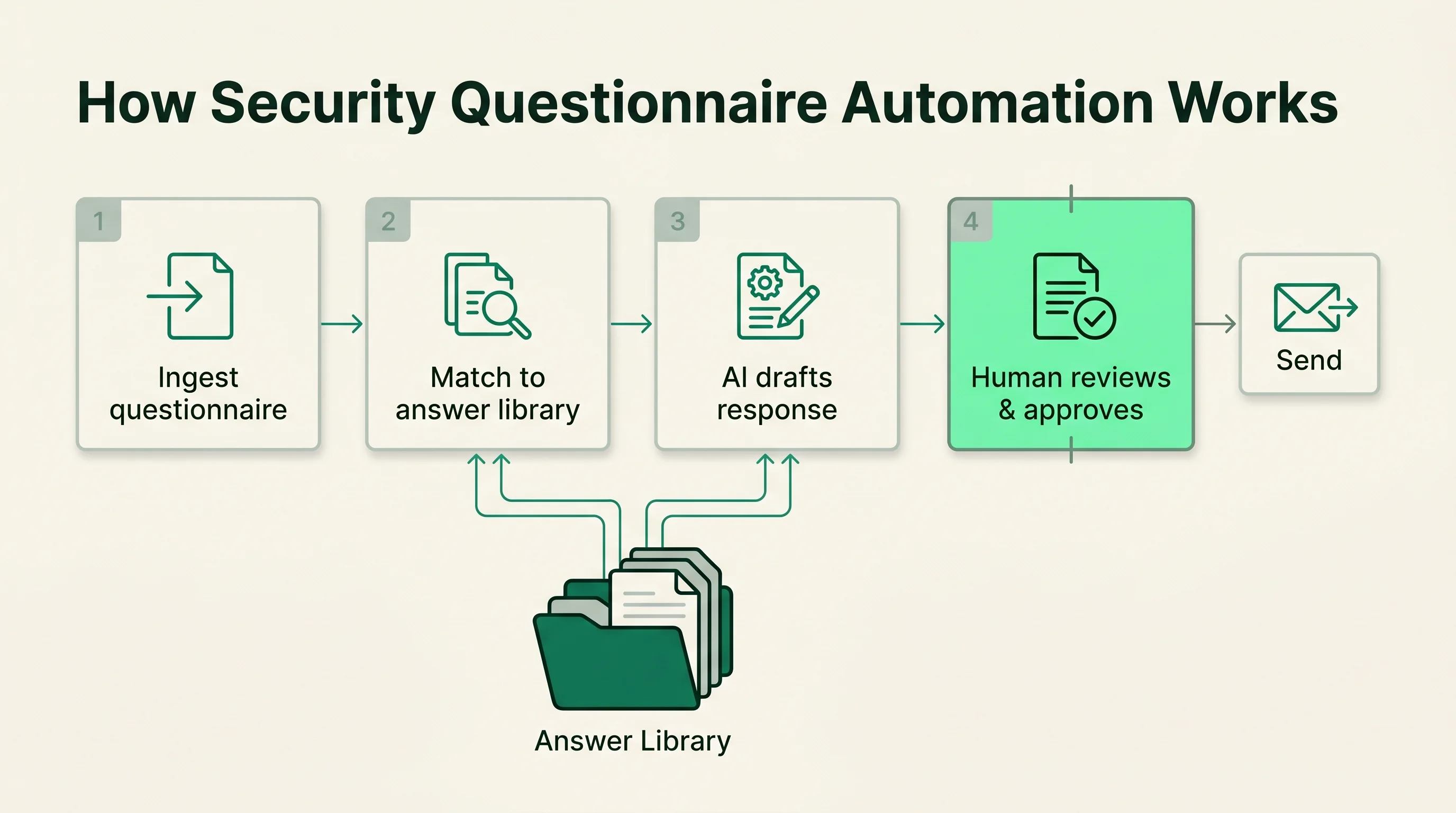
Security questionnaire automation works in four steps:
- Ingest the questionnaire, whatever its format
- Match each question to the answer library
- Draft responses with AI or rules
- Route them for human review before sending
The pipeline diagram for this article shows those four steps, with the answer library feeding the drafting step and a human approval gate before anything goes out.
The answer library is the source of truth. Every incoming question is matched against approved answers the team has already written and signed off. Older tools did this with keyword search, which broke when a buyer phrased a familiar question in unfamiliar words. Modern tools use AI semantic matching, which compares the meaning of the incoming question to the meaning of stored answers. That handles paraphrasing, so "do you encrypt data at rest" and "is stored customer data encrypted" resolve to the same approved answer.
Format handling is the unglamorous part that decides whether a tool is usable in practice:
- Excel files, often with merged cells and locked rows
- Web portals that require a login and field-by-field entry
- Scanned or exported PDFs
- Standardized CAIQ and SIG templates
A tool that only reads clean spreadsheets leaves portal work manual, and portal work is where teams lose the most hours.
The last step is the human-in-the-loop review gate. Drafted answers route to the right reviewer, often a subject-matter expert for technical sections, who edits, approves, or sends a question back. This gate is the control that keeps a person accountable for every claim. The end-to-end process is documented in our workflow on responding to security questionnaires, which maps the same steps to the roles that run them.
The answer library is the core asset
The quality of an automation tool is the quality of its answer library: curated, current, approved answers tied to evidence. The AI is a retrieval and drafting layer on top of that library. Point a capable model at a stale or thin library and it will draft confident, wrong answers faster than a human could type them.
A healthy library is maintained, not just populated. That upkeep has three parts:
- Review answers on a schedule, not just when they break
- Version them so the team can see what changed and when
- Expire them when they go out of date
Versioning and expiry dates are what stop yesterday's correct answer from becoming today's misrepresentation. A policy that named a former sub-processor, or an answer written before the company moved to a new identity provider, has to be caught and replaced.
Approved answers should link to the evidence that backs them. The links let a reviewer verify an answer in seconds and let a buyer trust that the response is grounded in a document, not a marketing line.
| Claim | Backing evidence |
|---|---|
| Audited controls | SOC 2 report |
| Information security management system | ISO 27001 certificate |
| Data handling and retention | The relevant internal policy |
Library hygiene is ongoing work, not a one-time setup. The most common failure mode is treating the library as a project that ends after launch. Questions evolve, controls change, and certifications renew. Teams that win with these tools assign clear ownership of the library and treat its upkeep as a standing responsibility, usually inside GRC.
Where AI fits, and where it doesn't
AI accelerates drafting and matching, but it does not replace the approving human. An unreviewed AI answer is a security claim made without sign-off, which is exactly the risk these reviews exist to surface. The right mental model is an assistant that drafts fast and a person who remains responsible.
The mechanism is retrieval over the answer library followed by a generated draft. The model finds the most relevant approved answers, then composes a response in the buyer's required phrasing. Strong tools cite the source answer or evidence document for each draft, so a reviewer can trace where a claim came from rather than trusting the model on faith.
The failure to watch for is hallucination, where a model generates a plausible answer that is not grounded in any approved source. In a security review, a fluent wrong answer is worse than no answer, because it can commit the company to a control it does not have. Per-answer citations are the practical defense. If a draft cannot point to a source answer or a piece of evidence, that is the signal to stop and have a human write it.
This is where the gap between the phrase "ai security questionnaire" and the operational reality matters.
- Marketing impression: full autonomy, answers sent without people
- Working reality: faster first drafts that still pass through review
Teams that adopt these tools well calibrate trust to the citation:
- High-confidence, well-cited drafts get a quick approval
- Uncited or novel questions get full human authoring
Requiring a source citation per answer is the single most useful discipline for keeping AI assistance safe.
Where it sits next to trust centers, RFPs, and TPRM
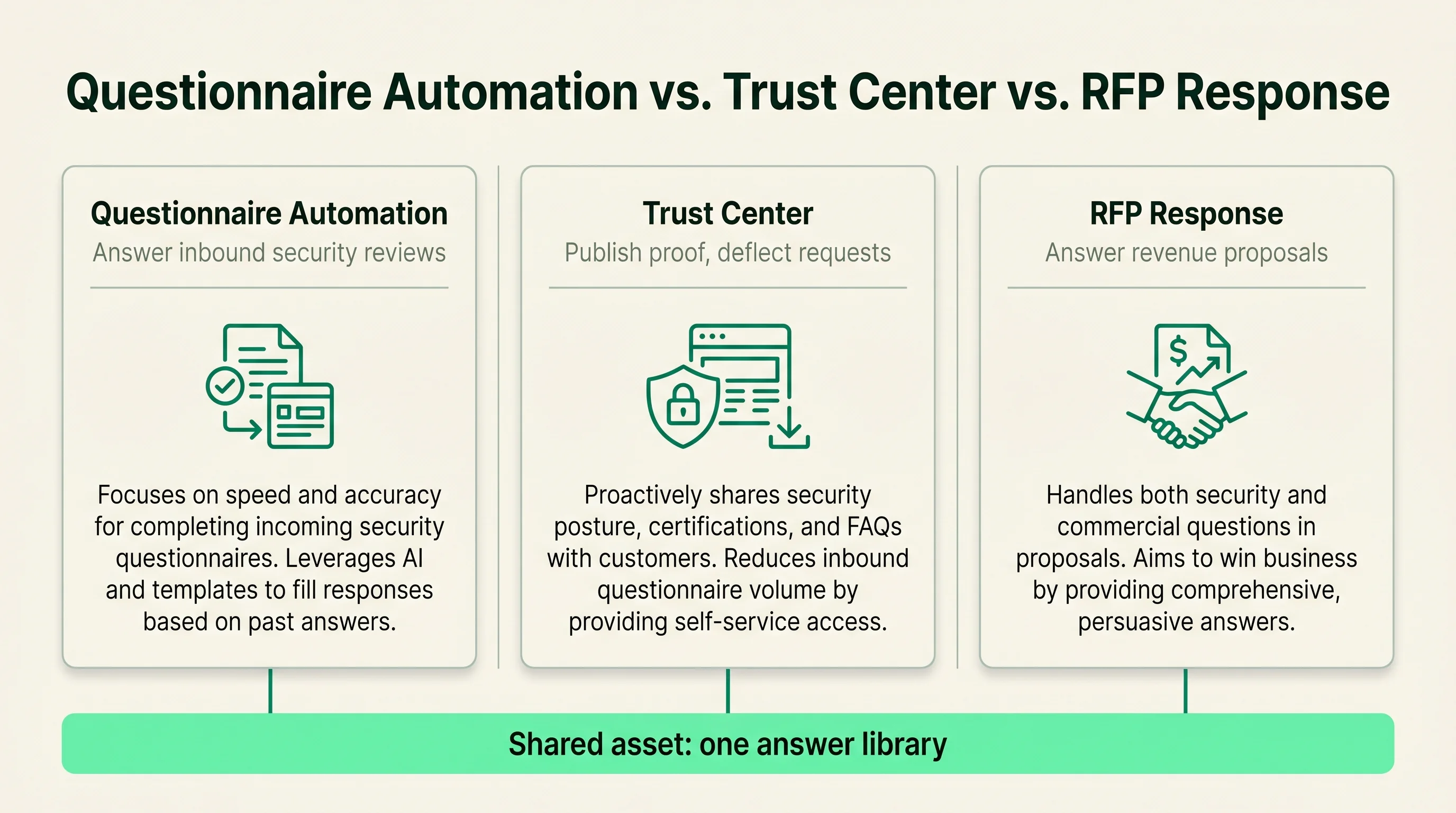
Security questionnaire automation handles inbound vendor reviews. It overlaps with, but is distinct from, trust centers, RFP response, and third-party risk management. All three can draw on the same answer library, which is what makes them easy to confuse.
| Surface | Its specific job |
|---|---|
| Questionnaire automation | Answer inbound security reviews |
| Trust center | Publish proof, deflect repeat requests |
| RFP response | Answer revenue proposals, including their security sections |
| TPRM / VRM | The buyer's program for assessing the vendors it buys from |
A trust center is a published page where a company posts its security documentation, certifications, and common answers so buyers can self-serve. The model is publish once, deflect many. A good trust center reduces how many questionnaires arrive in the first place, because buyers who can find the SOC 2 report and a completed CAIQ may not need to send a custom spreadsheet. Questionnaire automation handles what the trust center does not deflect.
RFP and proposal response is adjacent because it shares the same underlying asset. An RFP is a revenue document: a buyer's request for a proposal that includes pricing, capabilities, and often a security section. The security questions inside an RFP can be answered from the same approved library, which is why several vendors in this space, including Loopio and Responsive, grew from RFP response into security questionnaires. The work is the same shape: match a question to an approved answer and draft a response.
Third-party risk management, also called vendor risk management, is the same exchange viewed from the buyer's side. TPRM is the program a company runs to assess and monitor the vendors it buys from, and sending security questionnaires is one of its core activities. When you automate your responses, you are streamlining your side of someone else's TPRM process. Understanding that adjacency helps teams anticipate what buyers are checking for and why.
What are the benefits and tradeoffs of security questionnaire automation?
The measurable payoff is turnaround time and subject-matter-expert load. Teams move from re-typing answers to reviewing them, which compresses a questionnaire that took multiple days of manual effort into a same-day review-and-approve cycle. The largest gains come from reuse, because most questionnaires repeat questions the team has already answered many times.
The concrete benefits are clear:
- Faster deal cycles, because a stalled security review can hold up a signed contract
- Consistent answers, because manual answering drifts and a sharp buyer notices when one control is described three different ways
- An audit trail of who approved what, and when, useful for internal accountability and the company's own audits
The tradeoffs are real and worth stating plainly:
- Setup takes work, because a tool is only as good as the library you load into it, and building a curated initial library is a project
- Maintenance is a standing cost, not a one-time spend
- Over-trust in AI is the subtler risk: a team that stops reviewing carefully because the drafts look polished will eventually send a wrong answer with full confidence
The control against over-trust is keeping the human approval gate genuine rather than a rubber stamp.
There is also a point where automation is not worth it. A company that receives a handful of questionnaires a year does not need dedicated software; a shared document of approved answers and a careful reviewer will do. The economics favor automation when questionnaire volume is high enough that the same SMEs are repeatedly pulled into near-identical work. Below that threshold, the setup and license cost outweighs the saved time.
How to evaluate security questionnaire software
Evaluate security questionnaire software on five things: answer-library quality, AI accuracy with citations, format coverage, review and approval controls, and integrations. Do not buy on headline automation percentages, which are easy to claim and hard to verify in your environment.
Score each tool against the same criteria:
| Criterion | What good looks like |
|---|---|
| Answer-library quality | Curated, versioned answers with expiry dates and linked evidence |
| AI accuracy with citations | Every draft cites the source answer or evidence, so a human can verify fast |
| Format coverage | Excel, web portals, PDF, CAIQ, and SIG, because real questionnaires arrive in every format |
| Review and approval controls | Routing, SME assignment, and sign-off before send |
| Integrations | Trust center, CRM, Slack or Teams, and evidence stores |
Conveyor, Loopio, and Responsive are common reference points when teams build a shortlist, and they sit at different angles. Conveyor centers on security questionnaires and trust centers, while Loopio and Responsive came from RFP response and extended into security work. Each names its own AI and library capabilities, and those claims are vendor-reported; the point of evaluating is to test them against your own questionnaires rather than take the marketing at face value. For a head-to-head on two of them, see our Conveyor vs Loopio comparison.
The most reliable evaluation method is to run a real, recent questionnaire through a trial of each tool:
- Use one you have already answered manually, so you know the correct answers
- Watch how well each tool matches, drafts, cites, and routes
- Compare the drafted answers against your approved versions for accuracy
A trial on your actual questions will tell you more than any feature grid. When you are ready to shortlist, start from the security questionnaire automation category hub and compare the leading tools side by side.
How this article was reviewed
Sources reviewed
- AICPA - SOC 2Primary source for what a SOC 2 report attests.
- ISO/IEC 27001Primary source for the information security management standard used as evidence.
- Cloud Security Alliance - CAIQPrimary source for the CAIQ format definition and structure.
- Shared Assessments - SIGPrimary source for the SIG and SIG Lite questionnaire definitions.
- Vendor product documentation (Conveyor, Loopio, Responsive)Capability claims are vendor-reported and should be verified in a trial, not treated as independent fact.
FAQ
What is security questionnaire automation?
It is software that drafts answers to customer security reviews by matching questions to a maintained library of approved responses, increasingly using AI for the first draft. A human reviews and approves answers before they are sent, so the tool speeds up the work without removing accountability.
How does AI answer security questionnaires?
AI retrieves the most relevant approved answers from your library and drafts a response, ideally citing the source answer or evidence for each one. It does not invent security facts on its own, or should not, which is why the human approval step and per-answer citations matter.
What is the best security questionnaire automation software?
There is no single best tool; the right one depends on your answer-library needs, the formats you receive (Excel, portals, CAIQ, SIG), and your review controls. Conveyor, Loopio, and Responsive are common shortlist names. Compare them on library quality and AI accuracy rather than headline automation claims.
Is security questionnaire automation accurate?
Accuracy depends on the answer library, not the AI. A curated, current library with evidence links and a human approval gate produces accurate responses; a stale or unreviewed library produces confident wrong answers.
How much time does security questionnaire automation save?
Teams typically move from days of manual effort per questionnaire to a same-day review-and-approve cycle, because the work shifts from writing answers to checking them. The largest savings come from reusing answers across many near-identical questionnaires.