

Vanta vs. HyperComply
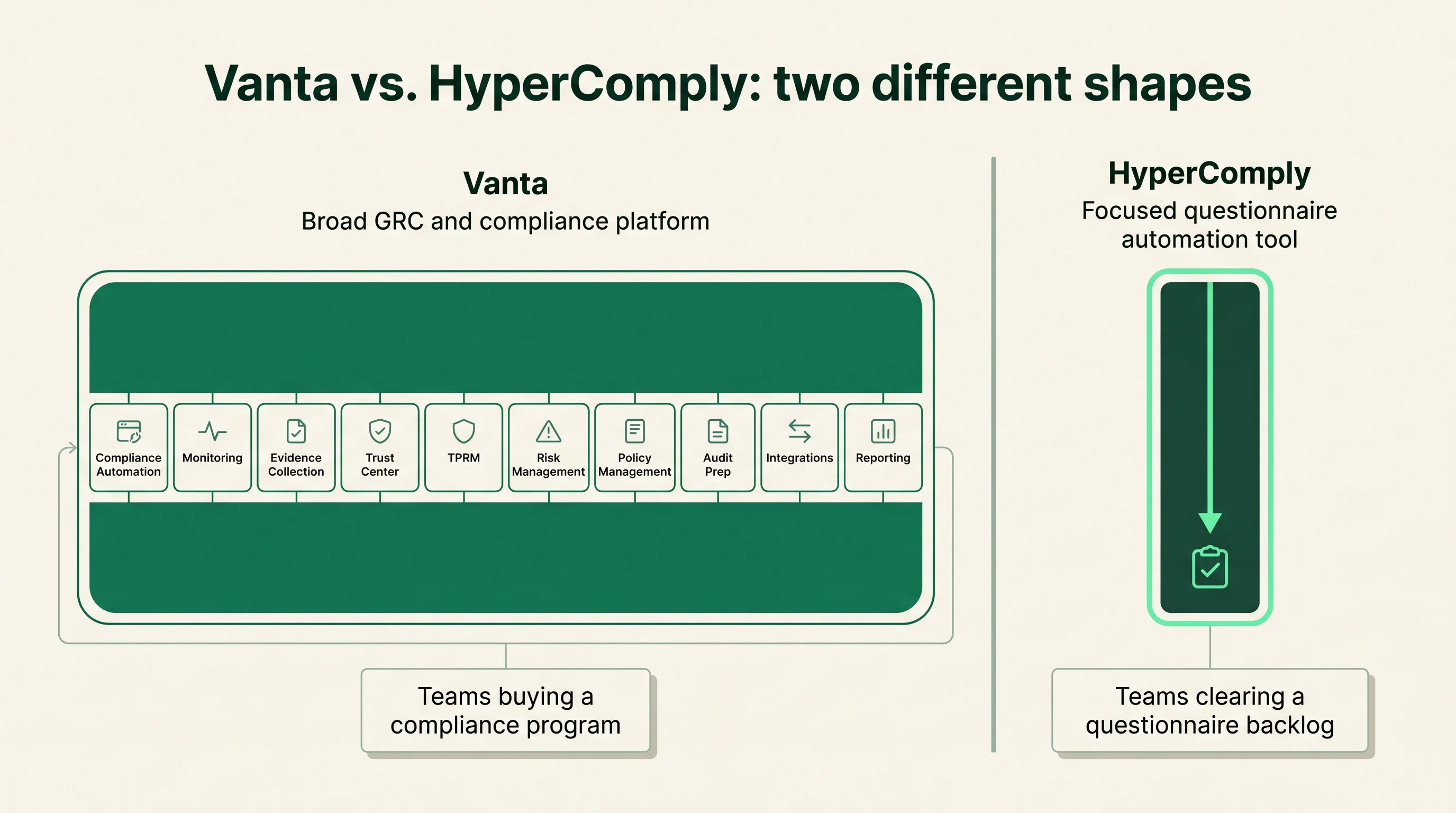
Vanta and HyperComply solve different shapes of the same problem. Vanta is a broad GRC and compliance automation platform that also offers a trust center and questionnaire features; HyperComply is a focused security questionnaire automation tool. The right pick depends on whether you are buying a compliance program or a questionnaire engine.
Quick answer: Vanta vs. HyperComply
Choose Vanta if you need a broad compliance and GRC platform that automates SOC 2 and ISO 27001 readiness, continuous monitoring, evidence collection, a trust center, and third-party risk, with questionnaire answering as one feature inside that suite. Choose HyperComply if your main problem is answering security questionnaires fast and accurately, and you want a focused tool built around an answer library and AI drafting rather than a full compliance program.
These are differently-shaped products, not two versions of the same thing. Vanta is a wide platform whose center of gravity is compliance automation and continuous monitoring. HyperComply is a focused questionnaire engine whose center of gravity is the response workflow itself.
The right choice depends on three things: which problem dominates your week, the questionnaire formats and volume you handle, and which team owns the work. There is no universal winner, only a better fit for a given program.
- Need a compliance program plus trust center and TPRM in one place: Vanta tends to fit.
- Need to clear a questionnaire backlog with a strong answer library: HyperComply tends to fit.
- Already run compliance elsewhere and only the questionnaire step hurts: lean focused, and test execution closely.
If the category itself is new to you, start with our explainer on what security questionnaire automation is, then return to compare these two.
Vanta vs. HyperComply: at a glance
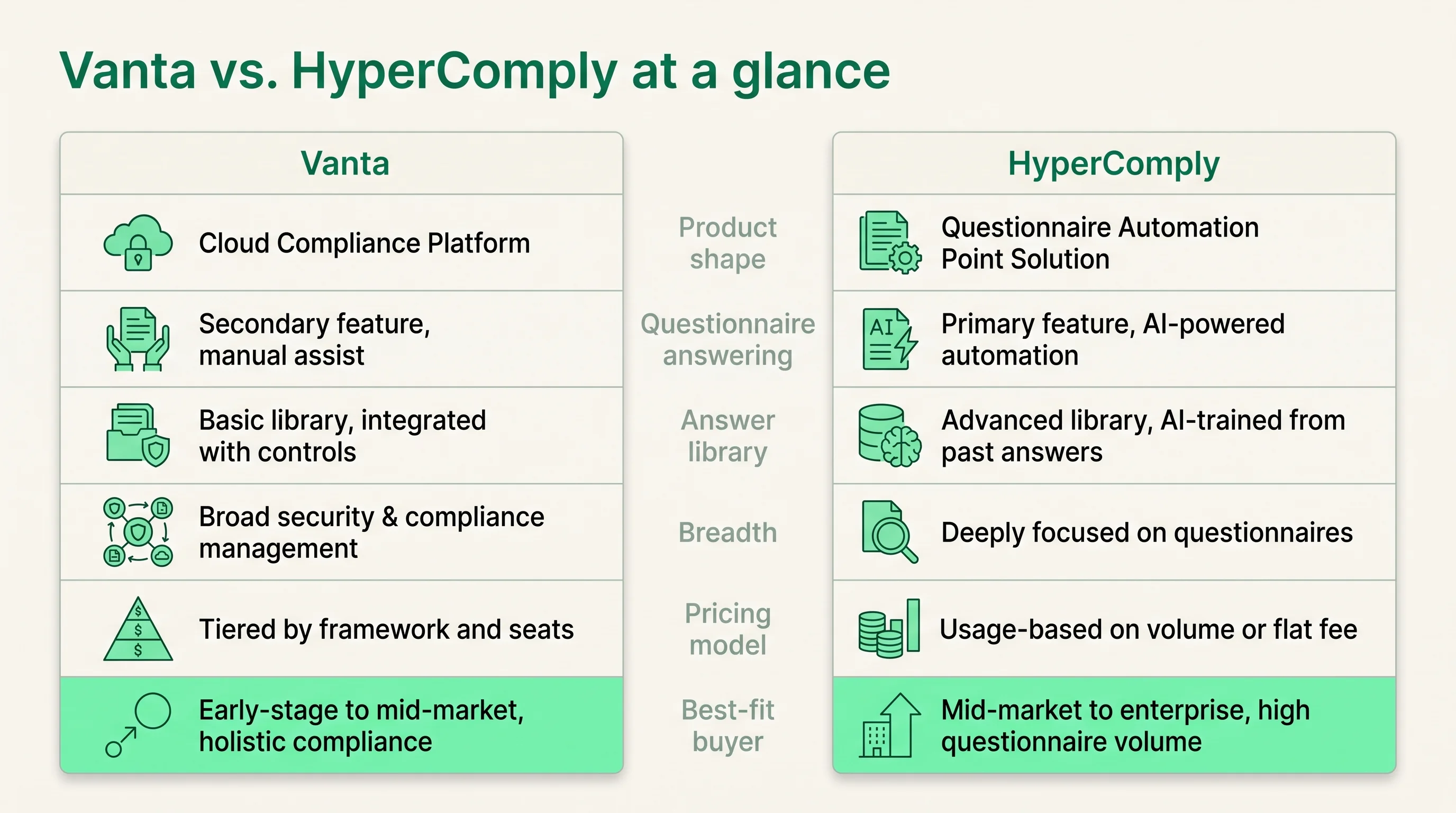
The fastest way to see the difference is side by side. The table below compares the two across the criteria most shortlisters weigh, using capability-level distinctions we can defend rather than specific feature claims that shift between releases.
| Criteria | Vanta | HyperComply |
|---|---|---|
| Product shape | Broad GRC and compliance platform | Focused questionnaire automation tool |
| Questionnaire answering | One feature within the suite | Core product |
| Answer library | Library tied to compliance and trust data | Library built for questionnaire reuse |
| AI assistance | AI-assisted drafting (vendor-reported) | AI-assisted drafting (vendor-reported) |
| Format coverage | Excel, portals, CAIQ and SIG via library | Excel, portals, CAIQ and SIG via library |
| Breadth | Compliance, audit, monitoring, TPRM, trust center | Questionnaire response and answer library |
| Integrations | Cloud, SSO, ticketing, HRIS, many connectors | CRM, knowledge base, document and workflow tools |
| Pricing model | Platform bundle, quote-based | Workload-oriented, quote-based |
| Best-fit buyer | Teams buying a compliance program | Teams clearing a questionnaire backlog |
Treat the AI, integration, and questionnaire-feature rows as directional. Vanta's questionnaire and trust center features continue to evolve, and each vendor publishes its own connector lists and accuracy figures, so verify those rows on each vendor's current docs.
A few rows deserve a closer read. On questionnaire answering, the difference is depth versus breadth: HyperComply concentrates its roadmap on that single workflow, while Vanta adds it alongside compliance automation. On answer library, both store approved, evidence-linked answers, but HyperComply's library is shaped around questionnaire reuse, while Vanta's connects to the compliance and trust data already in the platform. On breadth, the gap is the whole point: Vanta spans audit readiness, monitoring, TPRM, and a trust center, where HyperComply stays on the response problem.
The pattern is consistent. The two overlap on the act of answering a questionnaire, and diverge sharply on everything around it. Vanta surrounds that act with a compliance program; HyperComply keeps the focus on the questionnaire itself. Hold that distinction through the rest of this comparison, because it explains most of the fit differences below.
Where Vanta is stronger
Vanta is stronger when questionnaire answering is one job inside a wider compliance program. Its center of gravity is automating SOC 2, ISO 27001, and other framework readiness through continuous monitoring and evidence collection, then surfacing that posture in a trust center and feeding it into questionnaire responses. For a GRC lead or CISO buying a platform, that consolidation is the main reason to pick it.
The concrete strengths cluster around breadth and the data that breadth produces.
- Compliance automation across common frameworks, with continuous control monitoring and automated evidence collection (specific framework coverage is vendor-reported; verify on current docs).
- A trust center that publishes posture and documentation, so buyers can self-serve before they send a questionnaire.
- Third-party risk management in the same platform, useful when you both answer reviews and assess your own vendors. See our glossary entry on third-party risk management for how that fits a program.
- An answer library that draws on the compliance and monitoring data already in the platform, keeping published posture and questionnaire answers aligned.
- A wide integration surface across cloud providers, identity, ticketing, and HR systems that feeds the monitoring engine (specific connectors are vendor-reported; verify on current docs).
The consolidation payoff is real: one platform that owns audit readiness, evidence, trust, and questionnaire response means fewer tools to maintain and one source for posture. Vanta's questionnaire and trust center features continue to evolve, so confirm current depth in a demo. For how that surface reduces inbound reviews, see our piece on security questionnaire automation versus trust centers and where each fits.
Where HyperComply is stronger
HyperComply is stronger when answering questionnaires is the problem you are actually buying to solve. As a focused tool, its roadmap concentrates on the response workflow: ingesting a questionnaire in many formats, drafting answers from an approved library, routing them for review, and exporting in the buyer's format. For a sales engineer or security analyst who lives in that backlog, that focus is the differentiator.
The concrete strengths follow from a single-workflow design.
- Depth on the questionnaire workflow itself, where the whole product is built around answering reviews rather than running a compliance program.
- An answer library shaped for questionnaire reuse, with approval and source linking so the same vetted answer carries across reviews.
- Format coverage tuned to how questionnaires actually arrive, including Excel, portals, and standardized formats like CAIQ and SIG through the library.
- AI-assisted drafting aimed at the response step, with citations back to source answers (AI accuracy is vendor-reported; verify on current docs and test on your own questionnaires).
- A lighter footprint to adopt when you do not need the surrounding compliance suite, because there is less platform to configure.
The focus payoff is that the product is not splitting attention across audits, monitoring, and trust. If the questionnaire step is your bottleneck and your compliance program already lives elsewhere, a dedicated engine often clears it faster. Note HyperComply's market context too: as a smaller, focused vendor, its company status and any acquisition can change ownership and roadmap, so confirm current status during diligence. For what to probe, see our explainer on what security questionnaire automation is.
Pricing and implementation differences
Both Vanta and HyperComply price by quote rather than a published per-seat or per-questionnaire rate, so the real comparison is the model, not a list price. We do not publish specific dollar figures because neither vendor lists fixed public pricing we can stand behind; confirm current numbers in a quote. What differs is what each price is built around.
The models reflect the products' shapes.
| Dimension | Vanta | HyperComply |
|---|---|---|
| Pricing shape | Platform bundle, quote-based (vendor-reported) | Workload-oriented, quote-based (vendor-reported) |
| What you are buying | Compliance program plus trust and questionnaire features | A focused questionnaire engine and answer library |
| Main rollout work | Connecting systems and configuring monitoring | Seeding and curating the answer library |
| Ongoing upkeep | Maintaining controls, evidence, and posture | Keeping the answer library current |
Implementation reality matters more than the price label. Vanta rollout effort concentrates on connecting cloud, identity, and ticketing systems, mapping controls to frameworks, and configuring continuous monitoring, which is broader work because the platform is broader. HyperComply rollout effort concentrates on seeding the answer library and tuning the response workflow, which is narrower because the product is narrower.
For both, the hidden cost is library quality. Neither AI layer outperforms the approved answers behind it. A tool that drafts from stale or thin source content produces confident but wrong answers, and that risk is identical across both vendors. Plan for the curation and maintenance work regardless of which you choose.
There is also a scope mismatch worth pricing honestly. Buying Vanta to solve only a questionnaire problem means paying for a compliance platform you may not fully use; buying HyperComply when you actually need compliance automation means you still need a separate GRC tool. Match the purchase to the problem so you are not paying for breadth you will not use or focus that leaves a gap. To compare cost structures across the wider market, see our breakdown of questionnaire automation pricing models.
Which one should you choose?
Choose by your dominant problem and which team owns it. The two overlap on the act of answering a questionnaire, so the deciding factor is what surrounds that act: a full compliance program, or a focused response engine. Match the tool to the work you actually run.
Choose Vanta when:
- You need a compliance and GRC program, not just a questionnaire tool, with SOC 2 and ISO 27001 automation, continuous monitoring, and evidence collection.
- A trust center and third-party risk management belong on the same platform as your questionnaire responses.
- GRC or a CISO owns the work and wants one source for posture across audit, evidence, and trust.
- Consolidating tools matters more than maximum depth on the questionnaire step alone.
Choose HyperComply when:
- Answering security questionnaires is the specific bottleneck you are buying to clear.
- Your compliance program already lives elsewhere and you only need the response step to move faster.
- A sales engineer or security analyst wants depth on the answer library, format coverage, and drafting.
- A lighter footprint and faster focus on the questionnaire workflow outweigh a broad platform.
Both handle the everyday work of answering reviews in Excel, portals, and standardized formats like CAIQ and SIG through an approved-answer library, so for that baseline, test execution rather than positioning. Run a real questionnaire through each, check whether AI citations point to evidence you trust, and confirm format, integration, and feature scope on current docs, since Vanta's questionnaire features in particular continue to evolve. For a structured shortlist, use the security questionnaire automation category hub and our explainer on what security questionnaire automation is to score both against your own program.
How this article was reviewed
Sources reviewed
- Vanta product documentationVendor-reported. Capability, integration, AI accuracy, and pricing claims should be verified on the vendor's current docs and confirmed in a quote. Vanta's questionnaire and trust center features continue to evolve, so treat feature depth as time-sensitive.
- HyperComply product documentationVendor-reported. Capability, integration, AI accuracy, and pricing claims should be verified on the vendor's current docs and confirmed in a quote. Company status and any acquisition can affect roadmap, so confirm current ownership during diligence.
- AICPA - SOC 2Primary source for what a SOC 2 report attests, commonly automated by GRC platforms and cited in questionnaire answers.
- ISO/IEC 27001Primary source for the information security management standard both tools reference as evidence in their answer libraries.
- Cloud Security Alliance - CAIQPrimary source for the CAIQ format, one of the standardized questionnaires both tools support through their libraries.
- Shared Assessments - SIGPrimary source for the SIG questionnaire format referenced in the format-coverage comparison.
- NISTPrimary source for the security frameworks and controls referenced across compliance automation and questionnaire content.
FAQ
Which is better, Vanta or HyperComply, for security questionnaire automation?
Neither is universally better, because they are differently shaped. Vanta is a broad compliance and GRC platform that also answers questionnaires, so it fits teams buying a full compliance program. HyperComply is a focused questionnaire engine, so it fits teams whose main problem is clearing a questionnaire backlog. Both answer everyday reviews from an approved-answer library, so test execution on your own questionnaires before deciding.
How does Vanta pricing compare to HyperComply pricing?
Both price by quote rather than a published rate, but the models differ. Vanta is a platform bundle priced around frameworks and scope, so you pay for a compliance program with questionnaire features inside it. HyperComply is priced closer to the questionnaire workload itself. Pricing details are vendor-reported and change, so model your real volume and confirm current numbers in a quote with each vendor.
What does Vanta do better than HyperComply for customer trust teams?
Vanta consolidates compliance automation, continuous monitoring, evidence collection, a trust center, and third-party risk on one platform, with questionnaire answering as part of that suite. For a customer trust team that also owns compliance posture, that breadth keeps published trust data and questionnaire answers aligned from a single source. Vanta's questionnaire and trust center features continue to evolve, so confirm current depth in a demo.
What does HyperComply do better than Vanta for customer trust teams?
HyperComply concentrates entirely on answering security questionnaires, so its answer library, format coverage, and drafting are built for that one workflow rather than spread across a compliance suite. For a team whose compliance program already lives elsewhere and whose bottleneck is the questionnaire backlog, that focus often clears the work faster. It also adopts with a lighter footprint because there is no broad platform to configure.
When should you choose Vanta over HyperComply?
Choose Vanta when you need a compliance and GRC program, not just a questionnaire tool: SOC 2 and ISO 27001 automation, continuous monitoring, evidence collection, a trust center, and third-party risk on one platform. It also fits when GRC or a CISO wants a single source for posture across audit and trust. Choose HyperComply instead when answering questionnaires is the specific problem and your compliance program already lives elsewhere.