

SafeBase vs. Drata Questionnaire Automation
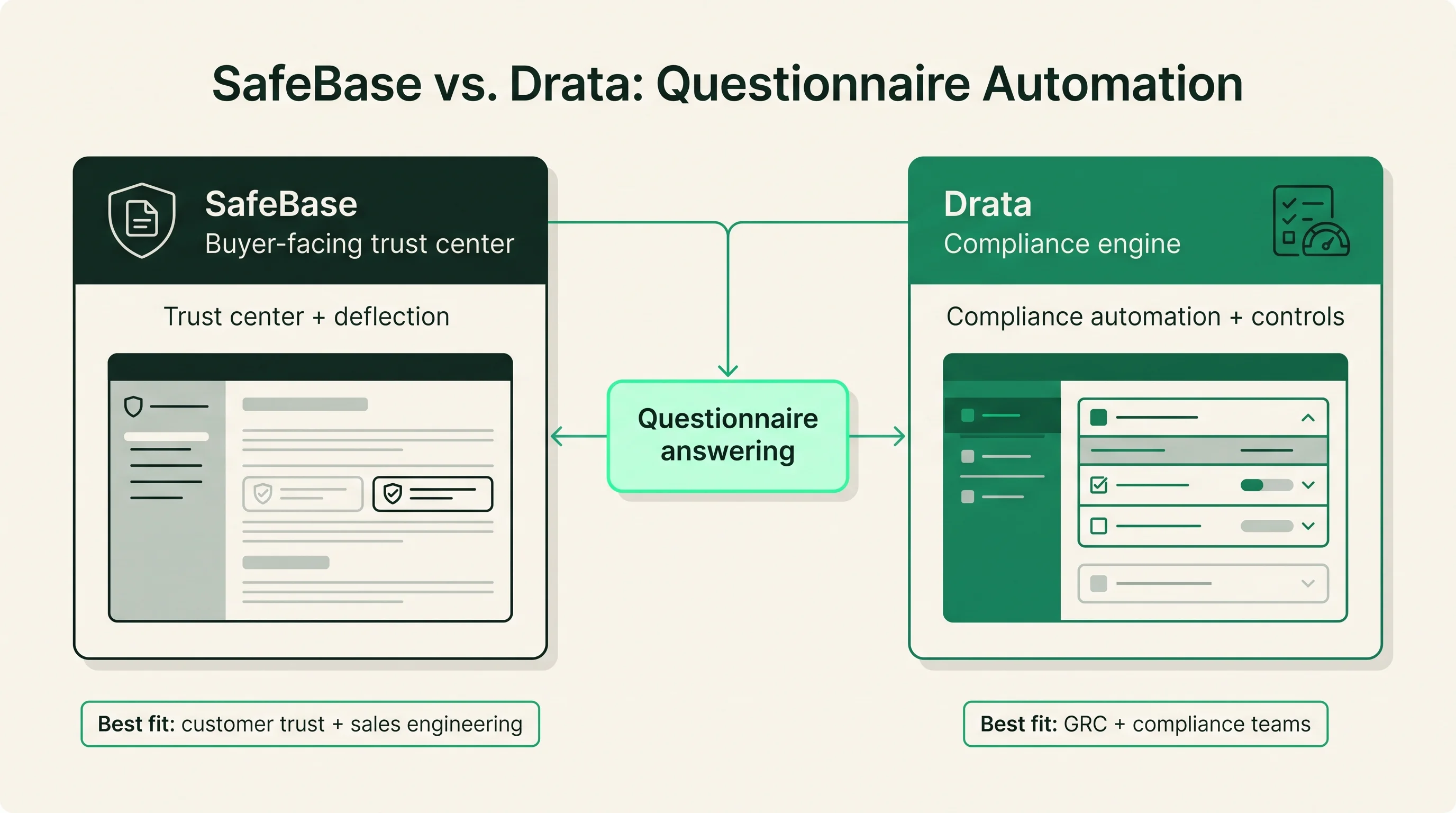
SafeBase and Drata both touch security questionnaire automation, but they are shaped differently. SafeBase centers on a customer trust center and deflecting inbound reviews; Drata centers on compliance automation and continuous-control monitoring. This comparison looks at how each handles questionnaires and which buyer fits which side.
Quick answer: SafeBase vs. Drata Questionnaire Automation
Choose SafeBase if your main goal is to deflect inbound security reviews through a customer trust center, share approved posture proactively, and answer the questionnaires that still come through from that same approved content. Choose Drata if you want questionnaire response folded into a compliance automation platform, with answers anchored to continuously monitored controls and audit-ready evidence.
The two products are shaped differently, and that shape matters more than any single feature. SafeBase is a customer trust platform. Its center of gravity is the trust center and deflection: showing buyers your security posture, certifications, and documents so fewer full questionnaires land in the first place. Drata is a GRC and compliance automation platform. Its center of gravity is controls, continuous monitoring, evidence, and audit readiness, with questionnaire response sitting on top as a module.
Because of that difference, the comparison is not a like-for-like feature race. Both can answer questionnaires from an answer library with AI assistance, but each treats that work as a means to a different end.
- Lead with deflecting buyer reviews and a buyer-facing trust center: SafeBase tends to fit.
- Lead with compliance automation and evidence-anchored answers: Drata tends to fit.
- Very high questionnaire volume as the only real pain: compare both against a dedicated response tool, because neither was built primarily as a response engine.
If the category itself is new to you, start with our explainer on what security questionnaire automation is, then return to compare these two.
SafeBase vs. Drata Questionnaire Automation: at a glance
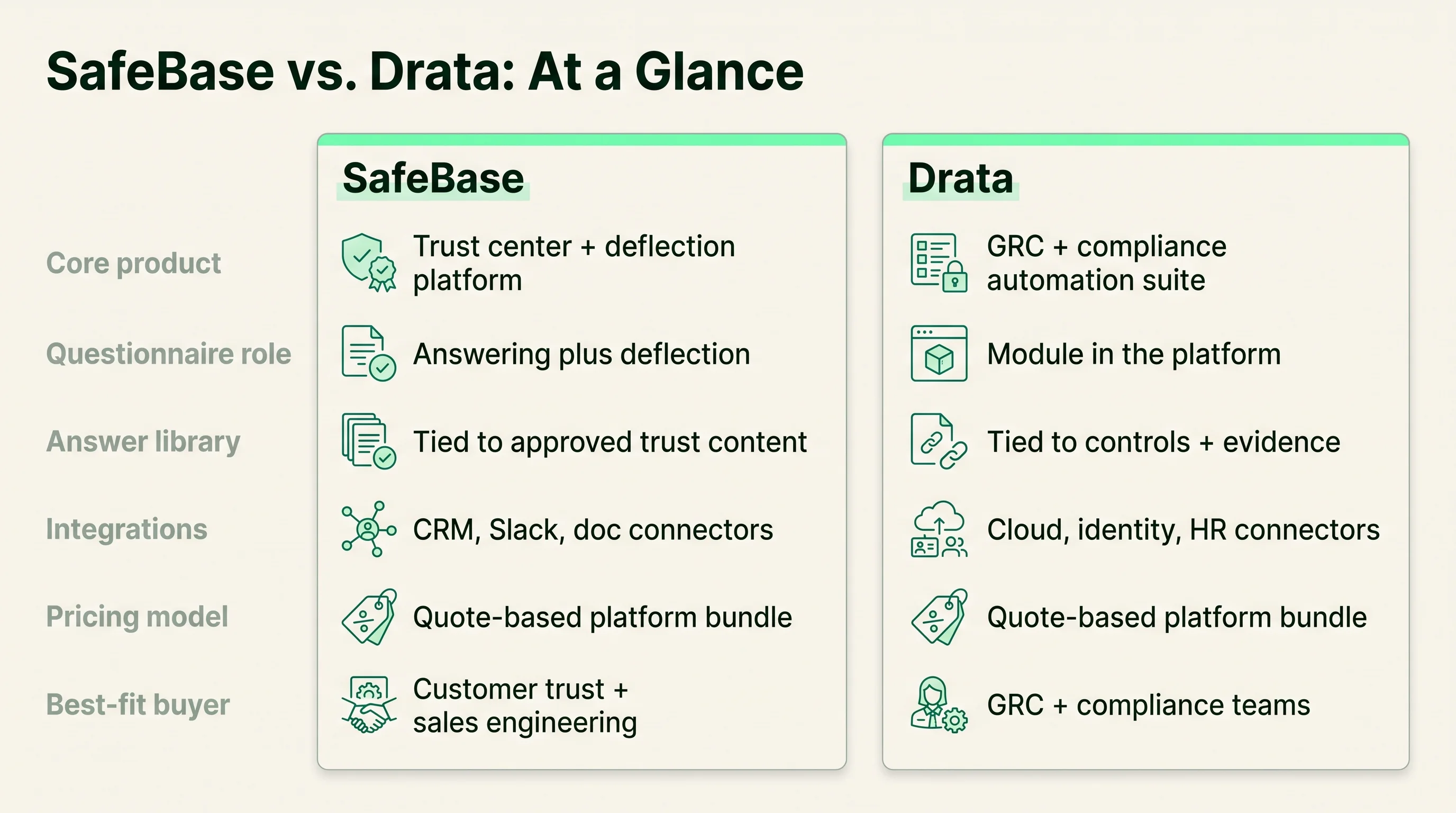
The fastest way to see the difference is side by side. The table below compares the two across the criteria most shortlisters weigh, using capability-level distinctions we can defend rather than specific feature claims that shift between releases.
| Criteria | SafeBase | Drata |
|---|---|---|
| Core product | Customer trust center and deflection platform | GRC and compliance automation suite |
| Questionnaire role | Answering plus deflection through the trust center | Module within the compliance platform |
| Answer library | Library tied to approved trust center content | Library tied to controls and evidence |
| AI assistance | AI-assisted drafting from approved content (vendor-reported) | AI-assisted drafting from evidence (vendor-reported) |
| Format coverage | Excel, portal, CAIQ and SIG via library | Excel, portal, CAIQ and SIG via library |
| Review and approval | Approval workflow on answers and trust center | Approval workflow on answers and trust center |
| Integrations | CRM, Slack, knowledge base and document connectors | Cloud, identity, HR and ticketing connectors |
| Pricing model | Quote-based, tiered platform bundle | Quote-based, tiered platform bundle |
| Best-fit buyer | Customer trust and sales engineering teams | GRC and compliance teams |
Treat the AI and integration rows as directional. Both vendors publish specific connector lists and accuracy figures on their own sites, and those rows change often, so verify them on each vendor's current docs.
A few rows deserve a closer read. On core product, the difference is real: SafeBase is built to reduce inbound reviews through a trust center, while Drata is built to automate compliance and feed answers from monitored controls. On answer library, both maintain approved answers, but SafeBase ties that library to buyer-facing trust center content and Drata ties it to internal controls and evidence. On integrations, SafeBase leans toward CRM and collaboration tools that fit a sales-adjacent trust workflow, while Drata leans toward cloud, identity, and HR systems its compliance core needs.
The pattern is consistent: these two overlap on the act of answering a questionnaire but diverge on what the surrounding product is for. The deciding factor is rarely the answer-drafting feature in isolation. It is whether your dominant workflow is deflecting buyer reviews or automating compliance. Hold that in mind through the rest of this comparison.
Where SafeBase is stronger
SafeBase is strongest when your goal is to reduce inbound security reviews before they become full questionnaires. The product centers on a customer-facing trust center: a controlled place to publish certifications, documents, posture, and approved answers so buyers can self-serve. For a customer trust or sales engineering team that loses hours to repetitive buyer questions, deflection through that surface is the main reason to pick it over a compliance-first platform.
The concrete strengths cluster around the trust center, deflection, and the buyer-facing workflow.
- A polished trust center as the primary surface, so many buyer questions are answered through self-service before a questionnaire is ever sent.
- An approved answer library tied to that buyer-facing content, which keeps published answers and questionnaire responses drawing from one reviewed source.
- AI-assisted drafting from approved trust center content to speed the questionnaires that still arrive (accuracy is vendor-reported; verify on the vendor's current docs).
- Access controls and NDA gating on documents, useful when buyers want sensitive evidence but you need to govern who sees it.
- Integrations into CRM and collaboration tools like Slack, which fit a workflow where sales, sales engineering, and security coordinate on buyer reviews.
The deflection model is the underlying advantage: the cheapest questionnaire to answer is the one you never receive because the buyer found what they needed in your trust center. For more on why that surface matters, see our piece on what a buyer-ready trust center is.
Where Drata Questionnaire Automation is stronger
Drata is strongest when you want questionnaire answers anchored to continuously monitored controls and audit-ready evidence inside a compliance automation platform. Its core is controls, continuous monitoring, and evidence collection for frameworks like SOC 2, ISO 27001, and NIST. The questionnaire module draws from that governed evidence. For a GRC or compliance team that already treats current, monitored evidence as the foundation of trustworthy answers, that discipline is the differentiator.
The concrete strengths follow from that compliance-and-monitoring starting point.
- Continuous-control monitoring as the platform core, so the evidence feeding answers is checked on an ongoing basis rather than gathered once for an audit.
- An answer library tied to that monitored evidence and your control state, which helps answers stay aligned with what is actually true today.
- AI-assisted drafting and a trust center built on the same governed source (AI accuracy is vendor-reported; verify on the vendor's current docs).
- Consolidation of compliance, evidence, audit support, and questionnaire response under one platform and one login, which suits teams already running Drata for certifications.
- Deep integrations into cloud, identity, and HR systems, supporting both the monitoring engine and the data that questionnaire answers reference.
The governance angle is the real edge: answers are only as good as the evidence behind them, and a platform built around continuous monitoring aims to keep that evidence current. Whether that discipline outperforms in practice depends on how your controls map to the questions you receive, which is worth testing directly. To frame that test, read how enterprise buyers evaluate security questionnaire automation tools.
Pricing and implementation differences
Both SafeBase and Drata use quote-based, platform-style pricing rather than a published per-seat or per-questionnaire rate, so the real comparison is scope, not list price. SafeBase typically prices its trust center and surrounding workflow as a tiered platform; Drata prices its compliance suite as a tiered bundle, with questionnaire response as one module beside controls, evidence, and audit support. We do not publish specific dollar figures because neither vendor lists fixed public pricing we can stand behind; confirm current numbers in a quote.
The models look similar on paper, but what you are buying differs.
| Dimension | SafeBase | Drata |
|---|---|---|
| Pricing shape | Quote-based tiered platform (vendor-reported) | Quote-based tiered platform (vendor-reported) |
| What you are buying | Trust center and deflection plus answering | Compliance suite plus questionnaire module |
| Main rollout work | Building the trust center and curating approved content | Connecting systems and configuring continuous monitoring |
| Ongoing upkeep | Keeping the trust center and approved answers current | Keeping monitored evidence and answers current |
Implementation reality matters more than the price label. With SafeBase, the rollout work centers on standing up a credible trust center: gathering documents, certifications, and approved answers, setting access and NDA gating, and wiring it to your CRM and collaboration tools. With Drata, the rollout work centers on the compliance platform: connecting cloud, identity, and HR systems, mapping controls, and configuring continuous monitoring, with the questionnaire module as a smaller add-on once that base is healthy.
For both, the hidden cost is content and evidence quality. Neither AI layer outperforms the answers and evidence behind it, so plan for the work of curating and maintaining that source. A tool that drafts from stale or thin content will produce confident but wrong answers, and that risk is identical across both vendors.
There is also a fit question that shapes total cost. SafeBase is a trust and deflection product; Drata is a compliance automation product. If your only real pain is very high questionnaire volume, you may be buying a broader platform to get a response feature in either case, so weigh both against a dedicated questionnaire tool. Map your owners and your dominant workflow before you buy. For how these models compare across the wider market, see our breakdown of security questionnaire automation pricing models.
Which one should you choose?
Choose by your dominant workflow and who owns it. The two products overlap on answering a questionnaire, so the deciding factor is whether your priority is deflecting buyer reviews through a trust center or automating compliance with evidence-anchored answers. Match the platform to the program you actually run.
Choose SafeBase when:
- Deflecting inbound security reviews through a buyer-facing trust center is the primary goal, and answering is secondary.
- Customer trust or sales engineering owns the work, and the workflow runs alongside sales rather than inside a compliance program.
- You want approved posture, documents, and certifications published in one controlled, self-service surface for buyers.
- CRM and collaboration integrations matter because sales, sales engineering, and security coordinate on reviews.
Choose Drata Questionnaire Automation when:
- You already run, or plan to run, Drata for SOC 2, ISO 27001, or wider compliance, and want questionnaire response folded into that platform.
- GRC or compliance owns the work and wants answers anchored to continuously monitored controls and audit evidence.
- A CISO or GRC lead values one governed evidence base feeding audits, the trust center, and questionnaire answers.
- Your questionnaire answers depend heavily on the cloud, identity, and HR data the compliance platform already monitors.
Both handle the everyday work of answering reviews in Excel, portals, and standardized formats like CAIQ and SIG through an answer library, so for that baseline, test execution rather than relying on positioning. Run a real questionnaire through each, check whether AI citations point to content or evidence you trust, and confirm format and integration scope on current docs. If questionnaire volume is your primary problem rather than deflection or compliance, also compare both against a dedicated tool. For a structured shortlist, use the security questionnaire automation category hub to score both against your own program.
How this article was reviewed
Sources reviewed
- SafeBase product documentationVendor-reported. Trust center, deflection, questionnaire, integration, AI accuracy, and pricing claims evolve quickly and should be verified on the vendor's current docs and confirmed in a quote, not treated as independent fact.
- Drata product documentationVendor-reported. Questionnaire, integration, AI accuracy, and pricing claims evolve quickly and should be verified on the vendor's current docs and confirmed in a quote, not treated as independent fact.
- AICPA - SOC 2Primary source for what a SOC 2 report attests, the evidence Drata manages and both platforms reference in answers.
- ISO/IEC 27001Primary source for the information security management standard referenced as evidence in questionnaire answers.
- Cloud Security Alliance - CAIQPrimary source for the CAIQ format, one of the standardized questionnaires both tools support through their libraries.
- Shared Assessments - SIGPrimary source for the SIG questionnaire format referenced in format-coverage comparison.
- NISTPrimary source for control frameworks frequently mapped in Drata's compliance suite and referenced in answers.
FAQ
Which is better, SafeBase or Drata, for security questionnaire automation?
Neither is universally better; they are shaped differently. SafeBase fits customer trust and sales engineering teams that want to deflect inbound reviews through a trust center and answer the questionnaires that still arrive from approved content. Drata fits GRC and compliance teams that want questionnaire response folded into a compliance automation platform with answers anchored to monitored controls and evidence. Both can draft answers from a library, so test execution on your own questionnaires before deciding.
How does SafeBase pricing compare to Drata pricing?
Both use quote-based, tiered platform pricing rather than published per-seat or per-questionnaire rates, so the comparison is about scope, not list price. SafeBase prices its trust center and surrounding workflow as a platform, while Drata bundles questionnaire response with controls, evidence, and audit support. Pricing details are vendor-reported and change, so model your real volume and confirm current numbers in a quote with each vendor.
What does SafeBase do better than Drata for customer trust teams?
SafeBase is built around deflection, so customer trust teams can publish certifications, documents, and approved answers in a buyer-facing trust center that reduces how many full questionnaires arrive. Access controls and NDA gating let the team share sensitive evidence while governing who sees it. For teams whose main pain is repetitive inbound buyer questions, that self-service surface and CRM and collaboration fit is the differentiator.
What does Drata do better than SafeBase for customer trust teams?
Drata anchors questionnaire answers to continuously monitored controls and audit-ready evidence inside a compliance automation platform. For trust teams that want answers tied to current control state rather than separately maintained content, that governed evidence base is the edge. It also consolidates compliance, audit support, and questionnaire response under one platform, which suits teams already running Drata for SOC 2 or ISO 27001.
When should you choose SafeBase over Drata?
Choose SafeBase when deflecting inbound security reviews through a buyer-facing trust center is your primary goal and answering is secondary, and when customer trust or sales engineering owns the work alongside sales. It also fits when you want approved posture and documents published in one controlled, self-service surface for buyers. Choose Drata instead when compliance automation and evidence-anchored answers matter more, and GRC owns the program.