
Security Questionnaire Automation Vendor Landscape
A working market map for the vendors shaping security questionnaire automation, trust centers, response management, compliance, and AI.
How to read the security questionnaire automation market
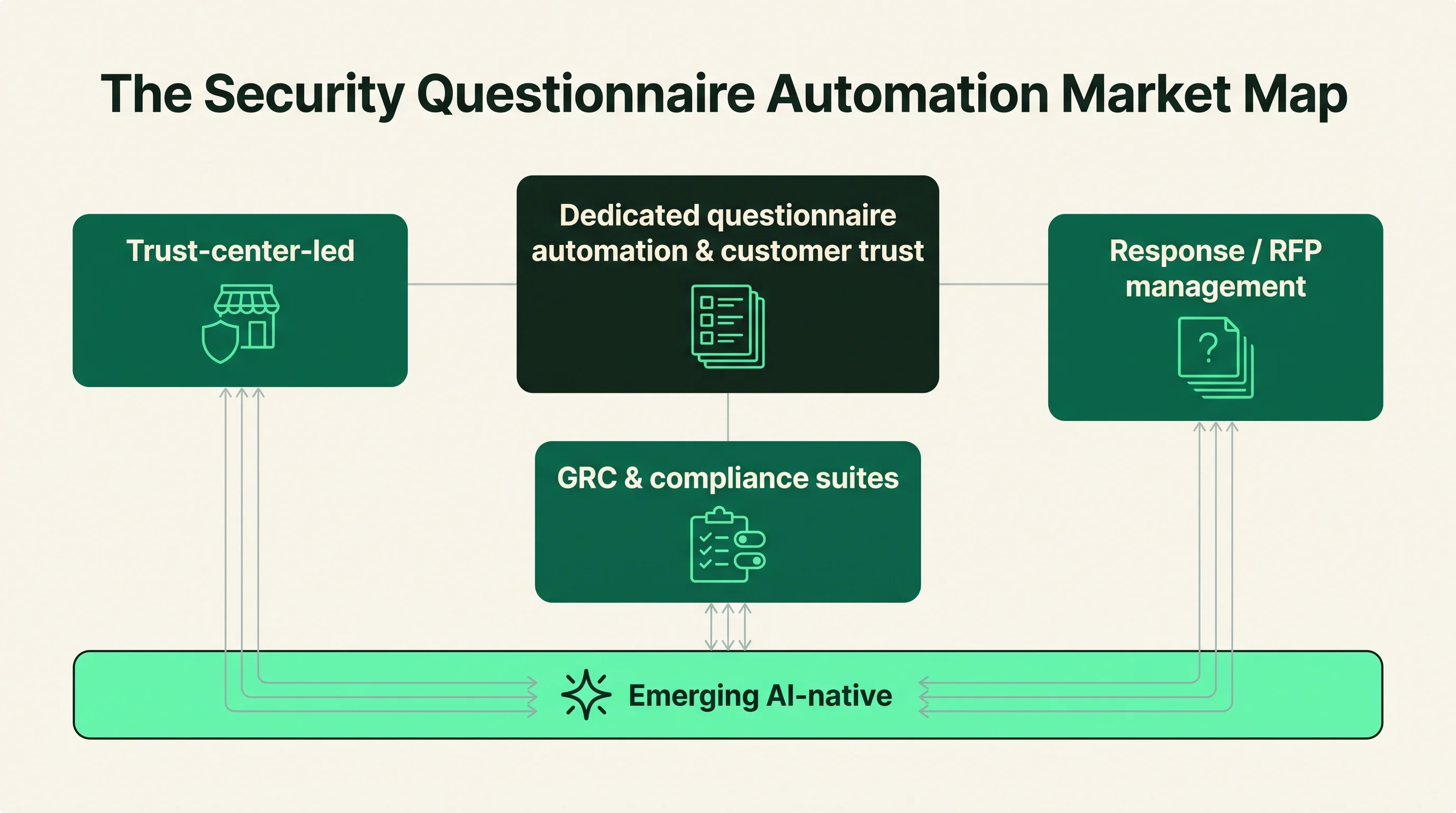
Read this market by segment, not by ranking. Security questionnaire automation is not a single tidy category with a clear leader. It is a band where five adjacent markets overlap, and each vendor entered from a different starting point. The fastest way to make sense of the field is to ask what a vendor was originally built to do, then look at what it has added since.
The core job is consistent across the market. Every vendor helps a team handle security questionnaire automation, answering the forms buyers send during procurement from an approved library and, increasingly, some form of AI drafting. What differs is the surface around that job. One vendor wraps it in a buyer-facing trust center. Another folds it into a compliance suite anchored to monitored controls. A third treats it as one response type beside RFPs and RFIs.
Three forces shape how to read the map:
- Origin. A vendor's first product still shapes its strengths. A trust-center company tends to be strong at deflection and weaker at high-volume response, and the reverse holds for a response platform.
- Overlap. Segments are converging. Response platforms add trust centers, trust centers add AI drafting, and compliance suites add questionnaire modules, so the lines between groups soften every quarter.
- Ownership. Who runs the tool matters as much as the tool. Sales engineering, GRC, security, and compliance teams each pull the same category toward a different shape.
This map is neutral and organized by segment. It does not rank vendors or declare a winner, because the right starting point depends on which problem dominates for your team. The next section lays out the five segments and places representative vendors in each. If the category is new to you, start with our explainer on what security questionnaire automation is, then return here for the vendor view.
What are the five segments of the questionnaire automation market?
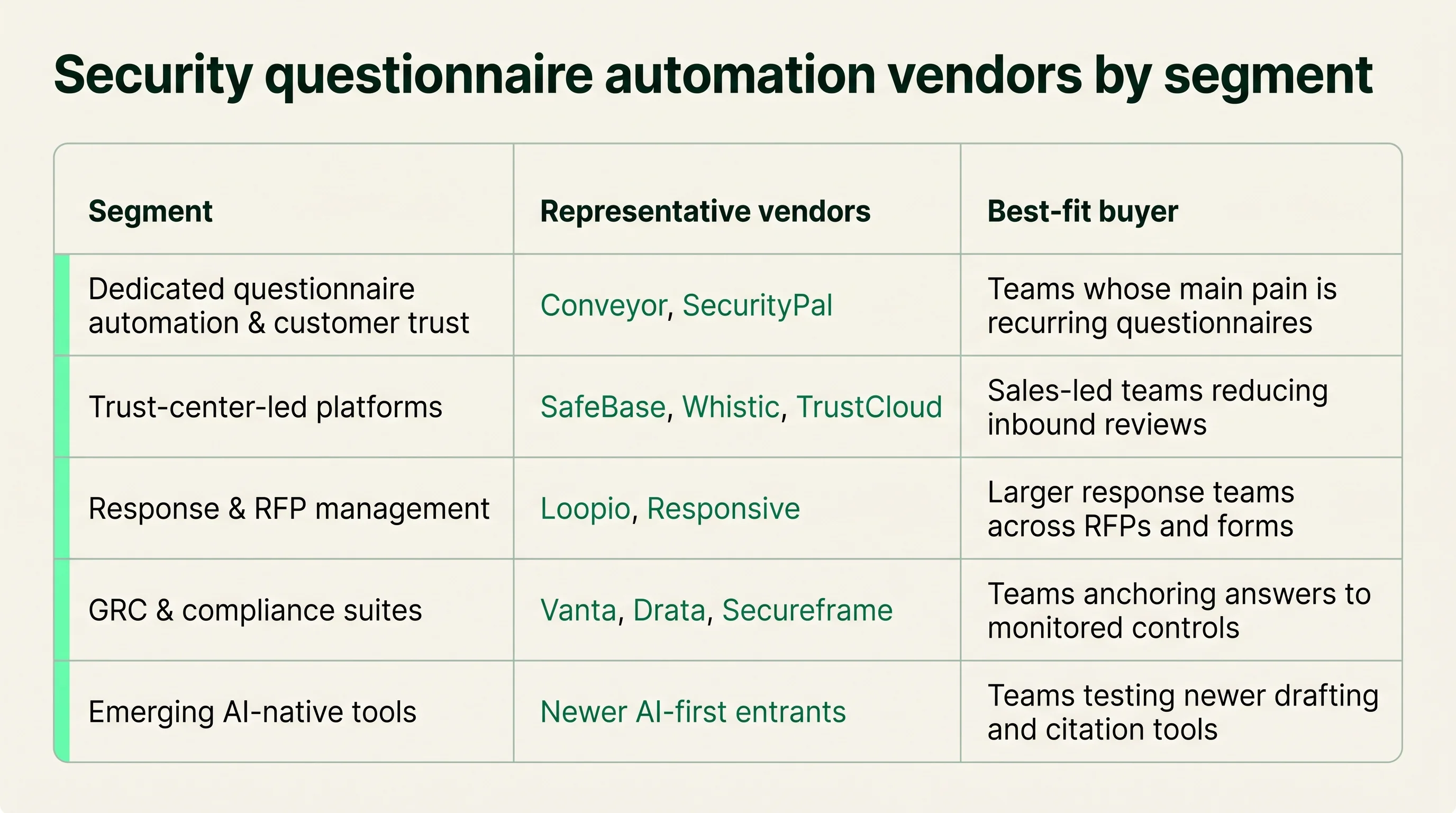
The market divides into five segments, each defined by the product a vendor was built around. The table below places representative vendors in each segment against the buyer that segment fits best. Capability descriptions reflect how each vendor positions itself and are vendor-reported; confirm current scope on each vendor's documentation before you shortlist.
| Segment | Representative vendors | Best-fit buyer |
|---|---|---|
| Dedicated questionnaire automation and customer trust | Conveyor, SecurityPal | GRC, security, or sales engineering teams whose main pain is recurring questionnaires and a messy answer library |
| Trust-center-led platforms | SafeBase, Whistic, TrustCloud | Sales-led teams reducing inbound reviews through buyer self-service before a questionnaire is sent |
| Response and RFP management spanning questionnaires | Loopio, Responsive | Larger response teams handling RFPs, RFIs, and security forms in one workflow |
| GRC and compliance suites with questionnaire features | Vanta, Drata, Secureframe | Teams already running SOC 2 or ISO 27001 evidence who want answers anchored to monitored controls |
| Emerging AI-native questionnaire tools | Newer AI-first entrants | Teams willing to test newer tools whose drafting and citation behavior is the central bet |
Read the table as a map of emphasis, not a scorecard. A vendor's segment tells you where its center of gravity sits, not the full extent of what it can do. Several vendors now reach into neighboring segments, which is why the same name can appear in more than one buyer's shortlist.
Two segments anchor the field. Dedicated questionnaire tools and response platforms compete most directly on the act of answering. Trust-center platforms and compliance suites compete on reducing or grounding that work through a different surface. The AI-native segment cuts across all four, since every established vendor is now adding AI drafting of its own. The sections that follow describe what defines each segment, who it fits, and how to read the overlaps.
Dedicated questionnaire automation and customer trust
This segment is built around the questionnaire itself. The product centers on importing a buyer's form, drafting answers from an approved library, routing them for review, and exporting them back in the format the buyer expects. Conveyor and SecurityPal sit here, though they take different routes to the same job.
Conveyor positions as a customer trust platform with questionnaire automation at its core, pairing an answer library and AI drafting with a trust center and portal handling. The emphasis is turning buyer forms around quickly while keeping a single source of approved answers. SecurityPal adds a managed human-in-the-loop service, where a vendor team answers on your behalf and your staff approve the final output. One is software your team runs; the other is capacity you buy.
This segment fits teams whose dominant pain is the questionnaire workflow itself:
- GRC or security teams with recurring questionnaires and an answer library that has drifted out of date.
- Sales engineering teams that lose hours to buyer portals and standardized forms like CAIQ and SIG.
- Thin teams with spiky volume that cannot staff the work, which is where a managed service like SecurityPal earns its place.
The overlap to watch is with trust-center platforms. Conveyor includes a trust center, so a buyer weighing it against SafeBase or Whistic is partly choosing between a response-first product that added deflection and a deflection-first product that added response. The deciding question is which job you lead with. If the questionnaire queue is the problem, start here. For the wider field, see our overview of the state of security questionnaire automation in 2026.
Trust-center-led questionnaire automation vendors
This segment is built around deflection. The core product is a buyer-facing trust center, a controlled place to publish certifications, documents, posture, and approved answers so buyers can self-serve before sending a full questionnaire. SafeBase, Whistic, and TrustCloud anchor this group, with questionnaire answering present but secondary to the trust surface.
The logic is that the cheapest questionnaire to answer is the one you never receive. A polished trust center lets a buyer find a SOC 2 report, an ISO 27001 certificate, or a standard answer without routing a form to your team. The questionnaires that still arrive draw from the same approved content, keeping the published trust center and the response library aligned to one source.
The three named vendors differ in emphasis:
- SafeBase centers on a polished customer trust center and inbound deflection, with access controls and NDA gating on sensitive documents.
- Whistic spans both sides of an assessment, offering a trust profile and a questionnaire exchange so a vendor and a buyer can share assessments through a common surface.
- TrustCloud leans toward folding trust, compliance posture, and questionnaire response into one platform, sitting closer to the compliance segment than the other two.
This segment fits sales-led teams whose main goal is reducing inbound review volume. It fits less well when the bespoke questions that still arrive are the real bottleneck, because a trust center does not answer those for you. The overlap to watch runs in two directions: toward dedicated response tools on answering depth, and toward compliance suites on posture and evidence. For a deeper look at the deflection surface, see our piece on what a buyer-ready trust center is.
Response and RFP management that spans questionnaires
This segment is built around the response library and the drafting workflow, across more than security forms. Loopio and Responsive come from the RFP and RFI world, where teams answer large, repeating proposal documents from a shared content library. Security questionnaires are one response type these platforms handle, not the only one.
The strength here is mature response management at scale. These tools are built for larger teams that collaborate on long documents, assign sections to subject-matter experts, track approvals, and reuse a deep library across many response types. A security questionnaire fits naturally into that machinery, and a team already running one of these platforms for RFPs can often answer security forms in the same place.
This segment fits response operations spanning document types:
- Larger response or proposal teams that already manage RFPs and RFIs and want security questionnaires in the same workflow.
- Organizations that value one content library and one collaboration model across all buyer-facing response work.
- Teams where the response function is a defined operation with its own owners, rather than a side task for GRC or security.
The overlap to watch is with dedicated questionnaire tools. A response platform brings depth in workflow and library management but may be lighter on security-specific surfaces like a trust center or portal autofill. A dedicated tool brings the reverse. For a direct comparison of the two approaches, see our Conveyor vs. Loopio head-to-head, which maps a dedicated questionnaire tool against a response platform on the dimensions that decide fit.
GRC and compliance suites with questionnaire features
This segment is built around compliance automation, with questionnaire response added as a module. Vanta, Drata, and Secureframe center on controls, continuous monitoring, and evidence collection for frameworks like SOC 2 and ISO 27001. The questionnaire feature draws from that governed evidence, so an answer is anchored to a monitored control rather than to separately maintained content.
The appeal is consolidation and grounding. A team already running one of these platforms for audit readiness maintains its evidence once and reuses it to answer questionnaires, avoiding a second copy of the same facts. For a GRC or compliance team that treats current, monitored evidence as the foundation of a trustworthy answer, that discipline is the differentiator over a response-first tool.
The three named vendors share a compliance core but differ in surrounding scope:
- Vanta pairs broad compliance automation with a questionnaire module and a trust center, drawing answers from monitored evidence.
- Drata centers on continuous-control monitoring with questionnaire response on top, and now sits alongside a trust-center capability through consolidation.
- Secureframe folds questionnaire automation into a compliance platform aimed at teams pursuing multiple frameworks at once.
The Drata and SafeBase consolidation is the signal to watch here. It pairs a compliance automation core with a polished trust-center surface, the exact convergence this map describes: monitored evidence on one side, buyer-facing deflection on the other, increasingly under one roof. Expect more compliance suites to reach toward the trust-center segment, and more trust centers to reach toward monitored evidence.
This segment fits teams whose answers depend on the cloud, identity, and control data the compliance platform already tracks. It fits less well when very high questionnaire volume is the only real pain, since you may be buying a broad platform to get a response feature. Weigh it against a dedicated tool in that case.
Emerging AI-native questionnaire tools
This segment is defined by the bet that AI drafting is the product, not a feature bolted onto an older one. Newer AI-first entrants build the workflow around a model that reads a questionnaire, drafts answers, and points to a source, rather than starting from a library, a trust center, or a compliance suite and adding AI later.
The distinction matters less every quarter, because every established vendor in the other four segments now ships AI drafting of its own. The useful question is not whether a tool uses AI, since they all claim to, but how the AI behaves on hard questions. The capabilities worth probing are the same across new and incumbent tools, and all such claims are vendor-reported until you test them:
- Citation. Does an AI-drafted answer cite the approved source it came from, so a reviewer can trace it rather than trust a black box?
- Abstention. Does the tool decline to answer when it lacks a grounded source, or produce a confident but unsupported answer?
- Grounding. Are answers drawn from your approved library and evidence, or generated from a general model with no tie to your facts?
- Review fit. Does the AI reduce reviewer effort, or shift it from drafting to verifying every line?
This segment fits teams willing to trial newer tools where AI accuracy is the central evaluation, and where a faster drafting loop justifies testing a less established vendor. It fits less well for teams that need proven scale, deep integrations, or a mature trust center on day one.
Treat the AI-native label as a starting point, not a verdict. A newer tool may draft well but lack format coverage or review controls, while an incumbent may pair a slower-moving product with more dependable grounding. Test both on your own questionnaires.
What should buyers compare first across questionnaire automation vendors?
Compare criteria before you compare vendor names. Each vendor leads with the dimension it is strongest on, so a fixed framework keeps the evaluation honest across segments. Score every candidate on the same criteria, weighted for your situation, then test the top ones on your real questionnaires.
The criteria that decide most shortlists:
- Answer-library quality. How the tool stores, versions, and surfaces approved answers, and how easily you keep them current. A large library is worthless if its answers are stale.
- AI accuracy and citations. Whether AI-drafted answers cite their source and abstain when there is no grounded answer. This separates a useful drafting tool from a confident but unverifiable one.
- Format coverage. Support for Excel uploads, buyer portals, CAIQ, SIG, and custom forms, since the format you cannot handle is the one that eats your week.
- Review and approval controls. Roles, approval steps, audit trails, and who can publish a final answer to a buyer.
- Integrations. Connections to your CRM, document storage, knowledge base, evidence sources, and single sign-on.
- Pricing model. Per-seat, per-questionnaire, tiered, or platform bundle, and how that scales with your real volume.
Map these criteria to the segments before shortlisting. If answer-library quality and format coverage rank highest, start with dedicated questionnaire tools or response platforms. If reducing inbound volume ranks highest, start with trust-center platforms. If grounding answers in monitored evidence ranks highest, start with compliance suites. If AI behavior is your deciding factor, test it across all four rather than assuming the AI-native segment owns it.
No single vendor wins this map, because the criteria weight differently for every team. Shortlist three candidates that match your top two criteria, include one from a different segment to test your assumptions, then run a real questionnaire through each and measure citation quality, abstention behavior, and review effort. Confirm pricing model, format coverage, and integrations on current documentation, since these change.
How Standard Answer tracks vendor coverage
This is a working view of the market, and our vendor coverage is expanding alongside it. The segments are stable, but the vendors inside them move, so treat the placements here as a current read rather than a fixed taxonomy.
Where our coverage stands:
- Vendor profiles. We publish deep profiles as we complete primary research on each vendor, starting with the most established names in the dedicated and trust-center segments. Where a profile exists, this map links to it; where one does not yet, the vendor is named without a link.
- Comparisons. We publish head-to-head comparisons between vendors that buyers routinely shortlist together, such as a dedicated tool against a response platform or a trust center against a compliance suite.
- Consolidation tracking. We track structural moves like the Drata and SafeBase consolidation, because mergers reshape which segment a vendor belongs to and which buyers it now fits.
A few caveats apply to every placement. Capability descriptions are vendor-reported and should be verified on current product documentation. We do not publish market-size or funding figures we cannot stand behind, so this map describes structure and fit rather than revenue or valuation. As vendors add features across segment lines, expect placements to move and overlaps to grow.
Use this map as a starting point for a shortlist, not a final answer. Pair it with the comparison criteria above, the category hubs for security questionnaire automation and trust center software, and the individual vendor profiles as they publish.
How this article was reviewed
Sources reviewed
- AICPA - SOC 2Primary source for what a SOC 2 report attests, a framework that questionnaire answer libraries and compliance suites reference.
- ISO/IEC 27001Primary source for the information security management standard referenced across questionnaire answers and compliance evidence.
- Cloud Security Alliance - CAIQPrimary source for the CAIQ format, one of the standardized questionnaire types referenced in format-coverage comparison.
- Shared Assessments - SIGPrimary source for the SIG questionnaire format referenced in format-coverage comparison.
- Vendor product and positioning documentation (Conveyor, SecurityPal, SafeBase, Whistic, TrustCloud, Loopio, Responsive, Vanta, Drata, Secureframe)Capability, segment placement, and feature claims are vendor-reported and should be confirmed against current product documentation, not treated as independent fact. Segment boundaries shift as vendors add features across category lines.
FAQ
Who are the main security questionnaire automation vendors?
The main vendors cluster into five segments. Dedicated questionnaire automation and customer trust tools include Conveyor and SecurityPal. Trust-center-led platforms include SafeBase, Whistic, and TrustCloud. Response and RFP management platforms that span questionnaires include Loopio and Responsive. GRC and compliance suites with questionnaire features include Vanta, Drata, and Secureframe. A fifth segment of emerging AI-native tools cuts across the others. The right starting point depends on which problem dominates for your team, since the segments overlap and boundaries are blurring.
How is the security questionnaire automation market organized?
It is best organized by segment, not by ranking, because vendors entered from five different adjacent markets. Each vendor's origin still shapes its strengths: a trust-center company tends to be strong at deflection, a response platform at high-volume drafting, and a compliance suite at grounding answers in monitored evidence. Segments are converging as response platforms add trust centers and compliance suites add questionnaire modules, so confirm a vendor's current scope rather than assuming it only does what its origin implies.
What does the Drata and SafeBase consolidation mean for buyers?
It pairs a compliance automation core with a polished buyer-facing trust center, which signals the convergence this market map describes: monitored evidence on one side and inbound deflection on the other, increasingly under one platform. For buyers, it means more vendors will offer both grounded compliance answers and trust-center self-service together. Expect more compliance suites to reach toward the trust-center segment and more trust centers to add monitored evidence, so weigh combined platforms against dedicated tools when very high questionnaire volume is your main pain.
How do trust-center platforms differ from dedicated questionnaire automation tools?
Trust-center platforms like SafeBase, Whistic, and TrustCloud center on deflection, publishing certifications, documents, and approved answers so buyers can self-serve before sending a questionnaire. Dedicated tools like Conveyor center on answering the questionnaires that arrive, importing forms, drafting from a library, and exporting in the buyer's format. The lines blur because dedicated tools often add a trust center and trust centers add AI drafting. Decide by which job you lead with: reducing inbound volume points to a trust center, while a heavy answering queue points to a dedicated tool.
What should buyers compare before choosing a vendor?
Compare criteria before vendor names: answer-library quality, AI accuracy and citations, format coverage across Excel, portals, CAIQ, and SIG, review and approval controls, integrations, and pricing model. Answer-library quality and AI citation behavior separate strong tools from weak ones, because a large library is worthless if stale and AI drafting is a liability if it cannot show its source. Shortlist three candidates that match your top two criteria, include one from a different segment, then run a real questionnaire through each before signing.