How to Compare Security Questionnaire Automation Accuracy Claims
Vendor accuracy percentages and automation rates are not comparable across tools, because each vendor defines accuracy, the denominator, and the role of human review differently. The only number you can trust is the one you produce by running every shortlisted tool against the same set of your own questionnaires.
Quick answer: how to compare vendor accuracy claims
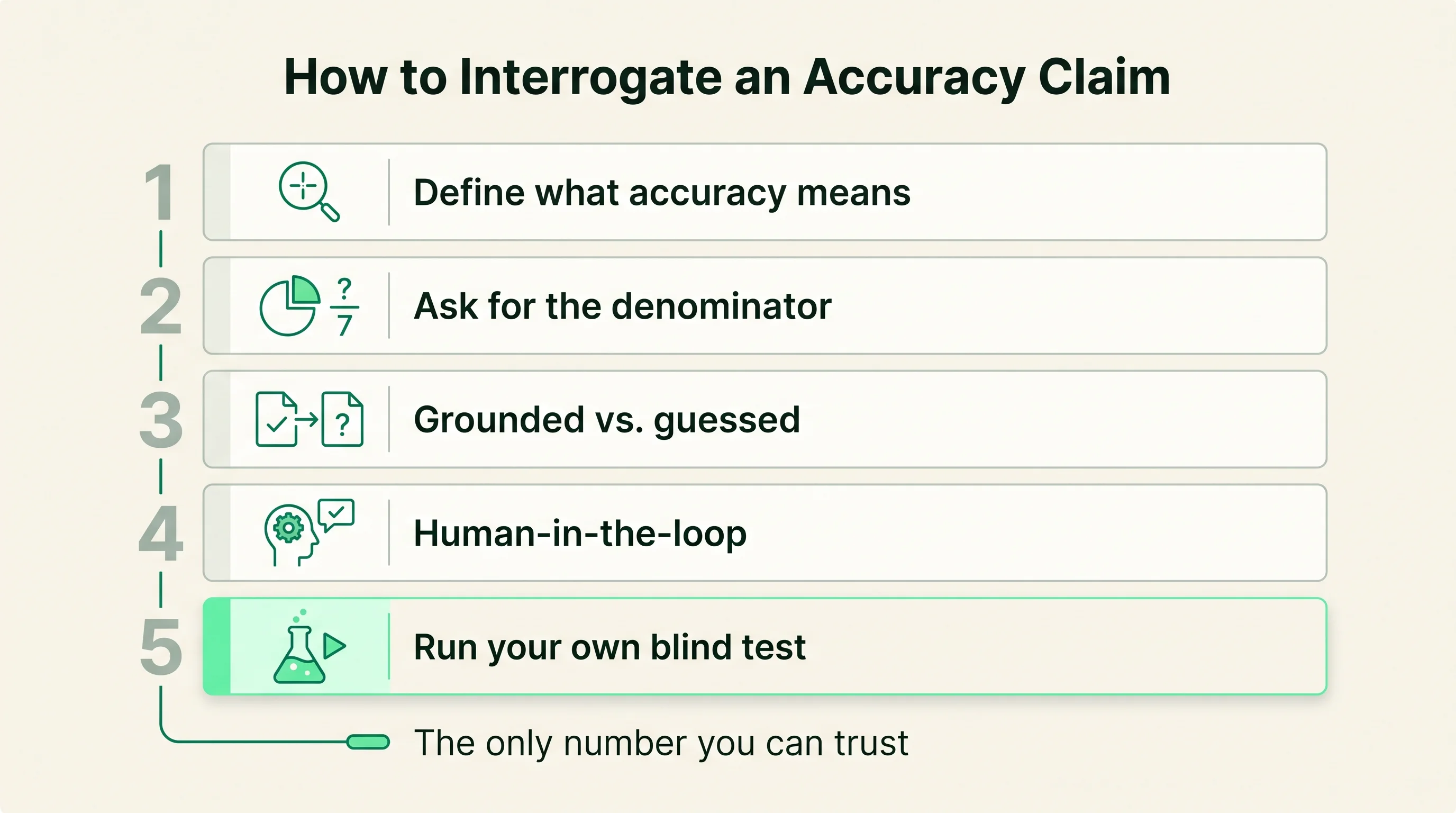
Do not compare vendors on their advertised accuracy or automation-rate numbers. Those figures are defined differently by each vendor, measured on different denominators, and shaped by different assumptions about how much a human corrects afterward. The only comparable number is one you produce yourself by running each shortlisted tool against the same set of your own questionnaires and scoring the output the same way.
This matters because security questionnaire automation is now sold heavily on a single statistic. A vendor advertises that its AI answers questionnaires with some high accuracy, or automates some high share of responses, and a buyer treats that as a feature to rank. It is not. Two tools can both claim the same accuracy and behave completely differently on the same SIG, because they are not measuring the same thing. If the category itself is new to you, our explainer on what security questionnaire automation is sets the context.
The people who have to defend these claims internally are the ones who should interrogate them. The GRC analyst owns whether an answer is correct and current. The CISO owns the risk of an unverified answer leaving the building. The AI governance lead owns whether the model is allowed to assert things it cannot support. The sales engineer just wants the response out the door. An accuracy claim that satisfies sales can still fail governance, which is why the test has to be run by the people accountable for the output.
The practical answer is a protocol, not a preference. Build a fixed test set from your real questionnaires, run every shortlisted tool against it under the same rules, and score grounding, citations, and abstention rather than trusting the marketing number. The rest of this guide gives you the questions to ask and the steps to run that test.
What does accuracy actually mean here?
Accuracy in security questionnaire automation means how often the tool produces an answer that is both correct and supportable, not how often it produces an answer that reads well. Those are different measures, and the gap between them is where weak claims live. A model can write a fluent, confident response that is wrong, and a naive accuracy metric will count it as a success because a human did not flag it.
The distinction that separates a defensible claim from a marketing one is grounding. A grounded AI answer is generated from, and tied back to, a specific approved source: a policy, a control description, a prior approved answer, or an evidence document. An ungrounded answer is generated from the model's general training and presented with the same confidence. Grounding is what lets a reviewer check an answer instead of trusting it.
The behaviors worth separating when you read any accuracy claim: - Grounded answer: drafted from a cited source in your library, so a reviewer can verify it against the evidence. - Hallucinated answer: fluent and confident but not supported by any source, which is the failure mode accuracy metrics are supposed to catch and often do not. - Cite-or-abstain: the tool answers only when it can attach a source and declines when it cannot, which trades coverage for trust. - Confidence threshold: a setting that controls how sure the model must be before it drafts an answer rather than flagging the question for a human.
The strongest pattern is cite-or-abstain: the system attaches a citation to every answer and abstains when it has no source, rather than guessing. A tool that abstains looks worse on a raw automation count and is usually safer, because the questions it skips are exactly the ones a human needed to see. When a vendor reports accuracy, the first thing to establish is whether that number counts only grounded, cited answers or whether it also counts confident text the tool was never able to support.
What accuracy claims will you hear, and what should you ask?
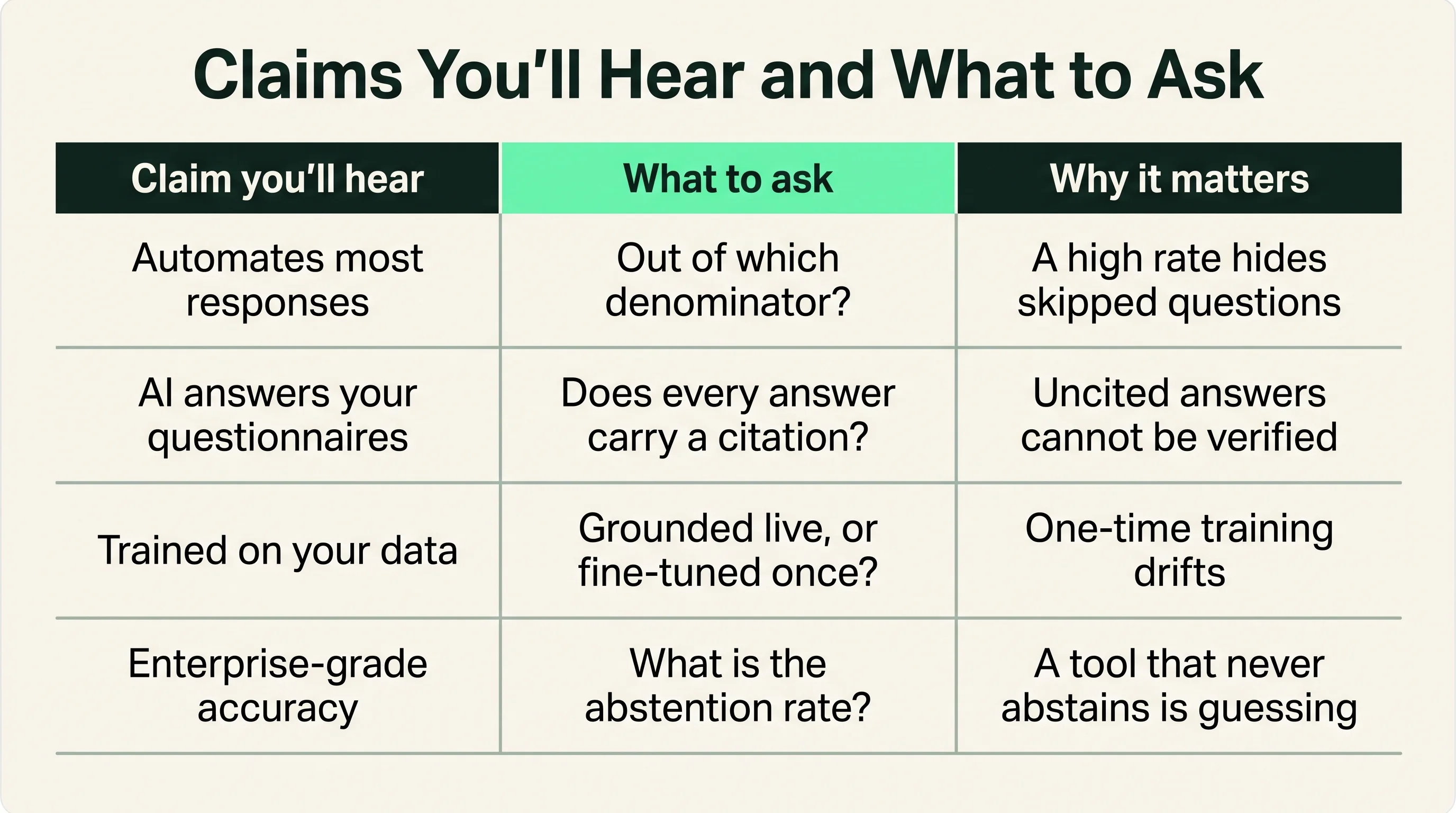
Every accuracy claim you hear can be turned into a sharper buyer question, and the table below pairs the common ones with what to ask and why it matters. Treat each advertised figure as vendor-reported until your own test confirms it. The goal is not to catch vendors lying; it is to make non-comparable numbers comparable by forcing each one onto the same definition.
| Claim you'll hear | What to ask | Why it matters |
|---|---|---|
| "95% accurate" | Accurate against what reference, scored by whom? | Self-scored accuracy with no ground truth is unfalsifiable. |
| "Automates most responses" | Out of which denominator: all questions or only answered ones? | A high rate on a small denominator hides skipped questions. |
| "AI answers your questionnaires" | Does every answer carry a citation, or only some? | Uncited answers cannot be verified and shift risk to the reviewer. |
| "Reduces review time by X" | Measured before or after human correction? | Time saved before review ignores the rework it creates. |
| "Trained on your data" | Grounded at answer time, or fine-tuned once? | One-time training drifts; live grounding stays current. |
| "Enterprise-grade accuracy" | What is the abstention rate when it has no source? | A tool that never abstains is guessing on the hard questions. |
The pattern across the table is consistent. Most inflated claims come from a hidden denominator, a missing ground truth, or counting answers a human still had to fix. None of those are visible in the headline number, which is why the claim alone tells you almost nothing.
Use these questions in the demo, not after the contract. A vendor who can answer them precisely, and show you the citations and abstention behavior live, is making a claim you can probably verify. A vendor who deflects to the marketing figure is telling you the number will not survive your own test. For the broader set of criteria buyers weigh alongside accuracy, see our guide on how enterprise buyers evaluate security questionnaire automation tools.
Why do the denominator and human review make accuracy claims hard to compare?
Two accuracy numbers are not comparable unless they share a denominator and the same assumption about human review, and they almost never do. This is the single biggest reason vendor figures mislead. The percentage is real; the thing it is a percentage of is undisclosed and varies by tool.
Consider what the denominator can quietly exclude: - Questions the tool chose to answer, dropping every question it skipped from the count entirely. - Questions it was confident about, after a high confidence threshold removed the hard ones. - Questions that matched the answer library, ignoring the novel questions that cause the most rework. - Questions after a human pass, so the reported accuracy is really the human's accuracy, not the model's.
The human-in-the-loop assumption compounds this. Almost every responsible deployment keeps a human review step, and that is correct. The problem is that some accuracy claims are measured after that review, which makes the number describe your team's correction rate rather than the tool's drafting quality. A fully automated figure and a human-reviewed figure can look identical and mean opposite things.
Automation rate and accuracy are the pair most often blurred. Automation rate is how much of the questionnaire the tool drafted without a human; accuracy is how much of that was correct. A tool can post a high automation rate by drafting confidently on everything, including questions it should have abstained on, and that inflates automation while quietly lowering trust. A high automation rate with no stated accuracy floor, or an accuracy figure with no stated denominator, should be read as marketing until your test fills in the missing half. The safe interpretation is that neither number means anything on its own, because the comparable measurement is grounding and abstention on a fixed set of questions, which only your own test produces.
How do you run an apples-to-apples questionnaire accuracy test?
Run every shortlisted tool against the same fixed set of your own questionnaires, score the output by the same rules, and compare those results instead of the advertised numbers. This is the only comparison that controls for the definitions, denominators, and review assumptions that make vendor claims non-comparable. It takes a day or two to set up and replaces guesswork with evidence.
The protocol, step by step: - Build a fixed test set: pull 50 to 100 real questions from your actual questionnaires, spanning easy library matches, novel questions, and a few you know are hard or ambiguous. - Establish ground truth first: have a subject-matter expert write or approve the correct answer for each question before you see any tool's output, so you are scoring against a known reference, not an impression. - Load each tool the same way: give every tool the same source documents and answer library, so you are testing the model and its grounding, not who got the better inputs. - Run blind and identical: submit the same test set to each tool with the same settings, and turn off any post-generation human assist so you measure the drafting itself. - Score four things per answer: correct or not, cited or not, grounded in a real source or hallucinated, and abstained where it should have. Record all four, not just correctness. - Compute your own rates: report accuracy as correct-and-cited over the full test set, and report abstention separately, so a tool that guesses cannot hide behind a high raw count. - Read abstention as a feature: a tool that abstains on the hard questions and routes them to a human is usually safer than one that answers everything, even though it looks less automated.
The output of this protocol is a small table of your numbers for each tool, computed identically, which is the only honest basis for ranking. When you brief leadership, show them that table and explain the method, because a self-run test is far more persuasive than a vendor slide. To turn the shortlist into a decision, work from the security questionnaire automation category hub and our buyer-evaluation guide, and weigh accuracy alongside format coverage, review controls, and pricing rather than in isolation.
Which accuracy claims should you trust?
Trust the claim you can reproduce, and discount the one you cannot. The distinction is not which vendor advertises the higher number; it is which vendor's behavior survives a controlled test on your own questionnaires with grounding and citations scored honestly. Accuracy is a property of a tool on a specific question set, so the only trustworthy figure is the one your test produced.
Trust a claim, provisionally, when: - The vendor states the denominator plainly and it is the full question set, not a filtered subset. - Every answer carries a citation to a source you can open and check. - The tool abstains on questions it cannot ground, and reports that abstention rate openly. - The accuracy figure is measured before human correction and labeled as such. - The vendor lets you run your own blind test in the evaluation and stands by the result.
Be skeptical of a claim when: - The percentage has no stated reference or ground truth and was scored by the vendor. - Automation rate is headlined with no accuracy floor attached to it. - Answers are confident but uncited, so a reviewer cannot verify them. - The figure is measured after human review and presented as the model's accuracy. - The vendor resists a structured test on your own questionnaires.
The decision rule is simple: rank tools by the numbers you computed under the protocol above, then weigh those against the rest of your requirements. A tool with a slightly lower self-run accuracy but full citations and honest abstention is usually the safer enterprise choice than one with a higher uncited figure, because the first keeps a human able to verify and the second asks you to trust the text. For where this fits in the wider safety question, see can AI safely answer security questionnaires, and to start a shortlist, use the AI security questionnaire tools category.
How this article was reviewed
Sources reviewed
- Cloud Security Alliance - CAIQPrimary source for the CAIQ questionnaire format used when building a representative accuracy test set.
- Shared Assessments - SIGPrimary source for the SIG questionnaire format referenced as a standardized test case for accuracy comparison.
- AICPA - SOC 2Primary source for what a SOC 2 report attests, relevant to verifying that grounded answers cite current evidence.
- NIST AI Risk Management FrameworkPrimary source for AI risk and measurement language relevant to evaluating accuracy, grounding, and human oversight claims.
- Vendor accuracy and automation-rate documentationAll advertised accuracy percentages, automation rates, and citation or abstention claims are vendor-reported and should be treated as unverified until confirmed by your own blind test on your own questionnaires, never as independent fact.
FAQ
Which vendor has the most accurate security questionnaire AI?
No vendor can claim that in a way you should trust without testing, because accuracy is defined and measured differently by each tool. The most accurate tool for you is the one that produces the most correct, cited, and verifiable answers on your own questionnaires under a controlled test. Run the same fixed question set through each shortlisted tool, score grounding and citations yourself, and rank by your results rather than the advertised number.
What is the most common mistake when comparing vendor accuracy claims?
The most common mistake is comparing two advertised percentages directly, as if they measure the same thing. They rarely do, because each vendor uses a different denominator and a different assumption about how much a human corrects the output. The second most common mistake is confusing automation rate with accuracy, since a high automation rate just means the tool drafts confidently, not correctly. Always ask what the number is out of and whether it was scored before or after human review.
How does interrogating accuracy claims compare to just trusting the vendor demo?
A standard vendor demo shows the tool succeeding on questions the vendor chose, which tells you little about your questionnaires. Interrogating the claims means running your own blind test on a fixed set of real questions with a known correct answer, then scoring grounding, citations, and abstention. That takes a day or two more than watching a demo and produces a number you can defend to leadership and audit. The demo shows what is possible; the test shows what is reliable on your data.
How do you get leadership buy-in for a structured accuracy test?
Frame it as risk control, not as extra procurement work. An unverified accuracy claim that turns out wrong means a stale or hallucinated answer can go to a buyer under your company's name, which is a security and trust risk a CISO already cares about. Present the test as a one-to-two-day exercise that replaces a vendor slide with your own evidence, and bring the scored results table to the decision meeting. Leadership tends to back a method that produces a number the team can stand behind.
How many questions should a real accuracy test include?
Use 50 to 100 real questions drawn from your actual questionnaires, weighted toward the mix you receive most. Include easy library matches, genuinely novel questions, and a few ambiguous or hard ones, because the hard questions are where weak tools either hallucinate or should abstain. A set that small is enough to expose the differences that matter while staying cheap to score by hand, and it is far more informative than any vendor-reported figure on an undisclosed denominator.