

What Is Grounded AI for Security Questionnaires?
Grounded AI constrains a model's answers to an organization's approved answer library and evidence, instead of letting it generate security claims from memory. The grounding is what separates fast automation from a confident, unverifiable wrong answer.
What is grounded AI for security questionnaires?
Grounded AI for security questionnaires is AI whose answers are constrained to an organization's approved answer library and evidence, rather than generated freely from the model's training data. The model does not answer from memory. It retrieves what the company has already approved and writes the response from that material. The grounding is the constraint that ties each answer back to a source the company stands behind.
The word grounded carries the whole idea. An answer is grounded when it can be traced to a specific approved source, such as a stored answer, a SOC 2 report, or an ISO 27001 certificate.
- Grounded: the AI retrieves an approved answer about encryption at rest and drafts from it, citing the entry
- Ungrounded: the AI writes a plausible-sounding encryption answer from its training data, with no link to anything the company approved
The distinction matters more here than in most AI use cases, because the output is a formal security claim. A grounded answer is a reuse of something a human already signed off on. An ungrounded answer is a guess that happens to read well. For the buyer reading it, both look equally polished, which is exactly why the grounding has to be enforced rather than assumed.
Ownership sits with the people accountable for the claims. GRC (governance, risk, and compliance) or a dedicated security team owns the approved answers and evidence the AI is grounded in. A sales engineer or customer trust lead works the deals those answers unblock. A CISO owns the standard every claim must meet, and increasingly an AI governance owner is accountable for how the model is constrained. The AI drafts; the security side owns the truth. This concept extends the broader topic covered in our explainer on whether AI can safely answer security questionnaires.
How does grounded AI work?
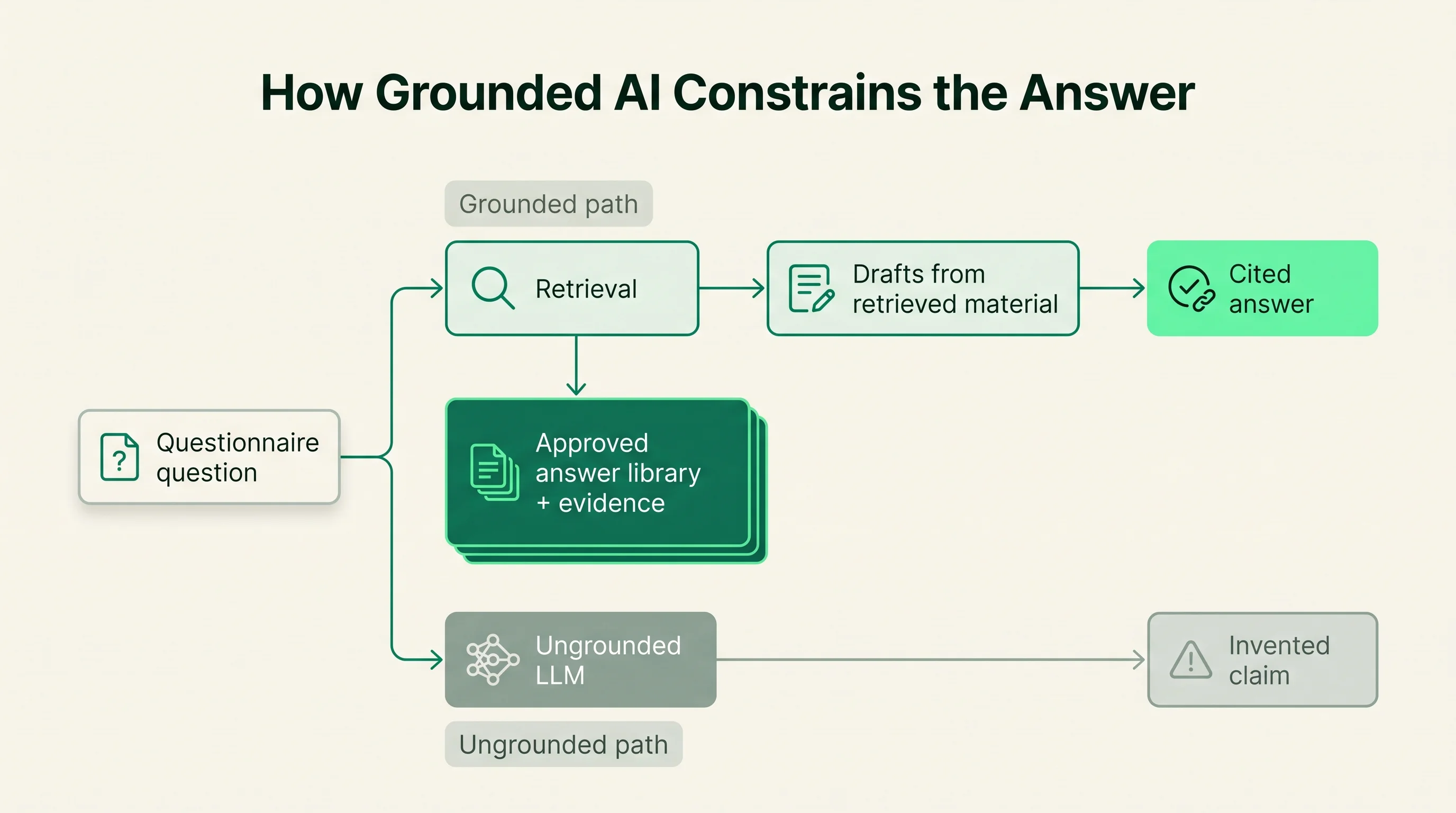
Grounded AI works through retrieval-augmented generation: it retrieves relevant approved material first, then generates an answer from that material rather than from the model's parameters. Retrieval-augmented generation, often shortened to RAG, is the technique that turns a general language model into a system that answers from your documents. The retrieval step is what grounds the generation step.
The flow runs in a clear sequence:
- A buyer sends a questionnaire in some format, such as Excel, a portal, a CAIQ, or a SIG
- The system matches each incoming question to entries in the approved answer library by meaning, not just keywords
- It retrieves the best-matched approved answers and their linked evidence
- It drafts a response from that retrieved material and cites the source it used
- A reviewer checks the draft against the cited source and approves or edits it
The retrieved material is what the model is allowed to use. A grounded system is told, in effect, to answer only from the entries it pulled back, and to flag when it found nothing suitable. That instruction is the difference between a tool that reuses approved answers and a chatbot that improvises security posture.
Grounding depends entirely on the asset underneath it. The answer library and the linked evidence are the source of truth the retrieval reads from, so a grounded model with a thin library has little to ground in. Our explainer on the security questionnaire knowledge base covers how that asset is built, versioned, and kept current.
Why grounding matters for security claims
Grounding matters because a security questionnaire answer is a formal claim, and an ungrounded model produces claims it cannot back. A general language model is built to write fluent, plausible text. It is not built to be correct about your specific controls, and it will fill a gap with an invented answer as readily as a real one. In security review, a fluent wrong answer is worse than no answer.
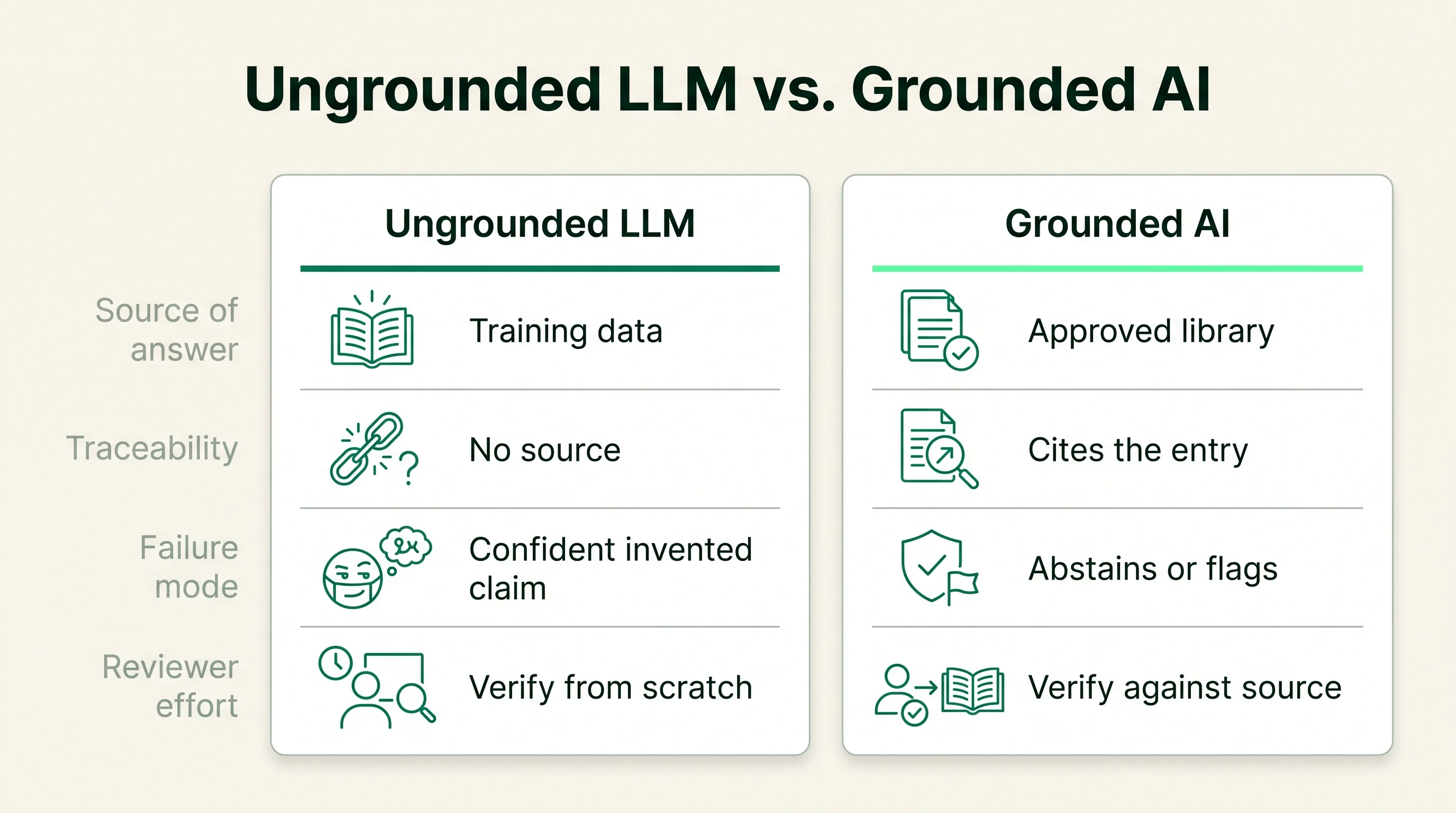
The contrast between grounded and ungrounded output is sharp once you look at it by dimension.
| Dimension | Ungrounded LLM | Grounded AI |
|---|---|---|
| Source of answer | Model training data | Approved answer library and evidence |
| Traceability | None; cannot show a source | Cites the specific entry it used |
| Failure mode | Confident invented claim | Abstains or flags a gap |
| Reviewer effort | Must verify every line from scratch | Verifies against the cited source |
The specific risk of an ungrounded model is the invented claim, sometimes called a hallucination. A model might state that data is encrypted with a particular key length, or that a certification is current, simply because that is the most likely sentence given the question. If that ships to a buyer and the underlying control differs, the company has made a false security representation in a procurement document.
Grounding closes that gap by design. Because every answer traces to an approved source, a reviewer can confirm it in seconds rather than re-deriving it, and the model has no license to assert anything the company has not already stood behind. That is the entire point of constraining the AI to retrieved material.
How grounding relates to cite-or-abstain and human review
Grounding is the foundation; cite-or-abstain and human review are the controls built on top of it. Grounding constrains where the answer comes from. Cite-or-abstain governs what the system does when it cannot find a grounded answer. Human review is the checkpoint that keeps a person accountable for the final claim. The three work as one safeguard.
Each plays a distinct role:
- Grounding: the AI may only answer from retrieved approved material, not from training data
- Citation: every drafted answer shows the specific source it used, so a reviewer can open and verify it
- Abstention: when no approved source matches, the system declines to answer rather than guessing
- Human review: a named owner approves, edits, or rejects each draft before it reaches the buyer
Cite-or-abstain is the behavior that makes grounding visible and safe. A grounded system that cites lets a reviewer trust but verify; a grounded system that abstains refuses to manufacture a claim when the library is silent. Our explainer on cite-or-abstain AI covers that behavior in depth.
Human review is what keeps the model assistive rather than authoritative. Grounding and citation make review fast, because the reviewer checks an answer against its source instead of researching it cold. But the person, not the model, remains accountable for what the company tells a buyer. A grounded pipeline without a review step is faster and riskier; the speed is real, and so is the exposure when a stale source slips through.
Where grounded AI sits next to adjacent surfaces
Grounded AI is a method, not a product surface, so it sits inside the tools rather than beside them. Questionnaire automation, the trust center, RFP response, and third-party risk management are the surfaces; grounding is the technique that should run within each. Understanding the placement keeps a buyer from confusing the feature with the category.
| Surface | Its specific job | Role of grounded AI |
|---|---|---|
| Questionnaire automation | Answer inbound security reviews | Drafts each answer from retrieved approved entries |
| Trust center | Publish proof and deflect repeat requests | Answers buyer questions from approved, published material |
| RFP and proposal response | Answer revenue proposals | Pulls security answers from the same grounded library |
Questionnaire automation is where grounded AI does its most visible work, drafting responses to inbound reviews from the approved answer library. Our explainer on security questionnaire automation covers that surface in full, and the category hub for security questionnaire automation lists the leading tools.
The trust center is a published page where a company posts certifications, evidence, and common answers so buyers can self-serve. A grounded trust center agent answers buyer questions from that approved material, declining when the answer is not published. The same grounding discipline applies, just facing outward.
Third-party risk management (TPRM) is the buyer's side of the same exchange. TPRM is the program a company runs to assess vendors it buys from, and sending questionnaires is one of its steps. Grounded AI streamlines the responder's half of someone else's TPRM process, which is why the technique shows up across questionnaire, trust center, and RFP tools alike. The AI security questionnaire tools category groups the products that apply it.
Benefits and tradeoffs of grounded AI
The payoff of grounded AI is accuracy with speed: the team gets drafted answers fast, and each one traces to something approved. The cost is that grounding inherits every weakness of the library it reads from. Both are real, and a buyer should weigh them before treating grounding as a guarantee.
The benefits are concrete:
- Accurate reuse, because answers come from approved material rather than model guesses
- Fast verification, because each answer cites a source a reviewer can open
- Lower hallucination risk, because the model is constrained to retrieved content
- An audit trail of which source backed which answer, useful for the company's own audits
- Lower subject-matter-expert load, because SMEs review matches instead of re-answering
The tradeoffs deserve equal weight:
- Grounding is only as good as the answer library; a thin or stale library produces frequent abstentions or weak citations
- Curation and maintenance are a standing cost, not a one-time import
- A grounded label is not a verified one; the system can cite an out-of-date source as confidently as a current one
- Over-trust is the subtle risk, because a clean citation can lull a reviewer into rubber-stamping a stale answer
There is a point where grounded AI is not worth the setup. A company that receives a handful of questionnaires a year does not need retrieval infrastructure; a careful reviewer and a shared document will do. Grounding earns its keep when volume is high enough that the same SMEs are pulled into repeated near-identical work, and when the cost of a wrong security claim is high enough to justify the discipline.
How to evaluate or verify a vendor's grounding claim
Verify a grounding claim by running a real questionnaire through a trial and checking that every answer cites a specific approved source you can open. Do not take the marketing at face value. Most vendors describe their AI as grounded, source-aware, or cited, and those descriptions are vendor-reported. The only reliable test is your own questionnaire on your own library.
Score each tool against the same criteria.
| Criterion | What good looks like |
|---|---|
| Source of answers | Drafts come from your approved library, not the model's general knowledge |
| Citation | Every answer links to a specific entry or evidence artifact you can open |
| Abstention | The tool declines or flags when no approved source matches |
| Evidence linking | Answers point to a SOC 2, ISO 27001, CAIQ, or policy artifact |
| Human review | A reviewer can approve, edit, or reject before anything reaches a buyer |
Conveyor, Vanta, SafeBase, Loopio, Responsive, HyperComply, SecurityPal, Whistic, and Drata are common reference points, and they reach grounding from different starting positions. Conveyor centers on questionnaires and trust centers; Vanta, SafeBase, and Drata arrive from compliance automation; Loopio and Responsive came from RFP response. Each names its own AI and library capabilities, and those claims should be tested rather than assumed. Our profiles of Conveyor and Loopio look at two of them in depth.
The most reliable test is a controlled trial on questions you already know the answers to.
- Use a real, recent questionnaire you have already completed, so you know the correct responses
- Watch whether each drafted answer cites a source you can open and verify
- Force a gap on purpose by asking something not in your library, and confirm the tool abstains instead of inventing an answer
- Compare drafted answers against your approved versions for accuracy
A trial that tests both grounding and abstention tells you more than any feature grid. When you are ready to shortlist, start from the security questionnaire automation category and compare the leading tools on how they ground, cite, and abstain.
How this article was reviewed
Sources reviewed
- AICPA - SOC 2Primary source for what a SOC 2 report attests as evidence behind a grounded answer.
- ISO/IEC 27001Primary source for the information security management standard used as evidence.
- Cloud Security Alliance - CAIQPrimary source for the CAIQ format definition and structure.
- Shared Assessments - SIGPrimary source for the SIG and SIG Lite questionnaire definitions.
- NISTReference framework cited in many security questionnaire controls.
- Vendor product documentation (Conveyor, Vanta, SafeBase, Loopio, Responsive, HyperComply, SecurityPal, Whistic, Drata)Grounding, citation, and AI capability claims are vendor-reported and should be verified in a trial, not treated as independent fact.
FAQ
What is grounded AI for security questionnaires?
Grounded AI is AI whose answers are constrained to an organization's approved answer library and evidence, rather than generated freely from the model's training data. It uses retrieval-augmented generation to pull matching approved material first, then drafts a response from that material and cites the source. The grounding is what lets a reviewer trust and verify each answer instead of treating it as a guess.
What is the difference between grounded AI and a regular LLM for questionnaires?
A regular LLM writes answers from its training data, so it can produce a fluent security claim with no source behind it. Grounded AI retrieves approved answers and evidence first and drafts only from that material, citing what it used. For a formal security claim, the difference is between a traceable reuse and a confident invented answer that looks identical to a buyer.
What are the most common mistakes when implementing grounded AI for security questionnaires?
The biggest mistake is trusting the grounded label without checking the library, so the AI cites stale or thin sources with full confidence. The second is removing human review because the drafts look polished, which lets a wrong answer ship unverified. The third is skipping abstention testing, so no one confirms the tool declines instead of inventing an answer when the library is silent.
How do you get leadership buy-in for grounded AI for security questionnaires?
Frame it as risk reduction, not just speed. A CISO and an AI governance owner care that an ungrounded model can put a false security claim into a procurement document, and grounding plus citation closes that exposure while keeping a human accountable. Pair that with the deal case a sales leader recognizes: stalled security reviews delay signed contracts, and grounded reuse turns repeated SME work into a fast review cycle.
How long does it take to implement grounded AI for security questionnaires?
Connecting a grounded tool is quick, but the grounding is only useful once the approved answer library is curated, which commonly takes a few weeks depending on how many past questionnaires need deduplicating and approving. The retrieval works on day one; the accuracy depends on the library behind it. Plan for ongoing maintenance, because a grounded model reading a stale library produces stale answers.