

GRC Add-On vs. Dedicated Security Questionnaire Automation Tool
A GRC platform's built-in questionnaire add-on bundles answering into the compliance tool you already pay for. A dedicated security questionnaire automation tool buys depth, format coverage, and AI accuracy as a standalone product. The right choice depends on your questionnaire volume, your format mix, and the team that owns the work.
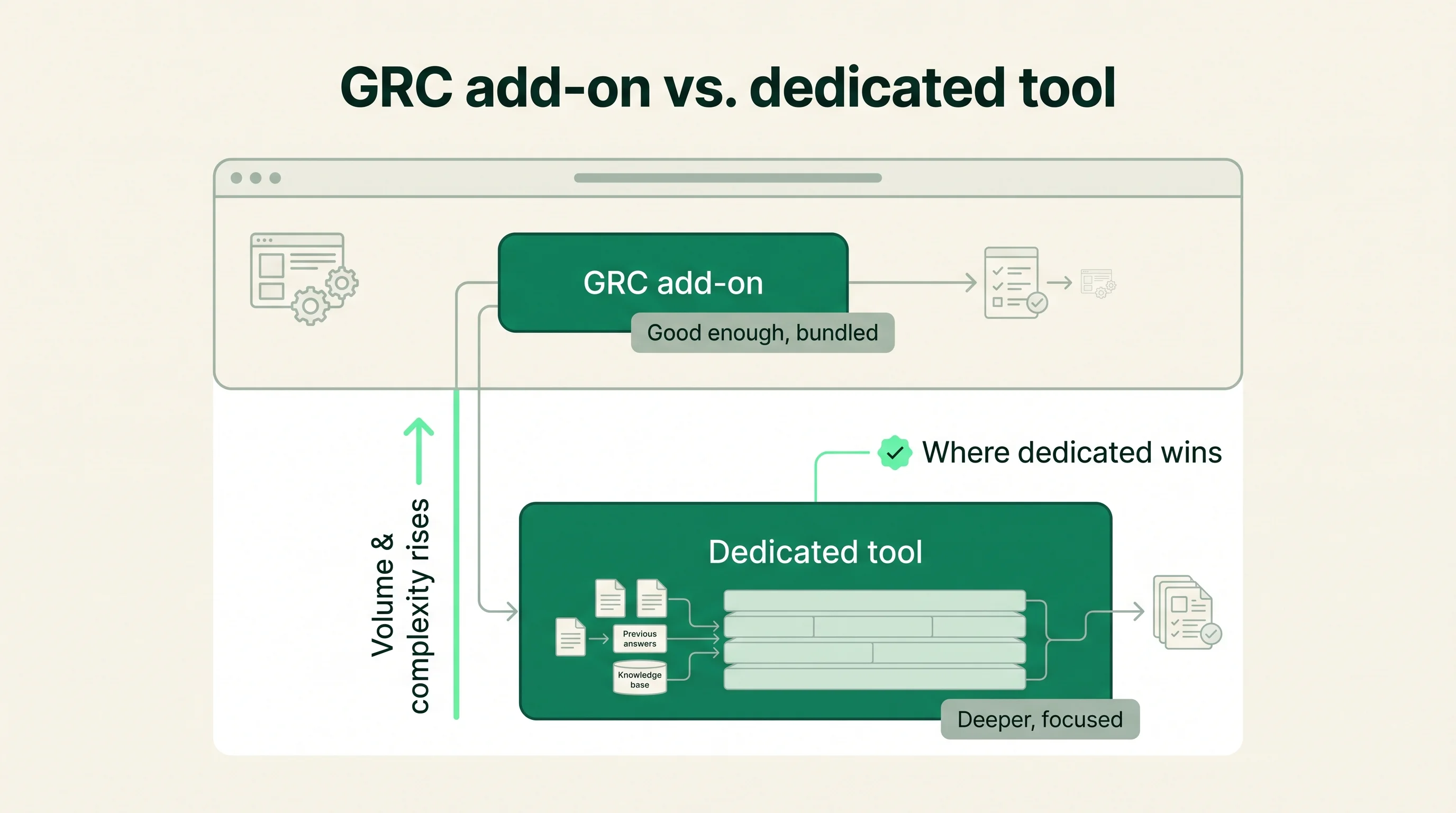
Quick answer: GRC add-on vs. dedicated security questionnaire automation tool
A GRC platform's questionnaire add-on fits teams with light to moderate questionnaire volume that want to answer inside the compliance tool they already run. A dedicated security questionnaire automation tool fits teams with heavy volume, varied formats, or a sales engineering function that owns the response workflow and needs depth the bundle does not provide.
Neither is universally better. The decision comes down to three things: how many questionnaires you handle, how varied their formats are, and who owns the work day to day.
- If volume is low and formats are simple, the GRC add-on usually covers it.
- If volume is heavy or formats are messy, a dedicated tool usually wins.
- If the work spans security, GRC, and sales engineering, ownership often decides it.
This is a good-enough-bundled versus best-of-breed tradeoff, not a contest between rival products. The GRC add-on reuses the evidence and controls you already maintain. The dedicated tool does one job and goes deeper on it. For the foundational definition, see our explainer on what security questionnaire automation is, then use the at-a-glance table below to map each option to your team.
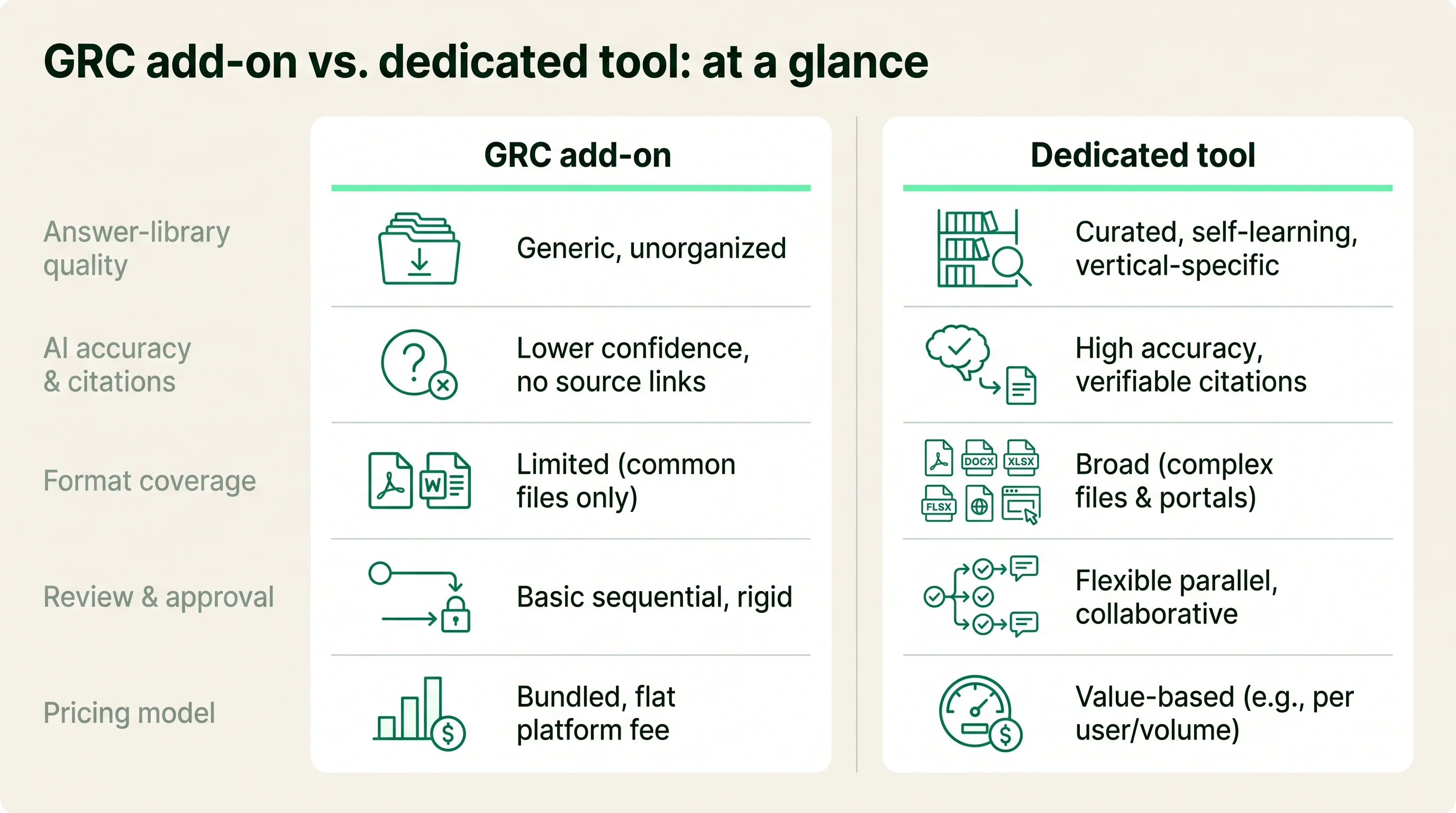
GRC add-on vs. dedicated tool: at a glance
The clearest way to separate the two is by what they are built for: the GRC add-on is a feature inside a compliance platform, while the dedicated tool is a standalone product built only to answer questionnaires. The table below compares them across the criteria buyers shortlist on. Capability descriptions reflect how vendors position each option and are vendor-reported; GRC modules evolve quickly, so verify current scope during procurement.
| Criteria | GRC add-on | Dedicated tool |
|---|---|---|
| Answer-library quality | Reuses compliance data; depth varies by module (verify current scope) | Purpose-built library with versioning and curation |
| AI accuracy and citations | AI drafting tied to your evidence (vendor-reported) | AI drafting with source citations tuned for questionnaires (vendor-reported) |
| Format coverage | Common frameworks; custom forms and portals vary | SOC 2, ISO 27001, CAIQ, SIG, custom forms, portals |
| Review and approval | Inherits the platform's workflow controls | Granular review, assignment, and approval for high volume |
| Integrations | Native to the GRC platform's own data | CRM, knowledge base, document storage, portals, API |
| Pricing model | Bundled or add-on tier on the platform | Standalone per-seat, tiered, or per-questionnaire |
| Support | Shared with the broader GRC product | Focused on response workflows |
Read this as a spectrum, not a scorecard. The add-on trades depth for consolidation: fewer tools, one contract, and answers drawn from compliance data you already keep. The dedicated tool trades that consolidation for depth: a richer answer library, wider format coverage, and controls built for throughput. The next two sections explain where each advantage shows up in the actual work. For how buyers weigh these criteria, see how enterprise buyers evaluate security questionnaire automation tools.
Where the GRC add-on is stronger
The GRC add-on is stronger when your security facts already live in the compliance platform and your questionnaire volume does not justify a second tool. The advantage is consolidation: the evidence, controls, and questionnaire response sit in one place, with one vendor and one contract. Vanta, Drata, and Secureframe each position a questionnaire module inside their broader compliance product.
The concrete strengths cluster around integration and cost:
- Answers can draw on the SOC 2 and ISO 27001 evidence you already maintain in the platform, so the source of truth and the response live together (vendor-reported).
- There is no second procurement cycle, no separate seat count, and no extra integration to build.
- Compliance teams already in the tool answer questionnaires without context-switching to a new product.
- Trust center, evidence collection, and questionnaire response share one data model, which reduces the work of keeping answers current as controls change (vendor-reported).
- For a small or early team, the add-on delivers questionnaire automation without standing up a separate response function.
The tradeoff is depth. Questionnaire answering is a secondary capability for a GRC platform, so the answer library, format coverage, and review controls may be thinner than a dedicated product, and module scope changes often. Confirm current capabilities rather than assuming parity. For a team with light volume and simple formats, the consolidation usually outweighs the missing depth. To see how the broader categories differ, read our comparison of security questionnaire automation versus GRC software.
Where the dedicated tool is stronger
The dedicated security questionnaire automation tool is stronger when questionnaire volume is heavy, formats are varied, or the response workflow needs depth a bundled module does not reach. The product exists to do one job well, so its advantages cluster around answer-library quality, format coverage, AI accuracy, and review controls built for scale. Conveyor, Loopio, Responsive, and SecurityPal each position themselves as standalone response tools.
The concrete strengths show up when answering is the core problem:
- A purpose-built answer library handles versioning, curation, and conflicting answers, which matters once the library grows past a few hundred questions (vendor-reported).
- Format coverage spans custom spreadsheets, CAIQ, SIG, and buyer portals, which is where internal teams lose the most hours.
- AI drafting is tuned for questionnaire phrasing and returns source citations, so a reviewer can verify each answer instead of trusting it blind (vendor-reported).
- Review, assignment, and approval controls are designed for high throughput, so security, legal, and sales engineering can divide the work cleanly.
- Integrations with CRM, knowledge bases, and document storage fit a sales-led response motion where deals depend on turnaround.
The tradeoff is a second tool and a second contract, plus the work of keeping its library in sync with your compliance evidence. For a team where questionnaire response is a recurring bottleneck, that depth usually justifies the standalone product. For how AI accuracy factors into this, see whether AI can safely answer security questionnaires and the AI security questionnaire tools category.
Pricing and implementation differences
The two options price and roll out differently because one is a feature you may already own and the other is a product you buy on its own. A GRC add-on is usually bundled into the platform or sold as a tier on top of it, so the marginal cost is lower and the rollout is shorter. A dedicated tool is a standalone purchase with its own pricing model and its own implementation. Specific figures are not published consistently and modules change, so verify current pricing and scope directly with each vendor.
The pricing models differ in shape:
- GRC add-on: bundled into the platform subscription or priced as an add-on tier, so questionnaire automation rides on a contract you already hold.
- Dedicated tool: priced standalone as per-seat, tiered by usage, or per-questionnaire, which makes cost scale with volume and team size.
- A managed or human-in-the-loop service prices for the answering work itself, not just the software.
Implementation effort differs in much the same way:
- The add-on inherits the data you already loaded into the GRC platform, so setup is mostly enabling the module and confirming the answer source.
- The dedicated tool needs its answer library built or imported, integrations connected, and review roles assigned before it pays off.
- Either way, the real work is curating an accurate answer library, which is the foundation both approaches depend on.
The practical read: the add-on wins on lower marginal cost and faster setup, while the dedicated tool asks for more investment upfront in exchange for depth. For the full breakdown of how vendors price this category, see our explainer on security questionnaire automation pricing models.
Which one should you choose?
Choose by volume, format complexity, and who owns the work, not by which product sounds more capable. The volume and complexity threshold is the deciding line: below it, the GRC add-on's consolidation usually wins, and above it, the dedicated tool's depth usually wins.
Use the GRC add-on when:
- Questionnaire volume is light to moderate and formats are mostly standard frameworks.
- Your security facts already live in Vanta, Drata, or Secureframe and you want one source of truth.
- A compliance or GRC team owns the work and you want to avoid a second contract.
- Cost and tool consolidation matter more than answer-library depth or portal coverage.
- You are early enough that a dedicated response function is not yet justified.
Buy a dedicated tool when:
- Questionnaire volume is heavy or spiky and turnaround affects sales cycles.
- Buyers send varied formats, custom spreadsheets, and portals that a module struggles with.
- Sales engineering or a dedicated response owner runs the workflow and needs throughput controls.
- Answer-library depth, versioning, and AI citations are central to accuracy at your scale.
- You have outgrown the add-on and the bundle's limits now slow deals down.
The cleanest signal is the trend in your own volume. If questionnaires arrive occasionally and look familiar, stay in the add-on. If they arrive constantly, in every format, and a missed deadline costs a deal, the dedicated tool earns its second contract. To pressure-test the decision, read how enterprise buyers evaluate security questionnaire automation tools and browse the security questionnaire automation category hub.
How this article was reviewed
Sources reviewed
- Vanta, Drata, and Secureframe product pages and documentation (questionnaire module scope)vendor-reported; GRC modules evolve, verify current scope and pricing directly
- Conveyor, Loopio, Responsive, and SecurityPal product pages and documentation (dedicated tool capabilities)vendor-reported; verify current capabilities, format coverage, and pricing directly
- AICPA (SOC 2), ISO/IEC 27001, CSA (CAIQ), Shared Assessments (SIG), NISTstandards bodies referenced for questionnaire frameworks; not vendor claims
FAQ
Is a GRC add-on or a dedicated tool better for security questionnaire automation?
Neither is better in the abstract; it depends on fit. A GRC add-on is the better choice for light to moderate volume when your security data already lives in the compliance platform and you want one tool. A dedicated tool is better for heavy volume, varied formats, or a sales-led workflow that needs answer-library depth and AI accuracy. Decide by your questionnaire volume, format mix, and who owns the work.
What are the most common mistakes when choosing between a GRC add-on and a dedicated tool?
The most common mistake is assuming a bundled add-on matches a dedicated tool's depth, since module scope changes and is often thinner on format coverage and answer-library controls. The second is buying a standalone tool before volume justifies it, which adds a contract and an answer library to maintain for little gain. Verify current module scope against your real format mix before deciding, and recheck it during renewal.
How do these options compare to answering questionnaires manually or with spreadsheets?
Both options beat manual spreadsheet work once volume is recurring, because each reuses approved answers instead of rewriting them every time. The GRC add-on adds the least friction if you already run the platform, while a dedicated tool adds the most capability for high volume. Spreadsheets stay defensible only at very low volume where the overhead of any tool is not yet worth it.
How do you get leadership buy-in for a dedicated questionnaire tool over the GRC add-on you already pay for?
Tie the request to deal velocity and headcount, not to features. Show how questionnaire turnaround affects sales cycles, how much time the current add-on leaves on manual reformatting, and where format gaps cause missed deadlines. Frame the dedicated tool as capacity that protects revenue, and propose verifying the add-on's current limits first so the comparison is concrete.
What is the typical implementation timeline for each option?
A GRC add-on is usually faster to enable because it reuses the evidence and controls already in the platform, so setup is mostly turning on the module and confirming the answer source. A dedicated tool takes longer because its answer library must be built or imported, integrations connected, and review roles assigned. For both, the real timeline driver is curating an accurate answer library, which is the work that determines whether either approach pays off.