What Is Cite-or-Abstain AI in Security Questionnaire Automation?
Cite-or-abstain AI is a grounding pattern where the model must either cite an approved answer for its response or flag the question for a human, instead of guessing. It trades a higher human-review rate for far fewer wrong security claims.
What is cite-or-abstain AI in security questionnaire automation?
Cite-or-abstain AI is a design pattern for security questionnaire automation in which the model is allowed to answer a question only if it can cite an approved source from the answer library, and is required to abstain when it cannot. Abstaining means the question is flagged for a human instead of answered with a guess. The pattern exists to control hallucination, where a language model produces a fluent but unsupported claim.
In a security review, an unsupported claim is not a harmless mistake. Each answer is a representation the company is making to a buyer, sometimes a contractual one. A model that confidently states the wrong data-retention period or invents a certification creates real exposure.
Cite-or-abstain replaces "always answer" with a stricter rule:
- Answer only when a stored approved answer or piece of evidence supports the response
- Attach a citation to that source so a reviewer can verify it
- Abstain and escalate when no source is a strong enough match
The people who own this control are the same teams that own the answers. GRC (governance, risk, and compliance) and security own the approved library and the evidence behind it. A sales engineer or CISO cares because the pattern determines how many answers go out clean versus how many land back in the review queue. Where a formal AI governance function exists, it sets the policy for when the model is allowed to speak at all. The same accuracy stakes apply across all of security questionnaire automation, but cite-or-abstain is the specific mechanism that decides whether AI output is trustworthy enough to send.
How does cite-or-abstain AI work?
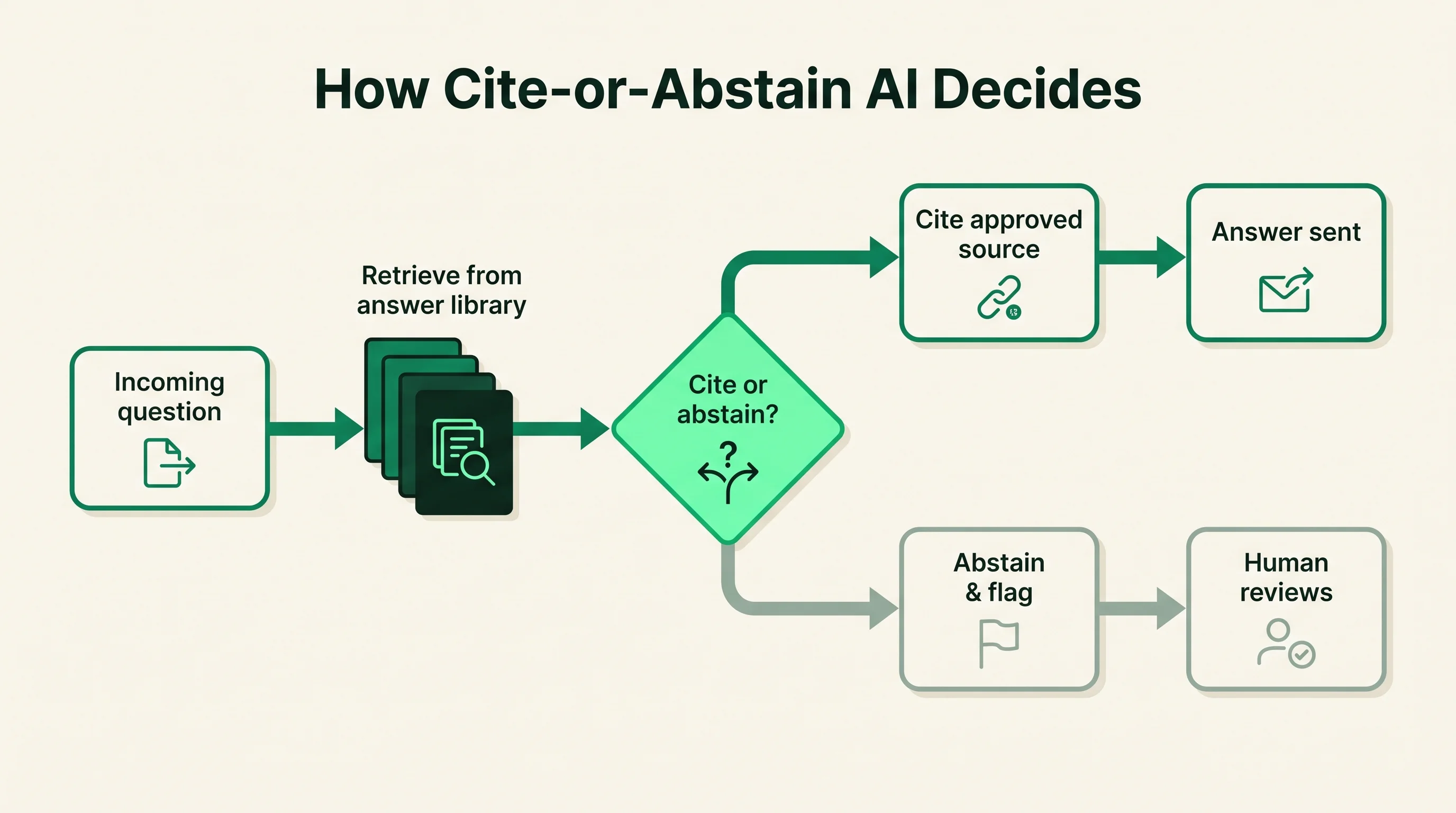
Cite-or-abstain AI works through three stages: retrieval, grounding, and a confidence threshold that decides between answering with a citation and abstaining. The first two find and check supporting evidence; the third sets the bar for how strong that support must be.
The flow runs in order:
- Retrieve candidate approved answers and evidence from the answer library that look relevant to the incoming question
- Ground the draft by checking whether a retrieved source actually supports the specific claim, not just shares keywords
- Score confidence in that match against a threshold
- Cite the source and draft the answer when confidence clears the threshold
- Abstain and route to a human reviewer when it does not
Retrieval is usually semantic, comparing the meaning of the question to the meaning of stored answers, so paraphrased questions still match the right approved content. Grounding is the step that separates this pattern from ordinary AI drafting. The model is constrained to the retrieved sources rather than its general training, so it cannot fill a gap with a plausible invention.
The confidence threshold is the tuning knob. Set it high and the tool abstains often, sending more questions to humans but rarely citing a weak source. Set it low and the tool answers more on its own, at the cost of occasional shaky citations.
| Stage | What it does | What it produces |
|---|---|---|
| Retrieval | Finds candidate approved answers and evidence | A shortlist of possible sources |
| Grounding | Checks whether a source supports the claim | A supported draft or no match |
| Threshold | Compares match strength to a set bar | A cited answer or an abstention |
This machinery sits on top of the answer library, the trust center evidence, and the SOC 2 or ISO 27001 artifacts a team already maintains. The pattern only works when those sources are current. Cite-or-abstain controls how the AI uses the library; it does not fix a stale one.
Why cite-or-abstain AI matters
Cite-or-abstain AI matters because the alternative, a model that always answers, produces confident wrong claims that a busy reviewer can miss. In a security questionnaire, a missed wrong answer is a misrepresentation to a customer, and the cost of catching it late is far higher than the cost of reviewing an abstention early.
The failure it prevents is specific. An ungrounded model asked whether data is encrypted with a particular key length will often produce a precise, plausible, and unverified figure. It reads like every other answer, so a reviewer skimming a long spreadsheet has no signal that this one is fabricated. Cite-or-abstain removes that trap by forcing a citation or an explicit flag.
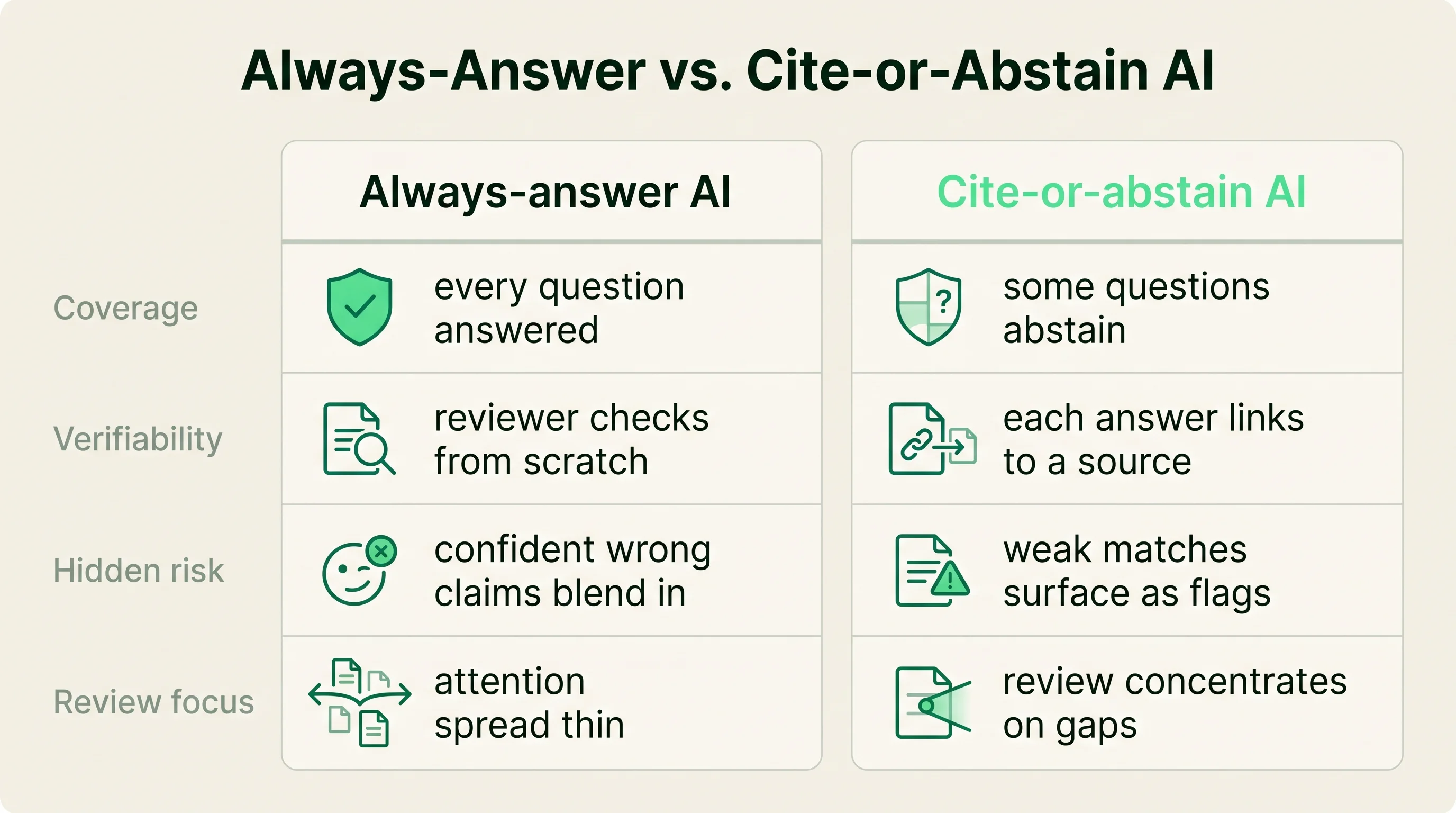
The practical contrast is between a tool that fills every cell and a tool that tells you which cells it could not stand behind.
| Dimension | Always-answer AI | Cite-or-abstain AI |
|---|---|---|
| Coverage | Every question gets a draft | Some questions abstain |
| Verifiability | Reviewer must check from scratch | Each answer links to a source |
| Hidden risk | Confident wrong claims blend in | Weak matches surface as flags |
| Review focus | Spread thin across all answers | Concentrated on flagged gaps |
The payoff is not speed for its own sake. It is putting human attention where the uncertainty actually is. Reviewers stop re-checking well-grounded answers and spend their time on the questions the model honestly could not support. The deeper question of whether AI can safely answer security questionnaires turns largely on whether the tool implements a discipline like this one.
Where cite-or-abstain AI sits next to adjacent surfaces
Cite-or-abstain AI is an accuracy control inside questionnaire automation, not a product category of its own. It is easy to confuse with the surfaces around it, because trust centers, RFP response, and third-party risk programs all touch security answers. The difference is scope and job.
The pattern governs how an AI drafts inbound questionnaire answers. A trust center is a place to publish standing answers and evidence for buyers to self-serve. RFP response automation handles a broader document type where not every claim is a security representation. Third-party risk management is the buyer's side of the same exchange, assessing vendors rather than answering for one.
| Surface | Primary job | Where cite-or-abstain fits |
|---|---|---|
| Questionnaire automation | Draft inbound security answers | The grounding rule on the AI itself |
| Trust center | Publish standing answers and evidence | Feeds approved sources the model can cite |
| RFP response | Draft sales and proposal documents | Same pattern, broader and less security-bound |
| TPRM | Assess vendors as a buyer | Consumes the answers, does not produce them |
The pattern depends on the others rather than competing with them. A well-maintained trust center and a curated answer library are the sources cite-or-abstain draws from. Tools across the third-party risk management software market increasingly advertise grounding and citation, so the term shows up far from its origin. The useful test is always the same: when this tool answers, can you click through to the source, and when it cannot, does it say so.
Benefits and tradeoffs of cite-or-abstain AI
The benefit of cite-or-abstain AI is trustworthy automation: answers a reviewer can verify in seconds and a defensible record of which claims were grounded. The tradeoff is a higher abstain rate, which means more questions land in the human queue. Both are real, and the balance depends on how much your answers are worth being right.
The benefits are concentrated where accuracy is the point:
- Every AI answer carries a citation a reviewer can check against the source
- Hallucinated claims are blocked at the source rather than caught downstream
- Human review focuses on flagged gaps instead of every cell
- The citation trail supports audit and AI governance requirements
The tradeoffs are just as concrete:
- A higher abstain rate raises the human-review load, at least early on
- A threshold set too high makes the tool feel slow and over-cautious
- A thin or stale answer library forces frequent abstentions, since there is nothing valid to cite
- Citations are only as good as the sources, so weak evidence still passes review weakly
The pattern is not worth heavy investment for a team that sends a handful of questionnaires a year and reviews each one carefully by hand. The overhead of tuning thresholds and maintaining a citable library outweighs the gain at low volume. It earns its keep when questionnaire volume is high, answers are reused often, and a wrong claim carries contractual or reputational cost. For most mid-market and enterprise B2B SaaS teams, that describes the workload exactly.
How to evaluate or implement cite-or-abstain AI
Evaluate cite-or-abstain AI on three things: whether every AI answer carries a verifiable citation, whether the tool exposes its confidence and abstain behavior, and whether abstentions route to the right human cleanly. A tool that drafts fluent answers but cannot show its sources has not implemented the pattern, whatever the marketing says.
Run the evaluation against your own questions, not a vendor demo set. Feed real questionnaires, including ones with gaps in your library, and watch what the tool does when it has no good source.
| Criterion | What good looks like | Why it matters |
|---|---|---|
| Citation on every answer | Each AI draft links to a specific approved answer or evidence file | A reviewer can verify without rebuilding the answer |
| Visible confidence | The tool shows a score or a clear flag, not just a draft | You can see where the model is unsure |
| Honest abstention | Unsupported questions are flagged, not filled with a guess | This is the entire point of the pattern |
| Routing | Abstentions go to the right reviewer or subject-matter expert | Flags only help if someone owns them |
| Tunable threshold | You can adjust how cautious the model is | Different teams accept different risk |
Real vendors implement and describe these capabilities differently. Conveyor, Loopio, Responsive, Vanta, SafeBase, and Whistic all position around AI-drafted answers, and several describe source-aware or citation-backed generation; treat each capability claim as vendor-reported until you test it. Tools such as HyperComply, SecurityPal, and Drata sit in the same market with their own approaches. The differentiator is rarely whether a tool uses AI; it is whether the AI will admit when it does not know. Compare options through the AI security questionnaire tools category, review a specific implementation like Conveyor, and ground the basics with our explainer on what security questionnaire automation is before you shortlist.
How this article was reviewed
Sources reviewed
- AICPA SOC 2Trust services criteria referenced as backing evidence for security claims.
- ISO/IEC 27001Information security management standard cited as a grounding artifact.
- Cloud Security Alliance CAIQConsensus Assessments Initiative Questionnaire, a standardized questionnaire format.
- Shared Assessments SIGStandardized Information Gathering questionnaire format.
- NISTReferenced as a control and risk-framework reference point.
- Conveyor, Vanta, SafeBase, Loopio, Responsive, HyperComply, SecurityPal, Whistic, DrataVendor product positioning on AI-drafted and source-aware answers; treated as vendor-reported, not independently verified.
FAQ
What is cite-or-abstain AI in security questionnaire automation?
Cite-or-abstain AI is a pattern where the model must cite an approved source from the answer library to support its response, or abstain and flag the question for a human. It exists to stop the model from generating confident but unsupported security claims. The result is that every AI answer is either backed by a verifiable source or explicitly marked as something a person needs to handle.
What are the most common mistakes when implementing cite-or-abstain AI?
The two biggest mistakes are pointing the model at a thin or stale answer library and ignoring the abstentions it produces. A model with nothing valid to cite will abstain constantly, which gets blamed on the tool when the real problem is the library. The other failure is treating flagged questions as noise instead of routing them to the right reviewer, which defeats the purpose of the pattern.
How does cite-or-abstain AI compare to answering questionnaires manually or with spreadsheets?
Manual and spreadsheet work makes a human responsible for finding and verifying every answer, which is accurate but slow and hard to scale. Cite-or-abstain AI drafts the answers it can support with a citation and hands back only the ones it cannot, so reviewers verify rather than research. It is faster than manual work without the silent-error risk of an AI tool that answers everything regardless of evidence.
How do you get leadership buy-in for investing in cite-or-abstain AI?
Frame it as risk control, not just speed. The argument leadership responds to is that a confident wrong answer in a security questionnaire is a misrepresentation to a customer with contractual exposure, and this pattern prevents that class of error. Pair that with the operational gain that reviewers spend time only on flagged gaps, and quantify it against your current questionnaire volume and turnaround time.
What is the typical implementation timeline for cite-or-abstain AI?
The AI configuration is fast; building the citable answer library behind it is the work. Teams with an existing maintained library of approved answers and linked evidence can often configure and validate the grounding behavior in a few weeks. Teams starting from scattered past responses should expect a longer effort, since the pattern is only as good as the sources it can cite, and curating those sources is the real timeline driver.