

Managed Service vs. Software-Only Security Questionnaire Automation
Managed-service automation means a vendor's team answers your security questionnaires for you. Software-only automation means you license the tool and your own team operates it. The right model depends on your volume, your team size, and how much control you want over the answer library.
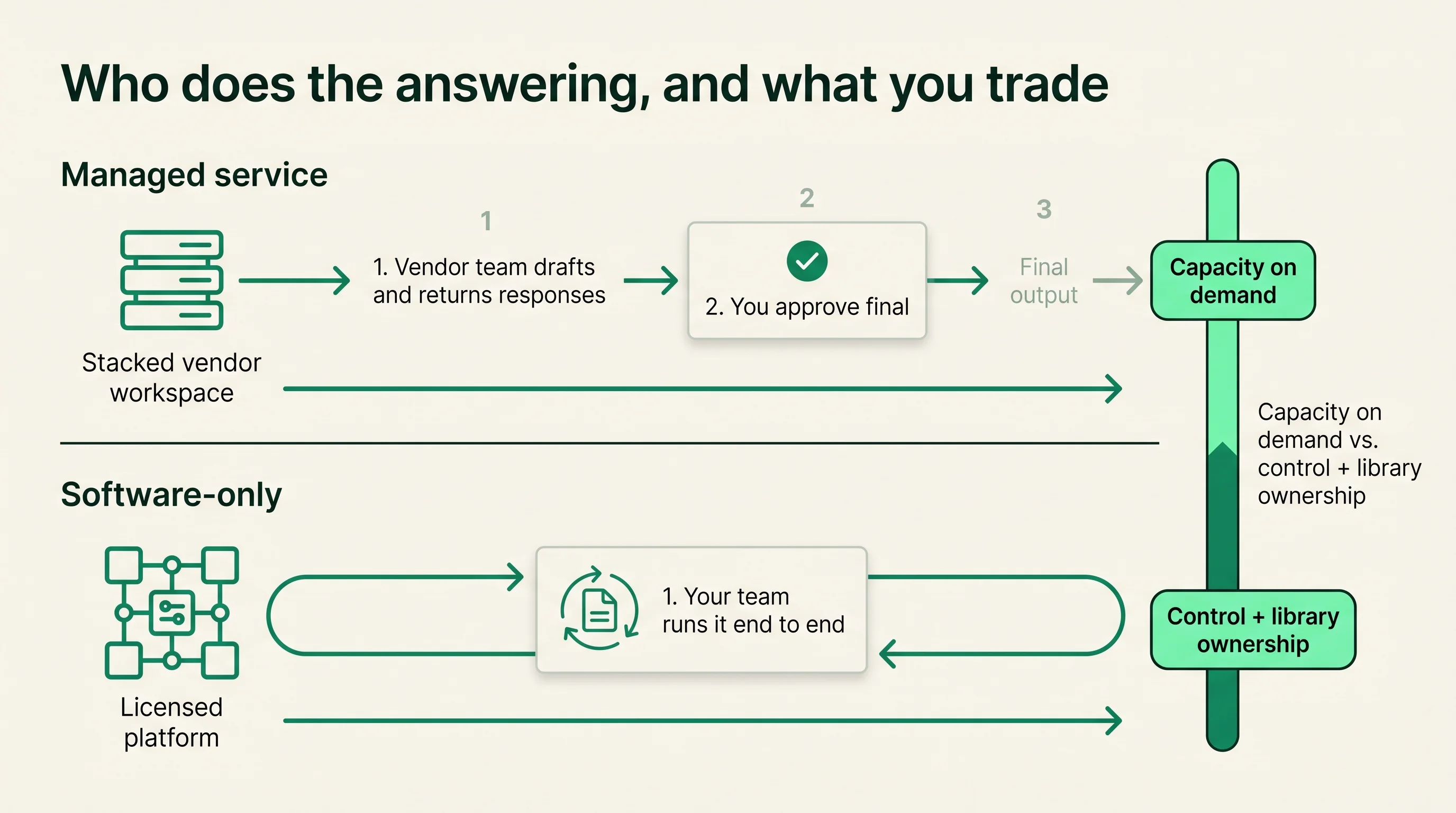
Quick answer: managed service vs. software-only security questionnaire automation
Managed-service security questionnaire automation means a vendor's team does the answering for you, while software-only means you license the tool and your own team operates it. Managed service fits teams with heavy or unpredictable questionnaire volume and too little headcount to staff it. Software-only fits teams that have an owner for the work and want direct control over the answer library, the review workflow, and the buyer relationship.
Neither model is universally better. The choice depends on three things: how much questionnaire volume you face, how much of it is predictable, and whether you have someone to own the tool day to day.
- If volume is heavy or spiky and headcount is thin, a managed service usually fits.
- If you have a dedicated owner and want control, software-only usually fits.
- If volume is steady but growing, the decision turns on whether you would rather buy capacity or build it.
This comparison treats the two as delivery models for the same job, not as rival products. The underlying work, drafting accurate answers to SOC 2, ISO 27001, CAIQ, and SIG questions from an answer library, is the same. What differs is who performs it. For the foundational definition, see our explainer on what security questionnaire automation is, then use the at-a-glance table below to map each model to your team.
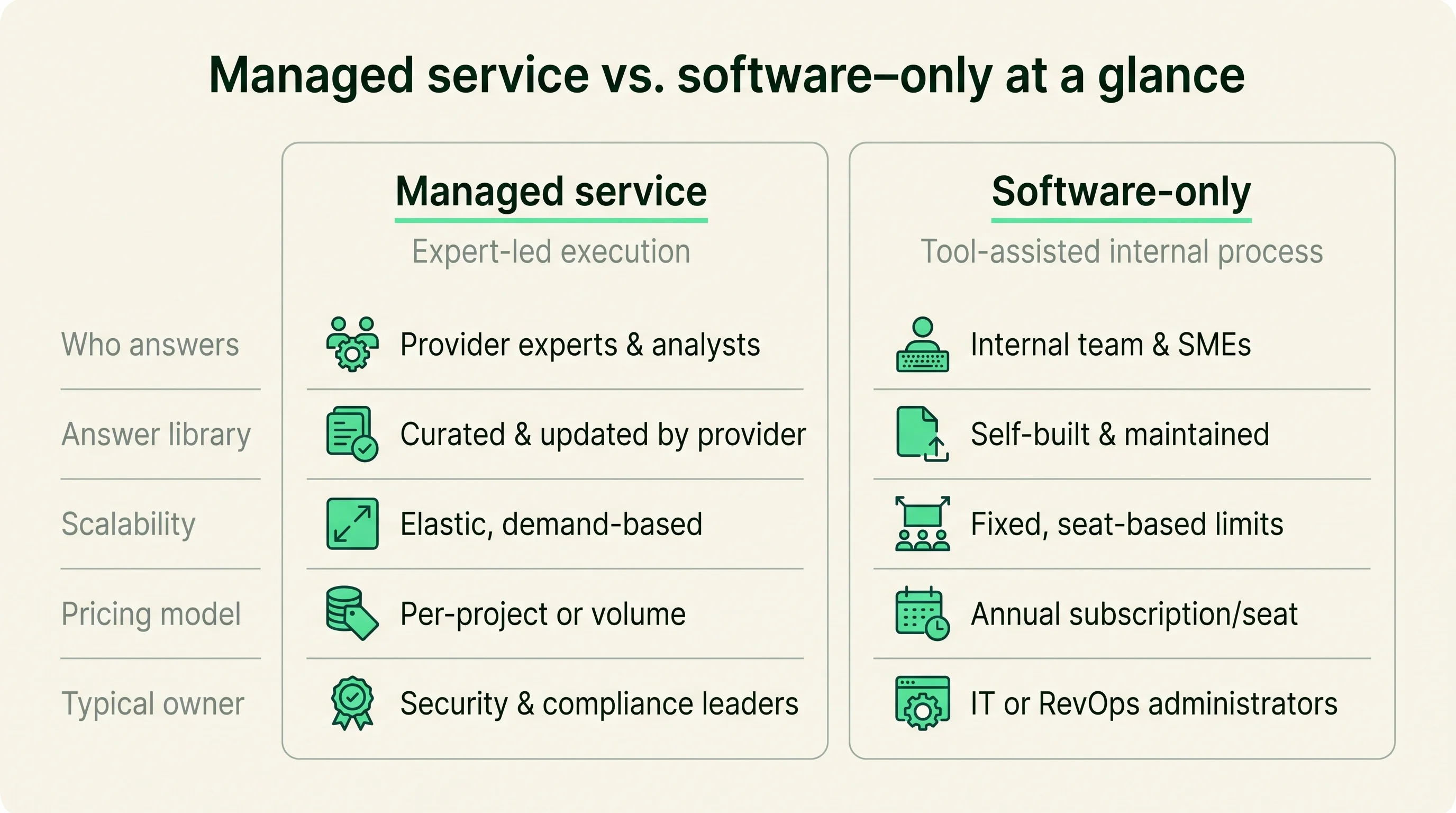
Managed service vs. software-only security questionnaire automation: at a glance
The clearest way to separate the two is by who operates the workflow: a managed service supplies the people, while software-only supplies the platform and you supply the people. The table below compares them across the criteria buyers shortlist on. Capability descriptions reflect how vendors position each model and should be confirmed against your own requirements.
| Criteria | Managed service | Software-only |
|---|---|---|
| Who answers | Vendor team drafts and returns responses | Your GRC, sales engineering, or security team |
| Answer library | Vendor builds and maintains it (confirm ownership) | You own and control it directly |
| AI accuracy and citations | AI plus human review by the vendor (vendor-reported) | AI drafting that your reviewers verify (vendor-reported) |
| Format coverage | SOC 2, ISO 27001, CAIQ, SIG, custom forms, portals | SOC 2, ISO 27001, CAIQ, SIG, custom forms, portals |
| Review and approval | Vendor reviews first, you approve final | Your team reviews and approves end to end |
| Scalability | Vendor absorbs volume spikes without you hiring | Scales with your seats and your headcount |
| Pricing model | Per-questionnaire or retainer for the service | Per-seat or tiered platform license |
| Typical owner | Light internal owner who approves output | Dedicated internal operator runs the tool |
Read this table as a spectrum, not a scorecard. Managed service trades control and direct ownership for capacity you do not have to staff. Software-only trades that off-loaded capacity for control, speed of internal iteration, and an answer library you keep. The next two sections explain where each advantage shows up in the actual work.
Where managed service is stronger
Managed-service automation is stronger when questionnaire volume outpaces the headcount you can dedicate to it. The model exists to add answering capacity without you hiring, so its advantages cluster around throughput, surge handling, and freeing your team for other work. SecurityPal positions itself around this human-in-the-loop service, pairing AI drafting with a vendor team that reviews and returns answers.
The concrete strengths show up when volume is the problem:
- A vendor team absorbs questionnaire surges, so a busy quarter does not stall sales while you recruit (vendor-reported).
- Your internal owner approves finished output instead of drafting from scratch, which lowers the headcount the workflow needs.
- Human review by the vendor adds a quality check on top of AI drafting, which can catch errors before a CISO or buyer sees them (vendor-reported).
- A small or early team gets enterprise-grade response coverage without standing up a dedicated GRC function.
- The vendor often handles format wrangling across portals and custom forms, which is where internal teams lose hours.
The tradeoff is control and proximity to the facts. A third party sits between your security posture and the buyer, so accuracy depends on how well the vendor understands your environment, and you should confirm who owns the answer library that gets built. For a team where volume is heavy and predictable enough to justify the spend but headcount is not, that tradeoff is usually worth it. For how this interacts with AI accuracy, see our analysis of whether AI can safely answer security questionnaires.
Where software-only security questionnaire automation is stronger
Software-only automation is stronger when you have someone to own the tool and you want direct control over how questions get answered. Licensing the platform keeps the work in-house, so its advantages cluster around control, a tight feedback loop, and outright ownership of the answer library. Conveyor, Loopio, and Responsive position themselves as self-serve platforms that your own team operates.
The concrete strengths show up where control and iteration matter:
- Your team owns the answer library outright, so approved answers, evidence links, and framing stay in your system of record.
- A reviewer who knows your environment edits answers directly, which shortens the loop between a wrong answer and a fixed one.
- Sensitive security detail never leaves your team for a third party, which can simplify data-handling and confidentiality review.
- A trust center lets buyers self-serve standard documentation, which can deflect questionnaires before they reach the queue.
- The per-seat or tiered cost is predictable, so a steady workload has a steady, plannable bill.
The tradeoff is staffing. The platform does not answer questionnaires on its own; someone has to operate it, curate the library, and run review. A team without a clear owner can buy the tool and still fall behind. For a staffed GRC team or sales engineering function that wants control and a clean feedback loop, that ownership is the point. To see how buyers weigh these criteria, read our guide on how enterprise buyers evaluate security questionnaire automation tools.
Pricing and implementation differences
Pricing differs mainly in what you are buying: a managed service charges for delivered capacity, while software-only charges for access to the platform. This shapes both the model you are quoted and the rollout work required to get value. No specific figures are universal, so model each quote against your own volume rather than comparing list prices.
The pricing models and rollout effort break down along delivery lines:
| Dimension | Managed service | Software-only |
|---|---|---|
| Common pricing model | Per-questionnaire or retainer for the service | Per-seat or tiered platform license |
| What you pay for | Vendor capacity to answer your questionnaires | Access to a tool your team operates |
| Implementation scope | Onboard the vendor to your security posture and evidence | Build your library, connect evidence, train your team |
| Rollout owner | Light internal owner manages the vendor relationship | Dedicated internal operator owns setup and adoption |
| Time-to-value driver | How fast the vendor learns your environment | Quality of your answer library and team adoption |
The implementation difference is real. A managed-service rollout front-loads onboarding the vendor: they need access to your policies, evidence, and prior answers before their output is reliable, and quality climbs as they learn your environment. A software-only rollout front-loads internal work: your team curates the library, links evidence, and learns the tool, after which the cost is mostly a flat license. Treat any pricing you see, in either model, as vendor-reported and a starting point for a quote against your real annual volume. For more on how these structures are packaged, see our breakdown of security questionnaire automation pricing models.
Which one should you choose?
Choose by weighing questionnaire volume against the headcount you can dedicate to it. If volume is heavy or unpredictable and you cannot staff it, a managed service buys you capacity. If you have an owner and want control, software-only keeps the work and the library in-house. The deciding factor is rarely a single feature; it is the gap between your inbound volume and your available people.
Choose managed service when:
- Questionnaire volume is heavy or spiky and you lack the headcount to absorb it.
- A busy sales quarter cannot wait for you to recruit and train a GRC owner.
- You want a vendor team and human review handling drafts so your staff only approve final answers.
- You are an early or small team that needs enterprise-grade coverage without a dedicated security function.
- You are comfortable with a third party between your security facts and the buyer, and you have confirmed who owns the answer library.
Choose software-only security questionnaire automation when:
- You have a dedicated owner in GRC, sales engineering, or security to run the tool.
- You want full control of the answer library and want to keep it in your system of record.
- A tight feedback loop matters, so reviewers who know your environment edit answers directly.
- Sensitive security detail should stay in-house rather than going to a vendor team.
- Volume is steady enough that a predictable per-seat or tiered license is easy to plan around.
Many teams land in the middle, with real volume and only partial staffing. In that case, weigh whether off-loaded capacity or in-house control removes more friction from your specific workflow, and note that some vendors offer both models so you are not locked to one forever. To go deeper on evaluation, start from our buyer-evaluation guide on how enterprise buyers evaluate security questionnaire automation tools, then browse the security questionnaire automation category hub to build a shortlist.
How this article was reviewed
Sources reviewed
- AICPA - SOC 2Primary source for what a SOC 2 report attests, a control framework both delivery models answer against.
- ISO/IEC 27001Primary source for the information security management standard referenced in security answer libraries.
- Cloud Security Alliance - CAIQPrimary source for the CAIQ format, one of the standardized security questionnaire types referenced in format coverage.
- Shared Assessments - SIGPrimary source for the SIG questionnaire format referenced in format coverage.
- Vendor product and positioning documentation (SecurityPal, Conveyor, Loopio, Responsive)Delivery-model positioning and capability claims are vendor-reported and should be confirmed against current product scope and contract terms, not treated as independent fact.
FAQ
Is managed service or software-only security questionnaire automation better?
Neither is universally better; the right model depends on your volume and headcount. A managed service is the better fit when questionnaire volume is heavy or unpredictable and you lack the staff to answer it, because a vendor team absorbs the load. Software-only is the better fit when you have a dedicated owner and want direct control of the answer library and the review workflow. Decide by comparing your inbound volume against the people you can dedicate to the work.
What is the difference between managed-service and software-only questionnaire automation?
Managed-service automation means a vendor's team drafts and returns your security questionnaire answers, with you approving the final output. Software-only automation means you license the platform and your own team operates it end to end. The underlying job is the same; what differs is who performs the answering and who owns the answer library.
Who owns the answer library in a managed-service model?
Ownership varies by vendor, so it is one of the first things to confirm in a managed-service contract. Some vendors build and maintain the library as part of the service but treat it as your asset that you can export, while others keep it inside their own system. If retaining the library matters to you, ask explicitly whether you can export it and whether you keep access if you leave. This is less of a concern with software-only, where the library lives in your own platform.
How do the pricing models compare between managed service and software-only?
Managed services tend to price per-questionnaire or as a retainer, because you are buying delivered capacity. Software-only prices per-seat or in tiers, because you are buying access to a tool your team runs. The practical difference is what you pay for: managed service charges for the answering work itself, while software-only charges for the platform. All pricing is vendor-reported, so model each quote against your own annual volume rather than comparing list prices.
Which vendors offer managed-service versus software-only automation?
SecurityPal positions itself around a managed, human-in-the-loop service that pairs AI with a vendor team. Conveyor, Loopio, and Responsive position themselves around software-only platforms that your team operates directly. These are positioning distinctions rather than rigid boundaries; several vendors offer elements of both, so confirm the current delivery model and what is included against your own requirements during evaluation.