

Can AI Safely Answer Security Questionnaires?
AI can draft security answers, but safe use depends on source grounding, review controls, confidence handling, and clear accountability.
Can AI safely answer security questionnaires?
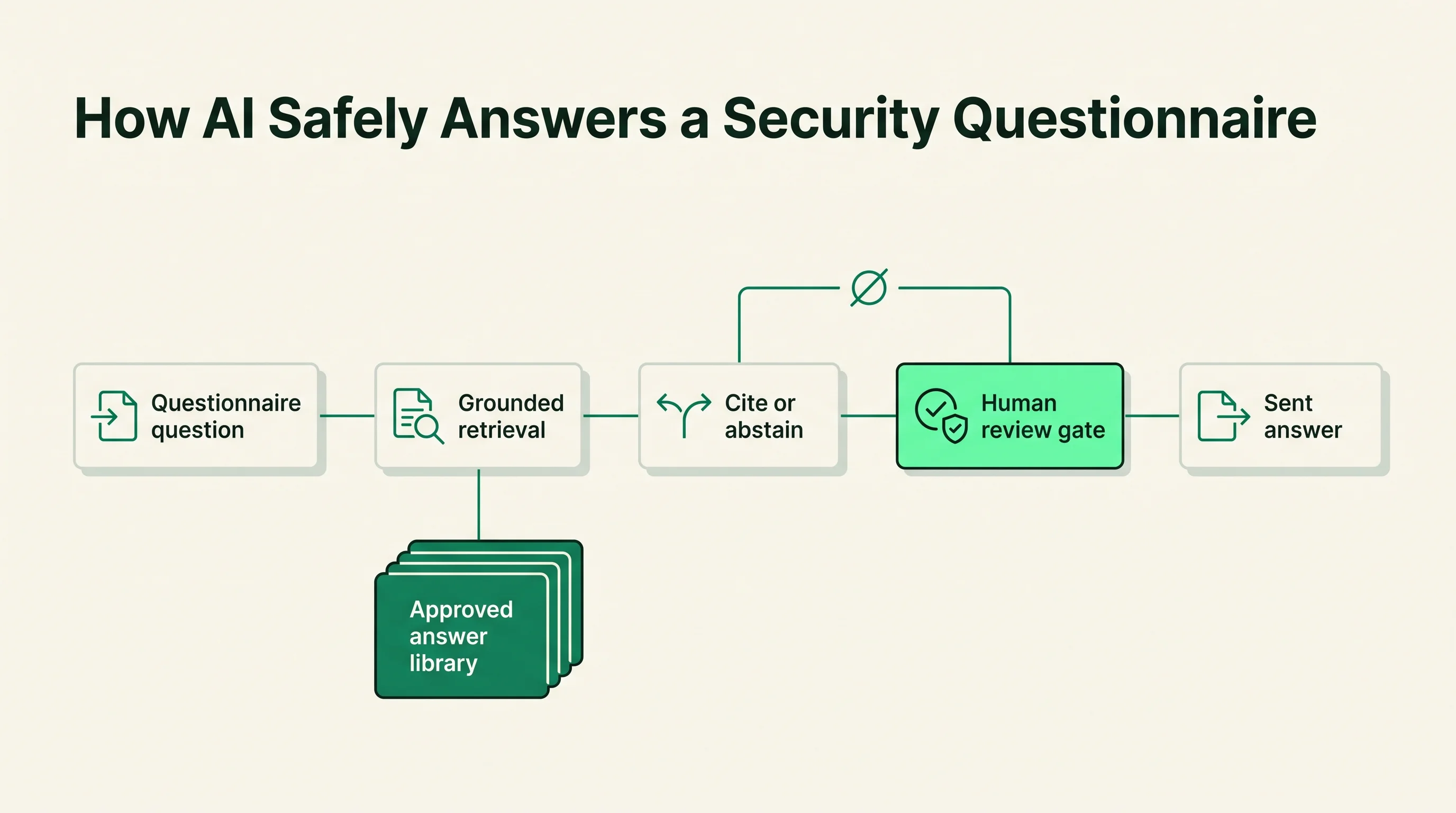
Yes, AI can safely answer security questionnaires, but only under specific controls. The safe version of this is narrow: AI drafts answers from an approved answer library, shows where each answer came from, declines to answer when it is not confident, and routes every response through a human reviewer before it reaches a buyer. Used that way, AI is a drafting and matching tool, not the final authority on what your company claims.
The unsafe version is a general-purpose model writing security claims from memory, with no source behind the words and no review before the file goes back to the buyer. That setup produces fluent, confident answers that may be wrong, and a wrong security answer is not a harmless mistake. It is a statement a buyer relies on during procurement and one a contract may later reference.
The distinction is not the model. It is the system around the model. Security questionnaire automation tools from vendors such as Conveyor, Vanta, SafeBase, Loopio, Responsive, SecurityPal, and Drata wrap AI in grounding, citations, confidence handling, and a review gate, which is what makes AI use defensible. The rest of this article defines what safe means for a security claim, explains the controls that deliver it, covers the failure modes to watch, and gives a clear verdict on when AI answering is safe and when it is not.
What does "safe" actually mean for a security answer?
Safe means an answer is true, current, correctly scoped, and attributable to a source your team stands behind. A security questionnaire answer is a representation made during a buyer's risk review, so the bar is higher than fluency. The reader is a security or procurement team deciding whether to trust your company with their data, and they act on what you write.
Four properties define a safe answer:
- True: the claim matches your actual controls, not an aspirational or generic description of them.
- Current: the answer reflects today's posture, not a control you retired or a certification that has lapsed.
- Scoped: the answer applies to the product, environment, or region the buyer is asking about, not a different part of the business.
- Attributable: the answer traces to a specific approved source, such as a policy, a SOC 2 control, or a prior reviewed response, so a human can verify it.
AI fluency is unrelated to any of these. A model can produce a confident, well-formed sentence that is false, outdated, or scoped to the wrong system, and it will read exactly as convincingly as a correct one. That is precisely why safety has to come from the controls around the model rather than from the quality of the prose. The questions that follow each map to one of these properties: grounding protects truth and attribution, confidence handling protects against guessing, and human review protects scope and currency before a buyer ever sees the answer.
How does grounding make AI answers safer?
Grounding makes AI answers safer by forcing the model to draft from your approved evidence instead of writing from general training. A grounded AI system retrieves relevant entries from an approved answer library and your policy and compliance documents, then composes a draft from those retrieved sources. The answer is anchored to material your team already reviewed and stands behind.
The contrast is with an ungrounded model, which generates an answer from patterns in its training data. That model has no access to your actual SOC 2 scope, your data residency setup, or your retired controls. It produces a plausible answer for a generic company, which may not be your company. For a security claim, plausible and correct are not the same thing, and the gap is where misrepresentation lives.
Grounding narrows the model's job from inventing an answer to finding and matching one. That is a meaningful safety improvement for three reasons:
- The source already exists and was approved, so the draft starts from evidence rather than from a guess.
- The retrieval step ties each answer to a specific document or prior response, which makes verification possible.
- The model is constrained to your material, so it is far less likely to fabricate a control or framework you do not actually have.
Grounding does not make AI infallible. If the approved answer library itself contains an error, grounding will faithfully reuse that error, which is the cascade risk covered below. But grounding moves the safety question from "did the model invent something" to "is our source library correct," and the second question is one a human team can actually audit and control.
What are cite-or-abstain and confidence thresholds?
Cite-or-abstain means the AI either shows the source behind an answer or declines to answer, rather than guessing in confident prose. It is the single most important safety behavior in AI questionnaire response, because it makes the system's uncertainty visible instead of hiding it inside fluent text.
A cite-or-abstain system does one of three things for every question:
- Answers with a citation, pointing the reviewer to the approved source the draft came from.
- Abstains, flagging the question as one it could not answer from approved material and routing it to a human.
- Drafts with a low-confidence flag, marking the answer for closer review rather than presenting it as settled.
Confidence thresholds set where those lines fall. A confidence score estimates how well a retrieved source matches the question, and a threshold decides what happens at each level. Above the threshold, the AI drafts with a citation. Below it, the AI abstains or flags rather than filling the gap with a guess. The point of a threshold is to convert quiet uncertainty into an explicit hand-off to a person.
The failure this prevents is the confident wrong answer. Without an abstain path, a model answers every question whether or not it has a basis, and the weakest answers look identical to the strongest ones. A buyer cannot tell which is which, and neither can a reviewer skimming a finished file. Cite-or-abstain surfaces the weak spots so review effort lands where it is actually needed.
The practical test for a vendor is simple: ask what the AI does when it does not know. A safe system has a real abstain behavior and shows citations by default. A system that always returns a confident answer with no source and no way to decline is not managing uncertainty; it is hiding it.
Why is human review still required?
Human review is required because AI drafts answers but does not carry accountability, and a security questionnaire is a statement your company is responsible for. The human-in-the-loop review gate is where a person checks the draft, confirms it is true, current, and correctly scoped, and approves it before it reaches a buyer. Without that gate, AI is making representations on your behalf with no one verifying them.
The review gate does work that AI cannot do reliably on its own:
- Confirms scope, since the buyer may be asking about a specific product or region the retrieved source does not cover.
- Confirms currency, since a control may have changed since the source answer was last approved.
- Catches the confident wrong answer that grounding and confidence scoring missed.
- Decides the genuinely judgment-bound questions, where the right answer depends on context the model does not have.
- Owns the result, so a named person stands behind every answer that ships.
Review does not have to mean reading every word from scratch, which would erase the time AI saves. A well-designed gate concentrates human attention where it matters most: low-confidence answers, abstained questions, anything touching a sensitive or high-stakes control, and answers that differ from the prior approved response. High-confidence answers with a clear citation can move through a lighter check. The goal is to focus review, not to eliminate it.
The accountability point is the one that does not bend. AI can draft, retrieve, match, and flag, but it cannot be the entity that vouches for a security claim. A buyer's risk team is trusting a company, not a model, and a contract references representations made by the company. Removing human review to go faster removes the only step where someone takes responsibility for what was said.
What are the real risks: hallucination and cascade error?
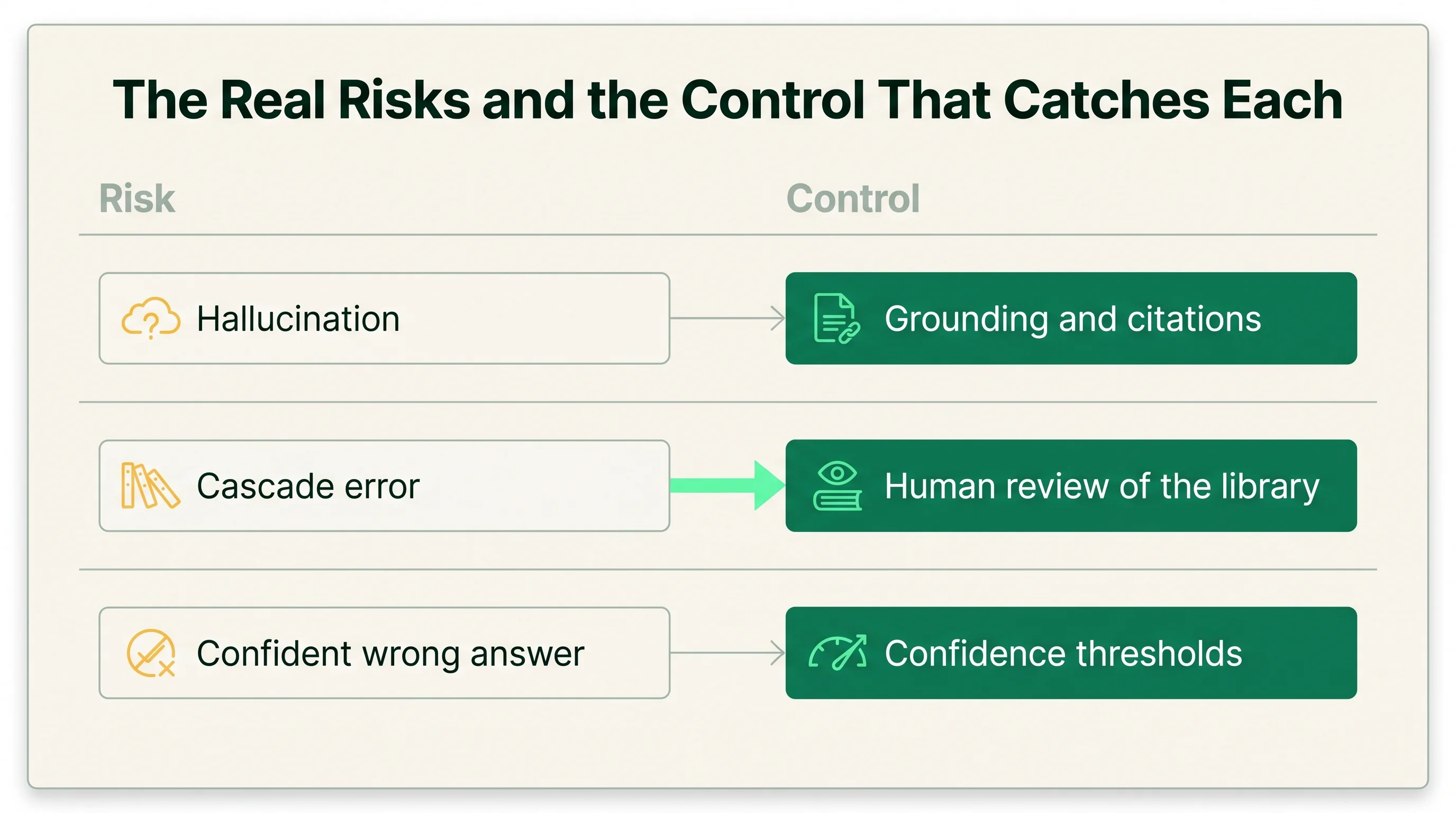
The two risks that matter most are hallucination and cascade error, and cascade error is the more dangerous of the two. Both are manageable, but only if you understand which controls address which risk.
Hallucination is a model stating something false in confident, fluent language. In an ungrounded setup, the model invents a control, a certification, or a data-handling practice that sounds right but is not true for your company. Grounding sharply reduces hallucination by tying drafts to approved sources, and cite-or-abstain reduces it further by declining when no good source exists. Hallucination is the failure mode most people worry about first, and it is also the one the standard controls handle most directly.
Cascade error is the harder problem. It is what happens when one wrong answer becomes the reused source for many future answers. A cascade inference failure starts when a bad answer is approved into the library, then retrieved and reused across questionnaire after questionnaire. Because the answer is grounded in an approved source, every reuse looks safe, and the error propagates silently until something forces a recheck. The failure is not loud; it is a quiet compounding of one mistake.
The difference in how you defend against each is worth stating plainly:
| Risk | What it is | What controls it |
|---|---|---|
| Hallucination | A single confident, false answer from the model | Grounding, citations, cite-or-abstain |
| Cascade error | One bad approved answer reused across many questionnaires | Human review of the source library, periodic re-approval |
| Confident wrong answer | A weak answer that looks as strong as a correct one | Confidence thresholds, low-confidence flags, review gate |
| Stale answer | A once-true answer that no longer reflects posture | Re-approval cadence, currency checks at review |
The takeaway is that grounding solves hallucination but can worsen cascade error, because grounding faithfully reuses whatever is in the library, including its mistakes. The defense against cascade error is not better AI. It is disciplined human review of the source library itself, with periodic re-approval so answers do not silently age into falsehood. A team that grounds its AI but never audits its approved answers has traded a loud risk for a quiet one.
What should you require of a vendor's AI, and the verdict
Before you trust a vendor's AI with a questionnaire, require evidence of the safety controls rather than a claim that the product is safe. Many tools describe AI answering, citations, and confidence scoring; those capabilities and any accuracy figures are vendor-reported, so test them against your own questionnaires rather than taking the marketing at face value.
Require each of the following, and confirm them in a trial on real questions:
- Citations on every answer, so each draft points to the approved source it came from and a reviewer can verify it.
- A real abstain behavior, so the AI declines or flags when it cannot answer from approved material instead of guessing.
- An enforced review gate, so answers cannot reach a buyer without a named human approving them.
- Configurable confidence handling, so you set the threshold for what gets flagged for closer review.
- A maintainable approved answer library, so you can audit, correct, and re-approve sources to control cascade error.
- Clear data-handling and retention terms, so you know whether your security answers train external models or are retained, and can say no.
The data-handling point deserves its own attention, because the content here is sensitive. Confirm whether questionnaire data and answers are used to train models, how long they are retained, and where they are processed. A safe answering workflow that leaks the underlying security posture is not safe in any meaningful sense.
The verdict: yes, AI can safely answer security questionnaires, conditionally. It is safe when it drafts from a grounded, approved answer library, cites its sources, abstains when unsure, and routes every answer through human review, with clear data-handling terms behind it. It is not safe as a general model writing confident claims from memory with no source and no review. The safe path treats AI as a fast, well-cited drafter and keeps a person accountable for every answer that reaches a buyer. Used that way, AI removes the repetitive work without removing the responsibility, which is the only version of this worth deploying.
How this article was reviewed
Sources reviewed
- AICPA - SOC 2Reference for the SOC 2 controls and scope that grounded answers should cite and that reviewers confirm for currency and scope.
- ISO/IEC 27001Reference framework commonly cited in questionnaire answers and used to check that an answer is scoped to a current certification.
- Cloud Security Alliance - CAIQStandardized questionnaire format (Consensus Assessments Initiative Questionnaire) frequently answered with automation, referenced as a common questionnaire type.
- Shared Assessments - SIGStandardized Information Gathering questionnaire referenced as a common format AI answering tools target.
- Vendor product documentation (Conveyor, Vanta, SafeBase, Loopio, Responsive, SecurityPal, Drata)AI answering, citation, confidence scoring, and abstain capabilities, along with any accuracy figures, are vendor-reported and should be tested on your own questionnaires rather than treated as independent benchmarks.
FAQ
Can AI answer a security questionnaire without any human review?
It can produce a finished file without review, but doing so is not safe. A security questionnaire is a set of representations your company is accountable for, and AI can draft but cannot vouch for them. Without a human gate, no one confirms the answers are true, current, and correctly scoped before a buyer relies on them. The safe pattern keeps AI as the drafter and a named person as the approver, concentrating review on low-confidence, abstained, and high-stakes answers rather than eliminating it.
Will AI hallucinate wrong answers on a security questionnaire?
An ungrounded model can, because it writes from general training rather than your actual controls and may state a certification or practice you do not have. Grounding sharply reduces this by drafting only from your approved answer library, and cite-or-abstain reduces it further by declining when no good source exists. The harder risk is cascade error, where one wrong answer that was approved into the library gets reused across many questionnaires. Grounding does not fix that; only human review of the source library and periodic re-approval do.
What is the difference between grounded AI and a general chatbot for questionnaires?
A general chatbot answers from its training data, so it writes a plausible answer for a generic company that may not match your controls. A grounded system retrieves from your approved answer library and policy documents, then drafts from that material and cites the source. The grounded version is far safer because each answer traces to evidence your team already reviewed, which makes verification possible and fabrication unlikely. For security claims, the source behind the answer matters more than how well the answer reads.
What does it mean when an AI abstains on a questionnaire question?
Abstaining means the AI declines to answer because it could not find a confident match in your approved material, and it routes the question to a human instead. This is a safety feature, not a failure. The alternative is a confident guess that looks identical to a correct answer, which a reviewer and a buyer cannot easily distinguish. A system with a real abstain behavior makes its uncertainty visible so review effort lands on the questions that actually need a person, rather than hiding weak answers inside fluent prose.
What should I ask a vendor before trusting its AI to answer questionnaires?
Ask what the AI does when it does not know the answer, since a safe system abstains or flags rather than guessing. Confirm that every answer shows a citation, that a human review gate is enforced before answers reach a buyer, and that you can configure confidence thresholds and maintain the approved answer library. Then ask the data-handling questions: whether your answers train external models, how long data is retained, and where it is processed. Treat accuracy and capability claims as vendor-reported and test them on your own questionnaires in a trial.