What Is Continuous Trust Management?
Continuous trust management treats customer-facing trust, evidence, questionnaire answers, and monitoring, as an always-on program rather than a per-deal scramble. This explainer defines the term, breaks down its components, and shows how to judge maturity.
What is continuous trust management?
Continuous trust management is the practice of treating customer-facing trust as an always-on program rather than work you reassemble for each deal. It keeps the evidence, questionnaire answers, monitoring, and trust center that buyers rely on current at all times, so a security review pulls from material that is already accurate instead of triggering a scramble.
The term is an analyst framing, not a product category. It names a way of operating that several tools support but none fully own. The point is the shift from episodic to continuous: instead of proving trust once a year and patching answers under deadline pressure, a team maintains trust the way it maintains uptime.
The work crosses several roles:
- Governance, risk, and compliance (GRC) owns the control framework and the evidence behind it.
- The CISO owns the risk story told to customers and the board.
- Customer trust and sales engineering own the buyer-facing answers and the trust center.
- Security engineering fixes drift when monitoring flags a control that has slipped.
In short, continuous trust management is the program that keeps security questionnaire automation and a trust center trustworthy between audits, rather than only on the day of one.
How does continuous trust management work?
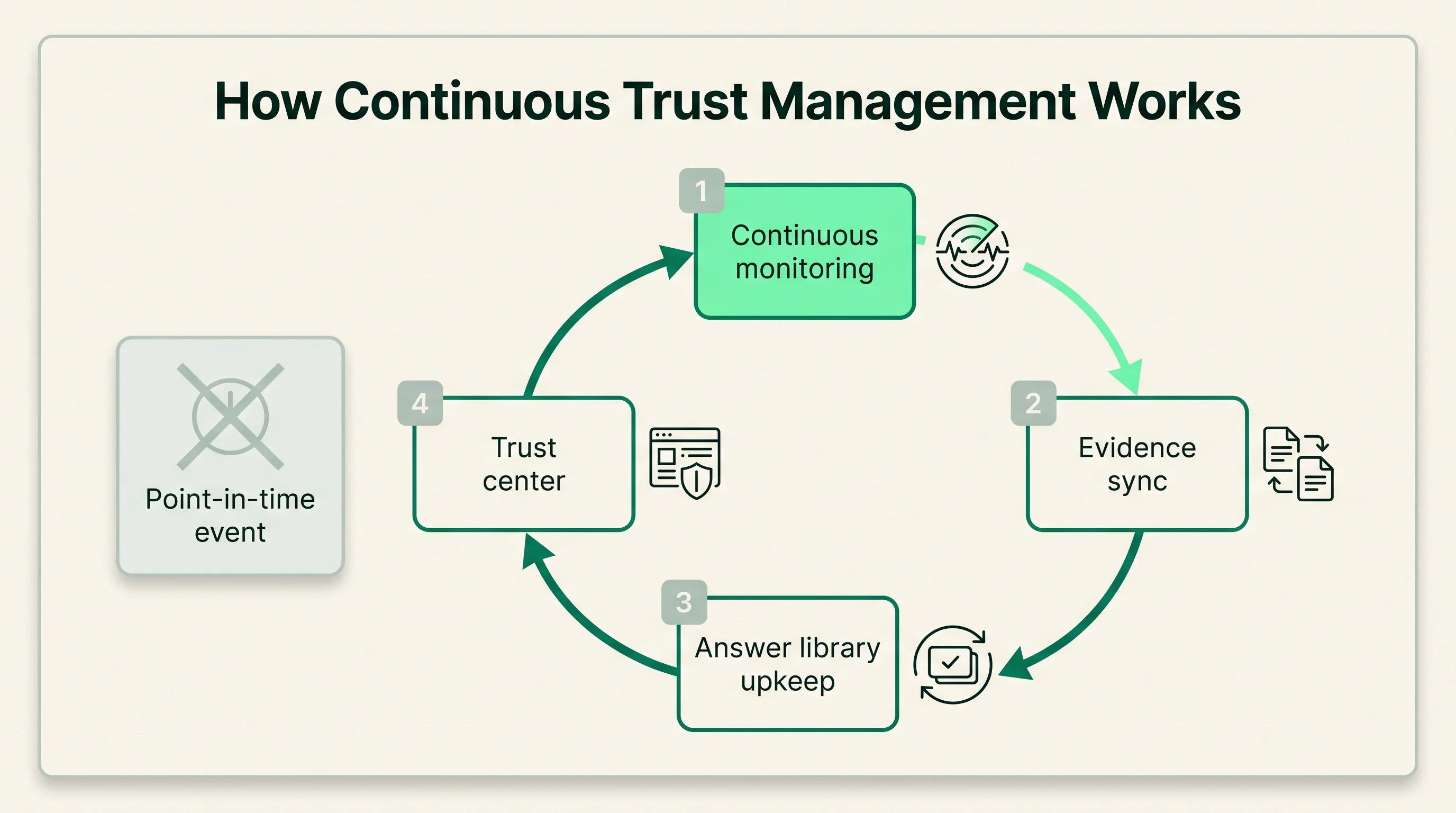
It works by keeping four artifacts in sync from a single, continuously updated source of truth. Each artifact serves a different buyer moment, but they all draw from the same fresh evidence, so an answer in a questionnaire matches the proof in the trust center and the live state of the control.
The four components are:
- Continuous monitoring. Automated checks read live signals from cloud, identity, and endpoint systems and flag controls that drift out of compliance.
- Evidence sync. SOC 2 reports, ISO 27001 certificates, penetration test results, and policies are stored once, dated, and pushed to wherever a buyer might ask for them.
- Answer library upkeep. An approved answer library holds reusable responses to common questionnaire items, reviewed on a schedule so answers do not go stale.
- Trust center. A public page lets buyers self-serve current status, certifications, and documents without filing a request.
The program runs as a loop rather than a project:
- Monitoring detects a change or a control failure.
- The evidence library updates to reflect the new state.
- Answer library entries that cite that evidence are reviewed and corrected.
- The trust center publishes the current version for buyers to see.
The result is that customer-facing trust updates as a byproduct of normal operations, not as a manual effort the week a large deal lands.
Why continuous trust management matters
It matters because trust artifacts go stale quietly, and stale artifacts create real friction in enterprise reviews. An answer written for last year's questionnaire, an evidence file from before a control changed, or a trust center listing an expired certificate all undermine the buyer confidence they were meant to build. Running trust continuously closes those gaps before a buyer finds them.
The concrete pain shows up in familiar ways:
- Subject-matter experts get pulled into deals to confirm controls that should be provable from current evidence.
- Answers drift out of date between the audit and the next review cycle.
- Deals stall while teams assemble proof a buyer requested under a clock.
- Nobody is sure whether the answer in the library still matches reality.
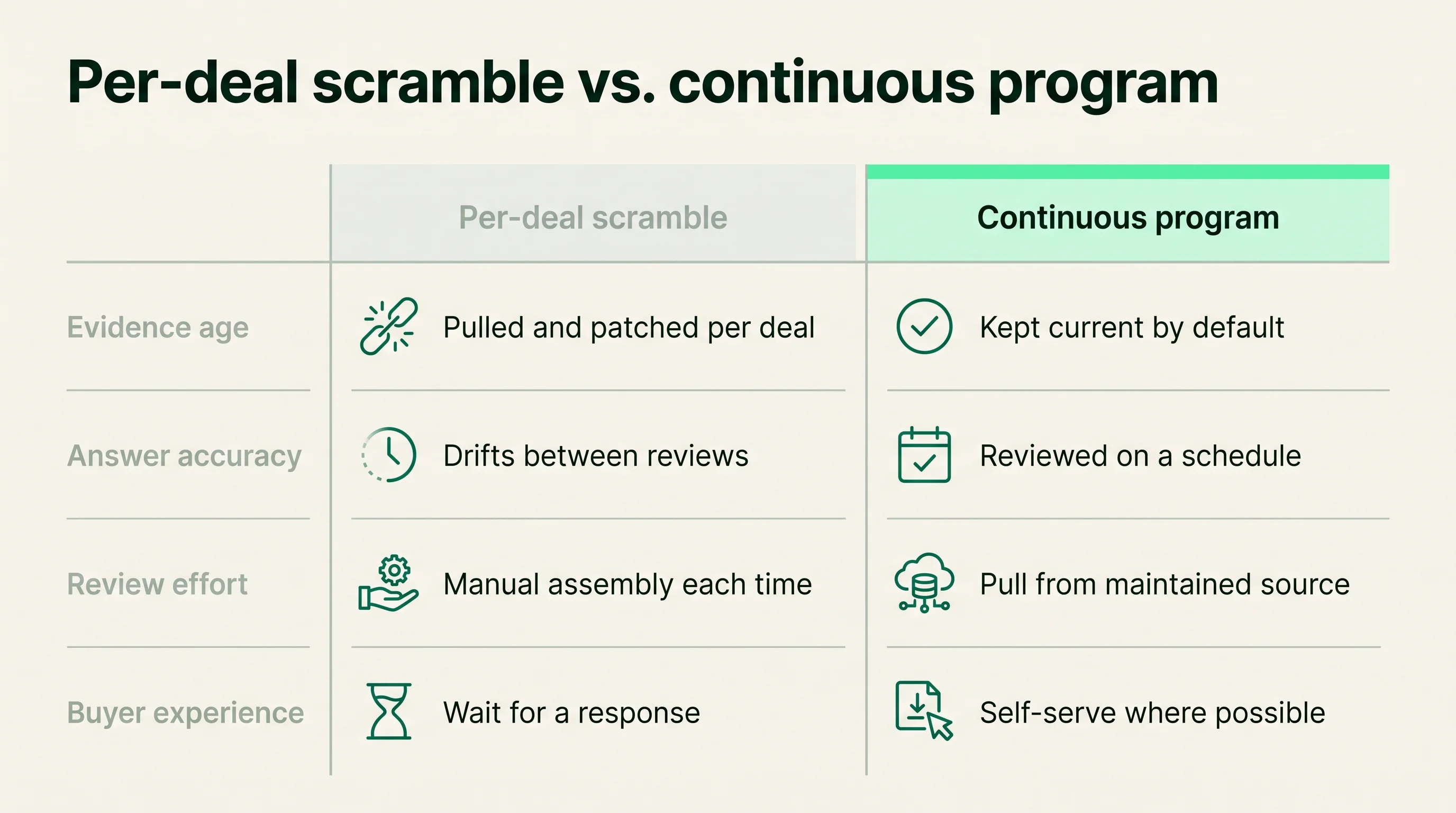
The difference between the per-deal scramble and the continuous program is clearest across a few dimensions:
| Dimension | Per-deal scramble | Continuous program |
|---|---|---|
| Evidence age | Pulled and patched per deal | Kept current by default |
| Answer accuracy | Drifts between reviews | Reviewed on a schedule |
| Review effort | Manual assembly each time | Pull from maintained source |
| Buyer experience | Wait for a response | Self-serve where possible |
The payoff is fewer fire drills, answers that hold up under scrutiny, and a trust story that stays defensible between audits.
Where continuous trust management sits next to adjacent surfaces
Continuous trust management is the program layer, not a single surface. It is the discipline that keeps questionnaire automation, the trust center, and the evidence library accurate and in step. Confusing the program with any one tool is a common error, so it helps to place them side by side.
Each surface plays a distinct role and the program connects them:
| Surface | What it is | Role in the program |
|---|---|---|
| Continuous monitoring | The evidence engine | Detects drift, refreshes proof |
| [Questionnaire automation](/categories/security-questionnaire-automation) | Reuses approved answers | Cites current evidence in replies |
| Trust center | Self-serve buyer portal | Publishes live status and docs |
| [TPRM](/glossary/third-party-risk-management) | Assessing your own vendors | Reuses the same evidence inward |
The relationship is directional. Monitoring produces the evidence; the answer library, trust center, and third-party risk management (TPRM) work all consume it. A trust center cuts inbound questionnaires, but only if the program keeps it current.
The practical takeaway: tools matter, but the upkeep matters more. For how the answer and trust layers divide the load, see where questionnaire automation and trust centers each fit.
How continuous trust management differs from point-in-time compliance
It differs in one core way: point-in-time compliance proves controls held at a single moment, while continuous trust management keeps that proof current between those moments. A SOC 2 Type II report covers a window that has already passed; a continuous program shows the state today and updates the buyer-facing answers when it changes.
The two are not opposites. Point-in-time audits remain the basis for most certifications, and continuous trust management depends on them as anchor evidence. The program adds the upkeep that audits do not cover.
The distinction lands across a few dimensions:
- Cadence. Compliance proves a window once; the program maintains trust between windows.
- Scope. Compliance targets a framework like SOC 2 or ISO 27001; the program covers every buyer-facing artifact, including answers and the trust center.
- Failure mode. Compliance fails at audit time; the program fails quietly when an answer or document goes stale and nobody notices.
- Output. Compliance produces a report; the program produces a current, self-serve trust surface.
The honest summary: you still need point-in-time compliance for certifications. Continuous trust management is what keeps the rest of your trust posture from drifting in the eleven months between audits.
Benefits and tradeoffs of continuous trust management
The benefit is current, defensible trust artifacts that cut review effort and shorten deals. The tradeoff is the standing cost of running the program: tool spend, integration upkeep, and a clear owner who maintains it. Both sides are real, and the balance depends on how often buyers ask you to prove your security.
The benefits are concrete:
- Buyer-facing answers and documents stay current without a manual refresh per deal.
- Control drift surfaces within a day instead of at the next audit.
- Review cycles shorten because proof is pulled, not assembled.
- Buyers self-serve common requests through the trust center, lowering inbound load.
The tradeoffs deserve equal weight:
- Monitoring and trust tooling carry subscription cost that scales with headcount or footprint.
- Integrations and answer reviews need ongoing maintenance as the stack and product change.
- Without a named owner, the program decays back into a per-deal scramble.
- The tooling keeps artifacts current; it does not design good controls or write good answers for you.
It is not always worth it. A small company with a simple stack and few security reviews often gets more value from a clean annual audit and a basic answer library than from a full continuous program. The practice earns its cost once review volume is high enough that stale trust is actively slowing deals.
How to evaluate continuous trust management maturity
Evaluate maturity on three things: how current the evidence is, how little manual work a review takes, and who clearly owns the upkeep. A program can have strong tools and still be immature if answers drift, evidence lags, or ownership is unclear when a deal lands.
Use this maturity model as a checklist:
| Stage | What it looks like | Signal of maturity |
|---|---|---|
| Ad hoc | Trust rebuilt per deal | Constant SME fire drills |
| Repeatable | Answer library exists, manual upkeep | Answers drift between reviews |
| Managed | Evidence synced, owner named | Reviews pull current proof |
| Continuous | Monitoring feeds every surface | Trust center stays live |
The vendor landscape splits into two groups, and neither owns the whole program. Compliance and monitoring platforms such as Vanta, Drata, Secureframe, and TrustCloud focus on the evidence engine: control mapping, continuous checks, and audit readiness. Trust and questionnaire platforms such as SafeBase, Whistic, and Conveyor focus on publishing and reusing that evidence with buyers. Some products reach across both. Treat every capability claim, including SCIM user management, secure access controls, and email notification features in a trust center, as vendor-reported until you test it in a trial.
Start by listing the frameworks your buyers ask about, confirm a tool keeps evidence for them current, then check how cleanly that evidence flows into your questionnaire automation and trust center. The handoff between surfaces is where most programs stall, and it is the gap buyers feel first.
How this article was reviewed
Sources reviewed
- AICPA SOC 2Standards body for SOC 2 reporting; anchor evidence for trust programs.
- ISO/IEC 27001International standard for information security management systems.
- Cloud Security Alliance (CAIQ)Publisher of the Consensus Assessments Initiative Questionnaire.
- Shared Assessments (SIG)Publisher of the Standardized Information Gathering questionnaire.
- NISTSource for security control frameworks referenced in trust programs.
- Vendor product documentationCapability descriptions for Vanta, Drata, Secureframe, TrustCloud, SafeBase, Whistic, and Conveyor are vendor-reported and should be verified in a trial.
FAQ
What is continuous trust management?
Continuous trust management is the practice of running customer-facing trust as an always-on program rather than reassembling it for each deal. It keeps continuous monitoring, an evidence library, an approved answer library, and a public trust center in sync from current evidence. The result is trust artifacts that stay accurate between audits, not just on audit day.
What are the most common mistakes when implementing continuous trust management?
The most common mistake is buying tools without naming an owner, which lets the program decay back into a per-deal scramble. Two others are letting the answer library drift while the evidence updates, and publishing a trust center that lists expired or out-of-date certifications. Fix all three by assigning clear ownership, reviewing answers on a schedule, and wiring evidence sync into the trust center early.
How does continuous trust management compare to doing it manually or with spreadsheets?
Manual and spreadsheet tracking captures trust at one moment, then goes stale until someone updates it by hand under deadline pressure. A continuous program keeps evidence, answers, and the trust center current automatically, so a review pulls from maintained material. Spreadsheets can work for a small stack with few reviews, but they scale poorly once questionnaire volume rises and answers start to drift.
How do you get leadership buy-in for continuous trust management?
Frame it in revenue and risk terms rather than compliance terms. Show how often deals stall while teams assemble stale proof, and how much subject-matter-expert time goes to confirming controls that should be provable from current evidence. Pair that with the risk of a trust artifact going stale and a buyer catching it. Leadership tends to fund the program when it is tied to deal velocity rather than to passing an audit.
What is the typical implementation timeline for continuous trust management?
Standing up the core tooling and evidence sync commonly takes a few weeks to a couple of months, depending on stack complexity and integrations. Reaching a continuous state, where monitoring, the answer library, and the trust center all stay current without manual effort, usually takes longer because it touches process and ownership, not just tools. Plan for a phased rollout rather than a single launch date.