Security Questionnaire Automation vs. Trust Centers: Where Each Fits
Trust centers can deflect repeated diligence requests. Questionnaire automation handles the custom review work that still arrives.
What is the core difference between a trust center and questionnaire automation?
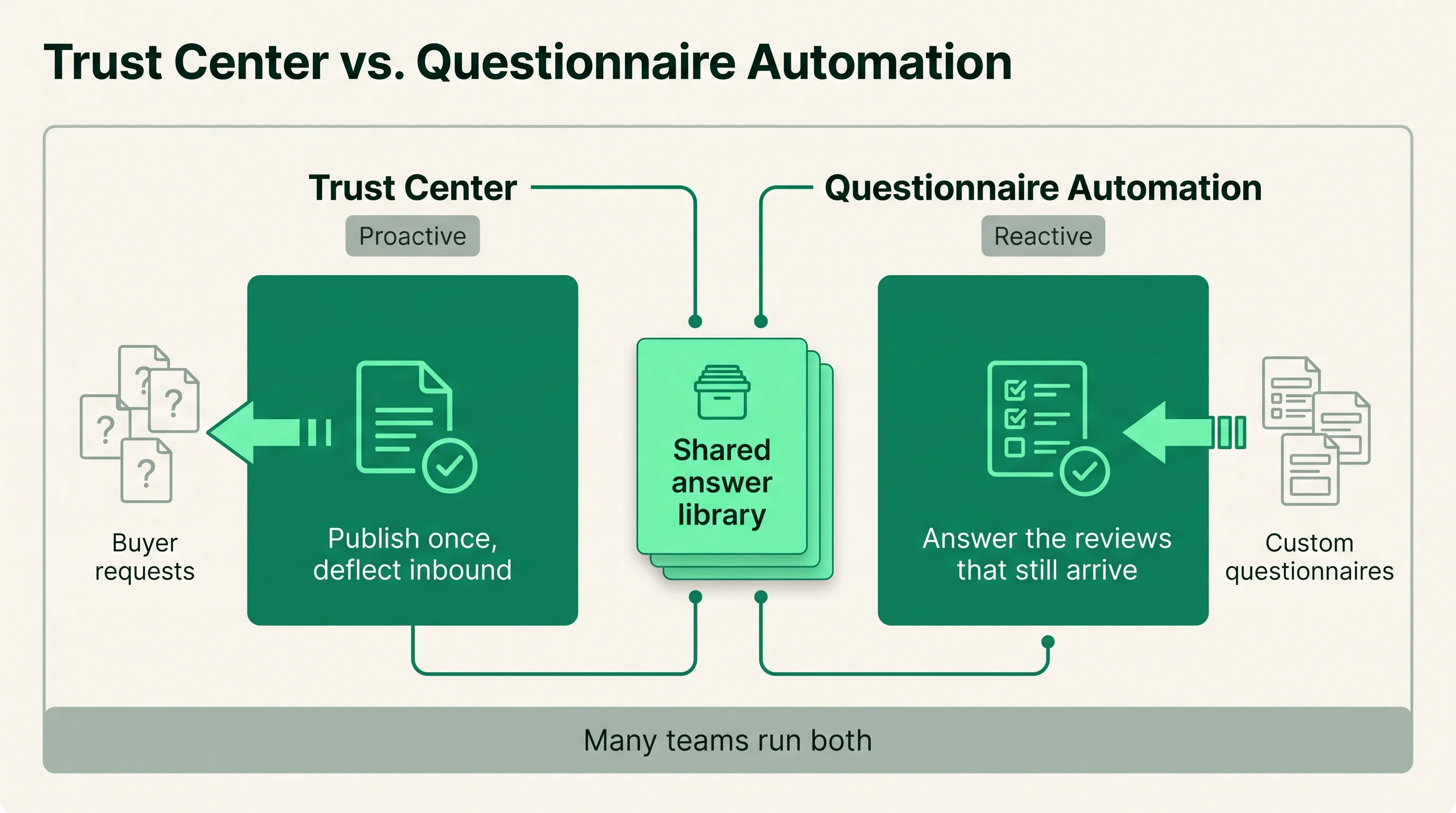
The core difference is direction. A trust center is proactive: it publishes your security proof once so buyers can self-serve, which deflects diligence requests before they ever become a questionnaire. Security questionnaire automation is reactive: it drafts answers to the questionnaires that still arrive, drawing from an approved answer library so your team does not retype the same responses across every deal.
That split decides almost everything else about how each tool behaves. A trust center works on the front of the funnel, satisfying a buyer with published evidence so no form is sent. Automation works at the point of intake, after a buyer has decided they need a completed questionnaire and put one in front of you.
Neither surface is a version of the other. Publishing a SOC 2 report does not fill in a buyer's custom spreadsheet, and drafting answers to that spreadsheet does nothing to stop the next buyer from sending one. They address two different moments in the same review cycle.
The useful way to frame the comparison is by the problem you have. If too many requests are arriving, the gap is on the deflection side. If the requests that arrive take too long to answer, the gap is on the automation side. Most teams have some of both, which is why the question is usually sequencing rather than either-or. The sections below cover how deflection works, where it stops, and how the two share a foundation.
At a glance: trust center vs. questionnaire automation
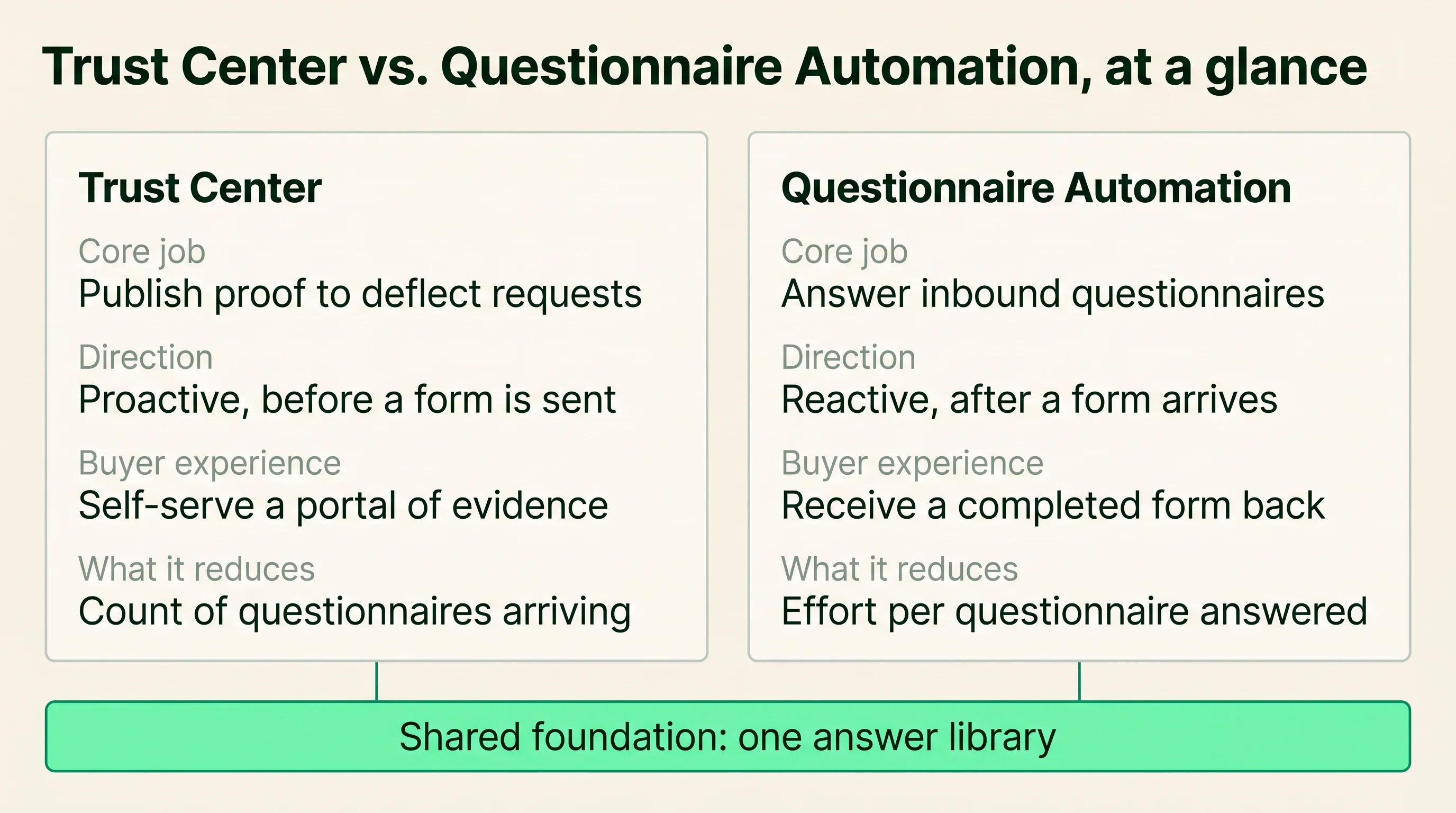
The clearest way to separate the two is by the job each one does. A trust center deflects standardized requests before they become work; automation completes the questionnaires that still arrive. The table below compares them across the criteria that matter when you are shortlisting. Both pull from the same approved answers and evidence, which is why they blur together and are often bought as a pair.
| Criterion | Trust center | Security questionnaire automation |
|---|---|---|
| Core job | Publish proof to deflect requests | Answer inbound questionnaires |
| Direction | Proactive, before a form is sent | Reactive, after a form arrives |
| Buyer experience | Self-serve a portal of evidence | Receive a completed form back |
| Format coverage | Standardized framework evidence | Custom forms, portals, CAIQ, SIG, Excel |
| Shared foundation | Answer library feeds published FAQs | Answer library feeds AI drafting |
| Access controls | NDA gating, public or gated tiers | Per-answer review and sign-off |
| What it reduces | Count of questionnaires arriving | Effort per questionnaire answered |
| Primary owner | Customer trust, GRC | GRC, sales engineering |
| Common tools | Vanta, SafeBase, Whistic, Drata | Conveyor, Loopio, Responsive |
The pattern across every row is proactive versus reactive. A trust center lowers how many questionnaires you ever touch; automation lowers the cost of touching the ones you cannot avoid. Neither replaces the other, because a trust center cannot deflect every request and automation cannot prevent one. The vendor names above are common reference points for building a shortlist, not endorsements, and each names its own capabilities that you should test against your real questionnaires and buyer mix. The rest of this comparison expands on how deflection works, where it stops, and how to decide what to buy first.
How does trust center deflection work, and where does it stop?
Deflection works by answering a buyer's question before they ask it. A trust center publishes the evidence that satisfies the most common diligence requests, such as a current SOC 2 report, an ISO 27001 certificate, a recent penetration-test summary, a subprocessor list, and answered FAQs covering encryption, access control, and incident response. When a buyer can find that evidence and accept it, they have no reason to send a questionnaire, and the request is deflected. Our explainer on trust center deflection covers the mechanics in more detail, and the trust center glossary entry defines the surface.
The mechanism depends on a few things working together:
- Evidence that is current, since an expired certificate deflects nothing and pushes the buyer back to a form
- Answered FAQs drawn from the same vetted answers your team would give on a questionnaire, so the published version is consistent and trusted
- Access controls that release sensitive evidence to a named counterparty under NDA, which lets buyers self-serve without exposing protected material
- A page buyers can actually find, usually surfaced by sales early in the cycle rather than buried
Deflection has a real ceiling, and that ceiling is the most important thing to understand before you treat a trust center as a questionnaire eliminator. Three categories of request keep arriving no matter how complete the page is:
- Regulated reviews, where a bank, insurer, or healthcare buyer must collect a completed questionnaire for their own audit file, regardless of what you have published
- Custom questionnaires written around one buyer's specific risk model, which no general published evidence can fully answer
- Procurement-mandated forms, where the buyer's process requires a signed, returned document rather than self-serve acceptance
Vendor deflection figures are reported under each vendor's own definitions and rarely match your buyer mix, so treat any specific deflection rate as vendor-reported. The practical takeaway is that a trust center reduces inbound volume, sometimes substantially, but it does not get you to zero. The questionnaires it leaves behind are the ones automation exists to handle.
What does each surface do well?
Each surface is strongest at a different half of the workflow, and the cleanest way to see the boundary is to look at what each genuinely removes from your team's day.
A trust center is strongest at deflecting the standardized middle of the market. Its concrete strengths:
- Publish-once deflection, where a current SOC 2 report, ISO 27001 certificate, and pen-test summary answer common requests with no questionnaire involved
- Consistency, because one published set of answers prevents the drift that happens when different people fill the same form differently
- Faster sales cycles for buyers who accept self-serve evidence, since a deflected request never gates a contract
- Centralized evidence freshness, so an expiring certificate is updated in one place instead of scattered across email threads
- Controlled sharing through NDA gating, which keeps sensitive proof protected while still letting the buyer self-serve
The launching a trust center to reduce questionnaires workflow walks through standing one up, and the trust center software category collects the tools.
Security questionnaire automation is strongest whenever a questionnaire must actually be completed, especially at volume or in a format you do not control. Its concrete strengths:
- High-volume handling, where drafting from an approved answer library removes repetitive copy, paste, and reformat work
- Multi-format coverage across Excel, buyer portals, CAIQ from the Cloud Security Alliance, and SIG from Shared Assessments, so the same answers serve any format
- Custom-question support, since a buyer's bespoke questionnaire can be answered from your library even when no published evidence fits
- Per-answer review and approval, so a sales engineer or GRC reviewer signs off before an answer ships
- AI-assisted drafting that proposes answers and cites the source evidence behind them, which several vendors market as their core capability
The AI accuracy claims deserve scrutiny. Vendors describe drafting, citation, and confidence scoring in their own terms, and those figures are vendor-reported rather than independent benchmarks. Our explainer on security questionnaire automation covers what the workflow includes, and the security questionnaire automation category collects the tools. The short version: a trust center wins on the requests you can prevent, and automation wins on the questionnaires you cannot.
How do cost and effort compare?
The two categories tend to price on different models, and the rollout effort differs in kind rather than just degree. None of these models has fixed public figures, so treat any specific number a vendor quotes as vendor-reported and confirm it in procurement.
The pricing models compare roughly as follows:
| Model | Where it appears | What it scales with |
|---|---|---|
| Tiered | Trust center | Feature level and access controls |
| Per seat | Questionnaire automation | Number of users answering |
| Per questionnaire volume | Questionnaire automation | Count of inbound reviews handled |
| Platform bundle | Both, sold together | A compliance or trust suite |
The effort to run each splits along the same proactive-versus-reactive line. Trust center effort is front-loaded into deciding what to publish, setting NDA gating correctly, and getting buyers to actually find and use the page. The document work is comparatively light, but the buyer-adoption work is real, because a trust center nobody visits deflects nothing.
Automation effort is concentrated in the answer library. An automation tool is only as good as the answers it drafts from, so building and curating that library is the work that makes the rest function. That effort is ongoing rather than one-time, since controls change and answers decay.
A few notes that affect total cost beyond the license:
- A trust center needs evidence kept current, since an expired certificate deflects nothing
- Automation needs continuous library maintenance, or generated drafts drift out of date as controls change
- A platform bundle can reduce integration work but may charge for capabilities you would not buy separately
- Both benefit from the same upkeep, so running them on a shared answer library lowers the combined maintenance load rather than doubling it
The pricing-model differences matter more than any single quote, because they decide how cost grows as you scale. A team whose inbound volume is climbing fast should pay attention to whether automation prices per seat or per questionnaire, since the two diverge sharply as volume rises.
Which should you choose?
Choose by the problem you actually have. Too many requests arriving points to a trust center. Too many questionnaires to fill points to automation. Most teams eventually need both, but one is usually the urgent purchase, and which one depends on your buyer mix, your formats, and who owns the work.
Choose questionnaire automation when:
- Inbound questionnaire volume is high enough that answering by hand blocks deals
- Most requests arrive as custom forms, buyer portals, or regulated assessments that must be completed
- A sales engineer or GRC team is re-answering near-identical questions across deals
- You need coverage across Excel, portals, CAIQ, and SIG in the buyer's exact format
- The bottleneck is effort per questionnaire, not the count of questionnaires
Choose a trust center when:
- Most inbound is standardized and satisfied by a SOC 2 report, ISO 27001 certificate, or answered FAQs
- You want to shorten sales cycles by letting buyers self-serve proof before they draft a form
- A customer trust leader owns reducing inbound assurance load as an explicit goal
- Your buyers are mostly mid-market and willing to accept published evidence under NDA
- The bottleneck is the number of questionnaires arriving, not the work to answer each one
Use both when:
- You receive a steady mix of standardized requests and custom or regulated ones
- You want a trust center to deflect the standardized middle and automation to fill what remains
- You can maintain one shared answer library and evidence set that feeds both surfaces
- A platform that bundles them reduces integration and upkeep more than it adds in unused features
The sequencing rule is simple. If filling questionnaires is the fire, start with automation. If the volume of incoming requests is the fire, start with a trust center. Then add the other as the workflow matures and the shared answer library is in place to support it.
How this article was reviewed
Sources reviewed
- AICPA - SOC 2Primary source for what a SOC 2 report attests when published as trust center evidence or cited in an automated answer.
- ISO/IEC 27001Primary source for the information security management standard used as deflection evidence and answer citations.
- Cloud Security Alliance - CAIQPrimary source for the CAIQ format that questionnaire automation must cover and trust center content can map to.
- Shared Assessments - SIGPrimary source for the SIG questionnaire format referenced for both automation format coverage and trust center mapping.
- Vendor product documentation (Conveyor, Loopio, Responsive, Vanta, SafeBase, Whistic, Drata)Capability, AI accuracy, deflection, and pricing-model claims are vendor-reported and should be tested against your own questionnaires and buyer mix, not treated as independent fact.
FAQ
Can a trust center replace security questionnaires?
Sometimes it reduces them, but it rarely replaces them entirely for enterprise buyers. A trust center deflects standardized requests when a buyer can self-serve a current SOC 2 report, an ISO 27001 certificate, and answered FAQs. It cannot deflect regulated reviews where a bank or insurer must collect a completed form for their own audit, custom questionnaires written around one buyer's risk model, or procurement processes that require a signed, returned document. Those keep arriving no matter how complete the page is, which is the work questionnaire automation handles.
Which should a team implement first, a trust center or automation?
Start with whichever addresses your bigger fire. If buyers mostly ask for the same documents and the volume of incoming requests is the problem, a trust center deflects more of that load. If buyers send frequent custom forms and the time to complete each one is the problem, automation removes more of that effort. If both are happening, choose a shared source model so the answer library and evidence feed both surfaces, then add the second tool as the program matures.
Do the two tools share the same answer library?
They should. The same approved answers that draft a questionnaire response also populate a trust center's published FAQs, and the same evidence, such as a SOC 2 report, serves as both deflection material and an answer citation. Running two separate answer sets risks the trust center saying one thing while the questionnaire library says another, which buyers notice and which undermines trust. Maintaining one library means an update flows to both the published page and the next drafted questionnaire at once.
How is trust center deflection measured, and is the figure reliable?
Deflection is usually measured as buyers who accepted self-serve evidence divided by total inbound assurance requests, ideally linked to specific deals so the attribution is defensible. The number is real but soft, because attribution is never perfect and your buyer mix moves it. Vendor-published deflection rates are reported under each vendor's own definitions and rarely match your situation, so treat them as vendor-reported and track your own trend over time rather than trusting a single quoted figure.
Do you need both questionnaire automation and a trust center?
Many teams do, because the two cover different halves of the workflow. A trust center deflects standardized, framework-aligned requests before they arrive, and automation fills the custom and regulated questionnaires a trust center cannot deflect. If your inbound is mostly standardized, a trust center alone may be enough. If it is mostly custom or regulated, automation alone may be enough. Running both on a shared answer library is common once volume grows, and some vendors package them together, though a bundle is not automatically cheaper than two focused tools.