What Is Trust Center Deflection?
Trust center deflection is the share of inbound security questionnaires a trust center prevents by letting buyers self-serve SOC 2, ISO 27001, pen-test summaries, and answered FAQs under NDA. It is the main efficiency metric for a trust center: the higher it is, the fewer questionnaires a security team has to fill by hand.
What is trust center deflection?
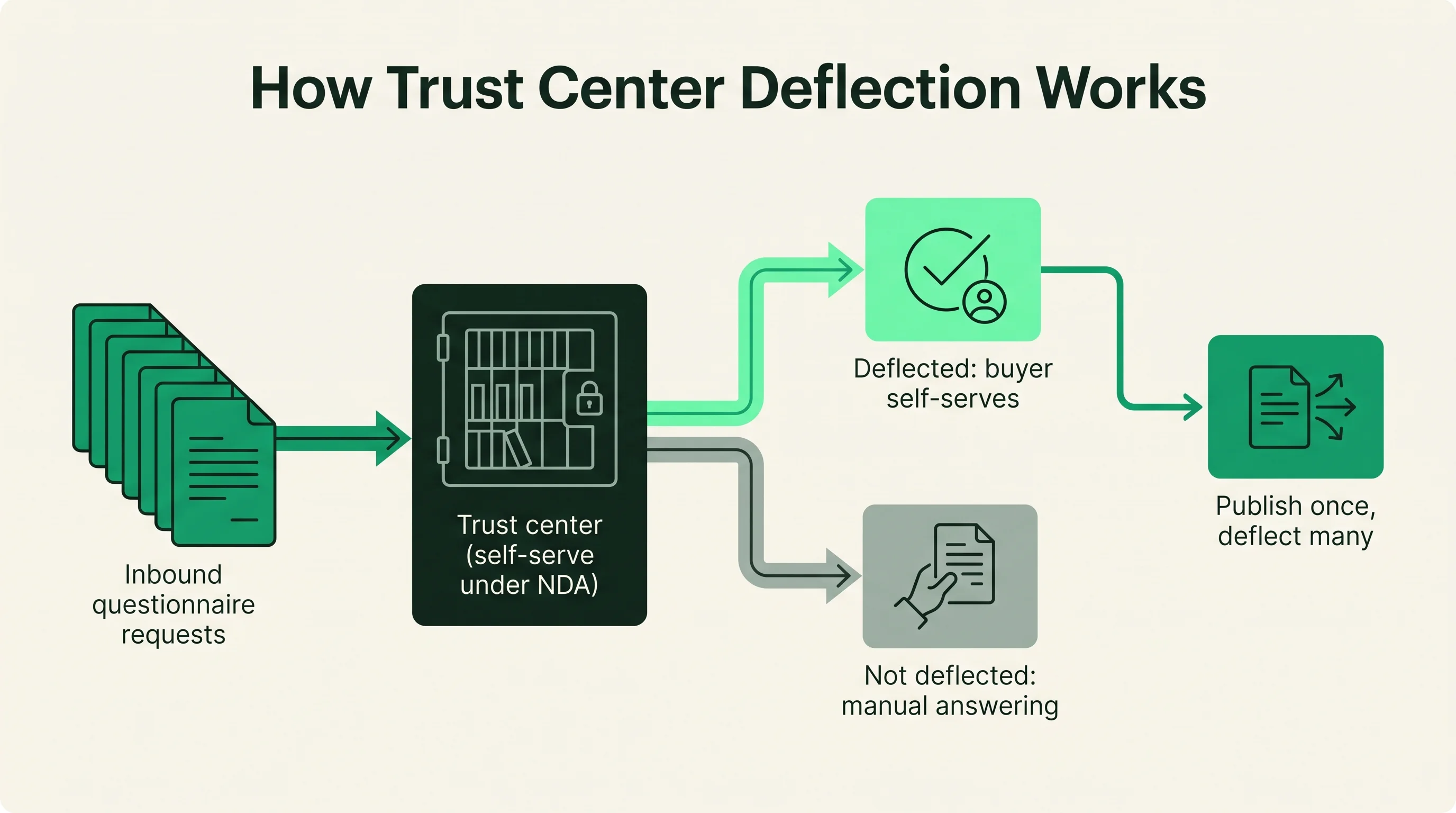
Trust center deflection is the share of inbound security questionnaires a trust center prevents by letting buyers self-serve the proof they need. Instead of sending a questionnaire and waiting for a vendor to fill it, the buyer reviews published evidence and answers, often behind an NDA, and accepts what they find. Every buyer who self-serves is a questionnaire a security team never has to complete.
A trust center is a published page where a company posts its security documentation, certifications, and common answers so buyers can review them directly. It usually holds the SOC 2 report, ISO 27001 certificate, a pen-test summary, subprocessor lists, and a set of answered frequently asked questions about access, encryption, and data handling. The glossary entry for a trust center covers the surface itself in more detail.
Deflection is the efficiency metric attached to that surface. A trust center can exist and deflect almost nothing if buyers cannot find what they need or do not trust what is published. The point of measuring deflection is to know whether the trust center is doing the one job that saves time: keeping questionnaires from arriving.
Ownership is shared across roles:
- GRC (governance, risk, and compliance) owns the evidence and the answered FAQs that get published
- Security and the CISO own the accuracy of what is claimed and the NDA gating
- Sales engineering and the sales engineer feel the result, because a deflected questionnaire is a deal that moves without a security bottleneck
- Customer trust, where the role exists, owns the deflection number itself
Deflection is best understood as a rate, not a feature. The rest of this article covers how the mechanism works, how to measure it, what deflects well and poorly, and how to raise it.
How does trust center deflection work?
Trust center deflection works on a publish-once, deflect-many model: you publish evidence and answers in one place, gate access appropriately, and a portion of buyers accept that self-serve material instead of sending a questionnaire. The deflection happens at the moment a buyer decides the published proof is enough.
The typical flow is:
- A buyer's security or procurement team needs assurance before a deal closes
- They reach your trust center, often from a link in the sales process or a security page
- They request access, and an NDA gate releases the sensitive evidence such as the SOC 2 report
- They review the published certificates, pen-test summary, subprocessor list, and answered FAQs
- If what they find answers their requirements, they accept it and no questionnaire is sent
- If it does not, they send a questionnaire for the gaps, and that one is not deflected
The answered FAQs are where most deflection is won or lost. A trust center that publishes the certificate but not the answers to common control questions forces the buyer back to a questionnaire to get those answers. The same approved answer library that feeds questionnaire automation should feed the trust center's published FAQs, so buyers see the team's vetted answers without asking.
NDA gating is the control that makes deflection possible for sensitive evidence. Most buyers will not let you publish a SOC 2 report openly, and most vendors will not want to. Gating releases the report to a named, agreed counterparty, which keeps the evidence protected while still letting the buyer self-serve. The workflow for launching a trust center to reduce questionnaires walks through setting this up.
Deflection is not automatic. It depends on buyers finding the trust center, trusting it, and finding their specific answers in it. When any of those break, the questionnaire arrives anyway.
Why trust center deflection matters
Trust center deflection matters because filling security questionnaires by hand is the most repetitive, deal-blocking work a security or GRC team faces, and deflection removes that work before it starts rather than speeding it up after. A questionnaire that is never sent costs nothing to answer.
The concrete pain without deflection is familiar. The same subject-matter experts re-answer near-identical questions across deals. Answers drift as different people phrase the same control differently. A stalled questionnaire holds up a signed contract while procurement waits. Stale answers slip through because no one updates a spreadsheet that lives in an inbox.
The difference between answering everything and deflecting first is direct:
| Dimension | Answer every questionnaire | Deflect with a trust center first |
|---|---|---|
| Volume of manual work | Every inbound request gets filled | Only undeflected requests get filled |
| SME load | High, experts re-answer basics | Lower, experts handle exceptions |
| Answer consistency | Drifts across people and deals | One published, vetted set |
| Deal velocity | Gated on response turnaround | Faster for buyers who self-serve |
| Evidence freshness | Scattered, easy to miss updates | Centralized, one place to update |
The shift is from answering to preventing. Deflection does not replace questionnaire automation; it shrinks the pile that automation has to handle. That is why a trust center and a questionnaire workflow are usually run together, not as alternatives.
How do you measure a trust center deflection rate?
A trust center deflection rate is accepted self-serve reviews divided by total inbound assurance requests over a period, expressed as a percentage. If 100 buyers needed security assurance in a quarter and 35 accepted the trust center without sending a questionnaire, the deflection rate is 35 percent. The number is only as honest as the denominator you choose.
The components to define before you trust the rate:
- The numerator: buyers who reviewed the trust center and did not send a questionnaire for the same need
- The denominator: total buyers who needed assurance, whether they self-served or sent a questionnaire
- The window: a quarter is common, because volume is large enough to be stable
- The exclusions: deals where no assurance was needed at all should not count either way
The hard part is attribution. A buyer who never sends a questionnaire might have self-served, or might have skipped the review entirely, or might still send one next month. Cleaner measurement ties a trust center access grant to a specific deal, then checks whether a questionnaire followed for that same deal. Without that link, the rate is an estimate, and it should be labeled as one.
| Measurement approach | What it tells you | The limitation |
|---|---|---|
| Access grants vs. questionnaires received | Direct deflection per deal | Needs deal-level linking |
| Quarter-over-quarter questionnaire volume | Whether the pile is shrinking | Confounded by deal mix and growth |
| Buyer self-report at access | Why they did or did not self-serve | Low response, optional step |
Track the rate as a trend, not a single snapshot. A deflection rate that is rising while inbound volume grows is doing its job; a flat rate next to rising questionnaire counts means the trust center is being bypassed. Defensible ranges matter more than false precision here, because the attribution is never perfect.
What deflects well and what deflects poorly?
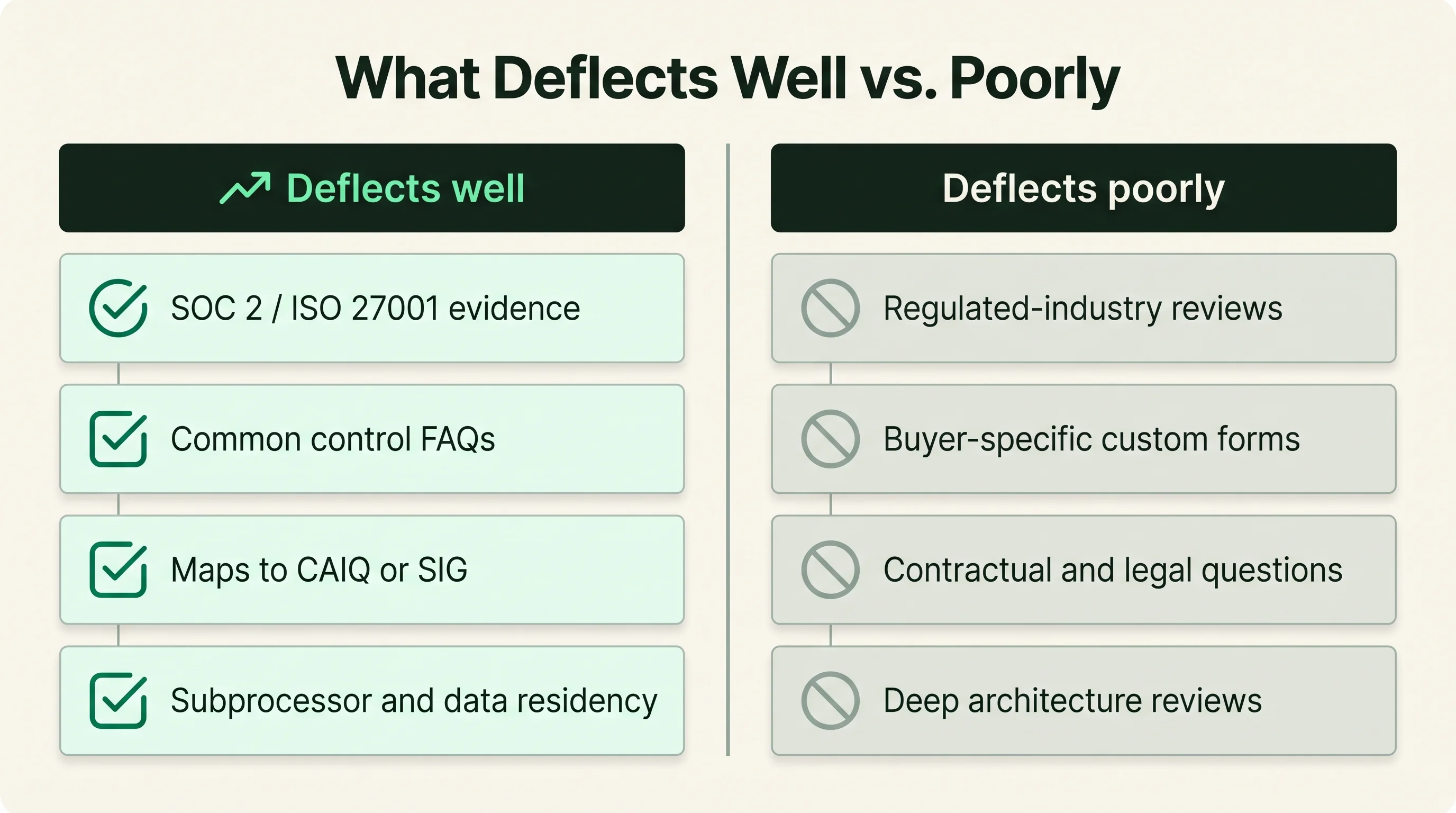
Standard, framework-aligned assurance deflects well, and custom, regulated, or contractual review deflects poorly. The pattern is consistent: a buyer accepts published evidence when their requirement maps cleanly to something a recognized framework already covers, and falls back to a questionnaire when it does not.
What a trust center deflects most reliably:
- Requests satisfied by a current SOC 2 report or ISO 27001 certificate
- Common control questions on encryption, access management, and incident response, when published as answered FAQs
- Standardized questionnaire content that maps to a CAIQ from the Cloud Security Alliance or a SIG from Shared Assessments
- Subprocessor and data-residency questions, when the lists are published and current
- Pen-test assurance, when a summary or attestation is available under NDA
What deflects poorly, no matter how good the trust center is:
- Regulated-industry reviews where a bank, insurer, or healthcare buyer is required to collect a completed questionnaire for their own audit
- Buyer-specific custom questionnaires written around one company's risk model
- Contractual or legal questions that need negotiation, not a published answer
- Deep technical or architecture reviews that go beyond what any framework attests
- Net-new control areas, such as a specific AI data-handling question, before the trust center has a published answer for it
The practical read is that deflection has a ceiling. A trust center can carry the standardized middle of the market, but regulated and custom reviews will still send questionnaires, and those are the ones questionnaire automation exists to handle. Knowing which bucket a buyer falls into tells you whether to expect deflection or a filled questionnaire.
Where trust center deflection sits next to adjacent surfaces
Trust center deflection sits at the front of the assurance workflow, ahead of questionnaire automation, RFP response, and the buyer's third-party risk management (TPRM) program. Its job is to reduce the volume that reaches everything downstream. All of these draw on the same approved answers and evidence, which is what makes them easy to confuse.
| Surface | Its specific job | How it relates to deflection |
|---|---|---|
| Trust center deflection | Prevent questionnaires by letting buyers self-serve | The metric for the front of the funnel |
| Questionnaire automation | Fill the questionnaires that were not deflected | Handles what deflection leaves behind |
| RFP response | Answer proposals and their security sections | Shares the same answer library |
| Buyer TPRM | The buyer's program for assessing vendors | The process that decides whether to self-serve |
Questionnaire automation and trust centers are complementary, not competing. A trust center deflects the standardized requests; automation fills the custom and regulated ones that arrive anyway. Our explainer on security questionnaire automation versus trust centers covers where each one fits, and the broader guide to security questionnaire automation places both in the full workflow.
The buyer's TPRM program is the other side of the same interaction. TPRM is the process a buyer runs to assess and monitor its vendors, and it is the buyer's policy that decides whether published evidence is acceptable or a questionnaire is mandatory. Deflection is high when a buyer's TPRM allows self-serve evidence and low when it requires a completed form. You can publish excellent evidence and still not deflect a buyer whose risk policy forbids accepting it.
The shared asset across all of these is the answer library and the evidence behind it. Maintaining one vetted set of answers and current certificates raises deflection, speeds automation, and improves RFP responses at the same time.
How to evaluate or improve trust center deflection
Evaluate a trust center on the things that actually drive deflection: evidence coverage, answered FAQ depth, how cleanly it gates an NDA, how easy it is for buyers to find and access, and whether it reports a deflection number you can trust. Do not buy on a vendor's headline deflection claim, which is reported under their own definitions and rarely matches your buyer mix.
Score tools and your own setup against the same criteria:
| Criterion | What good looks like |
|---|---|
| Evidence coverage | Current SOC 2, ISO 27001, pen-test summary, and subprocessor list, all kept fresh |
| Answered FAQ depth | Vetted answers to the common control questions buyers actually ask, not just certificates |
| NDA gating | Self-serve access with a clean, fast NDA step that buyers complete without sales involvement |
| Findability and access | Buyers reach it from the sales process and get access in minutes, not days |
| Deflection reporting | A deflection rate tied to access grants and deals, with a stated definition |
SafeBase, Vanta, Conveyor, Whistic, Drata, and TrustCloud are common reference points when teams build a trust center shortlist, and they sit at different angles. SafeBase and Conveyor center on trust centers and questionnaire handling. Vanta and Drata anchor in compliance automation with a trust center attached. Whistic and TrustCloud emphasize the buyer-vendor exchange. Each names its own deflection and automation capabilities, and those figures are vendor-reported; the point of evaluation is to test them against your own buyers, not to accept the marketing.
To improve deflection without adding more documents, close the gap between what buyers ask and what your trust center shows:
- Read the last quarter of received questionnaires and find the questions buyers asked despite the trust center; publish answered FAQs for them
- Make sure the NDA gate is fast, since a slow access step pushes buyers back to a questionnaire
- Link the trust center early in the sales process so buyers find it before they draft a questionnaire
- Keep evidence current, because an expired SOC 2 report deflects nothing
- Track which buyer types deflect and which do not, and stop expecting deflection from regulated reviews that will always send a form
When you are ready to shortlist, start from the trust center software category, then compare it against questionnaire automation to size what each surface should carry. The vendor profile for Conveyor is a useful reference point for how trust center and questionnaire features are packaged together.
How this article was reviewed
Sources reviewed
- AICPA - SOC 2Primary source for what a SOC 2 report attests when published as trust center evidence.
- ISO/IEC 27001Primary source for the information security management standard published as trust center evidence.
- Cloud Security Alliance - CAIQPrimary source for the CAIQ format that standardized, deflectable questionnaire content maps to.
- Shared Assessments - SIGPrimary source for the SIG questionnaire that standardized content can map to for deflection.
- NISTReference framework buyers cite when defining the control areas a trust center is expected to cover.
- Vendor product documentation (SafeBase, Vanta, Conveyor, Whistic, Drata, TrustCloud)Trust center and deflection capability claims are vendor-reported and should be verified against your own buyer mix, not treated as independent fact.
FAQ
What is a good trust center deflection rate benchmark?
There is no audited industry benchmark, and any single figure should be treated with caution, because deflection depends heavily on your buyer mix. A trust center serving mostly standardized, mid-market buyers can deflect a meaningful share of inbound requests, while one serving regulated enterprises will deflect far less because those buyers must collect completed questionnaires. Judge your rate against your own trend over time, not a published number, and label it as an estimate unless you tie access grants to specific deals.
How do you track trust center deflection over time?
Track it as accepted self-serve reviews divided by total inbound assurance requests, measured each quarter so volume is large enough to be stable. The cleanest method links a trust center access grant to a specific deal, then checks whether a questionnaire followed for that same deal. Watch the trend alongside total questionnaire volume: a rising deflection rate while inbound grows means the trust center is working, while a flat rate next to rising questionnaire counts means buyers are bypassing it.
What questionnaire categories does a trust center deflect most reliably?
It deflects standardized, framework-aligned requests best. Buyers satisfied by a current SOC 2 report or ISO 27001 certificate, common control questions on encryption and access published as answered FAQs, and content that maps to a CAIQ or SIG tend to self-serve. Subprocessor lists, data-residency questions, and pen-test summaries under NDA also deflect well when they are published and current.
What types of questionnaires are hardest for trust centers to deflect?
Regulated and custom reviews are the hardest. A bank, insurer, or healthcare buyer is often required to collect a completed questionnaire for their own audit, no matter what you publish, so those rarely deflect. Buyer-specific custom questionnaires, contractual and legal questions, and deep architecture reviews also fall through, because they go beyond what any published framework attests.
How to improve trust center deflection without adding more documents?
Close the gap between what buyers ask and what the trust center already shows. Read the last quarter of received questionnaires, find the questions buyers asked anyway, and publish vetted answered FAQs for them from your approved answer library. Then make the NDA gate fast and link the trust center early in the sales process, since slow access and late discovery both push buyers back to a questionnaire.