

What Is a Buyer-Ready Trust Center?
A buyer-ready trust center gives a security review team everything it needs to clear a vendor without sending a questionnaire. Here is what makes one acceptable, and what makes one useless.
What is a buyer-ready trust center?
A buyer-ready trust center is a vendor evidence portal that is complete, current, and accessible enough for a buyer's security review team to clear the vendor without sending a custom questionnaire. The bar is not whether the page exists. The bar is whether a security analyst on the other side can finish the review using only what the portal provides.
A plain trust center is the public or gated page where a vendor posts certifications, policies, and answered security questions. The buyer-ready version is the subset that holds up when a real reviewer applies real criteria.
Most trust centers are not buyer-ready. They show a SOC 2 badge, a one-line privacy statement, and a contact form. A reviewer still has to request the report, ask for the pen-test summary, and send a questionnaire to fill the gaps. That defeats the purpose.
A buyer-ready trust center carries the load buyers actually place on it: - Complete evidence: a current SOC 2 Type II report, ISO 27001 certificate, pen-test summary, and core policies, not just logos. - Self-serve access: an NDA-gated path the buyer can clear without a sales call. - Answered questions: an answer library covering the questions buyers ask most, often mapped to CAIQ or SIG. - Clear scope: an explicit statement of which products, environments, and subprocessors the evidence covers.
Ownership usually sits across GRC, security, and a customer trust function, with sales engineering as the day-to-day driver because they feel the deal friction first. On the buyer side, a security analyst, a member of the third-party risk management (TPRM) team, and often a CISO sign-off consume it. For the underlying definition, see the trust center glossary entry. A buyer-ready trust center is the operational standard, not a new product category.
How does a buyer-ready trust center work?
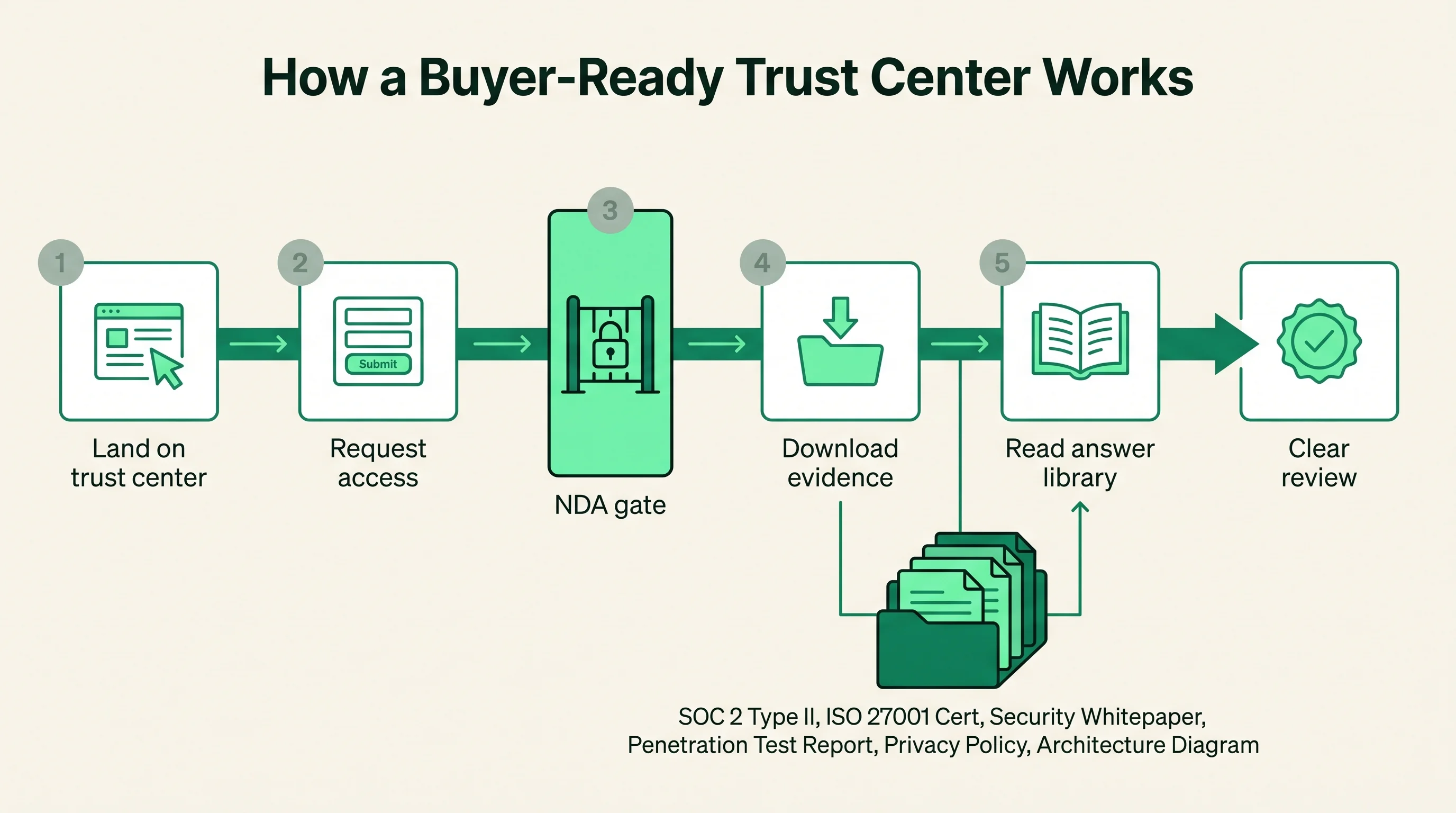
A buyer-ready trust center works by moving evidence to the front of the deal and letting buyers self-serve under an NDA. Instead of answering the same questions per deal, the vendor publishes the answers once and grants controlled access to the artifacts behind them.
The flow is straightforward from the buyer's side: - The buyer lands on the trust center, public or linked from the deal. - The buyer requests access; an NDA gate (click-through or countersigned) unlocks the confidential tier. - The buyer downloads evidence: SOC 2 Type II, ISO 27001, pen-test summary, policies, subprocessor list, data-flow detail. - The buyer reads the answer library for common questions, often structured against CAIQ or SIG. - The buyer closes the review, or sends a short residual questionnaire for the few items the portal did not cover.
Behind the page, a GRC or customer trust team keeps it current. Evidence is refreshed on the audit cycle, the answer library is updated as questions recur, and access is logged so the vendor knows who viewed what. Platforms such as SafeBase, Vanta, Conveyor, and TrustCloud automate the gating, access logging, and answer reuse so the team is not doing it by hand.
One detail separates a working trust center from a decorative one: the answer library and the evidence have to describe the same controls in the same way. When the library says one thing and the SOC 2 report implies another, a sharp reviewer notices, loses confidence, and sends the questionnaire anyway.
The mechanism only works if the answer library and the evidence stay synchronized with reality. A current page deflects questionnaires. A stale one invites them.
Why a buyer-ready trust center matters
A buyer-ready trust center matters because it removes the most expensive friction in an enterprise deal: the back-and-forth security questionnaire. Each custom questionnaire pulls a sales engineer, a GRC analyst, and often a subject-matter expert into days of copying, pasting, and reformatting answers that already exist.
The pain is concrete and repetitive: - Deals stall while security review sits in a queue on both sides. - Answers go stale, so the same control gets described three different ways across three deals. - Subject-matter experts get pulled off engineering work to confirm answers they already confirmed last quarter. - Buyers wait, lose trust, and sometimes pick a vendor that cleared review faster.
The contrast is clearest side by side:
| Dimension | Questionnaire-first | Buyer-ready trust center |
|---|---|---|
| Buyer access to evidence | Request, wait, repeat | Self-serve under NDA |
| Answer freshness | Re-keyed per deal | Maintained once, reused |
| SME load | High, recurring | Low after setup |
| Deal impact | Review becomes the bottleneck | Review runs in parallel |
When the front door is complete and current, most buyers never send the questionnaire. That is the entire point, and the whole return on the effort. For the deeper mechanics of handling what still gets through, see security questionnaire automation.
Where a trust center sits next to adjacent surfaces
A trust center is the deflection layer; it sits in front of questionnaire automation, RFP response, and TPRM rather than replacing any of them. Each surface handles a different stage of the same trust workflow, and buyers should not expect one to do another's job.
The distinctions matter when you are choosing what to build or buy:
| Surface | What it does | When it is used |
|---|---|---|
| Trust center | Publishes evidence and answers for self-serve review | Front of the deal, before a questionnaire |
| Questionnaire automation | Generates answers to inbound custom questionnaires | When a buyer sends one anyway |
| RFP response | Assembles narrative bids for procurement | Competitive sales, not security review |
| TPRM | Buyer-side program for assessing vendor risk | On the buyer's side of the table |
A trust center and questionnaire automation are complements, not rivals. The trust center cuts questionnaire volume; automation handles the residual. Many platforms ship both, which is why the line blurs in vendor marketing. For a full treatment of how the two divide the work, see where security questionnaire automation and trust centers each fit.
Keep the surfaces distinct in your own planning. A trust center reduces inbound. It does not assess your vendors, and it does not write your RFP.
The confusion is worth naming because it drives bad buying decisions. Teams sometimes buy a trust center expecting it to replace their questionnaire response process, then find that enterprise buyers still send questionnaires the portal cannot fully answer. Others buy questionnaire automation and skip the trust center, leaving the deflection layer empty so every deal starts with an inbound request. The clean model treats the trust center as the front door and automation as the room behind it.
Benefits and tradeoffs of a buyer-ready trust center
The benefit is fewer questionnaires and faster reviews; the tradeoff is the ongoing GRC effort to keep the portal honest. A buyer-ready trust center is worth building when security review is a measurable drag on deals, and not worth it when volume is low.
The benefits are real and compounding: - Lower questionnaire volume as buyers self-serve common answers. - Faster review cycles because evidence is ready on day one. - A single maintained source of truth, so answers stop drifting per deal. - A credible signal: a complete, current portal reads as operational maturity.
The tradeoffs are equally real: - Setup and upkeep fall on GRC and customer trust, and the upkeep never stops. - A stale portal is worse than none. It signals neglect and still triggers a full questionnaire. - NDA gating adds friction; over-gate, and buyers route around it back to the questionnaire. - Enterprise buyers with mandatory internal processes will send their questionnaire regardless.
A trust center is not worth the effort when deal volume is small, when buyers are mostly downmarket and skip security review, or when the team cannot commit to refreshing evidence on the audit cycle. In those cases, a basic evidence page plus questionnaire automation covers the need. Build the full portal when the questionnaire is the bottleneck and you have an owner who will keep it current.
How to evaluate or build a buyer-ready trust center
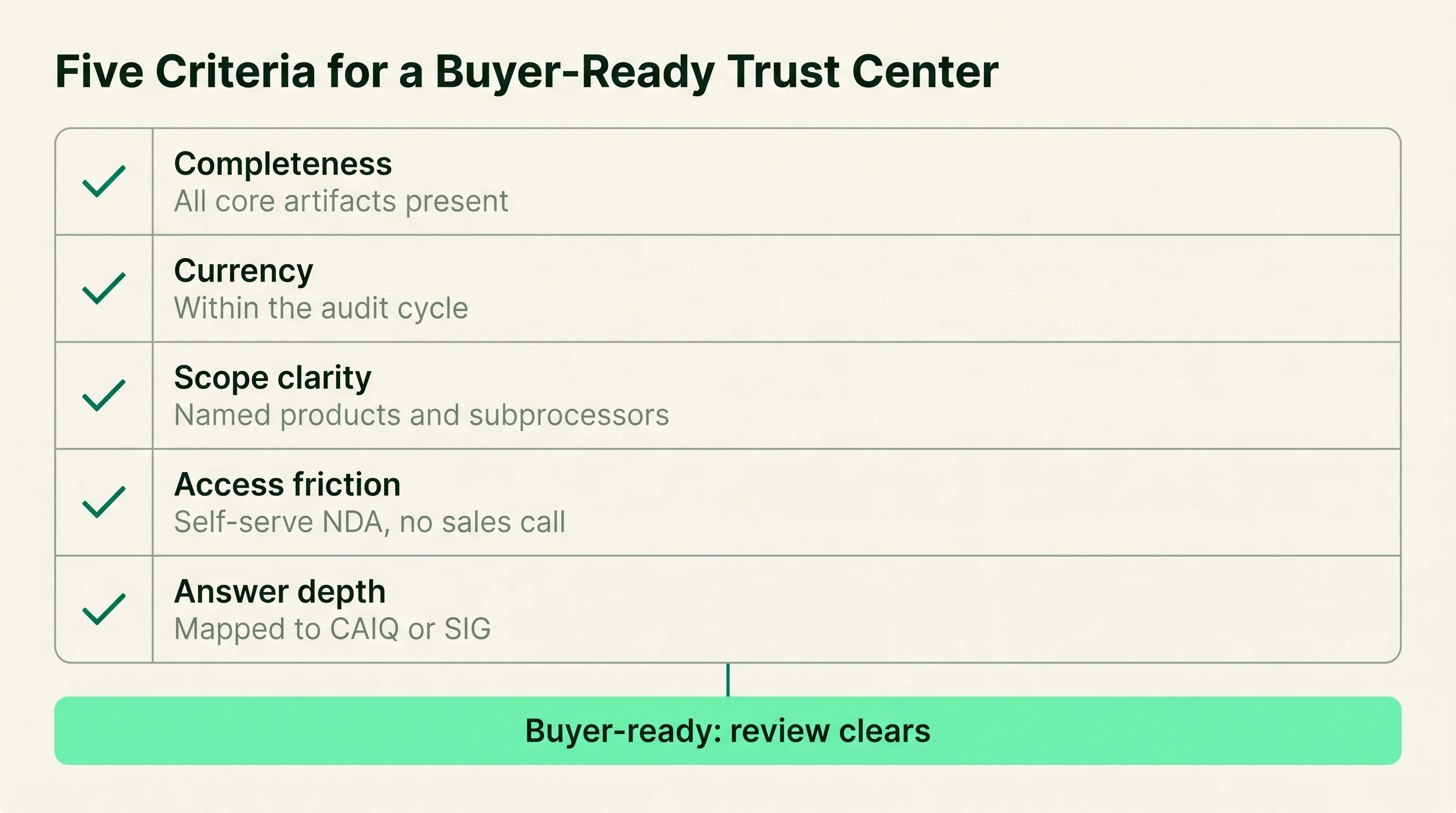
Evaluate a trust center on five dimensions: completeness, currency, scope clarity, access friction, and answer depth. Buyers should apply these as a checklist when judging a vendor's portal; sellers should treat them as the build spec, because these are the criteria the buyer's review team uses.
The checklist below is the same on both sides of the table. A buyer scores against it; a seller builds toward it:
| Criterion | What good looks like | Why it matters |
|---|---|---|
| Completeness | SOC 2 Type II, ISO 27001, pen-test summary, core policies all present | Missing any one item triggers a follow-up request |
| Currency | Reports within the audit cycle, dates visible | Stale evidence fails review on its own |
| Scope clarity | Named products, environments, subprocessors | Buyers reject evidence that may not cover the product they buy |
| Access friction | Self-serve NDA, no mandatory sales call | Gating that requires a meeting pushes buyers to the questionnaire |
| Answer depth | Library mapped to CAIQ or SIG, common questions answered | Resolves questions before they become a questionnaire |
Use named platforms as reference points, not endorsements. Vanta and Drata pair trust centers with their compliance automation. SafeBase and Whistic focus on the buyer-facing portal and answer reuse. Conveyor and TrustCloud connect the trust center to questionnaire response so the same answers serve both. Each is vendor-reported on specifics; confirm current capability during evaluation.
Whatever the tool, the test is the same: can a buyer's security team finish the review without contacting you? Browse the trust center software category for the current field, review Conveyor as one connected example, and see the launching a trust center to reduce questionnaires workflow for a build sequence. For the broader category, start with security questionnaire automation.
How this article was reviewed
Sources reviewed
- AICPA — SOC 2Primary source for SOC 2 reporting framework.
- ISO/IEC 27001Information security management system standard referenced as trust center evidence.
- Cloud Security Alliance — CAIQConsensus Assessments Initiative Questionnaire, referenced as an answer-library mapping.
- Shared Assessments — SIGStandardized Information Gathering questionnaire, referenced as an answer-library mapping.
- NISTReferenced as a control-framework reference point.
- Vendor product documentation (Vanta, SafeBase, Conveyor, Whistic, Drata, TrustCloud)Capability claims are vendor-reported, not independently verified.
FAQ
What is a buyer-ready trust center?
A buyer-ready trust center is a vendor evidence portal complete, current, and accessible enough that a buyer's security team can finish its review without sending a custom questionnaire. It carries a current SOC 2 Type II report, ISO 27001 certificate, pen-test summary, and core policies, plus self-serve NDA-gated access and an answer library for common questions. The distinction from an ordinary trust center is operational: it actually clears review, rather than just displaying badges.
Does a trust center replace the security questionnaire?
A trust center reduces questionnaires but does not fully replace them. A complete, current portal lets most buyers self-serve and skip the questionnaire entirely. Enterprise buyers with mandatory internal review processes will still send one, so vendors pair a trust center with questionnaire automation to handle the residual volume that gets through.
What evidence should a trust center include to be buyer-ready?
A buyer-ready trust center includes a current SOC 2 Type II report, an ISO 27001 certificate where applicable, a penetration test summary, core security policies, a subprocessor list, and a data-handling description. It should also include an answer library covering common questions, often mapped to CAIQ or SIG. Every artifact needs a visible date and a clear scope statement, because reviewers reject evidence that is stale or that may not cover the specific product.
Should a trust center be public or gated?
The summary tier can be public; the confidential evidence should sit behind an NDA gate. Public badges and high-level statements build initial trust and aid search. Sensitive artifacts like the full SOC 2 report and pen-test summary belong behind a self-serve NDA that the buyer can clear without a sales call. The gating should add minimal friction, because heavy gating pushes buyers back to the questionnaire.
How do trust center platforms differ?
Trust center platforms differ mainly in whether they lead with compliance automation, the buyer-facing portal, or questionnaire response. Vanta and Drata pair trust centers with their compliance and audit-readiness tooling. SafeBase and Whistic center on the buyer-facing portal and answer reuse. Conveyor and TrustCloud connect the trust center to questionnaire response so one answer set serves both surfaces. These distinctions are vendor-reported, so confirm current capability during evaluation.