

What Is a Continuous Security Posture?
A continuous security posture means keeping always-current, monitored proof that your security controls are working, so you can answer questionnaires and trust centers with fresh evidence instead of stale audit snapshots.
What is a continuous security posture?
A continuous security posture is the practice of keeping always-current, continuously monitored proof that your security controls are operating correctly. It replaces the point-in-time model, where a control is checked once during an annual audit, with ongoing automated monitoring that confirms controls stay in place every day. The goal is fresh evidence: at any moment you can show that encryption is on, access reviews are running, and backups are tested.
The term sits inside the broader discipline of governance, risk, and compliance (GRC). It matters most when a buyer or auditor asks you to prove a claim and you need evidence that reflects today, not a snapshot from nine months ago.
Several roles own and use it:
- GRC and compliance teams own the control framework and the monitoring program.
- Security engineering owns the controls themselves and fixes drift when it is flagged.
- The CISO owns the risk story told to customers and the board.
- Sales engineers and customer trust teams consume the evidence when answering buyer questions.
In short, a continuous security posture turns compliance from a once-a-year event into a steady state you can prove on demand.
How does a continuous security posture work?
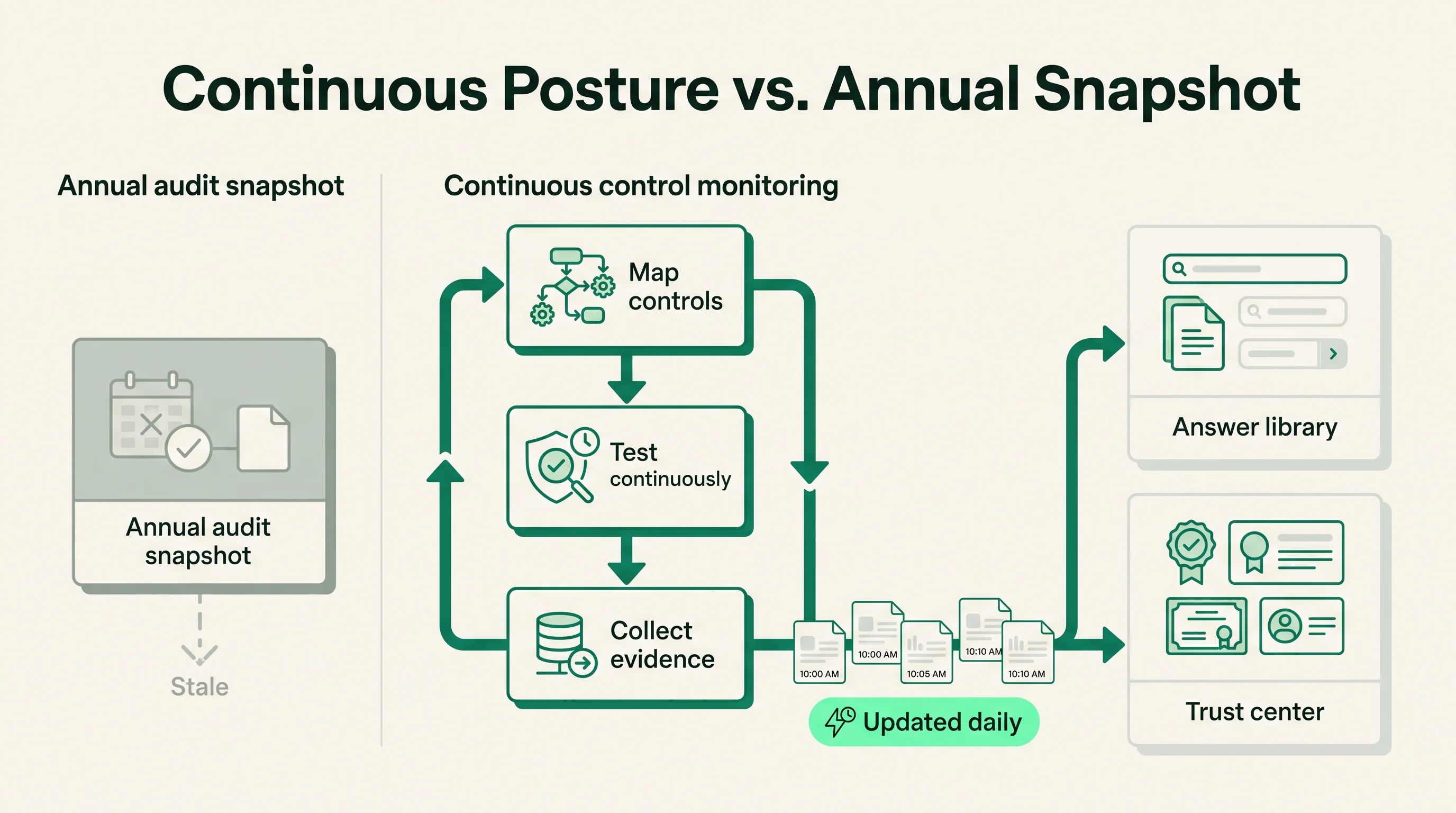
It works through continuous control monitoring: automated checks connect to your systems, pull live signals, and confirm that each control is operating as expected. When a control drifts out of compliance, the system flags it so a person can fix it before an auditor or buyer ever sees the gap.
The mechanism follows a repeatable loop:
- Map controls. Each requirement from a framework like SOC 2 or ISO 27001 is mapped to one or more technical controls.
- Connect sources. Integrations read from cloud providers, identity systems, endpoint tools, code repositories, and ticketing systems.
- Test continuously. Automated checks run on a schedule, often daily, and compare the live state against the expected state.
- Flag and remediate. Failing checks raise alerts and route to an owner with a deadline.
- Collect evidence. Passing checks generate timestamped artifacts that prove the control was working at that point.
The evidence this loop produces does not stay locked in a compliance tool. It feeds the surfaces buyers actually see. Current proof flows into your answer library so questionnaire responses cite live evidence, and into a trust center so buyers can self-serve without filing a request.
The result is a system where evidence is generated as a byproduct of normal operations rather than gathered by hand the week before a deadline.
Why a continuous security posture matters
It matters because point-in-time evidence goes stale, and stale evidence creates real friction in security reviews. When a buyer asks whether your access controls are current, an audit report dated months ago is a weaker answer than a monitoring dashboard updated this morning. Continuous monitoring closes that gap.
The concrete pain it solves is familiar to anyone who has answered enterprise security questionnaires:
- Subject-matter experts get pulled in to confirm controls that should be provable automatically.
- Answers drift out of date between the audit and the next review cycle.
- Deals stall while teams scramble to assemble proof a buyer requested.
- Nobody is sure whether a control held up in the months since the last audit.
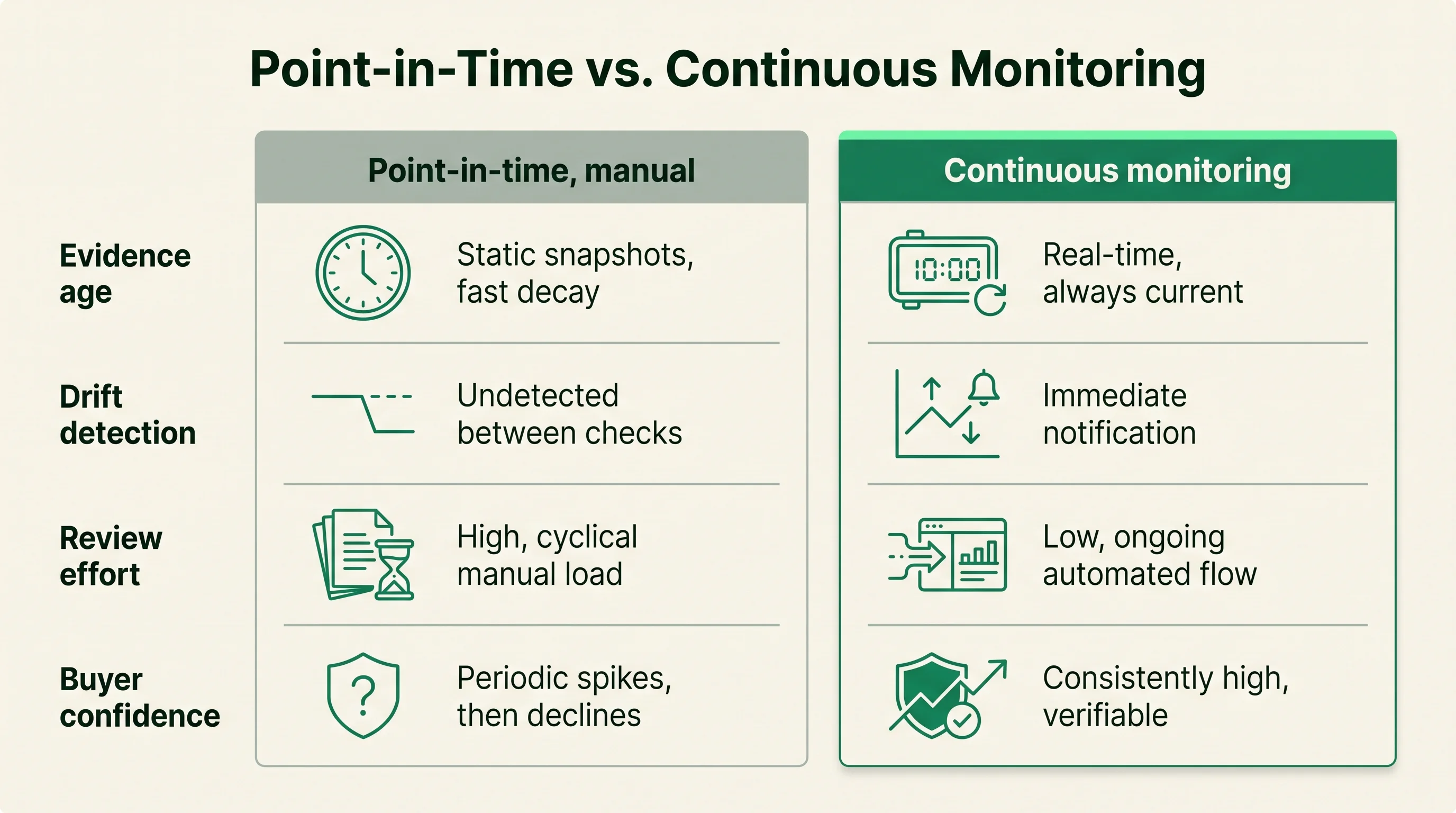
The difference between the manual way and the continuous way shows up across several dimensions:
| Dimension | Point-in-time, manual | Continuous monitoring |
|---|---|---|
| Evidence age | Months old by review time | Updated daily |
| Drift detection | Found at next audit | Found within a day |
| Review effort | Manual evidence gathering | Pull current artifacts |
| Buyer confidence | Snapshot from the past | Proof of present state |
The payoff is straightforward: fewer fire drills, fresher answers, and a defensible story when a buyer pushes on the details.
Where it sits next to adjacent surfaces
A continuous security posture is the evidence engine, not the buyer-facing surface. It produces the current proof that questionnaire automation, trust centers, and third-party risk programs all depend on. Confusing the engine with the surfaces it feeds is a common mistake, so it helps to place them side by side.
Each surface plays a distinct role:
| Surface | What it is | How continuous posture connects |
|---|---|---|
| Continuous monitoring | The evidence engine | Generates fresh proof of controls |
| [Questionnaire automation](/categories/security-questionnaire-automation) | Reuses approved answers | Cites current evidence in responses |
| Trust center | Self-serve buyer portal | Publishes live status and reports |
| [TPRM](/glossary/third-party-risk-management) | Assessing your own vendors | Consumes the proof you collect |
The relationship runs in one direction. Monitoring produces evidence; the other surfaces consume it. A trust center reduces inbound questionnaires, but it is only credible if the evidence behind it is current.
The practical lesson: you still need a way to publish and reuse evidence. Continuous monitoring makes that evidence trustworthy, but it does not replace the questionnaire or trust center layers. For more on how those layers divide the work, see where questionnaire automation and trust centers each fit.
Benefits and tradeoffs of a continuous security posture
The benefit is fresh, defensible evidence that cuts review effort and shortens deals. The tradeoff is the cost and operational overhead of running the monitoring program. Both sides are real, and the balance depends on how often buyers ask you to prove your controls.
The benefits are concrete:
- Evidence reflects the present, so questionnaire and trust center answers stay current without manual updates.
- Control drift surfaces within a day instead of at the next audit.
- Review cycles shorten because proof is pulled, not assembled.
- The audit itself gets easier, since evidence is already organized and timestamped.
The tradeoffs deserve equal honesty:
- Monitoring tools carry real subscription cost, often scaling with headcount or cloud footprint.
- Integrations require setup and maintenance as your stack changes.
- Noisy or misconfigured checks create alert fatigue and erode trust in the dashboard.
- The tool proves controls exist; it does not design good controls for you.
There are cases where it is not worth it. A small company with few security reviews and a simple stack may get more value from a clean annual audit and a basic answer library than from a continuous monitoring subscription. The practice earns its cost once review volume is high enough that stale evidence is actively slowing deals.
How to evaluate or implement a continuous security posture
Evaluate a continuous security posture program on four things: monitoring coverage, evidence freshness, framework mapping, and how cleanly evidence flows into the surfaces buyers see. A tool that monitors well but cannot export proof into a questionnaire or trust center leaves the most painful work undone.
Use these criteria as a checklist:
| Criterion | What good looks like | Why it matters |
|---|---|---|
| Coverage | Cloud, identity, endpoints, code | Gaps become blind spots |
| Freshness | Daily checks, timestamped proof | Stale proof is weak proof |
| Framework mapping | SOC 2, ISO 27001, NIST, CAIQ | Maps work to requirements |
| Evidence export | Feeds answer library and trust center | Closes the buyer-facing loop |
| Drift handling | Clear owners and deadlines | Alerts without action are noise |
The vendor landscape splits into two groups. Compliance and monitoring platforms such as Vanta, Drata, Secureframe, and TrustCloud focus on the evidence engine: control mapping, continuous checks, and audit readiness. Trust and questionnaire platforms such as SafeBase, Whistic, and Conveyor focus on publishing and reusing that evidence with buyers. Some products reach across both, but the split is a useful mental model. Treat all capability claims as vendor-reported until you test them in a trial.
Start by listing the frameworks your buyers ask about, confirm a tool monitors the controls behind them, then verify how evidence exports into your questionnaire automation and trust center stack. That last step is where many programs stall, and it is the one buyers feel most.
How this article was reviewed
Sources reviewed
- AICPA SOC 2Standards body for SOC 2 reporting; control framework reference.
- ISO/IEC 27001International standard for information security management systems.
- Cloud Security Alliance (CAIQ)Publisher of the Consensus Assessments Initiative Questionnaire.
- Shared Assessments (SIG)Publisher of the Standardized Information Gathering questionnaire.
- NISTSource for security control frameworks referenced in monitoring programs.
- Vendor product documentationCapability descriptions for Vanta, Drata, Secureframe, TrustCloud, SafeBase, Whistic, and Conveyor are vendor-reported and should be verified in a trial.
FAQ
What is a continuous security posture?
A continuous security posture is the practice of keeping always-current, continuously monitored proof that your security controls are operating, instead of relying on a single point-in-time audit. Automated checks confirm controls daily and flag drift quickly. The result is fresh evidence you can show buyers and auditors at any moment.
What are the most common mistakes when implementing a continuous security posture?
The most common mistake is treating the monitoring tool as the finish line and never connecting its evidence to the surfaces buyers see, such as a questionnaire answer library or a trust center. Two others are tolerating noisy checks that train people to ignore alerts, and assuming the tool designs good controls rather than just verifying the ones you have. Fix all three by mapping controls carefully, tuning alerts, and wiring evidence export early.
How does a continuous security posture compare to doing it manually or with spreadsheets?
Manual and spreadsheet tracking captures a control at one moment, then goes stale until someone updates it by hand. A continuous posture checks controls automatically on a schedule, so evidence reflects the present and drift surfaces within a day. The manual approach can work for a small stack with few reviews, but it scales poorly once questionnaire volume rises.
How do you get leadership buy-in for a continuous security posture?
Frame it in revenue and risk terms, not compliance terms. Show how often deals stall while teams assemble stale proof, and how much subject-matter-expert time goes to confirming controls that should be automatic. Pair that with the risk of a control drifting unnoticed between audits. Leadership tends to fund the program when it is tied to deal velocity and avoided incidents rather than to passing an audit.
What is the typical implementation timeline for a continuous security posture?
Initial setup of a monitoring platform commonly takes a few weeks to a couple of months, depending on stack complexity and how many integrations you connect. Reaching steady-state, where evidence flows cleanly into questionnaires and a trust center, usually takes longer because it touches process and ownership, not just tooling. Plan for a phased rollout rather than a single launch date.