Continuous Trust vs. Point-in-Time Compliance
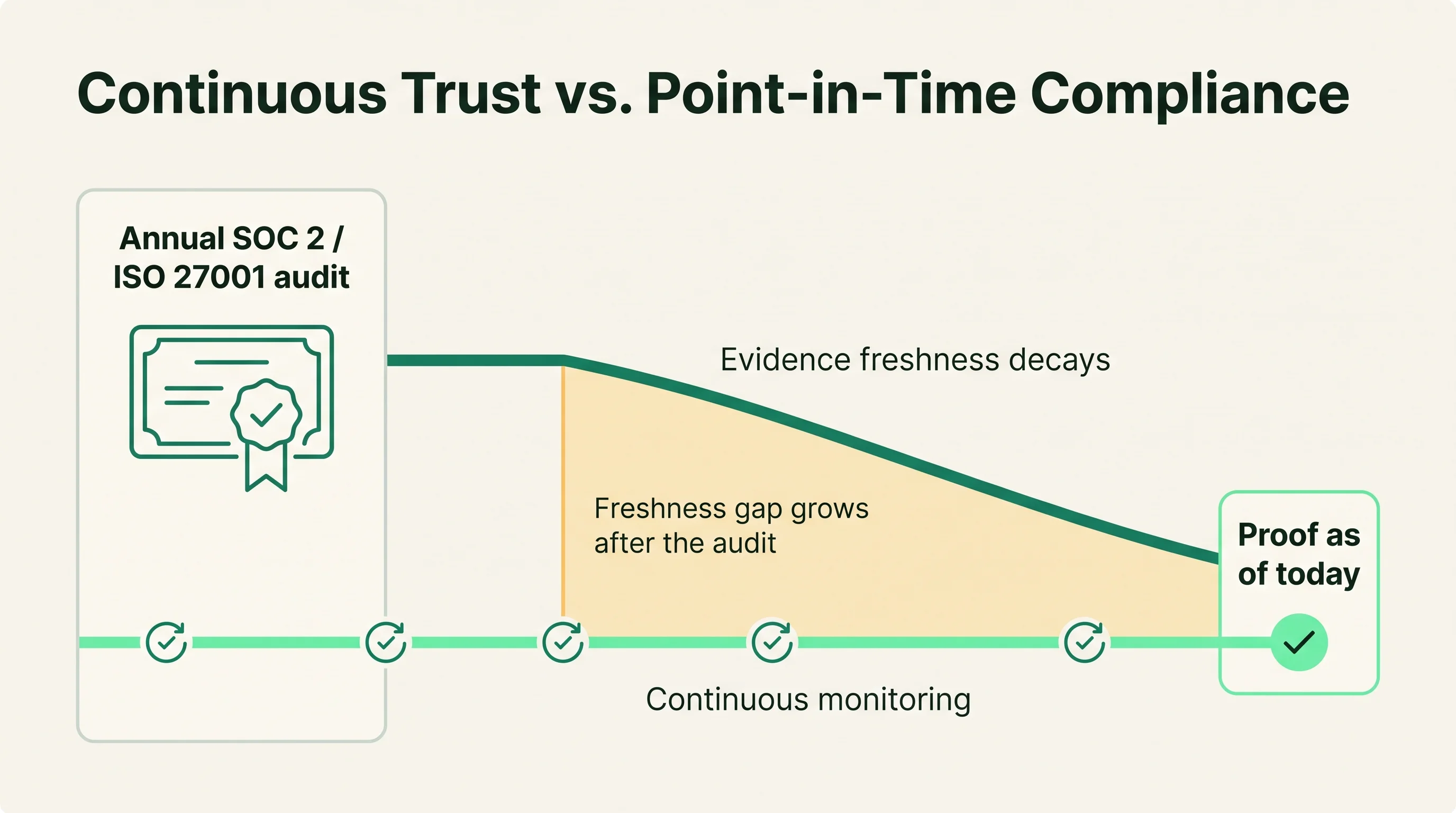
Point-in-time compliance is a snapshot: an annual SOC 2 or ISO 27001 audit that proves your posture on the days it was tested. Continuous trust keeps that proof current, monitoring controls and refreshing evidence between audits so a trust center and answer library never go stale. They are not rivals. The audit is the anchor, and continuous monitoring keeps it honest.
Quick answer: continuous trust vs. point-in-time compliance
Point-in-time compliance proves your security posture on the days an auditor tested it. Continuous trust proves that posture is still true today. Point-in-time means an annual SOC 2 or ISO 27001 audit that produces a report or certificate. Continuous trust means always-current, monitored proof kept fresh in a trust center and answer library so buyers and questionnaires can rely on it between audits.
The right approach depends on your buyers, your formats, and your team. A company whose buyers accept a current SOC 2 report as sufficient proof can run on point-in-time compliance alone. A company whose buyers send frequent questionnaires, ask for recent evidence, or expect a trust center that reflects today's controls needs continuous trust on top of the audit.
These are not competing choices so much as two layers of one assurance posture. The audit is the authoritative anchor; continuous monitoring keeps the proof between audits honest. Most GRC (governance, risk, and compliance), compliance, and customer trust teams keep the annual audit and add continuous trust to close the gap it leaves.
The shift toward continuous evidence is buyer-driven. Security reviewers and questionnaires increasingly ask not just whether you hold a certificate but whether your controls are operating now, and a CISO signing off on a vendor wants proof that reflects current state. The rest of this comparison covers where each is stronger, what each costs in effort and tooling, and how teams move from a snapshot to always-current proof without discarding the audit.
Continuous trust vs. point-in-time compliance: at a glance
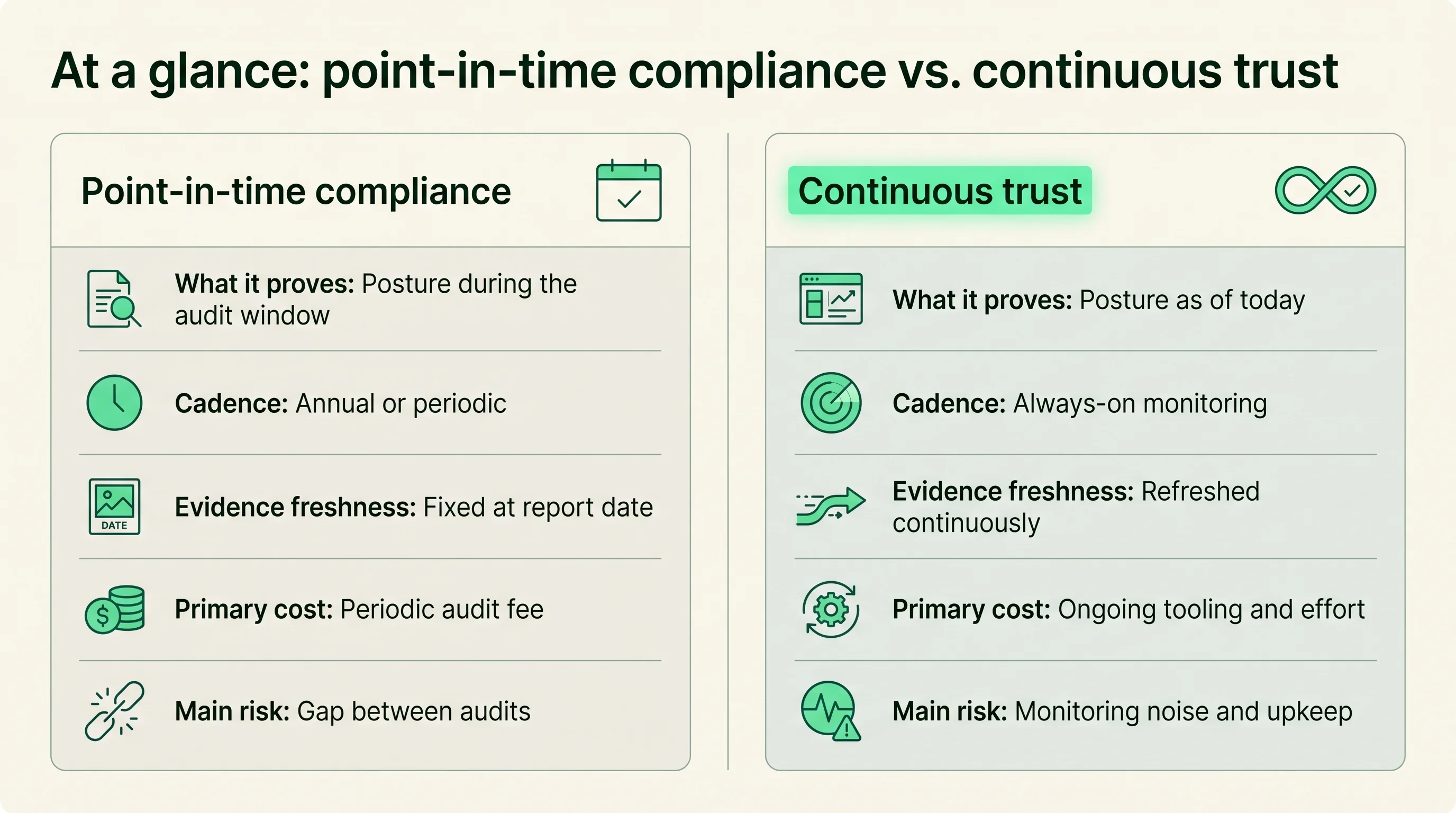
The clearest way to separate the two is by what they prove and when. A point-in-time audit proves your posture across an audit window; continuous trust proves it is current right now. The table below compares them across the criteria that matter when you decide how much of each to invest in. Both rest on the same controls and evidence, which is why they reinforce each other rather than compete.
| Criterion | Point-in-time compliance | Continuous trust |
|---|---|---|
| What it proves | Posture during the audit window | Posture as of today |
| Cadence | Annual or periodic | Always-on monitoring |
| Authority | Independent auditor opinion | Self-reported, monitored |
| Evidence freshness | Fixed at report date | Refreshed continuously |
| Buyer experience | Send the report on request | Self-serve current proof |
| Questionnaire impact | Answered from a static report | Deflected by a live trust center |
| Primary cost | Periodic audit fee | Ongoing tooling and effort |
| Primary owner | Compliance, GRC | Customer trust, GRC |
| Main risk | Gap between audits | Monitoring noise and upkeep |
The pattern across every row is snapshot versus always-current. A point-in-time audit gives you an authoritative but aging proof; continuous trust keeps proof fresh but carries no independent opinion on its own. Neither replaces the other, because buyers want both the auditor's weight and evidence that is current. The sections that follow expand on where each is genuinely stronger.
Where point-in-time compliance is stronger
Point-in-time compliance is stronger wherever buyers want an independent opinion, not a self-reported claim. An auditor's signature on a SOC 2 Type II report or an accredited ISO 27001 certificate carries weight that no internal dashboard matches. That authority is the work an audit exists to produce, and continuous monitoring does not replace it.
The concrete strengths center on credibility and scope:
- Independent attestation, where a licensed CPA firm issues a SOC 2 report or an accredited body certifies ISO 27001, so the proof is third-party, not self-asserted
- A defined audit scope and period, so buyers know exactly which controls were tested and over what window
- SOC 2 Type II coverage of operating effectiveness across a period, not just design at a single moment, which a Type I report covers
- Recognized frameworks buyers already trust, including AICPA SOC 2, ISO/IEC 27001, and NIST control mappings, so the proof needs little explanation
- A portable artifact, since one report answers many buyers' baseline due-diligence requests without custom work
- Regulatory and procurement fit, because many regulated buyers must collect a formal report or certificate for their own records
The tradeoff is time. A report describes the audit window and grows older every day after it; the moment the period ends, a gap opens between what the report says and what is true now. A control could fail the week after fieldwork closes, and the report would still read clean until the next cycle. That gap is exactly what continuous trust addresses. Point-in-time compliance remains the authoritative anchor, but a buyer reading a report from ten months ago is trusting that nothing material has changed since.
The practical implication is that a point-in-time audit is necessary but not sufficient for buyers who care about current state. It answers the baseline due-diligence question well, then ages until the next audit refreshes it. Our explainer on external assurance covers what an audit opinion does and does not certify, which matters because buyers often read more into a report than its scope supports.
Where continuous trust is stronger
Continuous trust is stronger wherever freshness and self-serve matter, especially when buyers send frequent questionnaires or expect proof that reflects today. A point-in-time report proves the past; continuous monitoring shows that controls are still operating now. That closes the gap a static audit leaves and reduces how often buyers ask for more.
The strengths concentrate on currency and review load:
- Always-current evidence, where control monitoring and automated checks refresh proof between audits instead of freezing it at the report date
- Lower questionnaire volume, because a live trust center lets buyers self-serve evidence that is current rather than forcing a custom request
- Faster answers, since an answer library kept in sync with monitored controls drafts responses from proof that is already up to date
- Early gap detection, where continuous control monitoring flags a failed check before the next audit does, so issues surface in days rather than months
- A consistent buyer narrative, because the trust center, answer library, and audit all draw on the same current evidence
- Audit readiness, since monitoring that runs all year reduces the scramble to collect evidence when the next audit begins
The monitoring and accuracy claims deserve scrutiny. Vanta, Drata, and Secureframe describe continuous control monitoring, and SafeBase and Conveyor describe live trust centers; those capabilities and any coverage figures are vendor-reported, not independent audit opinions. Continuous trust monitors your own controls and reports the result; it does not certify them the way an auditor does. That distinction is the core limit of the approach. A green dashboard is a self-reported claim, and a buyer who values independence still wants the auditor's signature behind it.
The payoff shows up in questionnaire and review load. When buyers can see current, monitored evidence in a trust center, fewer of them send a form to ask what the report already shows, and the forms that still arrive can be answered from an answer library that cites proof as of today. Our explainer on continuous trust management covers the operating model, and the trust center glossary entry defines the surface it keeps fresh. The category hub for trust center software collects the tools that publish this layer.
How do continuous trust and point-in-time compliance differ in cost and tooling?
The two layers cost differently and demand different effort, in kind rather than degree. Point-in-time compliance is a periodic professional-services expense; continuous trust is an ongoing tooling and operations expense. Neither has fixed public figures, so treat any specific number a vendor or audit firm quotes as their own and confirm it in procurement.
The cost and effort models compare roughly as follows:
| Dimension | Point-in-time compliance | Continuous trust |
|---|---|---|
| Cost shape | Periodic audit fee | Recurring tooling subscription |
| Scales with | Audit scope and frequency | Controls monitored and seats |
| Main effort | Evidence collection at audit time | Continuous monitoring and upkeep |
| Time to value | One audit cycle | Phased, grows with coverage |
Implementation effort splits along the same line. A point-in-time audit concentrates work into a defined window: scope the controls, collect evidence, complete fieldwork with the auditor, and receive the report. Continuous trust spreads work across the year: connect monitoring to your systems, define which controls are watched, tune alerts so they signal real drift rather than noise, and keep the trust center and answer library current.
A few notes that affect total cost beyond the headline price:
- A point-in-time audit recurs, so the fee is annual, not one-time, and scope creep raises it
- Continuous monitoring needs tuning, or false alerts create noise that teams learn to ignore
- A trust center and answer library decay without upkeep, so the tooling cost includes the people maintaining content
- Running both can share evidence collection, since monitoring that runs all year makes the next audit's evidence gathering lighter
The model difference matters more than any single quote, because it changes how cost grows. An audit fee scales with scope and frequency; continuous trust scales with how many controls you monitor and how many people maintain the proof.
How to move from a snapshot to continuous trust
Most teams do not replace the audit; they add continuous trust around it. Keep the annual SOC 2 or ISO 27001 audit as the anchor, then layer monitoring and a live trust center on top so the proof stays current between report dates. The goal is one set of evidence that feeds the audit, the trust center, and the answer library at once.
A practical sequence looks like this:
- Keep the audit as the anchor, since the independent opinion is what continuous monitoring cannot produce on its own
- Map your controls to the framework you are audited against, so monitoring watches the same controls the auditor tests
- Connect continuous control monitoring to the systems behind those controls, then tune alerts to flag real drift
- Publish current evidence in a trust center so buyers self-serve proof that reflects today, not the last report date
- Keep the answer library in sync with monitored controls, so drafted questionnaire answers cite current evidence
- Use the year-round evidence to make each audit lighter, turning monitoring into audit readiness rather than a separate task
The sequencing rule is simple: if buyers accept your current report and questionnaire volume is low, the audit alone may be enough for now. If buyers ask for recent evidence, send frequent questionnaires, or expect a trust center that reflects today, add continuous trust to close the gap the snapshot leaves. The workflow for launching a trust center to reduce questionnaires walks through standing up the self-serve layer, and our guide on how enterprise buyers evaluate security questionnaire automation tools covers what those buyers actually check. When you are ready to shortlist tooling, start from the security questionnaire automation category and the trust center software category.
How this article was reviewed
Sources reviewed
- AICPA - SOC 2 (Type I and Type II)Primary source for what a SOC 2 Type I and Type II report attests, including design versus operating effectiveness over an audit period.
- ISO/IEC 27001Primary source for the information security management standard and the accredited certification cited as point-in-time proof.
- NIST Cybersecurity FrameworkReference framework buyers cite when mapping the controls that both an audit tests and continuous monitoring watches.
- Vendor product documentation (Vanta, Drata, Secureframe, SafeBase, Conveyor)Continuous control monitoring and live trust center capabilities, plus any coverage or freshness figures, are vendor-reported and should be tested against your own controls and buyer mix, not treated as independent audit opinion.
FAQ
Is continuous trust or point-in-time compliance better?
Neither is universally better; they prove different things and most teams need both. Point-in-time compliance is better when your buyers want an independent auditor's opinion, because a SOC 2 or ISO 27001 report carries weight that self-reported monitoring cannot match. Continuous trust is better when buyers expect evidence that reflects today, because monitoring and a live trust center keep proof current between audits. The common pattern is to keep the audit as the anchor and add continuous trust to close the gap it leaves once the report is issued.
What are the most common mistakes when adding continuous trust to point-in-time compliance?
The most common mistake is treating continuous monitoring as a substitute for the audit rather than a layer around it, which removes the independent opinion buyers actually want. A second is leaving alerts untuned, so monitoring noise trains the team to ignore real control drift. A third is letting the trust center and answer library fall out of sync with monitored controls, so buyers self-serve stale evidence that the audit and monitoring already contradict. Keep the audit as the anchor, tune monitoring to signal real change, and maintain one shared evidence set.
How does continuous trust compare to managing compliance manually with spreadsheets?
Manual, spreadsheet-based compliance can produce an audit, but it cannot keep proof current between audits at any scale. A spreadsheet captures evidence at a moment and goes stale immediately, so a buyer asking for recent proof gets a snapshot that is already aging. Continuous trust replaces that periodic, manual collection with monitoring that refreshes evidence as controls change and publishes it where buyers self-serve. The audit still anchors both approaches, but continuous trust removes the gap and the recurring scramble that manual collection leaves behind.
How do you get leadership buy-in for investing in continuous trust beyond the audit?
Tie continuous trust to questionnaire and review load, sales-cycle speed, and audit readiness, not to compliance for its own sake. Show how many security questionnaires and follow-up requests current, self-serve evidence could deflect, and how often deals stall waiting on fresh proof. Pair that with the reduced scramble at audit time, since monitoring that runs all year makes evidence collection lighter. Present these as trends rather than precise figures, and frame the audit as the anchor that continuous trust protects, so leadership sees a complement to existing spend, not a replacement.
What is a realistic timeline for moving from point-in-time compliance to continuous trust?
Expect a phased rollout rather than a single launch, because coverage grows control by control. Connecting continuous control monitoring to your core systems and tuning the first alerts is the early work, followed by publishing a trust center and syncing the answer library to monitored controls. Each phase adds value on its own, so buyers see current evidence before full coverage is in place. The audit cadence is unchanged throughout, since continuous trust wraps the existing audit rather than altering its schedule, and the practical pace depends on how many controls and systems you bring under monitoring.