

What Is Cascade Inference Failure in AI Questionnaire Response?
When an AI questionnaire tool builds new answers on top of its own earlier mistakes, one wrong response can quietly contaminate a dozen related ones. Here is how cascade inference failure happens, where it concentrates, and how to catch it.
What is cascade inference failure in AI questionnaire response?
Cascade inference failure is when an AI security questionnaire tool produces one incorrect answer, then reuses or infers from that incorrect answer to generate related answers, spreading a single mistake across a connected set of responses. The result is a group of answers that agree with each other and read as confident, but share the same wrong root. Because they are internally consistent, a reviewer skimming for contradictions will not flag them.
The term combines two ideas. "Inference" is the model drawing a new answer from existing context, including its own earlier output. "Cascade" is that error flowing downstream into every answer that depends on it.
- It is not a single hallucination. A lone wrong answer is easier to spot because nothing else props it up.
- It is not stale answer library drift on its own, though a stale answer can seed a cascade.
- It is the propagation: the same error showing up in encryption, data retention, and subprocessor questions because all three inferred from one wrong claim about where data lives.
The people who own this risk are the same ones who own questionnaire accuracy: GRC and security teams who approve answers, sales engineers who send them, and the CISO who is accountable when a customer's third-party risk team finds the discrepancy. For the broader category, see our explainer on security questionnaire automation.
How does cascade inference failure happen?
It happens because AI questionnaire tools answer questions in context, and that context often includes the tool's own earlier answers or a knowledge base entry that is already wrong. The model does not re-verify each fact from primary evidence. It treats the nearest plausible source as settled and moves on.
A typical sequence looks like this:
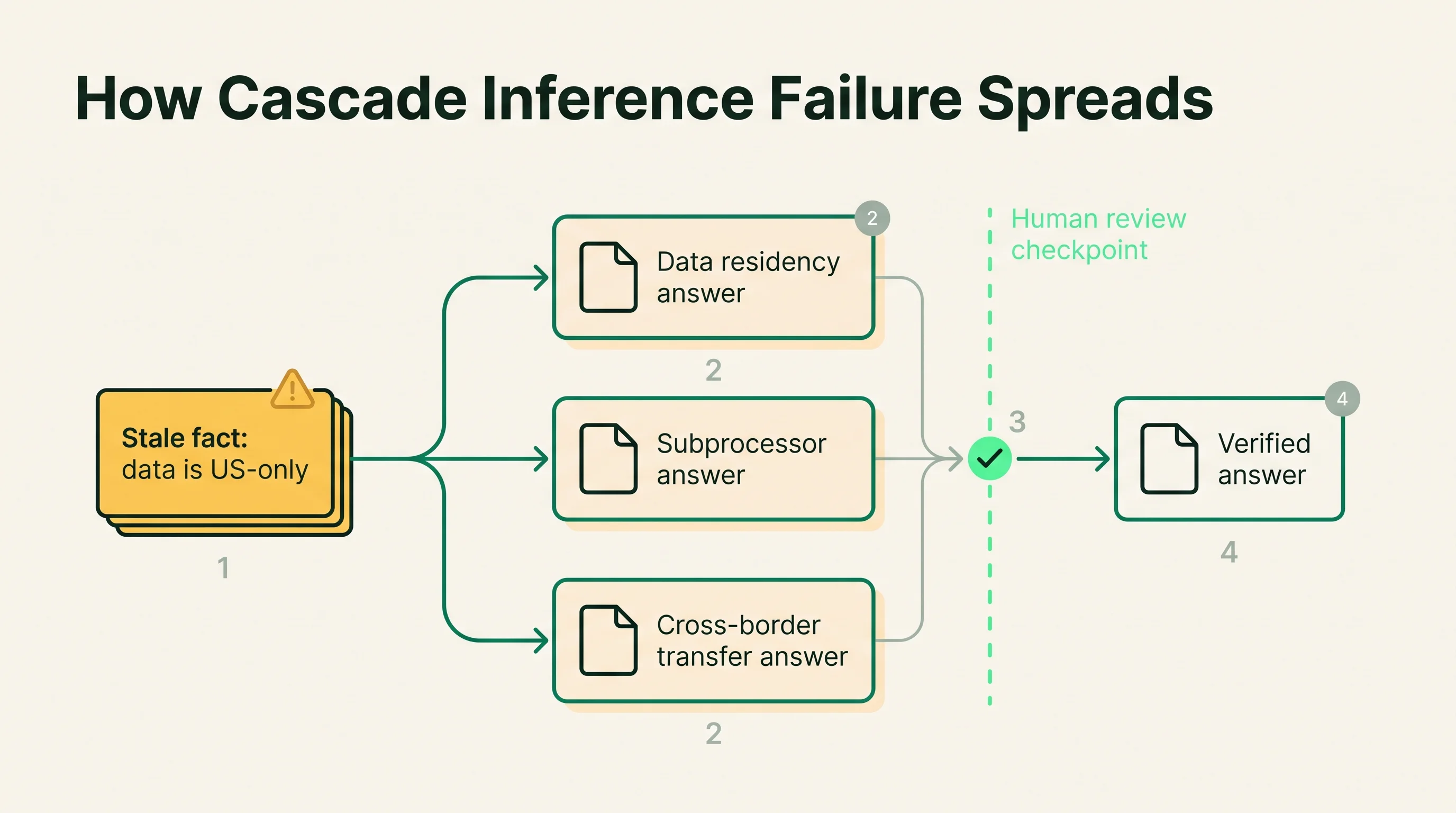
- An early question gets a wrong answer. Maybe the answer library says data is stored only in the US, but a new region was added last quarter and nobody updated the entry.
- A later question about data residency infers from that entry and repeats the US-only claim.
- A subprocessor question reasons that if data is US-only, the EU subprocessor must not handle production data, and answers accordingly.
- A cross-border transfer question concludes no transfers occur, because the chain of prior answers implies it.
One stale fact has now produced four wrong answers that reinforce one another. Each new answer made the wrong premise look more credible.
Two design choices make this worse. First, tools that pass prior answers into the prompt for consistency will happily propagate a wrong prior. Second, an answer library that lacks fresh evidence or citations gives the model no way to catch its own drift. The closing point is simple: cascade inference failure is a consequence of reuse without re-verification.
Why cascade inference failure matters more than a single wrong answer
It matters because the failure mode is engineered to evade the exact review most teams run. Reviewers look for answers that contradict each other or read as obviously implausible. Cascaded errors do neither. They agree, they sound confident, and they pass a consistency check while being uniformly wrong.
The downstream cost lands in real deals. A prospect's TPRM team spots that your data residency answer conflicts with your DPA, and now the whole response is suspect. One propagated error can stall a procurement cycle and force a full re-review.
| Failure mode | How review usually catches it | Why cascade slips through |
|---|---|---|
| Single hallucination | Looks odd, contradicts other answers | A cascade has no internal contradiction |
| Stale single answer | Caught when SME reads that one line | Cascade hides the stale fact behind derived answers |
| Cascade inference failure | Often not caught by skim review | Errors agree and reinforce each other |
The practical takeaway: spot-checking a sample of answers is a weak control against cascades, because a cascade can poison a whole section while leaving every individual line looking reasonable.
Which questionnaire sections carry the highest cascade risk?
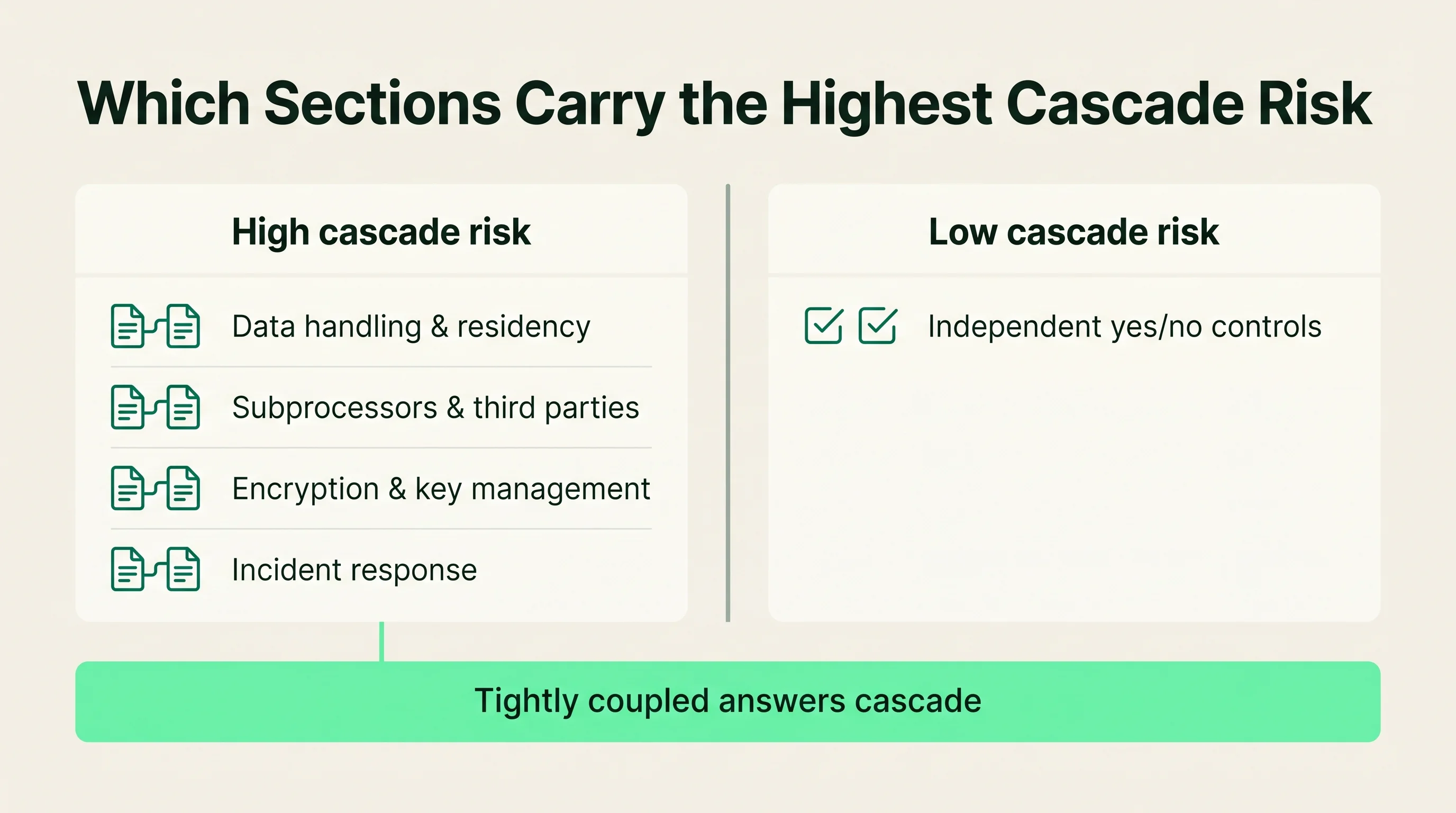
The highest-risk sections are the ones with many interdependent answers, where later questions logically depend on facts established earlier. Independent yes/no controls rarely cascade. Tightly coupled topics do.
- Data handling and residency: location, retention, deletion, and cross-border transfer all chain off where data actually lives.
- Subprocessors and third parties: who they are, what data they touch, and which contractual terms apply depend on each other.
- Encryption and key management: at-rest, in-transit, key custody, and rotation questions reference a shared architecture.
- Access control and authentication: SSO, MFA, role model, and privileged access answers build on one stated identity setup.
- Incident response and breach notification: detection, escalation, timelines, and customer notification form a sequence.
Frameworks with structured, interlocking control families concentrate this risk. A SIG questionnaire or a CAIQ mapped to Cloud Security Alliance domains has many questions that share underlying facts. The same is true for SOC 2 trust services criteria and ISO 27001 Annex A controls. The takeaway: weight your review toward sections where one architectural fact drives many answers, not toward sections with the most questions.
How human review and audit logging catch cascade inference failure
Human review catches cascades when it is organized around dependency chains and answer provenance, not around reading answers top to bottom. A reviewer who verifies the root facts of a section, then checks that dependent answers actually follow from verified evidence, will find a cascade that a line-by-line read misses.
Design the review workflow to expose propagation:
- Require an evidence citation on every generated answer, linking to a document, control, or approved answer library entry.
- Group answers by shared source so a reviewer can see when ten answers all trace to one entry.
- Flag answers the model derived from other answers, rather than from primary evidence, for mandatory SME review.
- Have a security SME, not only a sales engineer, sign off on data, subprocessor, and encryption sections.
Audit logging is what lets you trace a downstream error back to its source after the fact. A useful log records, per answer: the source the model used, whether that source was primary evidence or a prior answer, the model and prompt version, who reviewed it, and what they changed.
| Audit field | What it answers |
|---|---|
| Source reference | Did this come from evidence or another answer? |
| Derivation flag | Was this inferred from prior model output? |
| Reviewer and edit | Who approved it and what changed? |
| Source version | Was the underlying fact current at answer time? |
Vendors including Conveyor, Vanta, SafeBase, Loopio, Responsive, Drata, and SecurityPal describe answer-level citation and review trails in their products. Treat the specifics as vendor-reported and confirm the depth in a demo. The closing point: without source-level logging, you can see that an answer is wrong but not how far the same wrong fact reached.
How to test an AI questionnaire tool for cascade risk
Test for cascade risk by deliberately introducing one wrong fact and measuring how far it spreads before the tool or a reviewer stops it. This is a controlled exercise you can run during a trial, and it tells you more than a generic accuracy benchmark.
Run the test like this:
- Seed one false fact into the answer library or an early answer, such as an incorrect data storage region.
- Run a questionnaire that includes residency, subprocessor, encryption, and transfer questions.
- Count how many downstream answers repeat or build on the seeded error.
- Check whether each wrong answer carries a citation, and whether that citation would let a reviewer catch the problem.
- Correct the seeded fact and confirm the tool re-derives the dependent answers rather than leaving stale copies behind.
Use a short scorecard to compare tools on what actually limits cascades:
| Criterion | What good looks like |
|---|---|
| Answer-level citations | Every answer links to a verifiable source |
| Derivation visibility | Tool marks answers inferred from other answers |
| Source-of-truth control | One fact updates everywhere it is used |
| Audit log depth | Source, version, reviewer, and edit are all recorded |
| Re-derivation on update | Fixing a root fact refreshes dependent answers |
Name your shortlist as reference points and put each through the same seeded-error test. To go deeper on tooling, compare options in AI security questionnaire tools and the broader security questionnaire automation category, and review individual products such as Conveyor and Loopio. The closing point: a tool that reuses context for speed is fine, as long as it also makes propagation visible and lets you fix a root fact in one place.
How this article was reviewed
Sources reviewed
- AICPA SOC 2 Trust Services CriteriaPrimary source for SOC 2 control structure referenced in high-risk section coupling.
- ISO/IEC 27001 Annex A controlsStandards body reference for interlocking control families.
- Cloud Security Alliance CAIQSource for CAIQ structure and mapped domains.
- Shared Assessments SIGSource for SIG questionnaire structure.
- NISTReference for control and risk framing.
- Vendor product documentation (Conveyor, Vanta, SafeBase, Loopio, Responsive, Drata, SecurityPal)Vendor-reported claims for answer-level citation, review trails, and audit logging. Confirm specifics in a demo; not independently verified.
FAQ
How does a single incorrect AI questionnaire answer propagate errors to related questions?
It propagates when the tool reuses or infers from its own earlier output instead of re-verifying each fact against primary evidence. A wrong claim in one answer, such as an incorrect data storage region, becomes the premise the model uses to answer residency, subprocessor, and cross-border transfer questions. Each derived answer inherits the same error and makes it look more credible. The set ends up internally consistent but uniformly wrong.
Which questionnaire sections carry the highest risk of error propagation?
Sections with many interdependent answers carry the most risk, because later questions depend on facts set earlier. Data handling and residency, subprocessors, encryption and key management, access control, and incident response are the usual high-risk areas. Independent yes/no controls rarely cascade. Frameworks with interlocking control families, such as SIG, CAIQ, SOC 2, and ISO 27001, concentrate the risk in tightly coupled topics.
How do you design a human review workflow that catches cascading AI questionnaire errors?
Organize review around dependency chains and evidence provenance, not a top-to-bottom read. Require a citation on every generated answer, group answers by shared source so reviewers can see when many trace to one entry, and flag answers the model derived from prior answers for mandatory SME review. Have a security SME sign off on data, subprocessor, and encryption sections. The goal is to verify root facts first, then confirm dependent answers actually follow from verified evidence.
What audit logging helps trace the source of a downstream questionnaire error?
Log the source of each answer, including whether it came from primary evidence or from a prior model answer. Add a derivation flag for inferred answers, the source version so you know if the underlying fact was current, the model and prompt version, and the reviewer plus any edits. With this, you can trace a wrong answer back to its root and see every other answer that used the same source. Without source-level logging, you can see an error but not how far it reached.
How do you test AI questionnaire tools specifically for cascading error risk?
Seed one false fact, such as an incorrect data storage region, into the answer library or an early answer, then run a questionnaire covering residency, subprocessors, encryption, and transfers. Count how many downstream answers repeat or build on the error, and check whether citations would let a reviewer catch it. Then correct the seeded fact and confirm the tool re-derives dependent answers rather than leaving stale copies. A tool that reuses context for speed is acceptable only if it also makes propagation visible and updates a root fact everywhere it is used.