

Loopio is a better fit for organizations that want one response-management system across RFPs, security questionnaires, sales proposals, and due diligence requests than for teams looking only for a trust-center-first customer assurance product. A security questionnaire manager should evaluate Loopio on content governance, Confidence Pulse and stale-answer controls, SME routing, portal intake, plan-tier fit, and whether the broader proposal workflow creates useful leverage or extra process overhead.
Independent reviewReviewed Jun 2026
Loopio
Is Loopio right for your team?
Loopio helps proposal and response teams manage RFPs, due diligence, security questionnaires, approved answers, and expert review.
Best forOrganizations combining RFP, proposal, due diligence, and security questionnaire response in one process.
Main usersRevenue / proposal operations
Sources reviewed6
Broad response-management workflow for RFPs, proposals, due diligence, and security questionnaires.
Research inputs reviewed for this profile.
Structured integration coverage represented in this profile.
Features, workflow steps, and newer capabilities represented in this profile.
Where Loopio is strongest
These scores reflect the materials reviewed for this page. Use them to plan your demo, not as a product rating.
01
Process coverage
Published support for intake, routing, review, approval, and reuse.
02
Integrations
Published CRM, collaboration, document, API, and knowledge connections.
03
Enterprise controls
Published SSO, roles, audit, and rollout controls.
Source coverageAmount of public product information available for review.
4/10
AI answer supportPublished support for drafting, checking, and approving answers.
7/10
Process coveragePublished support for intake, routing, review, approval, and reuse.
10/10
Portal supportSupport for customer portals and nonstandard questionnaire formats.
5/10
Trust centerDocument sharing, access controls, and customer self-service.
3/10
IntegrationsPublished CRM, collaboration, document, API, and knowledge connections.
10/10
Enterprise controlsPublished SSO, roles, audit, and rollout controls.
9/10
Customer evidencePublished customer stories, product screenshots, and supporting sources.
8/10
Pricing and rollout at a glance
Quote-based subscription
Loopio publishes Foundations, Enhanced, and Enterprise plan names plus add-ons, but final pricing is custom quote-based.
Expect work to clean the answer library, set security SME ownership, define review cadence, configure project workflows, and align proposal and security governance.
Confirm who owns source cleanup, reviewer setup, and integrations.
Original-format export for Excel, PDF, and document projects.
Public review themes include export-formatting cleanup; test export fidelity and ask how the answer library exports at contract end.
What Loopio does
Loopio positions security questionnaire automation as part of its broader response-management platform. Official materials describe AI-assisted answers based on secure, vetted content from internal experts, a governed answer library, SmartScan for questionnaires in PDFs, Excel, and portals, Confidence Pulse for content freshness, and SME workflows for review and deadlines.
For security teams, the practical question is whether Loopio will be the system of record for all response content or only a security-questionnaire tool. The platform is likely most valuable when proposal, sales engineering, and InfoSec teams already share response work and need a common library, governance model, project workflow, and integration layer.
Product screenshots
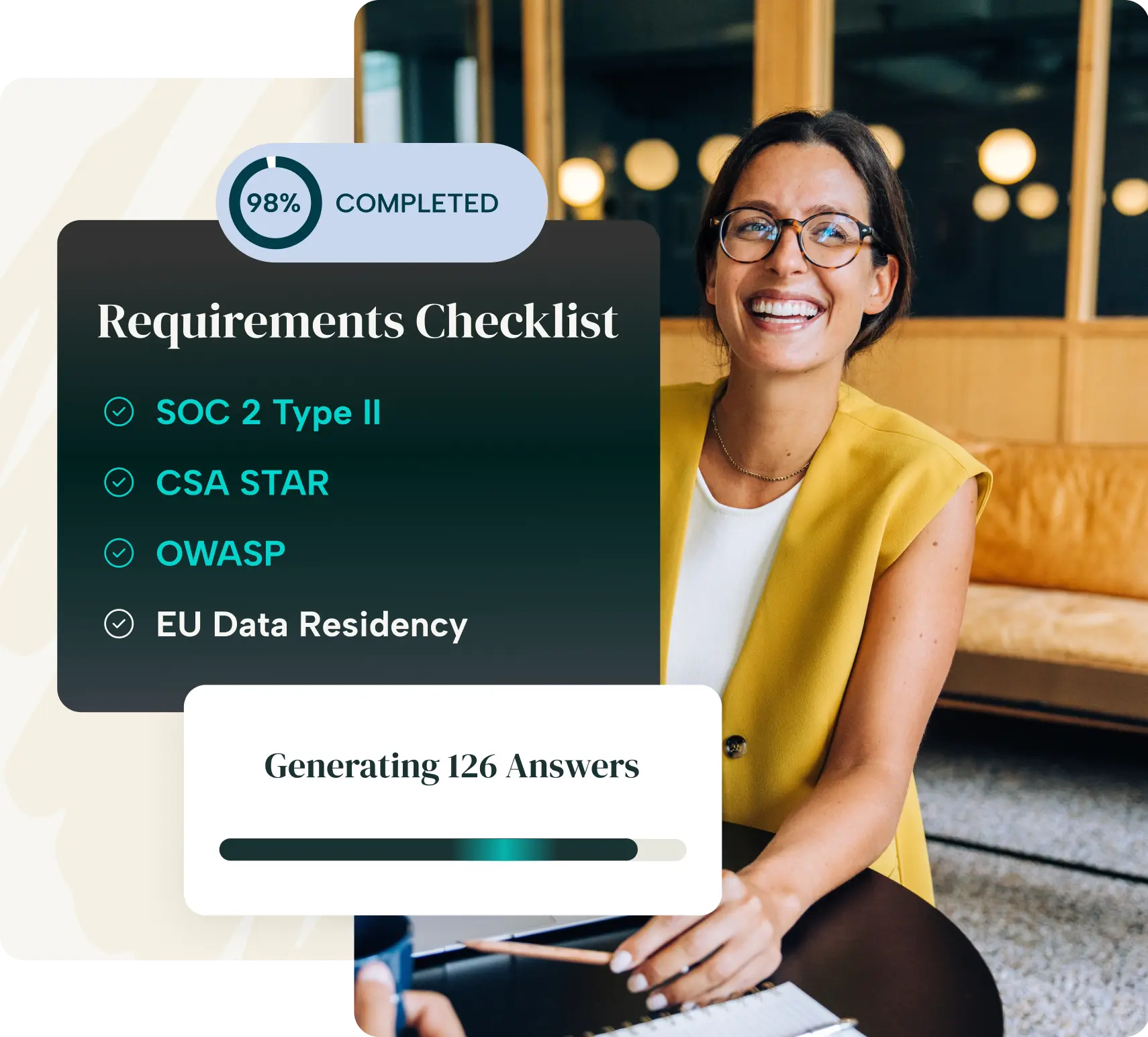
Official Loopio product image for its security questionnaire automation workflow.
Who should use Loopio?
Use cases
Where Loopio is most useful.
Security questionnaire response
Use vetted answer-library content and Loopio AI to draft answers for SIG, CAIQ, HECVAT, spreadsheets, documents, and portal-sourced questionnaires.
RFP and proposal response management
Coordinate broader RFP, RFI, proposal, and due diligence projects with project workflows, collaborators, assignments, and response analytics.
Answer library governance
Maintain approved answers, security artifacts, compliance statements, ownership, review cycles, and content freshness in a shared response library.
Teams
Teams and users
The people most likely to use the product during questionnaires, RFPs, assessments, and customer security reviews.
Proposal managerManager or director / Revenue / proposal operations
Creates response projects, assigns reviewers, manages deadlines, and keeps proposal and questionnaire work moving across teams.
Security SMEPractitioner / Security / compliance
Reviews technical answers, refreshes approved security content, and validates exceptions before answers are sent to customers.
Solutions engineerSales or solutions / Sales engineering
Finds vetted answers, contributes technical context, and reduces repetitive security-response requests during sales cycles.
How Loopio handles a response project
Maintain vetted content
Security SMEs keep approved answers, artifacts, and review dates current in the Loopio library.
Intake the questionnaire
Teams use Loopio project workflows and SmartScan to capture document, spreadsheet, or portal questionnaire questions.
Draft from approved sources
Loopio AI or saved-answer matching suggests responses from vetted content rather than starting from scratch.
Route expert review
SMEs receive assignments, deadlines, and review tasks for sensitive or uncertain questions.
Export and learn
Completed responses can inform future content reuse when governance rules keep the library current.
Features to test in a demo
Answer Library
Loopio’s governed library is the core system for reusable answers, security artifacts, review cycles, and content ownership.
- Evaluate whether answer ownership, review cadence, and expiration controls match your InfoSec governance process.
- Confirm whether security-specific artifacts such as SOC 2 reports, subprocessors, encryption policies, and SIG answers can be scoped and permissioned cleanly.
Security questionnaire automation
Loopio supports AI-assisted drafting, document and portal intake, SME assignments, and export workflows for security questionnaires.
- Test a real SIG, CAIQ, HECVAT, buyer spreadsheet, and portal workflow if those formats matter to your team.
Response Intelligence controls
Loopio positions Response Intelligence as purpose-built AI trained on response-management patterns and constrained by approved sources rather than general public data.
- Ask reviewers to inspect source lineage, Confidence Pulse status, and how generated answers differ from saved-answer verbatim mode.
- Use unsupported or ambiguous questions in the demo to confirm whether AI escalates, flags gaps, or drafts language that needs manual correction.
Integrations and customer examples
Integrations
Connections to source documents, review tools, customer portals, and sales systems.
SalesforceCRM
Loopio publishes CRM workflow and Salesforce reporting support; verify package and workflow scope.
HighspotOther
Listed in pricing add-on context as a sales enablement industry integration; confirm whether it is included or add-on.
Microsoft TeamsCollaboration
Loopio describes task reminders and content access through communication apps.
SlackCollaboration
Loopio describes task reminders and reusable answer access from Slack.
Google DriveDocument storage
Official integration page lists Google Drive under cloud storage services.
Microsoft SharePointDocument storage
Official integration page lists SharePoint under cloud storage services.
OneDriveDocument storage
Official integration page lists OneDrive under cloud storage services.
BoxDocument storage
Official integration page lists Box under cloud storage services.
Microsoft Azure SSOOther
Official integration and security pages list Azure / SAML SSO support.
Google SSOOther
Official integration and security pages list Google authentication / Google SSO.
DDQ integrations and APIAPI / webhook
Loopio says content can be used in due diligence, security, and risk platforms and that buyers can use its API for custom integrations.
Browser / portal workflowsCustomer portal
Loopio markets SmartScan support for vendor risk portals; test your real buyer portals.
Technical features
APIs and AI tooling
Features to ask about if APIs or AI tooling matter to your team.
Generative AI with vetted-content controlsAsk how generated answers are constrained to approved security content, how verbatim mode works, and how reviewers see source lineage and review history. ->
Loopio materials emphasize Response Intelligence and AI that drafts from expert-vetted internal content, exposes where generated content came from, and supports switching between generated and verbatim answer modes.
SmartScan for portal and document intakeTest a real customer portal and a messy spreadsheet before relying on intake automation. ->
Security questionnaire managers often lose time converting buyer forms into a workable project. Loopio positions SmartScan as a way to capture portal and document questionnaires into structured projects.
Confidence Pulse and freshness controlsAsk Loopio to show stale-answer alerts, review cadence, content owners, audit history, and what happens when an answer is past review date. ->
Loopio says Confidence Pulse helps teams avoid sending outdated information to high-priority buyers. Buyers should verify how freshness signals are calculated and enforced.
Customer stories
Results reported by Loopio
These results come from Loopio case studies. Ask customer references whether they saw similar results.
NetskopeVendor-published testimonial; treat as evidence rather than an audited benchmark. ->
Loopio publishes a customer quote from Netskope describing efficiency gains and reduced repeated rewriting of security questionnaire answers.
BugcrowdVendor-published case study; validate comparable workflow and volume during references. ->
Loopio publishes a case study stating Bugcrowd cut security questionnaire response time by 50%.
Compare Loopio with alternatives
What to compare
Loopio
Responsive →Conveyor →Best for
Organizations combining RFP, proposal, due diligence, and security questionnaire response in one process.Responsive helps teams manage RFPs, proposals, security questionnaires, approved content, and AI-assisted drafting.Conveyor helps security and customer trust teams answer questionnaires, run a trust center, respond to RFPs, and complete work in customer portals.Test in a demo
Shortlist Loopio when security questionnaires share ownership with proposal, sales, or response teams.Test your questionnaire, integrations, and setup requirements.Test your questionnaire, integrations, and setup requirements.Buyer checklist
Demo
What to test in a Loopio demo
A good Loopio demo should prove that proposal-scale workflow does not slow down security-specific answer review.
Answer-source control
Ask Loopio to show generated and verbatim answers side by side, including source records, review dates, and owner metadata.
SME routing
Trigger questions requiring security, privacy, legal, and product review to see whether assignments and deadlines are practical.
Portal intake
Bring a real portal or awkward buyer form and test whether SmartScan creates a clean project without manual cleanup dominating the workflow.
Verify before buying
Claims to verify before purchase
Loopio has strong public security-questionnaire positioning, but plan-specific limits and integration depth should be confirmed.
Pricing and packaging
Loopio publishes Foundations, Enhanced, and Enterprise plan names but still requires a custom quote. Confirm package limits, seat model, AI availability, collaborators, integrations, and portal support.
Security content governance
Confirm review cadence, content owner requirements, stale-answer alerts, audit history, and how deprecated answers are prevented from reuse.
Integration scope
Confirm which CRM, sales enablement, communication, cloud storage, SSO, DDQ, and API integrations are included in the proposed package versus add-ons.
What isn’t publicly documented
Confirm these items directly during procurement.
ItemPublic statusWhat to confirm
Buyer portalsSmartScan portal intake is marketed; test your real buyer portals.
Partial / indirect
EU data residencyAWS hosting is documented; confirm region options.
Verify with vendor
Zero data retentionAsk for the current contractual retention terms.
Verify with vendor
No-training commitmentConfirm whether customer data trains vendor or third-party models.
Verify with vendor
Full library exportPublic review themes include export-formatting cleanup; test export fidelity and ask how the answer library exports at contract end.
Verify with vendor
Company information
Loopio is a response-management software company founded in Toronto in 2014 by Zak Hemraj, Matt York, and Jafar Owainati. The company took a $200M growth investment from Sumeru Equity Partners in 2021 and focuses on RFP, questionnaire, proposal, and response workflows across sales, proposal, and security teams. Company-profile details should be treated as point-in-time context.
Company snapshot
Founded2014
HeadquartersToronto, Canada
Company typePrivately held
Funding stageGrowth equity (Sumeru Equity Partners, $200M, 2021)
FoundersZak Hemraj, Matt York, Jafar Owainati
Questions to ask Loopio
Ask these questions in the Loopio demo, then test the answers with your own content and approval process.
- Does the product answer customer requests, send vendor assessments, or both?
Loopio mainly helps your team answer customer requests, including RFPs and security questionnaires. It is not designed to send risk assessments to your suppliers.
- Can every AI-drafted answer be traced to its source?
Loopio says drafted answers use source material. In the demo, open several citations and test what happens when sources conflict or go out of date.
- Which questionnaire files and customer portals can it handle?
Loopio documents file and customer portal support. Test a real spreadsheet, PDF, and difficult portal before buying.
- Which standard and custom questionnaires does it support?
Loopio documents SIG, CAIQ, and HECVAT support. Confirm the versions and import one of your custom forms during the demo.
- Does it include buyer-side vendor risk assessment?
Loopio is not primarily a buyer-side vendor risk product. If you need to score suppliers before sending assessments, evaluate that separately.
- Can its trust center prevent repeat questionnaires?
Loopio does not list a trust center as a core feature. If customer self-service matters, compare it with products that include one.
- How does review, approval, answer ownership, and audit history work?
Loopio documents review and approval controls. In the demo, test a low-confidence answer, expert assignment, final approval, and the audit record.
- Does it connect to the systems your team already uses?
Loopio lists 12 integrations across CRM, other systems, collaboration, document storage, APIs and webhooks, and customer portals. Examples include Salesforce, Highspot, Microsoft Teams, Slack, and Google Drive. Confirm what each connection can do, whether API work is required, and which plans include it.
- How are reused answers updated when policies, reports, or products change?
Loopio documents controls for maintaining source content. Ask who updates policies, SOC 2 reports, subprocessors, and product details—and whether those changes reach every reused answer.
FAQ
Is Loopio only for security questionnaires?
No. Loopio is a broader response-management platform for RFPs, proposals, due diligence questionnaires, and security questionnaires.
What makes Loopio relevant for security teams?
Loopio emphasizes vetted answers, governed answer libraries, SmartScan intake, SME routing, and review cycles for security questionnaire response.
Does Loopio publish pricing?
Loopio publishes Foundations, Enhanced, and Enterprise plan names and some packaging details, but buyers still need a custom quote for final pricing.
What should buyers verify?
Verify pricing, AI controls, source governance, portal support, integration depth, and whether broad response workflows fit your security review process.
Disclosure: This page is not sponsored. We do not accept payment to change our findings or recommendations.