

What Is an AI Trust Center Agent?
An AI trust center agent answers a buyer's security questions in real time from an approved answer library, deflecting questionnaires before they are sent. Here is how it works and how to judge one.
What is an AI trust center agent?
An AI trust center agent is an AI assistant embedded in a company's trust center that answers a buyer's security, privacy, and compliance questions in real time using the company's approved answer library and posted evidence. Its purpose is narrow and specific: let a prospective customer get a grounded, sourced answer on the spot, so the buyer never has to send a full security questionnaire. It is a conversational front end on content the GRC team has already vetted.
A trust center is the public or gated page where a company publishes its security posture, certifications, and documents. The agent turns that static page into something a buyer can interrogate. Instead of downloading a SOC 2 report and emailing three follow-up questions, the buyer asks the agent and gets an answer drawn from approved material.
Several roles own different parts of it: - GRC and security teams own the answer library, the evidence, and what the agent is allowed to say. - Customer trust and sales engineering own the buyer experience and the deals it accelerates. - AI governance and the CISO own the controls: what the agent can access, when it must abstain, and how its output is logged.
It is not a general chatbot and not a marketing assistant. An AI trust center agent answers from approved security content or it declines.
How does an AI trust center agent work?
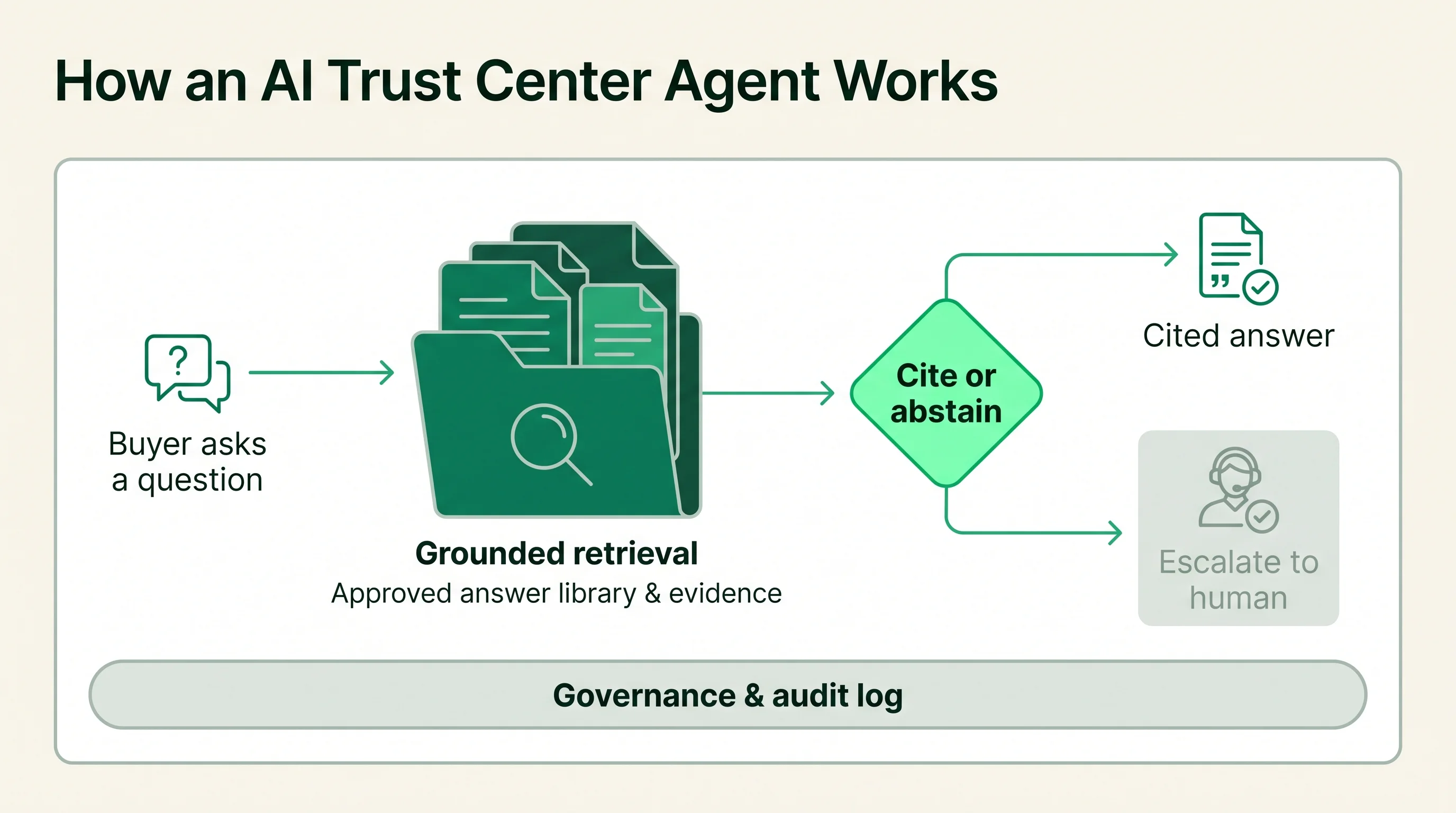
An AI trust center agent works by retrieving an answer from approved content, citing its source, and abstaining when it has no approved basis. The mechanism is grounding plus cite-or-abstain. Grounding means every answer is tied to a specific piece of vetted content rather than generated freely. Cite-or-abstain means the agent either shows the buyer where the answer came from or says it cannot answer.
The flow runs in a predictable sequence: - A buyer asks a question in natural language, such as whether the company encrypts data at rest. - The agent searches the approved answer library, the trust center documents, and posted evidence such as a SOC 2 or ISO 27001 summary. - It retrieves the most relevant approved passages and constructs an answer grounded in them. - It returns the answer with a citation to the source document or library entry. - If no approved content covers the question, it abstains and routes the buyer to a human or to a request form.
The quality of the agent depends almost entirely on the quality of the answer library behind it. A library of stale or unreviewed answers produces a fast agent that is confidently wrong. A maintained library of current, approved answers and fresh evidence produces an agent buyers can trust. The agent is a retrieval and citation layer; it does not create the security facts it reports.
Why an AI trust center agent matters
An AI trust center agent matters because it attacks the most expensive part of the security review: the back-and-forth before a deal can move. Every inbound questionnaire pulls a sales engineer, a GRC analyst, or a subject matter expert away from other work to answer questions the company has already answered many times. Deflecting even a portion of that demand returns hours to the security team and removes a common source of deal delay.
The pain is concrete and familiar to anyone who has staffed a security review queue: - Manual effort: copying, pasting, and reformatting the same answers across different questionnaire templates. - Stale answers: a spreadsheet of past responses that nobody owns and nobody refreshes after an audit. - Blocked deals: a buyer waiting days for a single clarification while the sales cycle stalls. - SME load: pulling an engineer into a review to confirm a detail that already lives in an approved document.
The contrast between the two approaches is sharp:
| Dimension | Manual review handling | AI trust center agent |
|---|---|---|
| Buyer answer time | Hours to days | Seconds, when approved content exists |
| Source of truth | Scattered spreadsheets and inboxes | One approved answer library |
| SME involvement | Frequent, per question | Only on escalation |
| Answer consistency | Varies by responder | Same approved answer every time |
| Audit trail | Email threads | Logged queries and citations |
The payoff is not eliminating security review. It is removing the repetitive, low-judgment questions so the team spends its time on the ones that genuinely need a human.
Where an AI trust center agent sits next to adjacent surfaces
An AI trust center agent is the conversational layer on top of a trust center, not a replacement for questionnaire automation or third-party risk management. It is easy to confuse these surfaces because they overlap, but each does a different job in the review lifecycle. The agent deflects questions before a questionnaire is sent; questionnaire automation handles the questionnaires that still arrive; a trust center hosts the evidence both rely on.
The distinction matters when you decide what to buy and in what order:
| Surface | Primary job | Direction | Who it serves |
|---|---|---|---|
| AI trust center agent | Answer buyer questions live, deflect questionnaires | Inbound, pre-questionnaire | The prospective buyer |
| Questionnaire automation | Fill questionnaires that still get sent | Inbound, reactive | Your GRC and sales engineering team |
| Trust center | Publish posture, certifications, evidence | Outbound, self-serve | The buyer's reviewer |
| Third-party risk management | Assess your own vendors | Outbound, you as buyer | Your security team |
The agent and a static trust center work best together. The trust center supplies the evidence and the answer library; the agent makes that material answerable in plain language. For a fuller treatment of how the deflection surface and the response surface divide the work, see where security questionnaire automation and trust centers each fit. An agent without an underlying trust center has nothing approved to ground on.
Benefits and tradeoffs of an AI trust center agent
The benefit of an AI trust center agent is fast, consistent, sourced answers that deflect questionnaires; the tradeoff is the risk that an unreviewed or out-of-date claim reaches a buyer under the company's name. This is the central tension, and it is worth stating plainly before anyone turns one on. Speed and risk move together. The same mechanism that answers a buyer in seconds can publish a wrong answer in seconds if the controls are weak.
The benefits are real when the underlying library is sound: - Buyers self-serve accurate answers without waiting on a human. - The same approved answer goes to every buyer, which improves consistency. - The security team reclaims hours spent on repetitive questions. - Every interaction is logged, which gives customer trust a record of what was said.
The tradeoffs are equally real and should not be glossed over: - An ungrounded or overconfident agent can state a control the company does not actually have. - A claim made to a buyer can carry contractual weight, so an unreviewed answer is a liability. - The library needs an owner; a neglected library degrades the agent over time. - Buyers and regulators may still require a signed questionnaire regardless of the agent.
An AI trust center agent is not worth it when the answer library is thin, unowned, or out of date, because the agent will amplify those gaps at speed. It is also a poor fit for companies whose deals turn on a handful of deeply custom security questions that no library can pre-answer. The honest version: the agent is only as trustworthy as the governance behind it, and the question of whether AI can safely answer security questionnaires comes down to those controls.
How to evaluate or implement an AI trust center agent
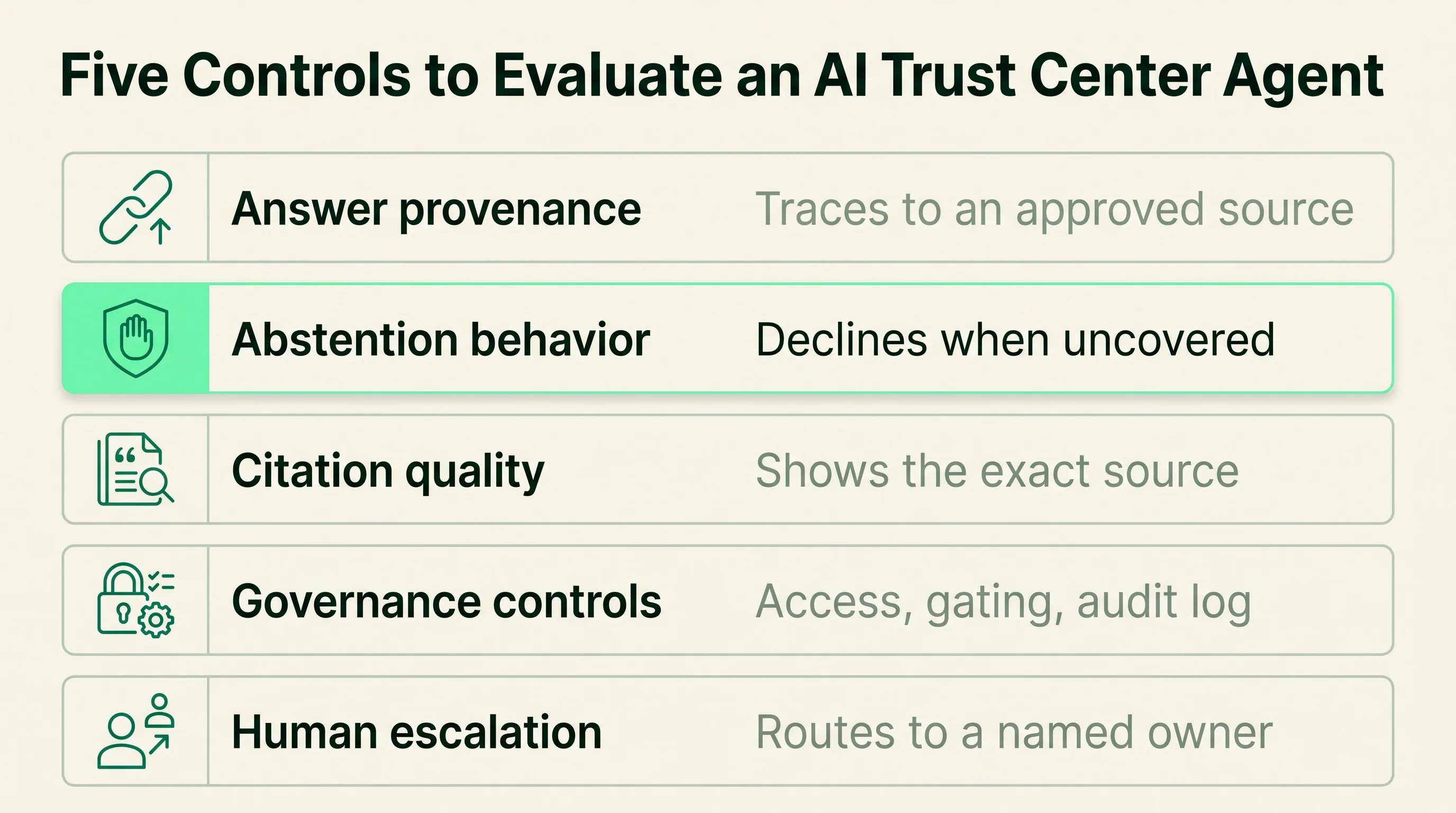
Evaluate an AI trust center agent on five things: answer provenance, abstention behavior, citation quality, governance controls, and human escalation. The marketing across vendors sounds similar, so the differences show up only when you test the agent against your own content and your own edge cases. The questions below are the ones a customer trust or AI governance leader should put to any product, whether it ships inside trust center software or as a standalone agent.
Use this checklist as a scorecard:
| Criterion | What good looks like | Why it matters |
|---|---|---|
| Answer provenance | Every answer traces to an approved library entry or document | Prevents free-form generation of security claims |
| Abstention behavior | Declines cleanly when no approved content covers the question | Stops the agent from guessing under pressure |
| Citation quality | Shows the buyer the exact source, not a vague reference | Lets buyers and your team verify the answer |
| Governance controls | Role-based access, gating, and an audit log of every query | Required for AI governance and incident review |
| Human escalation | Routes hard questions to a named owner or request form | Keeps a human in the loop where judgment is needed |
| Library freshness | Tracks answer age and flags content due for re-review | Stale answers are the main failure mode |
Vendors approaching this from adjacent products are useful reference points for how the capability is packaged. Vanta and SafeBase have pushed AI assistance into the trust center surface; Conveyor and Whistic come at it from questionnaire response; Drata sits in the compliance and evidence layer. Treat any specific accuracy or deflection figure as vendor-reported and confirm it against your own library during a demo. For implementation sequencing, a practical path is to stand up the evidence and answer library first, then layer the agent on top, as outlined in launching a trust center to reduce questionnaires. The agent is the last step, not the first.
How this article was reviewed
Sources reviewed
- AICPA SOC 2Standards body for SOC 2 reporting referenced as posted trust center evidence.
- ISO/IEC 27001Information security management standard referenced as trust center evidence.
- Cloud Security Alliance (CAIQ)Source of the CAIQ questionnaire commonly answered from an answer library.
- Shared Assessments (SIG)Source of the SIG questionnaire used in third-party risk reviews.
- NISTCybersecurity and AI risk frameworks referenced for governance context.
- Vendor product documentationCapability claims from Vanta, SafeBase, Conveyor, Whistic, and Drata are vendor-reported and should be verified in a demo.
FAQ
What is an AI trust center agent?
An AI trust center agent is an AI assistant embedded in a company's trust center that answers a buyer's security and compliance questions in real time from an approved answer library and posted evidence. Its goal is to deflect security questionnaires before a buyer sends one. It answers from vetted content with a citation, or it abstains and routes the buyer to a human.
How is an AI trust center agent different from questionnaire automation?
An AI trust center agent answers buyer questions live to prevent a questionnaire from ever being sent, while questionnaire automation fills out the questionnaires that still arrive. The agent is a pre-questionnaire deflection layer aimed at the buyer; automation is a response layer aimed at your own team. Most companies use both, since the agent reduces volume and automation handles what gets through.
How does an AI trust center agent stay accurate?
Accuracy comes from grounding and cite-or-abstain. The agent only answers from an approved answer library and posted evidence, attaches a citation to the source, and declines when no approved content covers the question rather than generating a guess. Accuracy also depends on keeping the library current, since the agent reports what the library contains and cannot correct stale or missing content on its own.
What is the main risk of an AI trust center agent?
The main risk is an unreviewed or out-of-date claim reaching a buyer in the company's name, which can carry contractual weight. Speed and risk move together, so weak grounding or a neglected answer library turns the agent into a fast source of wrong answers. The controls that manage this are abstention behavior, citation, an audit log, and clean escalation to a human.
How should a buyer evaluate an AI trust center agent?
Test it against your own content on five criteria: answer provenance, abstention behavior, citation quality, governance controls, and human escalation. Confirm that every answer traces to an approved source, that the agent declines cleanly on uncovered questions, and that every query is logged. Treat any vendor accuracy or deflection figure as vendor-reported and verify it in a demo using your real answer library.