

What Is the Questionnaire Chokepoint in TPRM?
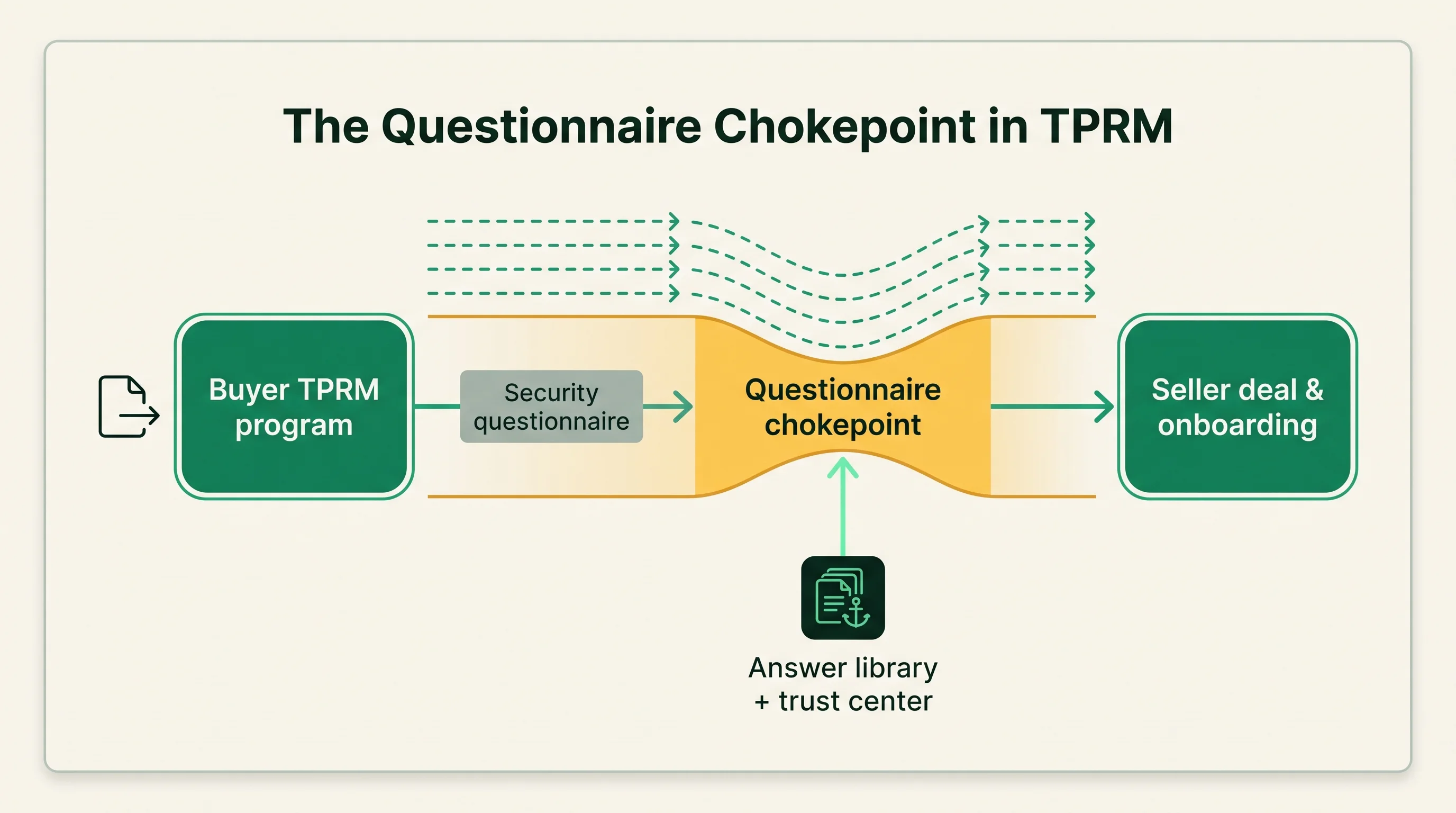
The questionnaire chokepoint is the point in third-party risk management where security questionnaires stall both the buyer's vendor onboarding and the seller's deal. It forms because the same questions get re-answered by hand, over and over, on both sides of every review.
What is the questionnaire chokepoint in TPRM?
The questionnaire chokepoint is the point in third-party risk management where security questionnaires become the bottleneck, holding up the buyer's vendor onboarding and the seller's deal at the same time. It is the moment a review stops being a formality and starts being the slowest step in the process. The questions are not hard. The volume, the repetition, and the manual handling are what stall the work.
Third-party risk management (TPRM) is the program a company runs to assess and monitor the vendors it buys from. Sending a security questionnaire is one of its core steps. A security questionnaire is a structured set of questions a buyer sends to check a vendor's security posture before signing, covering access controls, encryption, data handling, incident response, and compliance status.
The chokepoint shows up on both sides of that exchange:
- On the buyer side, vendor risk and procurement wait on completed questionnaires before they can approve onboarding.
- On the seller side, security, GRC, and sales engineering scramble to answer questionnaires before they block a contract.
- In the middle sit the subject-matter experts, the CISO, and the engineers who get pulled in to confirm the same details on every review.
Ownership is split, which is part of why the chokepoint persists. On the seller side the work usually sits with governance, risk, and compliance (GRC) or a dedicated security team, often with a sales engineer pushing to clear it because the deal is waiting. On the buyer side it sits with vendor risk or procurement. No single person owns both ends, so the slow handoffs between them are nobody's job to fix. For the broader program this lives inside, see our overview of third-party risk management.
How does the questionnaire chokepoint form?
The chokepoint forms because both sides handle the same questions by hand, in different formats, every time a new review starts. Nothing carries over. The work that cleared the last questionnaire does not clear the next one, because the next one arrives as a different spreadsheet with the questions reworded.
The mechanics follow a predictable sequence:
- A buyer's TPRM program triggers a review and sends a questionnaire.
- The seller receives it as an Excel file, a web portal, a PDF, or a standardized template.
- Security or GRC searches old responses for answers that fit the new wording.
- Subject-matter experts get pulled in to confirm technical details for the third or fourth time.
- Sales engineering chases the internal owners because the deal is stalled.
- The buyer's vendor risk team reads the completed answers, asks follow-ups, and the loop repeats.
Three forces turn that sequence into a bottleneck. First, format fragmentation: the same question arrives as a spreadsheet from one buyer and a portal field from the next, so reuse is manual. Second, content decay: an answer that was correct last quarter may name a former sub-processor or an old identity provider, so it cannot be pasted blind. Third, expert load: every uncertain answer routes to the same few engineers, who are not full-time questionnaire responders.
Relief comes from making answers reusable across all of that. A maintained answer library, a published trust center, and standardized frameworks let one approved answer satisfy many questions in many formats. That reuse is what security questionnaire automation is built to deliver.
Why the questionnaire chokepoint matters
The chokepoint matters because it taxes revenue and risk at the same time. A stalled questionnaire delays the seller's deal and the buyer's onboarding, and both delays compound when the same questions get re-answered across every review. The cost is not the questions. It is the repeated manual handling of answers that already exist somewhere.
The concrete pain shows up in four places:
- Slow turnaround that pushes deals into the next quarter.
- Stale answers that risk misrepresenting a control to a customer.
- Subject-matter experts spending hours on review work instead of engineering.
- Buyer-side reviewers waiting on responses they cannot act on yet.
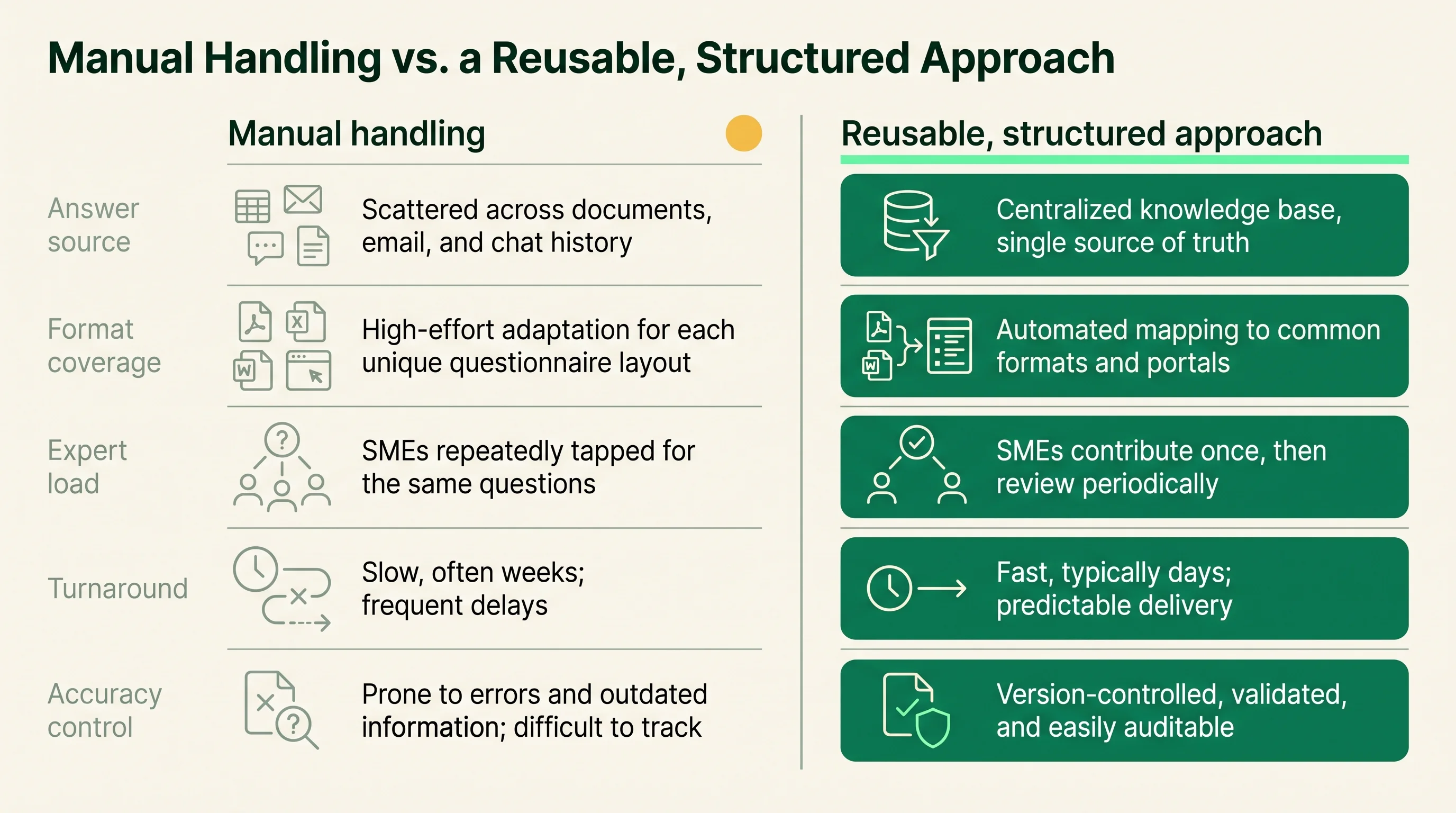
The contrast between the manual approach and a structured, reusable one is sharp across the dimensions that decide turnaround.
| Dimension | Manual handling | Reusable, structured approach |
|---|---|---|
| Answer source | Searched ad hoc per review | One maintained answer library |
| Format coverage | Re-keyed for each format | Reused across Excel, portals, CAIQ, SIG |
| Expert load | Pulled in repeatedly | Consulted once, answer reused |
| Turnaround | Days to weeks | Hours to days |
| Accuracy control | Inconsistent, hard to audit | Versioned, evidence-linked answers |
The ranges above describe the common pattern reported by mid-market and enterprise teams, not a fixed benchmark. The direction is what matters: when answers become reusable, the chokepoint narrows for both the seller and the buyer.
How do standardized frameworks relieve the chokepoint?
Standardized frameworks relieve the chokepoint by giving both sides a shared question set, so an answer written once can satisfy many buyers. When a buyer accepts a completed standard questionnaire instead of sending a custom spreadsheet, the seller reuses approved content and the buyer reads a familiar format. The repetition drops on both ends.
The frameworks buyers and sellers reach for most often serve different needs.
| Framework | Source | Where it fits |
|---|---|---|
| CAIQ | Cloud Security Alliance | Cloud and SaaS vendor reviews |
| SIG | Shared Assessments | Broad, detailed third-party assessments |
| SIG Lite | Shared Assessments | Lighter reviews and lower-risk vendors |
| SOC 2 | AICPA | Audited evidence of controls |
| ISO 27001 | ISO/IEC | Certified security management system |
The practical pattern is to scope the framework to the risk. SIG covers a wide assessment, while SIG Lite trims it to a shorter set for lower-risk or early-stage reviews, which keeps the buyer's program from sending a full assessment when a light one would do. CAIQ maps cleanly to cloud services. SOC 2 and ISO 27001 are not questionnaires but the evidence that backs the answers inside them, which is why buyers often accept a completed CAIQ plus a SOC 2 report in place of a custom form.
Frameworks reduce the chokepoint but do not remove it, because many buyers still send their own questions on top of the standard set. The realistic goal is to deflect the common ones, then automate the custom remainder.
How do trust centers and automation narrow the chokepoint?
Trust centers and automation narrow the chokepoint by removing two kinds of repeated work: requests that should never have become a questionnaire, and answers that should never have been re-typed. A trust center deflects the first. An answer library and AI-assisted drafting handle the second.
A trust center is a published page where a company posts its certifications, common answers, and security documentation so buyers can self-serve. The model is publish once, deflect many. A buyer who finds the SOC 2 report and a completed CAIQ may not need to send a spreadsheet at all, which means the questionnaire never reaches the chokepoint. SafeBase, Whistic, and Conveyor all offer trust center surfaces alongside response tooling, per their product documentation.
What automation removes, and what it does not, splits cleanly.
- Removed: searching old responses, re-keying answers per format, drafting from scratch.
- Kept: human review and approval of every answer before it is sent.
- Kept: subject-matter judgment on novel questions the library has not seen.
AI accelerates the matching and drafting. It compares the meaning of an incoming question to stored approved answers, so reworded questions resolve to the same content. Strong tools cite the source answer or evidence document for each draft, which lets a reviewer trust the output and catch a hallucinated answer before it goes out. The discipline that keeps this safe is requiring a citation per answer, covered in our look at whether AI can safely answer security questionnaires. The tool removes the typing, not the accountability.
Where the chokepoint sits next to adjacent surfaces
The questionnaire chokepoint sits at the intersection of four surfaces that all touch the same questions: questionnaire automation, trust centers, RFP response, and the buyer's TPRM program. The chokepoint itself is not a product. It is the moment in the workflow where the review blocks a deal or an onboarding, and each surface relieves a different part of it.
| Surface | What it does | How it eases the chokepoint |
|---|---|---|
| Questionnaire automation | Drafts answers from a library | Cuts re-typing on the seller side |
| Trust center | Publishes proof and common answers | Stops questionnaires from being sent |
| RFP response | Answers proposals and their security sections | Reuses the same approved answers |
| TPRM / vendor risk | The buyer's program for assessing vendors | Standardizes what gets asked |
The overlap is real because all four draw on one answer library. RFP response tooling and questionnaire automation share the same shape of work, which is why Loopio and Responsive grew from RFP response into security questionnaires. A trust center and a questionnaire tool both publish from the same approved content. The buyer's TPRM program is the same exchange viewed from the other side: when a seller automates responses, it is streamlining its half of someone else's vendor risk process.
Knowing where the chokepoint sits helps teams target the right fix. If buyers keep sending custom spreadsheets, a trust center deflects more. If the team is drowning in completed-but-stale answers, library hygiene matters more than another tool. Our hub on third-party risk management software maps the surfaces in more detail.
How to evaluate relief for the questionnaire chokepoint
Evaluate relief for the questionnaire chokepoint on how well a tool reuses answers across formats and buyers, not on raw automation claims. The chokepoint narrows when one approved answer satisfies many questions, so the criteria that matter are the ones that make reuse reliable and safe.
Use these criteria as a checklist when comparing options.
| Criterion | What good looks like | Why it matters |
|---|---|---|
| Format coverage | Excel, portals, PDF, CAIQ, SIG | Portal work is where teams lose hours |
| Answer library | Versioned, evidence-linked, expiring | Stale answers misrepresent controls |
| Framework support | CAIQ, SIG, SIG Lite handled natively | Standard forms deflect custom ones |
| Review controls | Per-answer approval and citations | Keeps a human accountable per claim |
| Trust center | Self-serve proof for buyers | Deflects questionnaires before they arrive |
| Integrations | CRM, knowledge base, storage | Keeps the library current with less effort |
Real vendors map to different parts of this. Conveyor, Loopio, Responsive, HyperComply, and SecurityPal focus on response and answer-library workflows. SafeBase, Whistic, and Conveyor offer trust center surfaces. Vanta and Drata come at it from compliance evidence, which feeds the answers rather than drafting them. Most teams end up combining a deflection surface with a response surface, per each vendor's documentation.
The tool is the smaller half of the work. The larger half is owning the answer library and keeping it current, usually inside GRC. To compare specific products, start with our security questionnaire automation category and the Conveyor profile, then weigh them against the AI security questionnaire tools that lead with drafting.
How this article was reviewed
Sources reviewed
- AICPA — SOC 2Standards body for SOC 2 reports, cited as the evidence backing audited control claims.
- ISO/IEC 27001Standard for information security management systems, cited as certified evidence.
- Cloud Security Alliance — CAIQSource of the Consensus Assessments Initiative Questionnaire used in cloud vendor reviews.
- Shared Assessments — SIG and SIG LiteSource of the Standardized Information Gathering questionnaires.
- NISTReferenced as a primary standards body for third-party risk practices.
- Vendor product documentation (Conveyor, Loopio, Responsive, Vanta, SafeBase, Whistic)Capability claims are vendor-reported, not independently verified.
FAQ
What is the questionnaire chokepoint in TPRM?
It is the point in third-party risk management where security questionnaires become the bottleneck, slowing the buyer's vendor onboarding and the seller's deal cycle at the same time. It forms because both sides handle the same questions by hand, in inconsistent formats, on every review. The questions are routine. The repeated manual handling of answers is what stalls the work.
What are the most common mistakes when trying to fix the questionnaire chokepoint?
The biggest mistake is buying automation without maintaining the answer library behind it, which produces confident wrong answers faster than a person could type them. The second is treating the library as a one-time setup project instead of standing upkeep, so answers decay. The third is skipping a trust center, which means questionnaires that could have been deflected still reach the chokepoint. Assign clear ownership, usually inside GRC, and version and expire answers on a schedule.
How does fixing the chokepoint compare to handling questionnaires manually or with spreadsheets?
Spreadsheets keep every answer re-keyed per review, so the chokepoint persists and turnaround stays in days to weeks. A maintained answer library and automation reuse one approved answer across formats and buyers, pulling turnaround toward hours to days. The structured approach also versions answers and links evidence, which spreadsheets cannot do reliably. Manual handling only works at low questionnaire volume, where the tooling overhead is not worth it.
How do you get leadership buy-in for relieving the questionnaire chokepoint?
Frame it as a revenue and risk problem, not a tooling request. Show stalled deals waiting on questionnaire turnaround and the engineering hours lost to repeated subject-matter expert reviews. Tie the fix to deals unblocked and to reduced risk of misrepresenting a control with a stale answer. Leadership funds chokepoints that delay contracts more readily than ones that only save effort.
What is the typical timeline to relieve the questionnaire chokepoint?
Standing up a tool and importing existing responses commonly takes a few weeks. Building the answer library to the point where it covers most incoming questions usually takes a few months of curating, approving, and tagging answers as real questionnaires come in. A trust center can deflect requests early, but the compounding relief comes from library maturity, which is ongoing rather than a fixed end date. Timelines vary with question volume and how clean the existing responses are.