

Security Questionnaire Automation vs. Third-Party Risk Management
Security questionnaire automation is mostly the seller's tool for answering inbound reviews fast, while third-party risk management is the buyer's program for assessing and monitoring vendors. They sit on opposite sides of the same exchange, and the questionnaire is the artifact both touch.
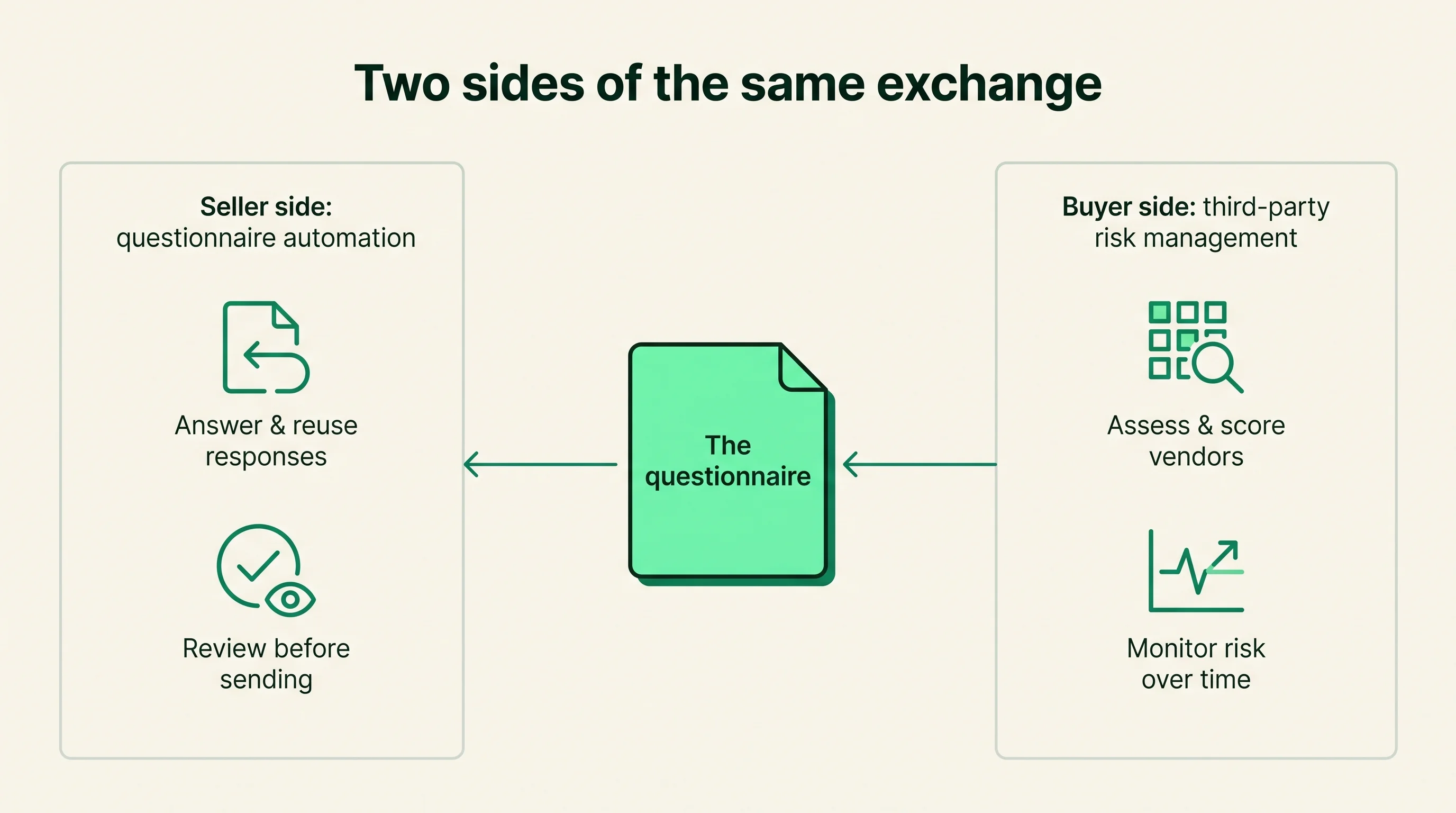
Quick answer: questionnaire automation vs. third-party risk management
Choose security questionnaire automation if your main job is completing or answering security questionnaires quickly, most often as the seller responding to a buyer's inbound review. Choose third-party risk management if you are the buyer assessing vendors and you need to send assessments, score risk, and monitor that risk over time across a portfolio of third parties.
These are two sides of the same exchange. A buyer runs a TPRM program and sends a questionnaire to a vendor. The vendor uses questionnaire automation to answer it and send it back. The questionnaire is the artifact both sides touch, which is why the categories get confused even though they solve opposite problems.
The perspective gap drives most of the confusion. A vendor risk analyst hears "questionnaire" and pictures sending and scoring assessments at scale. A seller-side sales engineer hears the same word and pictures answering reviews faster so a deal can close. Both readings are valid, and the right tool depends entirely on which seat you sit in.
The choice comes down to three questions: which side of the review you are on, your annual volume of questionnaires or vendors, and which team owns the work.
- Answering or completing questionnaires fast and consistently: questionnaire automation fits.
- Assessing many vendors and tracking their risk over time: a TPRM program and platform fit.
- Doing both, because you respond to inbound reviews and also run a vendor program: layer the two.
If the category itself is new to you, start with our explainer on what security questionnaire automation is, then return to see how it sits opposite a third-party risk management program.
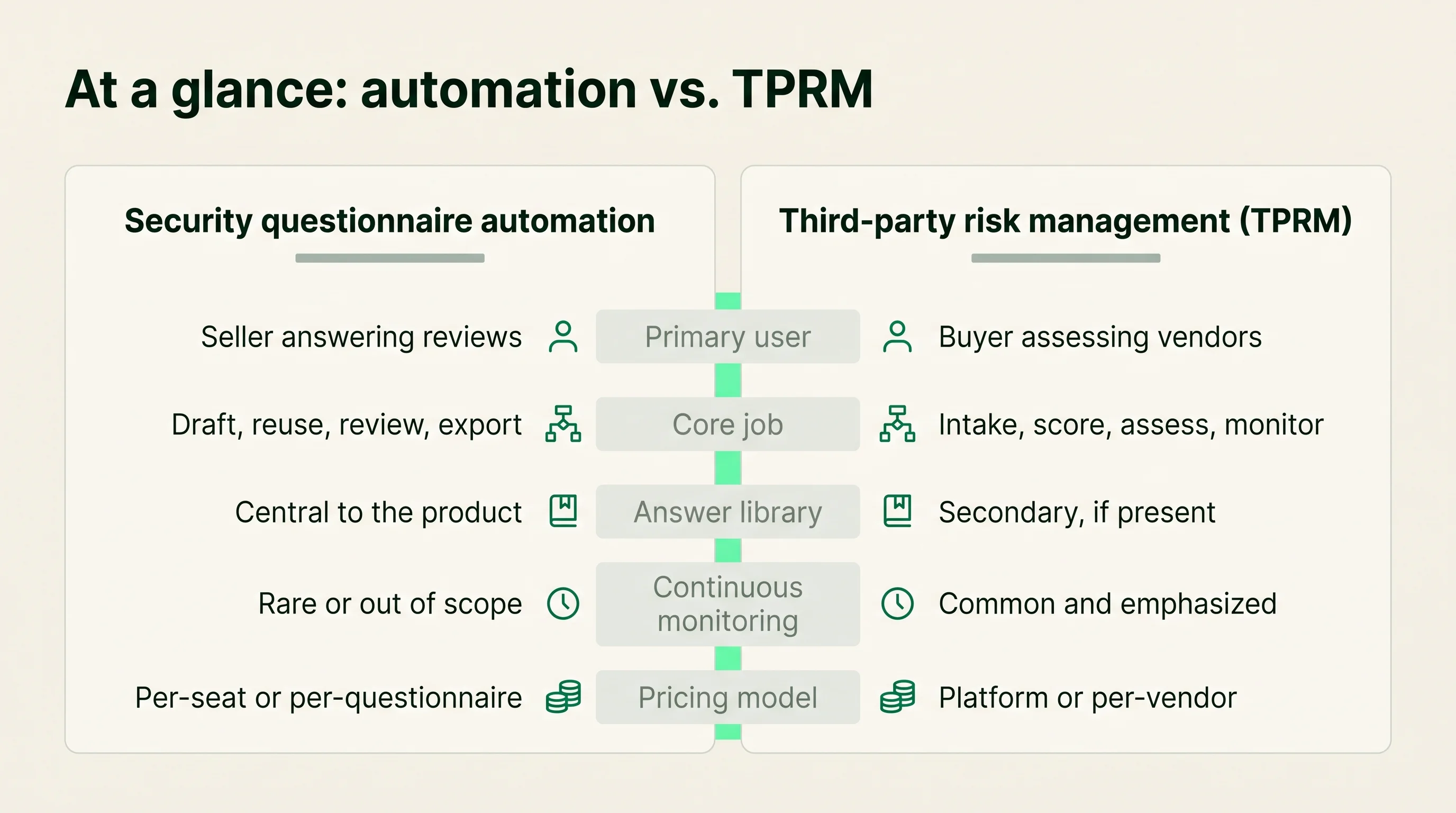
Questionnaire automation vs. third-party risk management: at a glance
The fastest way to see the difference is to compare the two side by side. The table below contrasts the seller-leaning automation tool with the buyer-side TPRM program across the criteria a shortlister actually weighs, using capability-level distinctions rather than specific vendor claims.
| Criterion | Security questionnaire automation | Third-party risk management (TPRM) |
|---|---|---|
| Primary user | Seller answering reviews | Buyer assessing vendors |
| Core job | Draft, reuse, review, export answers | Intake, score, assess, monitor vendors |
| Answer library | Central to the product | Secondary, if present |
| AI accuracy and citations | Key buying criterion (vendor-reported) | Less central to the workflow |
| Format coverage | CAIQ, SIG, Excel, portals, custom | Assessment frameworks across vendors |
| Review and approval controls | Built for sign-off before answers go out | Built for scoring and risk decisions |
| Continuous monitoring | Rare or out of scope | Common and emphasized |
| Pricing model | Per-seat, per-questionnaire, or tiered | Platform or per-vendor program |
| Best-fit owner | Sales engineering, GRC, security | Vendor risk, procurement, GRC |
The pattern is consistent. Automation looks inward at one document and the answers inside it. TPRM looks outward across many vendors and a full lifecycle. Named examples on the seller side include Conveyor, Loopio, and Responsive; named examples on the buyer side include OneTrust, Prevalent, and ProcessUnity. Capability and positioning details for any of these are vendor-reported, so verify scope against each vendor's current documentation.
Where the two meet is the questionnaire. The buyer's TPRM program produces and sends it; the seller's automation tool receives and answers it. That single handoff is the overlap, and it is the reason a tool built for one side can occasionally touch the other.
Where security questionnaire automation is stronger
Security questionnaire automation is stronger whenever the bottleneck is the questionnaire itself rather than a broader risk program. Its center of gravity is an approved answer library plus assisted drafting that turns a slow, repetitive document into a fast, consistent one. For the team that actually fills out or answers reviews, that focus is the reason to pick a dedicated tool.
The concrete strengths follow from that narrow, document-level design.
- An approved answer library that lets teams reuse vetted responses instead of rewriting them for each new questionnaire.
- Format coverage across CAIQ, SIG, NIST-aligned templates, Excel, and buyer portals, which is where most manual time is lost.
- AI-assisted drafting that proposes answers from prior responses and evidence (accuracy and citation quality are vendor-reported; test them on your own questionnaires).
- Review and approval controls so security and legal sign off before answers reach a buyer's reviewer.
- Portal autofill and export that move answers into the buyer's required format with less copy and paste.
The payoff is speed and consistency on the one step that slows sales cycles. A sales engineer or CISO who is measured on how fast security reviews clear cares about turnaround and about answers that do not contradict the last questionnaire. Automation is built for exactly that, with SOC 2 and ISO 27001 evidence reused across reviews rather than reassembled each time.
The tradeoff is depth on the document and little on the program. A questionnaire tool will not inventory your vendors, score portfolio risk, or run continuous monitoring, so a buyer who needs those things will outgrow it quickly. The same automation can serve the buyer side too, standardizing the questions a program sends, but that is a lighter use than a full TPRM platform. For how this fits both sides of the exchange, see our security questionnaire automation category hub.
Where third-party risk management is stronger
Third-party risk management is stronger whenever the problem is managing risk across a population of vendors rather than completing a single questionnaire. TPRM is a buyer-side program for inventorying vendors, tiering them by risk, assessing them, and watching them over time. For a vendor risk or procurement team measured on portfolio coverage, that breadth is the reason to think in TPRM terms.
The concrete strengths cluster around scale, lifecycle, and governance.
- Vendor inventory and risk tiering, so a program can focus effort on the third parties that matter most.
- Assessment workflows that send, collect, and score questionnaires across many vendors at once.
- Continuous monitoring signals such as external risk ratings and breach alerts that sit outside any single questionnaire.
- Program reporting for boards, auditors, and regulators that needs portfolio-level risk views.
- Lifecycle coverage from onboarding through offboarding, which a point questionnaire tool does not attempt.
The underlying advantage is coverage. A TPRM platform answers "how risky is our whole vendor base, and is that changing?" rather than "how do we answer this one questionnaire faster?" That is what a procurement, vendor risk, or GRC owner needs when a regulator asks how the organization governs its third-party exposure, or when leadership wants a single view of which critical vendors are overdue for reassessment.
The tradeoff is the mirror of the automation tradeoff: depth on the program, less on the document. A TPRM platform spreads across the lifecycle, so its questionnaire-answering experience is usually lighter than a dedicated seller tool, and answer reuse is a secondary feature rather than the core. Platform capabilities are vendor-reported, so verify current scope on each vendor's documentation. For the category definition, see our glossary entry on third-party risk management, and our TPRM software hub for how the market is organized.
Pricing and implementation differences
The two price differently because they sell different scope. Security questionnaire automation usually prices as a focused SaaS tool: per seat, per questionnaire, or in tiers based on volume and features. TPRM usually prices as a program: a platform fee, often scaled by the number of vendors assessed or monitored, sometimes bundled with risk-rating data. We do not publish specific figures because neither side lists fixed public pricing we can stand behind, so confirm current numbers in a quote.
The rollout effort matters more than the price label.
| Criterion | Security questionnaire automation | Third-party risk management (TPRM) |
|---|---|---|
| Typical pricing shape | Per-seat, per-questionnaire, or tiered | Platform or per-vendor program |
| What you are buying | A questionnaire response tool | A vendor-risk program platform |
| Main rollout work | Seeding and curating the answer library | Vendor inventory, tiering, workflow design |
| Ongoing upkeep | Keeping approved answers and evidence current | Monitoring config and reassessment cadence |
Implementation reality follows the scope. Automation rollout concentrates on seeding the answer library and connecting export targets; it is lighter, but the result depends entirely on answer quality. TPRM rollout concentrates on building a vendor inventory, defining risk tiers and assessment workflows, and wiring monitoring sources; it is a program build, not a single install.
For both, the hidden cost is the data behind the tool. No AI layer outperforms the approved answers and evidence it draws from, and no risk score outperforms the assessment data feeding it. Budget for curation on both sides. To compare cost structures across the questionnaire side of the market, see our breakdown of security questionnaire automation pricing models.
Which one should you choose?
Choose by which side of the exchange you sit on, not by which category sounds broader. Automation wins when your bottleneck is producing answers; TPRM wins when your job is assessing and monitoring the vendors who send those answers. Mis-buying happens when a seller buys a TPRM platform to solve an answering-speed problem, or a buyer buys a point answering tool when it actually needs portfolio risk management.
Use questionnaire automation when these describe you.
- You answer or complete questionnaires often, and turnaround time slows your sales cycle.
- Sales engineering, GRC, or security needs reusable approved answers across CAIQ, SIG, and buyer portals.
- Inconsistent answers between questionnaires are creating rework or reviewer friction.
- Your reviews lean on SOC 2 and ISO 27001 evidence that you want to reuse rather than reassemble.
Use TPRM when these describe you instead.
- You assess many vendors, tier them by risk, and must monitor and report on them over time.
- Procurement, vendor risk, or GRC owns vendor onboarding and offboarding across a lifecycle.
- Auditors or regulators expect portfolio-level risk evidence, not just per-vendor answers.
- You need continuous signals such as risk ratings or breach alerts beyond any single questionnaire.
Many organizations need both, layered. If you respond to inbound reviews and also run a vendor program, pair automation for the answering step with a TPRM platform for the program. The questionnaire is the shared artifact, and the cleanest setups use the focused tool for speed on one side and the broad platform for coverage on the other. Before you shortlist, read how enterprise buyers evaluate security questionnaire automation tools, then return to the security questionnaire automation category hub to compare options.
How this article was reviewed
Sources reviewed
- Vendor product pages and documentation for capability and pricing-model claims (Conveyor, Loopio, Responsive, OneTrust, Prevalent, ProcessUnity)vendor-reported; not independent fact, verify on each vendor's current docs
- AICPA SOC 2 reporting frameworkgeneral industry framing; standards body reference
- ISO/IEC 27001 information security management standardgeneral industry framing; standards body reference
- Cloud Security Alliance CAIQ (Consensus Assessments Initiative Questionnaire)general industry framing; standards body reference
- Shared Assessments SIG questionnairegeneral industry framing; standards body reference
- NIST cybersecurity and risk frameworksgeneral industry framing; standards body reference
FAQ
Is security questionnaire automation better than third-party risk management?
Neither is better in general, because they serve opposite sides of the same exchange. Security questionnaire automation is better when your job is answering or completing questionnaires fast, usually as the seller. Third-party risk management is better when your job is assessing and monitoring vendors as the buyer. Pick by which seat you sit in, and recognize that many organizations need both.
Can a TPRM platform replace a security questionnaire automation tool?
Usually not, because a TPRM platform is built for the buyer's program rather than the seller's answering workflow. TPRM platforms send and score questionnaires across many vendors, while automation tools focus on an answer library, AI-assisted drafting, and format coverage for completing reviews. A buyer who only needs to send and assess questionnaires may not need a separate automation tool, but a seller answering inbound reviews usually will.
Do sellers ever use TPRM tools, or buyers use questionnaire automation?
Both happen at the overlap, which is the questionnaire itself. Some buyers use questionnaire automation to standardize the questions they send and to parse responses, and some sellers track inbound reviews inside broader systems. The core fit still holds: automation is built for answering and TPRM is built for assessing, so cross-use tends to be lighter than the tool's primary purpose.
Which costs more, questionnaire automation or TPRM?
The two price on different models, so a direct comparison depends on scope rather than a flat figure. Automation tends toward per-seat, per-questionnaire, or tiered SaaS pricing, while TPRM tends toward platform or per-vendor program pricing that can scale with the number of vendors monitored. Confirm current numbers in a quote, since neither side lists reliable public pricing, and factor in the curation work each tool requires.
If I am a SaaS vendor answering customer security reviews, which do I need?
You most likely need security questionnaire automation, because your bottleneck is producing accurate answers fast rather than assessing your own vendors. An answer library, format coverage across CAIQ and SIG, and review controls map directly to the seller-side problem. You would add a TPRM program only if you also run a meaningful vendor-assessment program of your own, in which case the two operate side by side.