

Forrester TPRM Platforms vs. Security Questionnaire Automation Tools
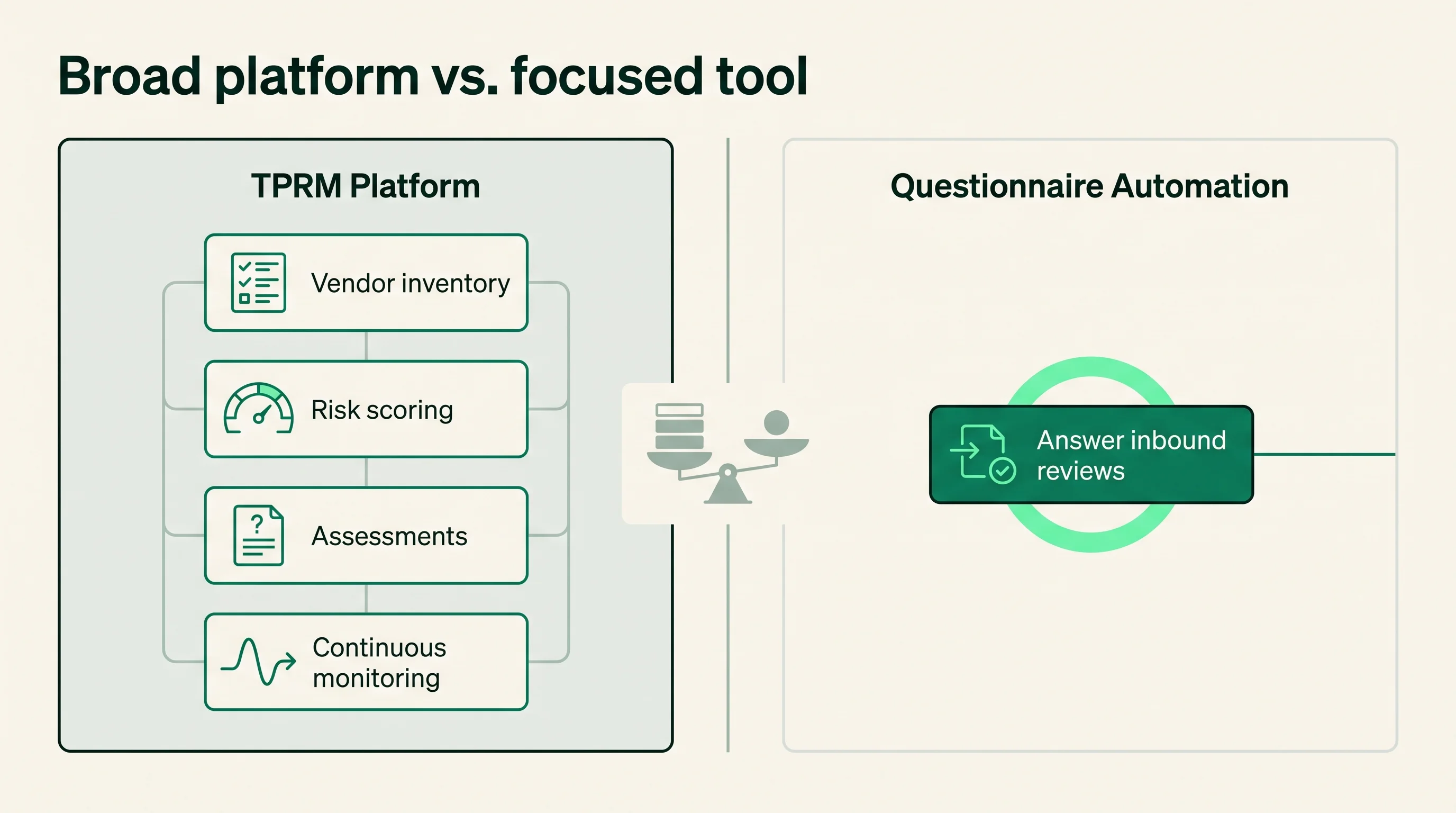
A full TPRM platform and a focused security questionnaire automation tool solve different problems. TPRM suites manage the whole vendor-risk program: inventory, risk scoring, assessments, and continuous monitoring. Questionnaire automation tools do one job well: answering inbound security reviews fast and accurately from an approved answer library.
Quick answer: TPRM platforms vs. security questionnaire automation tools
Choose a broad TPRM platform if you assess and monitor many third parties and need one system for vendor inventory, risk scoring, assessments, and ongoing oversight. Choose a focused security questionnaire automation tool if your pressure point is inbound: your team has to answer buyers' security questionnaires quickly and consistently, and you want accurate answers drafted from an approved library.
The two categories are not competitors so much as tools for opposite ends of the same transaction. TPRM platforms serve the buyer reviewing vendors. Questionnaire automation tools usually serve the seller responding to those reviews. Some products blur the line, but the core jobs stay distinct.
The right choice depends on your formats, your volume, and which team owns the work. There is no universal winner here, only a better fit for a given program.
- Managing a portfolio of vendors with assessments and monitoring: a TPRM platform fits.
- Answering a steady stream of inbound security questionnaires: a focused automation tool fits.
- Doing both at scale: many organizations run a TPRM platform on the buyer side and a questionnaire tool on the seller side.
If the category itself is new to you, start with our explainer on what security questionnaire automation is, then return to weigh it against a full TPRM suite.
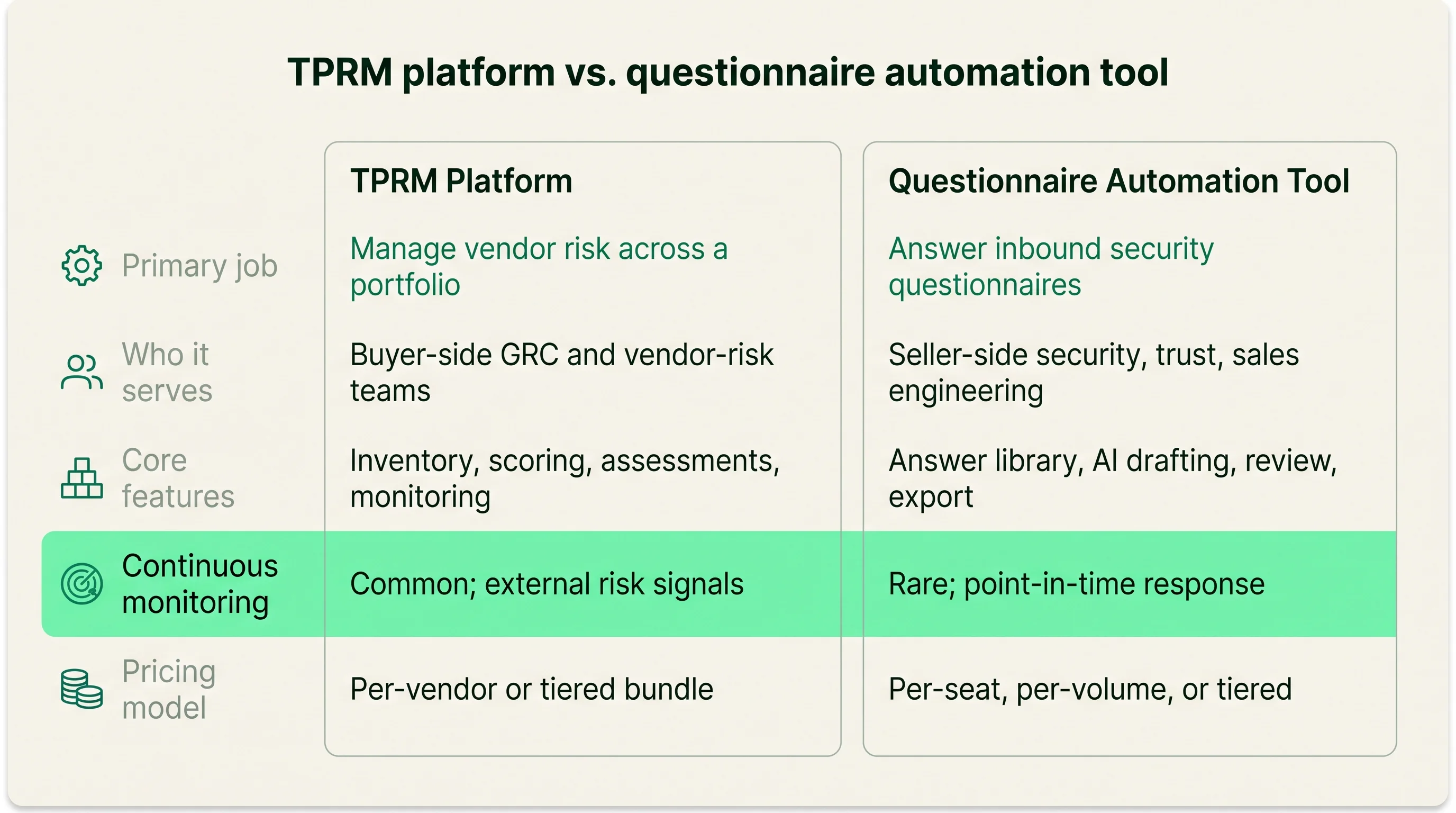
TPRM platforms vs. questionnaire automation tools: at a glance
The fastest way to see the difference is side by side. The table below compares the two categories across the criteria most shortlisters weigh, at the capability level rather than by naming specific products, since features shift between releases.
| Criteria | TPRM platform | Questionnaire automation tool |
|---|---|---|
| Primary job | Manage vendor risk across a portfolio | Answer inbound security questionnaires |
| Who it serves | Buyer-side GRC and vendor-risk teams | Seller-side security, trust, and sales engineering |
| Core features | Inventory, risk scoring, assessments, monitoring | Answer library, AI drafting, review, export |
| Answer library | Sometimes, focused on outbound assessments | Central, focused on approved reusable answers |
| Format coverage | Send and track SIG, CAIQ, custom assessments | Respond across Excel, portals, CAIQ, SIG |
| Continuous monitoring | Common; external risk signals over time | Rare; point-in-time response is the focus |
| Pricing model | Per-vendor or tiered platform bundle | Per-seat, per-volume, or tiered |
Treat the feature rows as directional. Vendors in both categories publish their own capability lists, and the boundaries move, so verify the specifics on each vendor's current docs.
A few rows deserve a closer read. The continuous-monitoring row is the cleanest dividing line: TPRM platforms add external risk signals such as breach, financial, and security-rating feeds over time, while questionnaire tools are built around a point-in-time response. The answer-library row matters for sellers, because a focused tool treats the approved-answer library as its center of gravity, whereas a TPRM platform's library, if present, is oriented toward sending and scoring assessments rather than answering them.
The pattern is consistent: TPRM platforms are broad and program-level; questionnaire tools are narrow and workflow-level. Hold that distinction in mind through the rest of this comparison, because it explains most of the fit differences below.
Where TPRM platforms are stronger
A TPRM platform is strongest when you are the one assessing vendors at scale. Third-party risk management is the discipline of evaluating and overseeing the vendors, suppliers, and partners your organization depends on, and a platform exists to run that whole program in one place. For a GRC or vendor-risk team measured on portfolio coverage, that breadth is the main reason to pick it.
The concrete strengths cluster around managing many vendors across their lifecycle.
- Vendor inventory and tiering, so you can rank third parties by criticality and apply the right level of due diligence to each.
- Risk scoring that rolls individual assessment results into a portfolio view a CISO or board can read.
- Assessment workflows for sending, collecting, and reviewing standardized questionnaires such as SIG and CAIQ across many vendors at once.
- Continuous monitoring that layers external risk signals on top of point-in-time assessments, so a vendor's score can change between reviews (specific data feeds are vendor-reported; verify on current docs).
- Evidence and remediation tracking, so findings turn into tasks rather than sitting in a spreadsheet.
This is also where general industry framing, including the way analysts like Forrester describe the TPRM category, tends to concentrate: lifecycle coverage, automation of assessment workflows, and continuous oversight. We refer to that coverage only in general terms and do not cite specific reports, scores, or vendor placements. For a plain-language definition of the discipline, see our glossary entry on third-party risk management, and for the wider category our hub on third-party risk management software.
Where questionnaire automation tools are stronger
A focused security questionnaire automation tool is strongest when the bottleneck is answering reviews, not running them. These tools do one job well: take an inbound questionnaire, draft accurate answers from an approved library, route them through review, and export them in the buyer's format. For a security, trust, or sales engineering team drowning in inbound requests, that focus is the advantage.
The concrete strengths follow from that single, well-defined workflow.
- An approved-answer library as the core asset, keeping responses consistent and reusable across hundreds of questionnaires.
- AI-assisted drafting that proposes answers from prior approved responses and evidence, which can cut repetitive work for some teams (accuracy claims are vendor-reported; test them on your own questionnaires).
- Citation and grounding controls in newer tools, so a drafted answer points back to the evidence behind it rather than guessing.
- Format coverage tuned for responding: Excel, web portals, and standardized formats like CAIQ and SIG, including portal autofill where supported.
- Review and approval routing built for the speed a sales cycle demands, with security and legal sign-off baked into the flow.
The payoff is time to response. A focused tool is built so that a sales engineer or security analyst can turn around a long questionnaire in hours instead of days, without re-deriving answers the team already approved. The tradeoff is narrower scope: these tools generally do not manage your own vendor portfolio or run continuous monitoring on third parties. For how buyers weigh these tools against each other, see our explainer on how enterprise buyers evaluate security questionnaire automation tools.
Pricing and implementation differences
The two categories price for different units of value, so the comparison is about model, not list price. TPRM platforms tend to price around the size of your vendor program, while questionnaire automation tools tend to price around the size of your response team or volume. We do not publish specific dollar figures, because pricing is largely quote-based and changes; confirm current numbers in a quote.
The models differ in shape and in what drives the bill.
| Dimension | TPRM platform | Questionnaire automation tool |
|---|---|---|
| Common model | Per-vendor or tiered platform bundle | Per-seat, per-volume, or tiered |
| What drives cost | Number of vendors and modules | Number of users or questionnaires |
| Main rollout work | Onboarding vendor inventory and workflows | Seeding and curating the answer library |
| Time to value | Longer; program-wide configuration | Shorter; first questionnaires answered fast |
Implementation reality matters more than the price label. A TPRM platform rollout concentrates on importing your vendor inventory, tiering third parties, and configuring assessment and monitoring workflows across the program, which is broader work that often involves GRC, procurement, and security together. A questionnaire tool rollout concentrates on seeding the answer library and connecting the formats and tools your team already uses, which tends to show value sooner.
For both, the hidden cost is content quality. A TPRM platform is only as useful as the assessments and evidence flowing through it, and a questionnaire tool's AI is only as good as the approved answers behind it, so plan for ongoing curation either way. To compare cost structures across the questionnaire side of the market, see our breakdown of security questionnaire automation pricing models.
Which one should you choose?
Choose by which side of the review you sit on and where the work piles up. The two categories overlap only at the edges, so the deciding factor is your primary job: managing a vendor portfolio, or answering the questionnaires buyers send you. Match the tool to the program you actually run.
Choose a TPRM platform when:
- You assess and oversee many third parties and need vendor inventory, tiering, and risk scoring in one system.
- A GRC or vendor-risk team owns the program and reports portfolio-level risk to a CISO or board.
- Continuous monitoring matters, because you need a vendor's risk picture to update between formal assessments.
- Sending and tracking assessments such as SIG and CAIQ across the portfolio is the core workflow.
Choose a focused questionnaire automation tool when:
- Inbound security questionnaires are slowing your sales cycle and your team needs faster, consistent responses.
- Security, trust, or sales engineering owns the work and is measured on turnaround and accuracy.
- An approved-answer library and AI-assisted drafting would remove repetitive copy-paste from your response process.
- Your pressure is point-in-time response across Excel, portals, CAIQ, and SIG, not managing your own vendor risk.
Many organizations need both, on opposite sides of the same transaction: a TPRM platform to assess the vendors they buy from, and a questionnaire tool to answer the buyers they sell to. If that is you, scope them separately and avoid forcing one tool to do the other's job. For a structured shortlist, use the security questionnaire automation category hub and our buyer-evaluation explainer to score options against your own program.
How this article was reviewed
Sources reviewed
- Forrester third-party risk management coverageGeneral industry framing only. We refer to Forrester's TPRM category coverage in general terms and do not cite specific reports, scores, dates, or vendor placements. Treat any analyst concept here as general framing, not a cited claim.
- TPRM and questionnaire automation vendor product pages and docsVendor-reported. Capability, integration, AI accuracy, and pricing claims should be verified on each vendor's current docs and confirmed in a quote, not treated as independent fact.
- AICPA - SOC 2Primary source for what a SOC 2 report attests, commonly referenced as evidence in both vendor assessments and questionnaire responses.
- ISO/IEC 27001Primary source for the information security management standard cited as evidence on both sides of a vendor review.
- Cloud Security Alliance - CAIQPrimary source for the CAIQ format, a standardized questionnaire both TPRM platforms and response tools support.
- Shared Assessments - SIGPrimary source for the SIG questionnaire format referenced in format-coverage comparison.
- NISTPrimary source for NIST control references commonly cited in third-party assessments and questionnaire answers.
FAQ
Which is better for security questionnaire automation, a TPRM platform or a focused tool?
For answering inbound security questionnaires specifically, a focused automation tool is usually the better fit, because that single workflow is its core job. A broad TPRM platform is built to assess and monitor your own vendors, so its questionnaire features lean toward sending assessments rather than responding to them. Decide by which side of the review you sit on, and test the actual response workflow before committing.
What is TPRM, and how is it different from questionnaire automation?
TPRM, or third-party risk management, is the discipline of evaluating and overseeing the vendors and partners your organization relies on. A TPRM platform manages that whole program: inventory, risk scoring, assessments, and continuous monitoring across many vendors. Questionnaire automation is narrower, focused on answering the security questionnaires buyers send you, drafted from an approved answer library. One is buyer-side program management; the other is seller-side response.
Can a TPRM platform replace a security questionnaire automation tool?
Sometimes partially, but rarely cleanly. TPRM platforms are designed to send and track assessments to vendors, not to draft and export fast, accurate responses to inbound questionnaires. If your bottleneck is response turnaround, a focused tool with an approved-answer library and AI-assisted drafting will usually fit that workflow better. Test a real inbound questionnaire in any TPRM platform before assuming it covers the seller-side job.
Do TPRM platforms and questionnaire tools use the same questionnaire formats?
They share standardized formats but use them from opposite directions. Both work with frameworks like SIG, CAIQ, SOC 2, ISO 27001, and NIST references. A TPRM platform sends and scores these assessments against your vendors, while a questionnaire automation tool responds to them on your behalf. Confirm exact format support and import or export behavior on each vendor's current documentation.
How should procurement decide between the two?
Start by naming the bottleneck and the owner. If a GRC or vendor-risk team needs to assess and monitor a portfolio of third parties, scope a TPRM platform. If security, trust, or sales engineering needs to clear an inbound questionnaire backlog faster, scope a focused automation tool. Many organizations buy both for different jobs, so price and evaluate them separately rather than expecting one tool to cover both sides.