

Vendor Risk Questionnaire Automation: Buyer and Seller Workflows Explained
Vendor risk questionnaire automation has two sides: buyers send, collect, and score questionnaires to assess vendors, while sellers answer inbound questionnaires fast and accurately from an approved answer library. The same exchange, run by different software and different teams.
What is vendor risk questionnaire automation, on both sides?
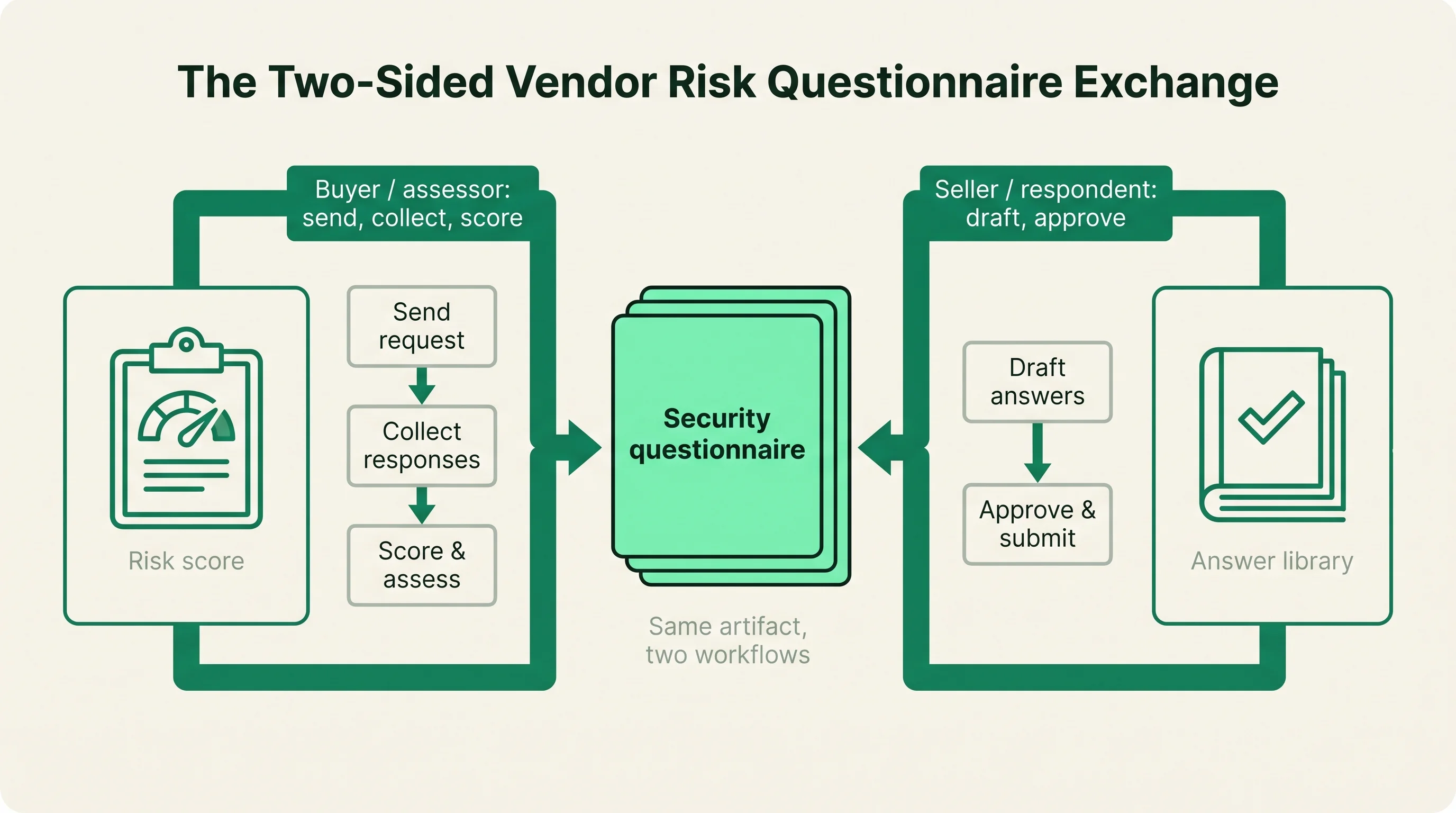
Vendor risk questionnaire automation is software that speeds up the security questionnaire exchange between a buyer assessing a vendor and the seller answering that assessment. It has two distinct sides. The buyer side automates sending, collecting, and scoring questionnaires across many vendors. The seller side automates drafting accurate answers to inbound questionnaires from a maintained answer library.
A security questionnaire is a structured set of questions a buyer sends to evaluate a vendor's security posture before or during a deal. The same document looks different depending on which desk it lands on.
- To the buyer, it is an assessment input that feeds a risk score and a purchasing decision.
- To the seller, it is an inbound request that can block a deal until it is answered.
The roles that own the work differ by side. On the buyer side, the owner is usually procurement or a vendor risk team inside a third-party risk management (TPRM) program, often reporting to the CISO. On the seller side, the owner is usually GRC (governance, risk, and compliance), security, or a sales engineer, depending on whether the pressure is treated as a compliance task or a deal blocker.
The questionnaires themselves are frequently standardized, which is what makes automation possible on both sides. Common formats include the CAIQ (Consensus Assessments Initiative Questionnaire) from the Cloud Security Alliance, the SIG and SIG Lite (Standardized Information Gathering) questionnaires from Shared Assessments, and custom spreadsheets mapped to SOC 2, ISO 27001, or NIST controls. The same artifact, two workflows: that two-sided structure is the whole point of this category.
How does it work on each side?
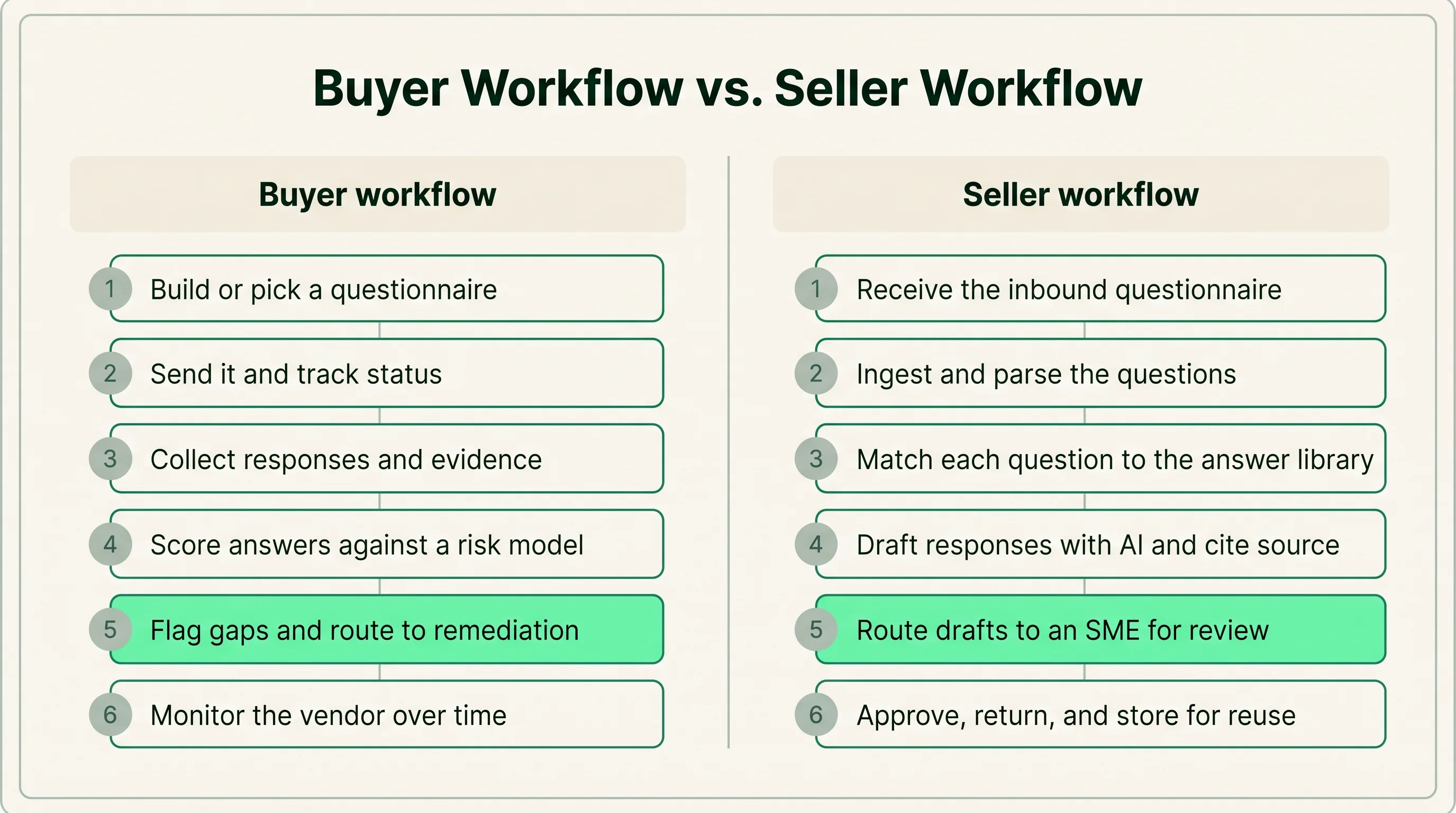
It works as two mirrored pipelines over the same questionnaire. The buyer's pipeline distributes and scores; the seller's pipeline drafts and approves. Reading them side by side shows why the same document needs two different kinds of software.
| Step | Buyer workflow | Seller workflow |
|---|---|---|
| 1 | Build or pick a questionnaire (SIG, CAIQ, custom) | Receive the inbound questionnaire in any format |
| 2 | Send it to the vendor and track status | Ingest it and parse the questions |
| 3 | Collect responses and request evidence | Match each question to the answer library |
| 4 | Score answers against a risk model | Draft responses with AI, cite the source |
| 5 | Flag gaps and route for remediation | Route drafts to an SME for review |
| 6 | Monitor the vendor over time | Approve and return, then store for reuse |
The buyer mechanism centers on scoring and tracking. The software sends a questionnaire to each vendor, chases late responses, and scores returned answers against a risk model so a reviewer can rank vendors instead of reading every cell. Many buyer platforms also pull in continuous signals, such as certification status or external scan data, so the assessment is not a one-time snapshot.
The seller mechanism centers on the answer library and AI drafting. Every incoming question is matched against approved answers the team has already written and signed off, and a model drafts the response in the buyer's required phrasing. The library, not the AI, is the asset that decides accuracy, a point covered in depth in what security questionnaire automation is. Strong seller tools cite the source answer or evidence document for each draft so a reviewer can verify it fast.
Both pipelines end with a human. The buyer signs off on a risk decision; the seller approves a claim about its own controls.
Why does vendor risk questionnaire automation matter?
It matters because the manual version of this exchange is slow, repetitive, and error-prone on both sides at once. Buyers drown in spreadsheets they have to read and score by hand. Sellers retype the same answers for every new prospect. The same friction blocks deals from both directions.
The concrete pains are familiar to anyone who has run either side.
- Buyers: tracking dozens of questionnaires in email, chasing late vendors, and scoring inconsistent answers by hand.
- Sellers: pulling subject-matter experts off other work to re-answer questions they have answered many times, with answers drifting out of sync.
- Both: stale responses, where last quarter's correct answer is this quarter's misrepresentation, and blocked deals waiting on a review.
The contrast between the manual way and the structured way is sharp.
| Dimension | Manual / spreadsheet | Automated / structured |
|---|---|---|
| Buyer scoring | Read every cell by hand | Score against a risk model |
| Seller drafting | Retype from memory or old files | Draft from an approved library |
| Status tracking | Email threads and reminders | Dashboard with deadlines |
| Consistency | Answers drift over time | Versioned, single source |
| SME load | High and repeated | Lower, focused on review |
The shared win is that both sides move the human from production work to judgment work. The buyer reviews scores and exceptions instead of reading raw answers. The seller reviews drafts instead of writing them. Neither side removes the human, but each removes the typing.
Where does it sit next to adjacent surfaces?
Vendor risk questionnaire automation sits between broad third-party risk management on the buyer side and security questionnaire response on the seller side, with trust centers and RFP response software adjacent to both. The surfaces overlap because they can draw on the same questionnaires and the same answers, which is what makes them easy to confuse.
| Surface | Whose side | Its specific job |
|---|---|---|
| Buyer questionnaire automation | Buyer | Send, collect, and score vendor questionnaires |
| TPRM / VRM platform | Buyer | Run the full vendor risk program, not just questionnaires |
| Seller questionnaire automation | Seller | Draft and approve answers to inbound reviews |
| Trust center | Seller | Publish proof so fewer questionnaires arrive |
| RFP response software | Seller | Answer proposals, including their security sections |
On the buyer side, questionnaire automation is one function inside a wider TPRM program. A full platform also handles vendor onboarding, contract risk, continuous monitoring, and offboarding. The questionnaire is the assessment step; the third-party risk management software category covers the rest of that lifecycle.
On the seller side, the adjacent surface is the trust center. A trust center is a published page where a company posts its certifications, completed CAIQ, and common answers so buyers can self-serve. The model is publish once, deflect many. A good trust center reduces how many questionnaires arrive, and questionnaire automation handles what it does not deflect.
RFP response software is adjacent on the seller side because it shares the answer library. The security section of an RFP draws on the same approved answers as a standalone questionnaire, which is why several vendors grew from RFP response into security questionnaires. The work is the same shape: match a question to an approved answer and draft a response.
What are the benefits and tradeoffs?
The payoff is faster cycles and lower repeated effort on both sides; the cost is setup, maintenance, and the risk of trusting unreviewed output. The benefits and tradeoffs are largely symmetric, so it helps to read them per side.
Buyer benefits:
- Consistent scoring across vendors, instead of one reviewer's judgment varying by mood and workload.
- Faster onboarding, because a scored questionnaire turns around quicker than a hand-read one.
- An audit trail of who assessed what, useful for the company's own audits and regulators.
Seller benefits:
- Faster deal cycles, because a stalled security review can hold a signed contract.
- Reuse, since most questionnaires repeat questions the team has already answered.
- A versioned answer library that keeps responses consistent across prospects.
The tradeoffs are real and worth stating plainly.
- Setup is a project on both sides: buyers configure a scoring model, sellers build a curated library.
- Maintenance is a standing cost, not a one-time spend.
- Over-trust is the subtle risk. A buyer who trusts an automated score without reading exceptions, or a seller who rubber-stamps polished AI drafts, will eventually act on a wrong answer with full confidence.
There is a point where it is not worth it. A buyer assessing a handful of low-risk vendors a year does not need a scoring platform, and a seller receiving a few questionnaires a year does not need dedicated software. A shared spreadsheet of approved answers and a careful reviewer will do until volume is high enough that the same people are repeatedly pulled into near-identical work.
How do you evaluate or implement it?
Evaluate the two sides on different criteria, because they do different jobs. Buyer tools live or die on scoring, framework coverage, and monitoring. Seller tools live or die on answer-library quality, AI accuracy with citations, and format coverage. Do not buy either on headline automation percentages, which are easy to claim and hard to verify in your environment.
| Criterion | Buyer tool: what good looks like | Seller tool: what good looks like |
|---|---|---|
| Core engine | Configurable risk scoring and tiering | Curated, versioned answer library with evidence links |
| Framework coverage | SIG, CAIQ, NIST, SOC 2, ISO 27001 mapping | Same formats, plus portal and Excel ingestion |
| AI use | Summarize and flag risky answers | Draft answers, cite the source for each one |
| Workflow | Send, track, chase, and remediate | Route drafts to the right SME for sign-off |
| Ongoing signal | Continuous monitoring of vendor status | Reuse and library upkeep over time |
Real vendors anchor each side, and the claims below are vendor-reported, so test them against your own questionnaires rather than the marketing. On the buyer/TPRM side, OneTrust, Prevalent, ProcessUnity, and Vanta are common reference points for assessment and scoring. On the seller side, Conveyor, Loopio, Responsive, HyperComply, SecurityPal, SafeBase, Whistic, and Drata come up most often. Several names, including Vanta and Whistic, operate on both sides of the exchange.
The most reliable evaluation method is to run a real, recent questionnaire through a trial.
- Buyers: load a vendor you have already assessed and check whether the scoring matches your own judgment.
- Sellers: load a questionnaire you have already answered and compare the drafted answers, and their citations, against your approved versions.
- Both: watch the review step, since that gate is where the human stays accountable.
When you are ready to shortlist seller tools, start from the security questionnaire automation category hub and compare the leading tools on library quality and AI accuracy rather than raw automation claims.
How this article was reviewed
Sources reviewed
- AICPA - SOC 2Primary source for what a SOC 2 report attests.
- ISO/IEC 27001Primary source for the information security management standard used as evidence.
- Cloud Security Alliance - CAIQPrimary source for the CAIQ format used in vendor assessments.
- Shared Assessments - SIGPrimary source for the SIG and SIG Lite questionnaire definitions.
- NISTReference framework used to map and score questionnaire controls.
- Vendor product documentation (Conveyor, Loopio, Responsive, Vanta, OneTrust, Whistic, and others)Capability claims are vendor-reported and should be verified in a trial, not treated as independent fact.
FAQ
What is vendor risk questionnaire automation?
It is software that speeds up the security questionnaire exchange on both sides. Buyers automate sending, collecting, and scoring questionnaires to assess vendors, while sellers automate drafting accurate answers from a maintained answer library. Each side keeps a human in the loop: the buyer approves a risk decision, and the seller approves every claim before it is returned.
What are the most common mistakes when implementing vendor risk questionnaire automation?
The most common mistake is treating it as a one-time setup. On the buyer side, teams configure a scoring model and never tune it, so the scores stop reflecting real risk. On the seller side, teams load a library and stop maintaining it, so the AI drafts confident answers from stale content. The second mistake is over-trusting automated output and letting the human review become a rubber stamp.
How does vendor risk questionnaire automation compare to doing it manually or with spreadsheets?
Automation moves both sides from production work to judgment work. Manually, buyers read and score every cell and sellers retype answers from memory or old files, which is slow and drifts out of sync. Automated, buyers score against a risk model and sellers draft from an approved library, so the human reviews exceptions and drafts instead of producing them. Spreadsheets still work below a few questionnaires a year, where the license and setup cost outweigh the saved time.
How do you get leadership buy-in for vendor risk questionnaire automation?
Tie it to a number leadership already tracks. On the seller side, that is deal cycle time and SME hours lost to repeated questionnaires, since a stalled security review can hold a signed contract. On the buyer side, it is vendor onboarding time and assessment consistency, which matter for audits and regulators. Frame the spend against the cost of the people currently doing the work by hand, not against the abstract value of automation.
What is the typical implementation timeline for vendor risk questionnaire automation?
Implementation commonly ranges from a few weeks to a few months, depending on side and scope. Seller-side setup is driven by building and curating the answer library, which is the longest task and the one that decides accuracy. Buyer-side setup is driven by configuring the risk-scoring model and connecting vendor data sources. Both timelines depend more on internal content and process readiness than on the software itself.