

Seller-Side Security Reviews vs. Buyer-Side Vendor Risk Assessments
A seller-side security review is the work a vendor does to answer inbound security questionnaires and close deals. A buyer-side vendor risk assessment is the work a customer does to evaluate that vendor and manage third party risk. Both sides touch the same questionnaire artifact, but they have different goals, owners, tooling, and metrics.
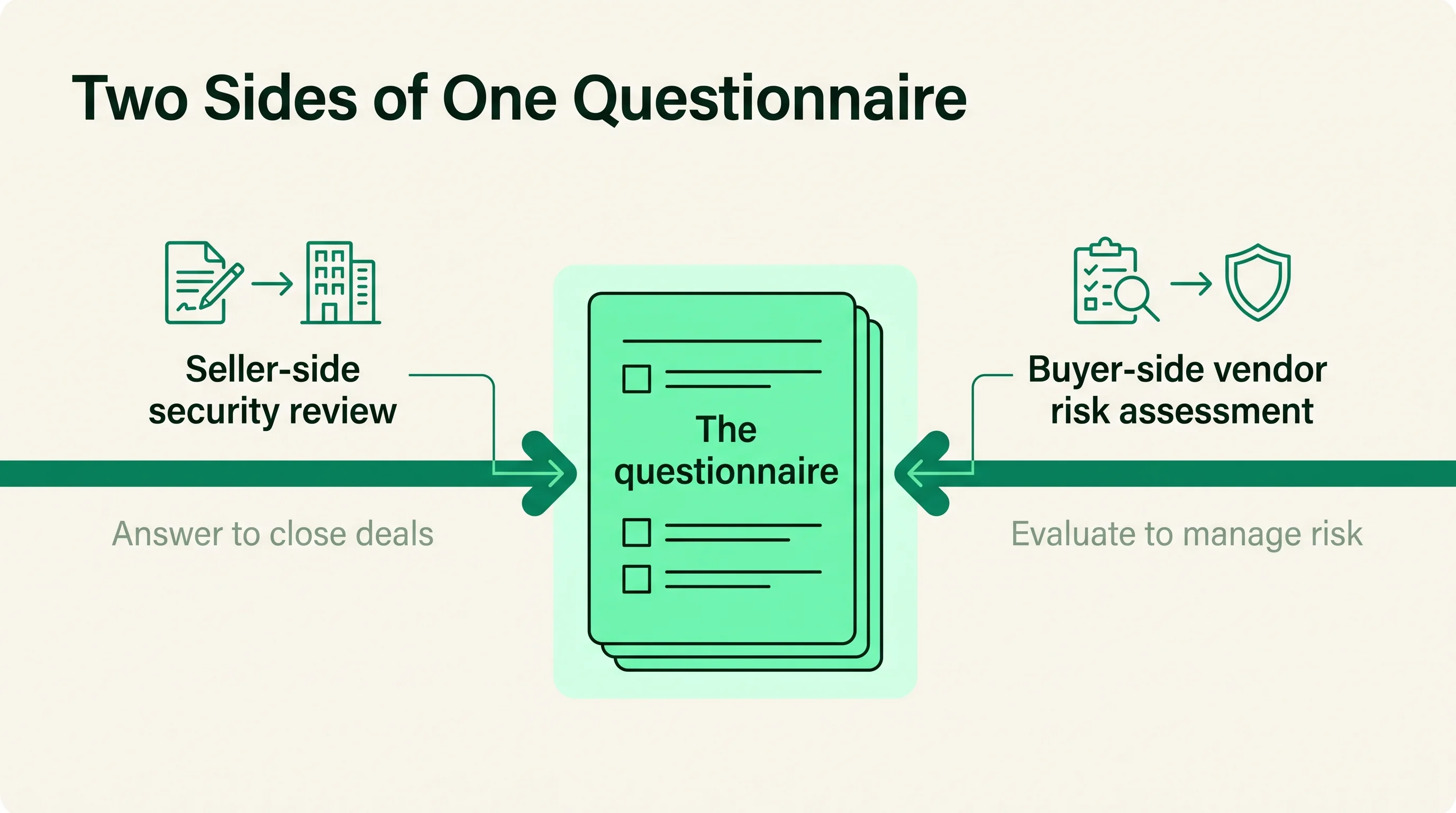
Quick answer: seller-side security reviews vs. buyer-side vendor risk assessments
Seller-side security reviews and buyer-side vendor risk assessments are two views of the same security questionnaire, seen from opposite ends of a deal. The seller answers the questionnaire to prove the product is safe enough to buy. The buyer reads those answers to decide whether the vendor is safe enough to onboard. Same artifact, opposite goals.
A security questionnaire is the structured set of security questions a buyer sends a vendor during procurement. On the seller side, a security review is the workflow of receiving that questionnaire, drafting accurate answers from an approved answer library, routing them for approval, and returning them in the buyer's format. On the buyer side, a vendor risk assessment is the workflow of sending the questionnaire, scoring the answers against a risk standard, flagging gaps, and recording a decision.
Which side you sit on determines almost everything else: your goal, your owner, your tools, and your metrics. The seller side is usually owned by GRC and sales engineering and measured on turnaround time and win rate. The buyer side is usually owned by procurement and vendor risk and measured on risk coverage and decision defensibility.
Keep two questions in front of you while you read. Which side of the questionnaire do you own today? And what does the other side need from the same document to move the deal forward? For the underlying mechanics shared by both sides, see our explainer on what security questionnaire automation is.
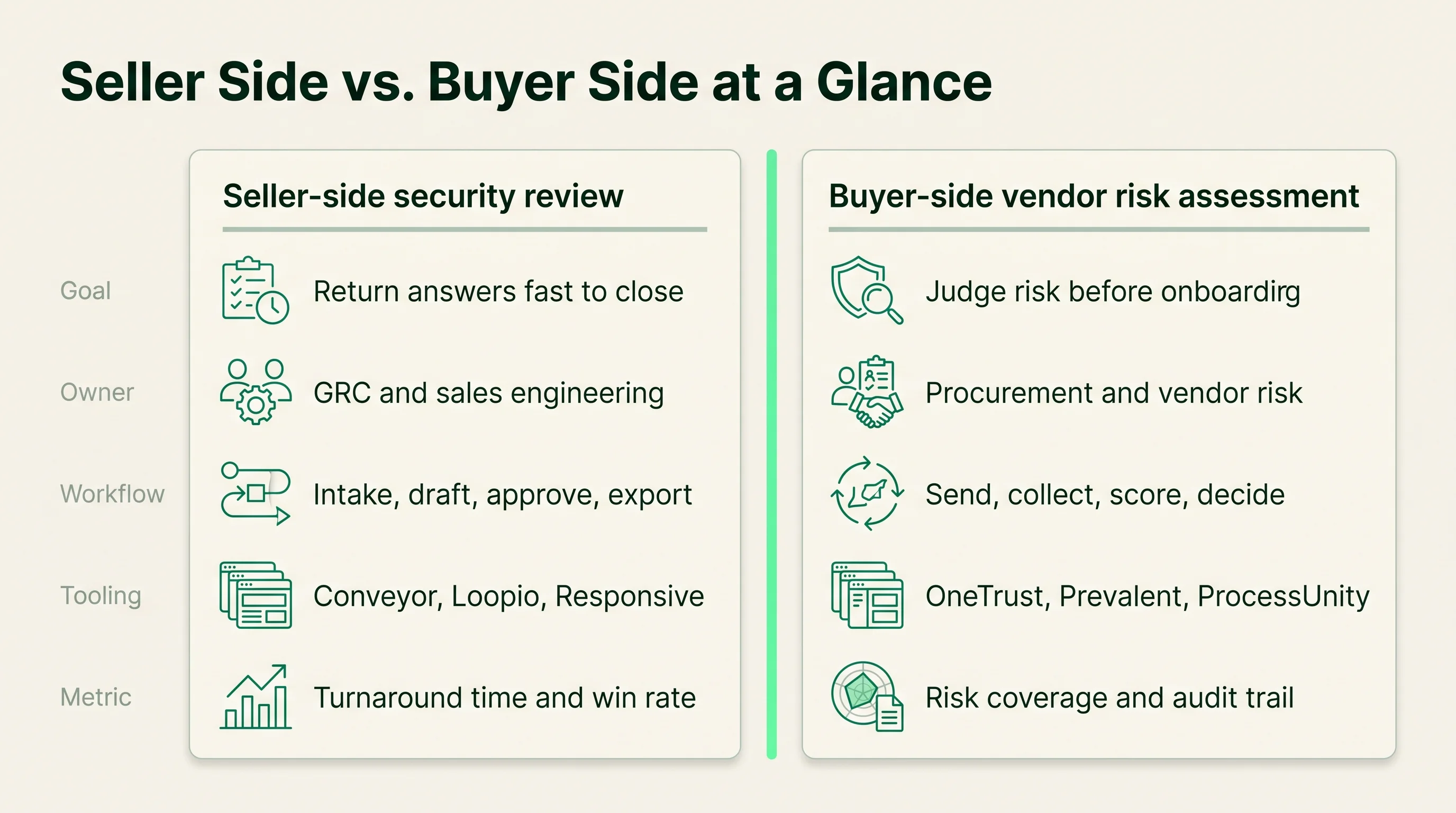
Seller-side security reviews vs. buyer-side vendor risk assessments: at a glance
The two sides differ most on their goal, and that single difference shapes the owner, the workflow, the tooling, and the metrics. The seller works to return answers fast and unblock revenue. The buyer works to reach a defensible risk decision and keep an audit trail. The table below compares them on the criteria that define each role.
| Criterion | Seller-side security review | Buyer-side vendor risk assessment |
|---|---|---|
| Goal | Return accurate answers fast to close the deal | Judge vendor risk before onboarding |
| Typical owner | GRC, sales engineering, security | Procurement, vendor risk, TPRM |
| Core workflow | Intake, draft, approve, export | Send, collect, score, decide |
| Direction | Outbound responses to buyers | Inbound evaluation of vendors |
| Primary artifact | Answer library and trust center | Risk register and scoring rubric |
| Common tooling | Conveyor, Loopio, Responsive | OneTrust, Prevalent, ProcessUnity |
| Key metrics | Turnaround time, reuse rate, win rate | Risk coverage, time to onboard, audit trail |
Read this table as the shared map, not a verdict, because the same questionnaire is the input on both sides. A seller optimizes the left column; a buyer optimizes the right. The frameworks behind the questions, such as SOC 2, ISO 27001, CAIQ, and SIG, are the common language that lets both sides read the same artifact. For the broader category context, see our overview of third party risk management.
What does the seller side of a security review optimize for?
The seller side optimizes for accurate answers returned fast, because a stalled security review can hold up a signed contract. The job is to take an inbound questionnaire, produce trustworthy answers from approved content, get them reviewed, and return them in the buyer's format before the review blocks the deal. Speed and accuracy are not in tension here; both protect the same revenue.
The seller-side workflow and its goals break down cleanly:
- Intake: receive the questionnaire in whatever format the buyer chose, including CAIQ, SIG, a custom spreadsheet, or a buyer portal that needs autofill.
- Draft: generate answers from an approved answer library, reusing language that security has already signed off on so the same experts are not pulled into near-identical questions.
- Approve: route sensitive or non-standard answers to the right subject-matter expert and capture sign-off before anything leaves the building.
- Export: return answers in the buyer's required format and, where possible, point the buyer to a trust center so they can self-serve common documents.
The owners are usually GRC, sales engineering, and security working together. GRC keeps the answers correct and current. Sales engineering keeps the deal moving and translates buyer urgency. Security approves the claims that carry real risk. The metrics follow the goal: turnaround time, answer reuse rate, and the questionnaire's effect on win rate and sales cycle length.
Response platforms such as Conveyor, Loopio, and Responsive are built for this side. They center on an answer library, AI-assisted drafting with citations, format coverage, and approval routing. Vendors report broad format support and accuracy gains, which you should test against your own questionnaires in a trial. The honest limit of the seller side is that it ends when the answers are returned; the seller does not control how the buyer scores them. To reduce inbound volume in the first place, see our workflow on launching a trust center to reduce questionnaires.
What does the buyer side of a vendor risk assessment optimize for?
The buyer side optimizes for a defensible risk decision and an auditable record, because the buyer is accountable for every vendor it onboards. The job is to send the questionnaire, collect the answers, score them against a consistent standard, flag gaps, and record a decision that survives an audit. Speed matters, but defensibility matters more.
The buyer-side workflow and its goals break down cleanly:
- Send: issue the right questionnaire for the vendor's risk tier, scaling depth to how much access or data the vendor will hold.
- Collect: gather answers and supporting evidence, then chase the gaps and clarifications that the first pass leaves open.
- Score: evaluate answers against a rubric tied to frameworks such as SOC 2, ISO 27001, and NIST, and translate findings into a risk rating.
- Decide: approve, approve with conditions, or reject, and keep the questionnaire and its scoring as the evidence behind that decision.
The owners are usually procurement and a vendor risk or TPRM function, with the CISO accountable for the risk standard. Procurement runs the onboarding process and the contract. Vendor risk owns the rubric and the rating. The CISO owns the threshold for what is acceptable. The metrics follow the goal: risk coverage across the vendor portfolio, time to onboard a vendor, and the completeness of the audit trail.
TPRM platforms such as OneTrust, Prevalent, and ProcessUnity are built for this side. They center on a risk register, questionnaire distribution, scoring workflows, and continuous monitoring across many vendors. Vendors report automation across scoring and reassessment, which buyers should confirm against their own rubric in a demo. The honest limit of the buyer side is that it depends on the quality of the answers it receives; a fast but vague seller answer becomes slow buyer work. For where this fits in a TPRM program, see our breakdown of the questionnaire chokepoint in third party risk management.
Where the two sides meet: the questionnaire artifact
The two sides meet at one shared object: the questionnaire itself. Every answer a seller writes becomes evidence a buyer scores, so the same document is a response on one side and an input on the other. Understanding that handoff is what makes either role faster, because most review friction lives at the seam between the two.
The friction is usually a mismatch in what each side wants from the same line:
- The seller wants to reuse an approved answer; the buyer wants an answer specific to its own risk question, so generic reuse triggers follow-up.
- The seller wants to close the deal; the buyer wants to defend a decision, so an answer that reads as marketing slows scoring.
- The seller measures speed; the buyer measures coverage, so a partially answered questionnaire returns fast but bounces back.
- The seller points to a trust center; the buyer still needs that evidence inside its own risk record, so the link has to lead to something scoreable.
Standard frameworks are the shared language that reduces this friction. When a seller answers in CAIQ or SIG terms and maps claims to SOC 2 or ISO 27001, the buyer can score the answer without a round of clarifying questions. The format is doing translation work for both sides.
The practical lesson is that each side can pre-empt the other. A seller who writes for the buyer's rubric, not just for speed, gets fewer follow-ups. A buyer who sends a clear, tiered questionnaire, not a maximal one, gets faster and more useful answers. For a closely related boundary, see our comparison of security questionnaire automation versus trust centers and where each fits.
How do seller-side and buyer-side tooling and pricing differ?
The two sides buy different tools because they do different jobs, and the pricing and rollout follow the job. Seller-side response platforms price around the team and the volume of answers. Buyer-side TPRM platforms price around the portfolio of vendors and the depth of risk management. Neither is cheaper in the abstract; cost tracks what each side actually runs.
The tooling and pricing models split by side:
- Seller-side platforms, such as Conveyor, Loopio, and Responsive, commonly price per-seat or tiered around response volume and answer-library use, since cost tracks how many people answer reviews and how many reviews you process.
- Buyer-side platforms, such as OneTrust, Prevalent, and ProcessUnity, commonly price as a platform bundle scaled to the number of vendors assessed, the modules enabled, and the depth of monitoring.
Implementation effort splits the same way. The seller's rollout centers on curating an answer library, connecting a CRM or knowledge base, and tuning approval routing, so a team can often start answering real questionnaires once the library is loaded. The buyer's rollout centers on defining a risk rubric, importing the vendor portfolio, configuring scoring and reassessment cadences, and connecting the process to procurement, which is a broader program to stand up.
The pricing models above are vendor-reported and vary by release, so price each option against your real usage rather than list comparisons. One nuance matters at the seam: some seller-side tools answer buyer portals directly, and some buyer-side platforms host those portals, so the same portal is a cost driver on one side and a feature on the other. For the underlying response-side models, see our breakdown of security questionnaire automation pricing models.
Which side are you on, and how do you get better at it?
Decide based on which side of the questionnaire you own, then learn enough about the other side to remove the friction between you. The seller owns answering; the buyer owns judging. You will be better at your own role once you can anticipate what the other side needs from the same document.
If you own the seller side, work on these:
- Build and curate an approved answer library so reuse is fast and security has pre-signed the language that carries risk.
- Write for the buyer's rubric, not just for speed, so answers map cleanly to SOC 2, ISO 27001, CAIQ, or SIG and trigger fewer follow-ups.
- Stand up a trust center so common evidence is self-serve and inbound questionnaire volume drops.
- Measure turnaround time, reuse rate, and the effect on sales cycles, and route only the risky answers to subject-matter experts.
If you own the buyer side, work on these:
- Tier your questionnaires to vendor risk so low-risk vendors get a short form and high-risk vendors get depth, which speeds the whole portfolio.
- Keep a consistent scoring rubric tied to frameworks so decisions are comparable and defensible across vendors.
- Accept trust center evidence into your risk record where it is scoreable, rather than forcing a custom questionnaire for answers you can already verify.
- Measure risk coverage, time to onboard, and audit-trail completeness, not just questionnaires sent.
The shared move is empathy for the other column of the table. A seller who understands buyer scoring and a buyer who understands seller reuse meet at a faster, cleaner review. To go deeper on the evaluation side, start from the security questionnaire automation category hub and review the trust center software category for where the two sides connect.
How this article was reviewed
Sources reviewed
- AICPA - SOC 2Primary source for what a SOC 2 report attests, referenced by sellers in answers and scored by buyers during assessment.
- ISO/IEC 27001Primary source for the information security management standard both sides use as shared language.
- Cloud Security Alliance - CAIQPrimary source for the CAIQ format that standardizes questions sellers answer and buyers score.
- Shared Assessments - SIGPrimary source for the SIG questionnaire format common in buyer-side vendor risk assessments.
- NISTPrimary source for the cybersecurity framework buyers map controls to when scoring vendor risk.
- Seller-side response platforms (Conveyor, Loopio, Responsive)Capability, format-coverage, and pricing-model claims are vendor-reported and evolving; confirm current scope in a trial against your own questionnaires.
- Buyer-side TPRM platforms (OneTrust, Prevalent, ProcessUnity)Scoring, monitoring, and pricing-model claims are vendor-reported and evolving; confirm current scope in a demo against your own risk rubric.
FAQ
How does the seller experience of a security questionnaire differ from the buyer experience?
The seller experiences the questionnaire as outbound work: receive it, draft accurate answers from an approved library, get them approved, and return them fast to unblock a deal. The buyer experiences the same document as inbound evaluation: send it, collect and score the answers against a risk rubric, and record a defensible decision. Same artifact, opposite goals, which is why the seller optimizes for turnaround and the buyer optimizes for risk coverage and audit trail.
What does a seller-side security review workflow look like at a fast-growing SaaS company?
It usually runs in four steps: intake the questionnaire in whatever format the buyer sent, draft answers from an approved answer library, route sensitive answers to a subject-matter expert for approval, and export the response in the buyer's format. GRC keeps the answers correct, sales engineering keeps the deal moving, and security approves the high-risk claims. A trust center often sits alongside the workflow to deflect common, repeat questions before they become full questionnaires.
How do you scale a seller-side security review program as inbound questionnaire volume grows?
Scale by reuse, not by adding headcount per questionnaire. Invest in a curated answer library so approved language is reused across reviews, stand up a trust center so common evidence is self-serve, and reserve subject-matter expert time for only the non-standard answers. Response platforms such as Conveyor, Loopio, and Responsive are built to absorb spiky, deal-driven volume; vendors report accuracy and throughput gains that you should test on your own questionnaires.
What is the biggest operational challenge in seller-side questionnaire response at scale?
The biggest challenge is keeping answers both accurate and current as volume rises. Reused answers drift out of date, formats vary by buyer, and the same subject-matter experts get pulled into near-identical questions, which slows turnaround and risks inconsistent claims. The common fix is a governed answer library with clear ownership and review cadence, so reuse stays fast without sacrificing accuracy the buyer will later score.
How do ROI metrics for seller-side and buyer-side security review automation differ?
Seller-side ROI is measured against revenue and effort: faster turnaround time, higher answer reuse rate, less subject-matter expert time per questionnaire, and shorter sales cycles. Buyer-side ROI is measured against risk and throughput: broader risk coverage across the vendor portfolio, faster time to onboard, and a more complete, defensible audit trail. The two sides justify automation differently because one protects deals and the other protects against vendor risk.