

The State of Security Questionnaire Automation in 2026
Security questionnaires are becoming part of a larger customer trust operating system: answers, evidence, controls, trust centers, and AI.
The problem is no longer just the questionnaire
The job buyers are trying to solve has grown well past the spreadsheet. A few years ago the work was narrow: a long questionnaire arrived, someone copied answers from a past response, and a deal moved forward. In 2026 that single document sits inside a larger process of evidence, control mappings, a trust center, and an audit trail that procurement and security teams expect to hold up.
That shift changes what a tool has to do. The questionnaire is now one surface of a broader customer trust operating system. The same approved answers feed inbound questionnaires, a public or gated trust center, and the evidence buyers want before they will even send a questionnaire. Teams that treat these as separate problems end up maintaining three copies of the same truth, which drift apart and create the exact inconsistencies that slow reviews down.
The operational pain moved with it. The bottleneck used to be typing speed and copy-paste. Now it is keeping a single source of approved answers and evidence current across every place a buyer might look. A questionnaire answer that contradicts the trust center, or an outdated SOC 2 reference in an export, costs more trust than a slow response does.
This is why the category has stopped being described as questionnaire software and started being described as trust, assurance, or customer-facing security. For a grounding definition of the workflow, see what security questionnaire automation is. The rest of this piece reads the market through that wider lens, the lens buyers now bring to procurement. The takeaway: scope the tool against the whole trust process, not just the next questionnaire. A tool that clears a backlog but cannot keep answers, evidence, and a trust center consistent solves the smaller half of the problem.
From manual, to automated, to AI-grounded
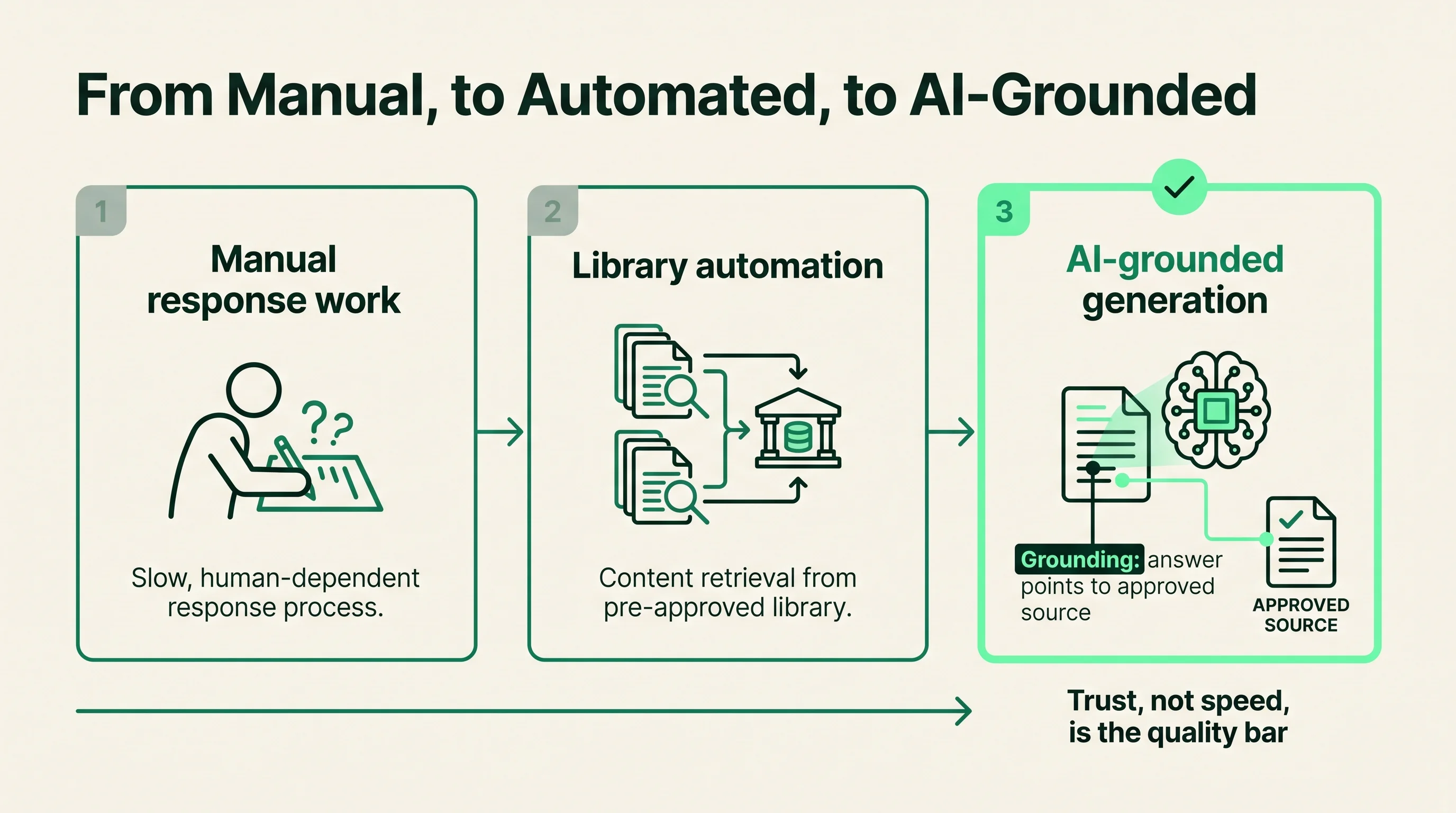
The market has moved through three distinct stages, and where a vendor sits on that path tells you most of what you need to know about it. Each stage solved the previous one's main complaint and exposed a new one.
The first stage was manual response work. Answers lived in past questionnaires, email threads, and a few people's heads, accurate when the right person was available and inconsistent when they were not. The complaint was speed and key-person risk.
The second stage was template-and-library automation. Tools added a central answer library, autofill, and reuse across formats like CAIQ, SIG, and custom spreadsheets, fixing consistency and cutting repetitive typing. The new complaint was maintenance: a library is only as good as its last review, and stale answers spread fast when reuse is easy.
The third stage, where the market is now, is AI-grounded answer generation. AI drafts a response, but the meaningful version does not generate free text from a general model. It retrieves from approved answers and evidence, then cites what it used, so a reviewer can see why an answer was proposed.
| Stage | Core mechanism | Main strength | Main weakness |
|---|---|---|---|
| Manual | Past responses, tribal knowledge | High judgment when an expert is present | Slow, inconsistent, key-person risk |
| Library automation | Central library, autofill, reuse | Consistency and speed across formats | Stale answers, ongoing curation cost |
| AI-grounded | Retrieval from approved sources, citation | Speed with a verifiable basis | Quality depends on source library and review |
The distinction that matters is grounding. Ungrounded AI produces a confident answer with no traceable basis, which is the worst outcome in a security review because it looks done but is not defensible. Grounded AI ties each draft to an approved source a human can confirm. For how this works in detail, see grounded AI for security questionnaires. Most vendors now claim AI capability; far fewer can show grounding and citation, and that gap is the real dividing line in 2026.
How is AI raising the bar for security questionnaire automation?
AI raised the floor on speed and moved the conversation from speed to trust. When any tool can draft a long questionnaire in minutes, speed stops being a differentiator and accuracy becomes the thing worth measuring. The quality bar is no longer how fast an answer appears; it is whether the answer is correct, current, and defensible.
This matters because the cost of a wrong answer rose as the cost of a slow answer fell. A security questionnaire is a representation a buyer relies on, increasingly a contractual one. An AI that fills a field with a plausible but inaccurate claim creates real exposure: an overstated control, a lapsed certification still referenced, a data-handling answer that no longer matches reality. Speed without grounding manufactures these errors faster than a human would.
Grounding is becoming the quality bar for three reasons buyers can verify:
- Traceability. A grounded answer points to the approved source behind it, so a reviewer confirms rather than re-derives. That is the difference between AI that saves review time and AI that adds a verification tax.
- Freshness. Answers and evidence go stale. A tool that knows which source an answer came from can flag when that source changes; an ungrounded tool cannot.
- Defensibility. When a buyer or auditor challenges an answer, the team needs to show the basis. Citation makes that a lookup instead of an investigation.
The market effect is a split between vendors that automate drafting and vendors that automate trustworthy drafting. The first competes on speed and coverage; the second on grounding, citation quality, and how much review effort the AI removes. Treat any single accuracy percentage with caution. Accuracy depends on your own library and questionnaires, and the honest measure is how much reviewer effort remains after the AI runs.
Is the security questionnaire automation market consolidating?
The clearest market trend in 2026 is consolidation. Capabilities sold as separate products a few years ago, questionnaire automation, trust centers, and compliance monitoring, are converging into broader trust and GRC suites, through both acquisition and platform expansion.
Drata's acquisition of SafeBase is the marker buyers cite most often (vendor-reported). It pairs a compliance and continuous-monitoring platform with a trust center, signaling that the evidence a company collects for its own compliance and the assurance it shows customers are being treated as one motion, not two products. Whether or not any single deal reshapes the market, the direction is consistent: the lines between compliance, trust centers, and questionnaire response are blurring.
Several forces push the same way:
- Shared data. Compliance platforms already hold controls and evidence. Trust centers and questionnaires consume that same data, so owning all three reduces duplication for buyers and stickiness for vendors.
- Buyer fatigue with point tools. Procurement teams resist stitching together four overlapping subscriptions. A suite that covers compliance, trust center, and questionnaire response is an easier purchase to justify.
- AI economics. Grounded AI is more valuable when it can draw on a larger, connected base of controls, evidence, and approved answers, which favors platforms that hold all of it.
Consolidation has tradeoffs to weigh rather than assume. A suite reduces integration work and keeps data consistent, but it can bundle a strong product with a weaker one, and a questionnaire module inside a compliance suite is not automatically as capable as a dedicated tool. Focused specialists compete by being deeper on the response workflow than a suite's module. The buyer question is whether one platform's convenience outweighs a specialist's depth for the workflow that actually hurts. For a structured shortlist across the category, see the security questionnaire automation category.
Where trust centers fit
Trust centers have moved from a nice-to-have page to a core part of how companies handle inbound security review, so their role is now essential to reading the market. A trust center is a customer-facing place, public or gated, where a company publishes its security posture, certifications, and evidence so buyers can self-serve before sending a questionnaire at all. For a definition, see trust center.
The strategic point is deflection. Every question a buyer answers from a trust center is a question that never enters the manual response queue. A well-stocked trust center with current certifications, a security overview, and gated evidence can resolve a meaningful share of routine reviews without a human drafting anything. That changes the questionnaire tool's job from answering everything to answering what the trust center could not.
This is also where the two surfaces must stay consistent, and where many teams stumble. A trust center and a questionnaire response draw on the same approved answers and evidence. If they diverge, a buyer who reads the trust center and then receives a contradicting questionnaire answer trusts neither. Answers and evidence should have one source feeding both surfaces.
Trust centers do not replace questionnaires, and treating them as a full substitute is a common misread. Large enterprise buyers still send custom questionnaires, ask follow-ups a static page cannot anticipate, and require negotiated answers. The trust center handles the predictable middle of the market; the questionnaire tool handles the long tail and custom enterprise reviews. For how the two divide the work, see security questionnaire automation vs. trust centers.
The takeaway: a trust center and questionnaire automation are complements, not alternatives. The strongest setups run both from one base of approved answers, using the trust center to deflect routine reviews and the questionnaire tool to handle what cannot be standardized.
How does the security questionnaire automation market break into segments?
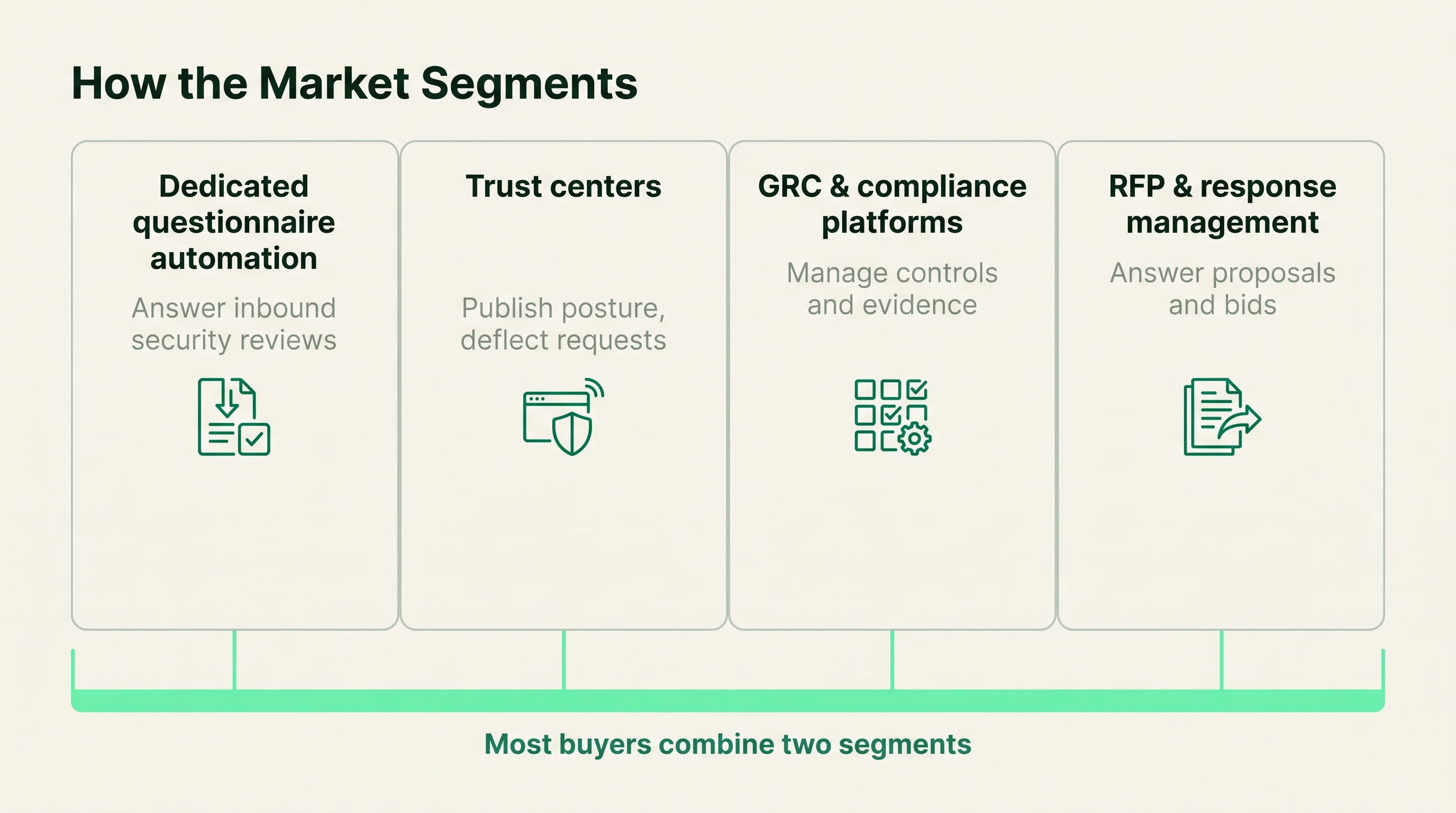
The market splits into four segments that overlap at the edges but solve distinct jobs. Buyers confuse them because vendors in each increasingly claim the others' capabilities. Naming the primary job of each keeps a shortlist honest.
| Segment | Primary job | Reference vendors (positioning, vendor-reported) | Best for |
|---|---|---|---|
| Dedicated questionnaire automation | Answer inbound security reviews fast from an approved library | Conveyor, HyperComply, SecurityPal | Security and sales engineering teams under inbound pressure |
| Trust centers | Publish posture and evidence so buyers self-serve | SafeBase, Whistic, TrustCloud | Teams that want to deflect routine reviews before they arrive |
| GRC and compliance platforms | Manage controls, evidence, and continuous compliance | Vanta, Drata | Teams running compliance programs that also feed trust surfaces |
| RFP and response management | Manage RFPs and proposals, security questionnaires as one case | Loopio, Responsive | Proposal and bid teams where security is part of a larger response |
Treat the vendor column as positioning, not fixed boundaries. Several of these companies span more than one segment as suites expand. Vanta and Drata anchor in compliance but reach into trust centers and questionnaire response; SafeBase and Whistic anchor in trust centers but add response features; Loopio and Responsive come from the RFP world and handle security questionnaires as a content type. Capabilities shift between releases, so verify current scope on each vendor's documentation.
The segments differ most in their center of gravity: questionnaire automation centers on the approved answer library and response speed; trust centers on the customer-facing surface and deflection; GRC platforms on controls and evidence, with response downstream; RFP tools on large proposals, where a security questionnaire is one workstream among many.
Most buyers combine two segments rather than finding one tool that does everything well, often a compliance platform plus a dedicated questionnaire tool, or a trust center plus questionnaire automation from the same base. The mistake is assuming a strong product in one segment is automatically strong in another. A GRC platform's questionnaire module and a dedicated tool can both list the feature and differ sharply in how much review effort each removes.
Which AI questionnaire automation claims are real versus overhyped?
AI is the loudest part of the market and where claims and verifiable reality diverge most. Nearly every vendor markets AI; the buyer's job is separating capability that changes the workflow from language that decorates it. The line is usually drawn at grounding, citation, and measured review effort.
What tends to be real and verifiable in 2026:
- Retrieval from a company's own approved answers and evidence, rather than free generation from a general model. This is checkable: ask to see where a drafted answer came from.
- Citation that shows the source behind each drafted answer, so a reviewer confirms rather than re-derives. A demo on your own content reveals whether citation is genuine or cosmetic.
- Format and portal handling, where AI maps questions across CAIQ, SIG, and custom spreadsheets. This is mature and demonstrable.
What tends to be overhyped or unverifiable:
- Single-number accuracy claims. An accuracy percentage with no methodology, no test set, and no definition of correct is marketing, not a benchmark. Accuracy depends on your library and your questionnaires.
- Fully autonomous response. Claims that AI answers without human review overstate where the market is and understate the risk. Security answers are representations buyers rely on; review remains the control that makes them defensible.
- Agentic framing without a concrete workflow. Translate any agent claim into what the buyer can actually do and verify, or treat it as positioning.
The practical test cuts through most of it: run a demo on your own questionnaires and answer library, not the vendor's curated example, then measure how much reviewer effort remains after the AI runs. A tool that drafts fast but requires re-verifying every answer has moved the work rather than removed it. The honest frame is to ask for grounding and citation, not a headline number, and to validate against your own content before trusting any claim.
What should security questionnaire automation benchmarks measure?
Most questionnaire automation benchmarks measure the wrong things, which is why they rarely predict how a tool performs in production. Speed and feature checklists are easy to publish and easy to game. A benchmark that helps a buyer measures whether answers are trustworthy and how much human effort the tool removes, on the buyer's own content.
The dimensions worth measuring, in rough priority order:
- Grounding rate. What share of AI-drafted answers point to an approved source rather than free-generated text. Higher grounding means a more defensible response and less re-verification.
- Citation quality. Whether citations point to the actual basis for an answer, and whether a reviewer can confirm them in one step. Cosmetic citations that link to a whole document are weaker than ones that point to the specific approved answer or evidence.
- Reviewer effort remaining. How much time a human still spends after the AI drafts. This is the honest measure of automation, far more than draft speed.
- Answer freshness and staleness detection. Whether the tool can tell when a source answer or certification has changed and flag dependent answers. Stale-but-confident answers are the quiet failure mode of library tools.
- Consistency across surfaces. Whether the same question gets the same answer in a questionnaire, a trust center, and an export. Divergence here erodes buyer trust directly.
- Format and portal coverage. Real handling of CAIQ, SIG, custom spreadsheets, and buyer portals, tested on the formats you actually receive.
A benchmark should avoid fake precision. A single accuracy percentage with no methodology, a speed number from a curated example, or a feature checkbox that ignores depth all mislead more than they inform. Prefer ranges and observed behavior over exact figures, and state the test conditions plainly.
The methodology that holds up is buyer-specific. A benchmark run on a vendor's sample content measures the vendor's content, not your reality. The credible test seeds the tool with your approved answers, runs your real questionnaires, and measures grounding, citation, reviewer effort, and consistency. Dedicated comparisons such as Conveyor vs. SafeBase show how these dimensions play out between named products. The benchmark that matters is the one you run on your own questions.
What is the outlook for security questionnaire automation in 2026?
The direction of the market is clearer than its endpoint, and three trends are durable enough to plan around. Each is a continuation of what 2026 already shows rather than a prediction of something new.
First, consolidation continues. Compliance platforms, trust centers, and questionnaire automation keep converging into trust and assurance suites, by acquisition and by expansion. Drata and SafeBase pairing compliance with a trust center points the way (vendor-reported), and the underlying logic, shared evidence data and buyer fatigue with point tools, does not reverse. Expect more bundling, and expect specialists to defend themselves by being deeper on the response workflow than any suite module.
Second, grounding becomes table stakes. AI drafting is already commoditizing; what separates vendors is whether the draft is traceable to approved sources. Over 2026, grounding and citation move from a differentiator that leading vendors advertise to a baseline buyers assume, and ungrounded AI starts to read as a liability rather than a feature.
Third, the trust center becomes the front door. More inbound review gets deflected to self-serve trust surfaces before a questionnaire is ever sent, shifting the questionnaire tool's job toward the custom and enterprise long tail. The teams that benefit most run a trust center and questionnaire automation from one base of approved answers, so the two surfaces never contradict.
What will not change is the core constraint: a security questionnaire is a representation a buyer relies on, so trust, not speed, governs the category. Tools that make answers faster without making them more defensible solve a problem the market has mostly solved. The advantage in 2026 belongs to whatever keeps answers correct, current, and verifiable across every surface a buyer might check. Scope for that whole trust process, test AI on your own content, and treat any single accuracy number as a starting question rather than an answer.
How this article was reviewed
Sources reviewed
- Questionnaire automation, trust center, GRC, and RFP vendor product pages and documentationVendor-reported. Capability, AI accuracy, grounding, integration, and positioning claims for Conveyor, Vanta, Drata, SafeBase, Loopio, Responsive, Whistic, HyperComply, SecurityPal, and TrustCloud should be verified on each vendor's current documentation and tested on your own content, not treated as independent fact.
- Drata acquisition of SafeBaseVendor-reported and used here only as a directional marker of market consolidation. We do not cite deal terms, dates, or figures and do not treat the transaction as independently audited.
- Standard Answer category and comparison coverageGeneral framing. Internal analysis on segmentation, grounding, and trust centers; treat as editorial perspective rather than a cited external study.
- Cloud Security Alliance - CAIQPrimary source for the CAIQ questionnaire format referenced in format-coverage discussion.
- Shared Assessments - SIGPrimary source for the SIG questionnaire format referenced in format-coverage discussion.
- AICPA - SOC 2Primary source for what a SOC 2 report attests, commonly referenced as evidence in trust centers and questionnaire responses.
FAQ
What is the state of the security questionnaire automation market in 2026?
The market has moved from manual response work, to library-based automation, to AI-grounded answer generation, and it is now consolidating into broader trust and compliance suites. The problem buyers solve has widened from answering one questionnaire faster to running a defensible trust process across answers, evidence, controls, and a trust center. Grounding, where an AI answer points back to an approved source, is becoming the quality bar that separates capable tools from fast but unverifiable ones.
Is the security questionnaire automation market consolidating?
Yes. Questionnaire automation, trust centers, and compliance monitoring are converging into combined trust and GRC suites, both through acquisition and platform expansion. Drata's acquisition of SafeBase is the marker buyers cite most often (vendor-reported), pairing a compliance platform with a trust center. The forces behind it, shared evidence data, buyer fatigue with overlapping point tools, and AI that works better over a connected data base, are durable, so more bundling is likely. The tradeoff is that a suite module is not automatically as deep as a dedicated specialist tool.
How do trust centers fit into questionnaire automation?
Trust centers and questionnaire automation are complements, not alternatives. A trust center publishes a company's posture and evidence so buyers self-serve answers and deflect routine reviews before sending a questionnaire. Questionnaire automation handles the custom questions and enterprise reviews a static page cannot anticipate. The strongest setups run both from one base of approved answers, so the trust center and questionnaire responses never contradict each other, which is a common failure mode when they are maintained separately.
What separates real AI capability from hype in questionnaire tools?
The dividing line is grounding and citation. Real capability retrieves answers from a company's own approved sources and shows the basis for each draft, so a reviewer confirms rather than re-derives. Overhyped claims include single accuracy percentages with no methodology, promises of fully autonomous response without human review, and agentic framing with no concrete workflow. The practical test is to run a demo on your own questionnaires and answer library, then measure how much reviewer effort remains after the AI runs.
What should a security questionnaire automation benchmark measure?
It should measure trustworthiness and effort removed, not raw speed. The dimensions that matter are grounding rate, citation quality, reviewer effort remaining after the AI drafts, answer freshness and staleness detection, consistency across surfaces like the trust center and exports, and real format and portal coverage. Critically, the benchmark should run on your own approved answers and real questionnaires, because a test on a vendor's sample content measures the vendor's content, not your production reality. Prefer observed ranges over a single precise number.