

TrustCloud is a strong fit when questionnaire automation should be tied to live GRC, control assurance, risk, and enterprise security data. It is less obvious for teams that only need a focused customer trust workflow. Buyers should test whether TrustShare truly uses current source-of-truth data and whether the broader GRC platform is needed enough to justify the implementation.
Independent reviewReviewed Jun 2026

Is TrustCloud right for your team?
TrustCloud is an AI-assisted GRC and security assurance platform whose TrustShare product combines a trust portal with AI security questionnaire automation.
Best forEnterprise GRC teams that want customer assurance tied to live control and risk data.
Main usersSecurity / GRC
Sources reviewed4
Questionnaire automation is tied to broader GRC and control assurance data.
Research inputs reviewed for this profile.
Structured integration coverage represented in this profile.
Features, workflow steps, and newer capabilities represented in this profile.
Where TrustCloud is strongest
These scores reflect the materials reviewed for this page. Use them to plan your demo, not as a product rating.
01
AI answer support
Published support for drafting, checking, and approving answers.
02
Process coverage
Published support for intake, routing, review, approval, and reuse.
03
Enterprise controls
Published SSO, roles, audit, and rollout controls.
Source coverageAmount of public product information available for review.
5/10
AI answer supportPublished support for drafting, checking, and approving answers.
9/10
Process coveragePublished support for intake, routing, review, approval, and reuse.
9/10
Portal supportSupport for customer portals and nonstandard questionnaire formats.
2/10
Trust centerDocument sharing, access controls, and customer self-service.
3/10
IntegrationsPublished CRM, collaboration, document, API, and knowledge connections.
7/10
Enterprise controlsPublished SSO, roles, audit, and rollout controls.
9/10
Customer evidencePublished customer stories, product screenshots, and supporting sources.
2/10
Pricing and rollout at a glance
Quote-based enterprise subscription
Confirm TrustShare packaging, required modules, proposal pricing, implementation services, API limits, data-room/NDA features, product/business-unit scoping, and support.
Expect implementation around GRC data sources, control mapping, product scopes, trust portal content, review workflows, integrations, and reporting.
Confirm who owns source cleanup, reviewer setup, and integrations.
Not documented publicly.
Ask how questionnaire history and trust-portal content export, and how GRC source data remains portable.
What TrustCloud does
TrustCloud describes itself as an AI-assisted GRC transformation platform for enterprise CISOs. Public materials describe TrustOps for compliance and audit readiness, TrustRegister for risk quantification, TrustLens for third-party assurance, TrustHQ for collaboration, API surfaces, and TrustShare for customer assurance.
For security questionnaire automation, TrustShare is the key product. TrustCloud says TrustShare combines a dynamic trust portal with AI questionnaire automation, pre-fills unavoidable questionnaires from prior questionnaires and artifacts, uses controls, policies, documents, knowledge-base material, and a GRC lexicon, and can support complex enterprises with multiple products, business units, or regions without multiple TrustShare instances.
Product screenshots
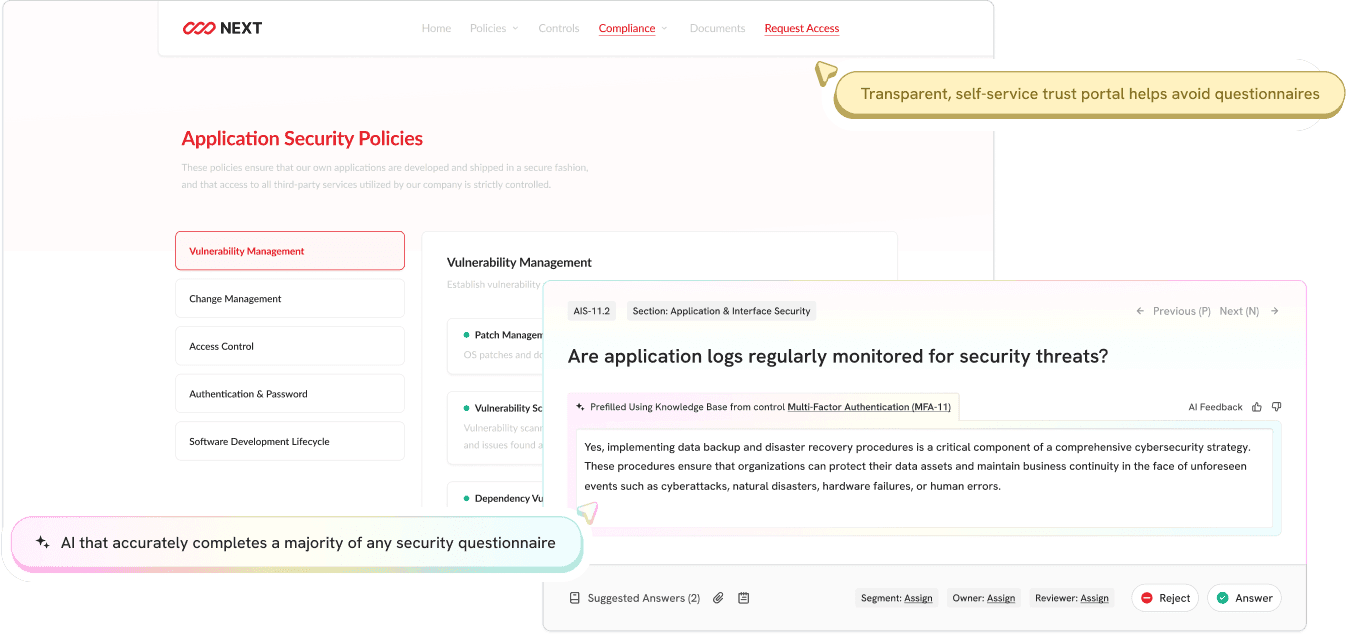
Official TrustCloud customer assurance website image.
Who should use TrustCloud?
Use cases
Where TrustCloud is most useful.
TrustShare customer assurance
Use a live trust portal plus AI to reduce questionnaires and pre-fill unavoidable security reviews.
GRC-backed questionnaire answers
Ground customer-facing answers in controls, policies, documents, prior questionnaires, and live security/privacy program data.
Enterprise security assurance platform
Connect customer assurance with compliance, risk quantification, third-party assurance, APIs, and collaboration workflows.
Teams
Teams and users
The people most likely to use the product during questionnaires, RFPs, assessments, and customer security reviews.
GRC leaderManager or director / Security / GRC
Connects controls, evidence, policies, risks, and compliance status to customer-facing assurance.
Customer assurance analystPractitioner / Security / customer trust
Uses TrustShare to manage trust portal content, questionnaire pre-fill, and approvals.
Enterprise security stakeholderexecutive / Security leadership
Uses assurance, risk, and reporting outputs to prove security posture and business impact.
How TrustCloud handles a questionnaire
Connect GRC sources
Controls, policies, artifacts, prior questionnaires, privacy data, and security program records become source material.
Publish trust portal
TrustShare gives prospects a public-facing trust portal to reduce repetitive questionnaire work.
Pre-fill questionnaire
AI pre-fills unavoidable questionnaires from approved program data and prior responses.
Review by scope
Teams verify product, business unit, region, and framework-specific answers before release.
Route tasks
TrustHQ and integrations can route follow-up work through project management or ITSM systems.
Features to test in a demo
TrustShare customer assurance
TrustShare combines a live trust portal with AI questionnaire automation and source-of-truth syncing.
- This is strongest when answers need to reflect live controls and privacy/security program data.
- Buyers should test whether “no knowledge base maintenance” works in their actual control and evidence environment.
Enterprise GRC platform
TrustCloud connects customer assurance to first-party assurance, third-party assurance, risk, compliance, APIs, and collaboration workflows.
- This breadth can be valuable for CISOs, but excessive if the only need is questionnaire response speed.
Integrations and customer examples
Integrations
Connections to source documents, review tools, customer portals, and sales systems.
JiraOther
TrustCloud homepage references Jira for task sync and collaboration.
SlackCollaboration
TrustCloud homepage references Slack workflow support.
TeamsCollaboration
TrustCloud homepage references Teams workflow support.
ServiceNowOther
TrustCloud homepage references ServiceNow and has a ServiceNow solution page.
FreshWorksOther
TrustCloud homepage references FreshWorks workflow support.
BMCOther
TrustHQ materials reference BMC among workflow integration signals.
TrustCloud APIAPI / webhook
Platform navigation references TrustCloud API.
Technical features
APIs and AI tooling
Features to ask about if APIs or AI tooling matter to your team.
TrustShare questionnaire pre-fill from source systemsAsk which systems are live sources of truth, whether reviewer-facing citations are visible, and how changes propagate into portal content and questionnaire answers. ->
TrustCloud says TrustShare syncs with security and privacy programs and uses GraphAI-style grounding across controls, policies, documents, knowledge base, prior questionnaires, and a GRC lexicon.
Multi-product and business-unit handlingTest whether answers change correctly by product, region, data type, and compliance scope. ->
TrustCloud positions TrustShare for organizations with multiple products, business units, or regions.
TrustCloud API and TrustHQ collaborationConfirm which workflow tools, APIs, and webhooks are included in the proposed package. ->
TrustCloud’s broader platform includes API-driven automation and collaboration with Jira, Slack, BMC, FreshWorks, Teams, and ServiceNow signals.
Compare TrustCloud with alternatives
What to compare
TrustCloud
Vanta →Hyperproof →Best for
Enterprise GRC teams that want customer assurance tied to live control and risk data.Vanta combines compliance automation, a trust center, risk management, and AI-assisted security questionnaire response.Hyperproof is an AI-powered GRC platform (160+ frameworks) that includes trust operations and automated security questionnaire responses alongside compliance, risk, audit, and third-party risk.Test in a demo
Shortlist TrustCloud when the questionnaire problem is part of a larger GRC, control assurance, and enterprise risk program.Test your questionnaire, integrations, and setup requirements.Test your questionnaire, integrations, and setup requirements.Buyer checklist
Demo
What to test in a TrustCloud demo
TrustCloud should prove that questionnaire answers stay tied to current GRC source data.
Source-of-truth sync
Change a policy, control, subprocessor, or product fact and verify how TrustShare updates the answer and portal.
Product scoping
Run one questionnaire for two products or business units and confirm the answers differ where they should.
Workflow integration
Create a review task in the connected project or ITSM tool your team actually uses.
Verify before buying
Claims to verify before purchase
The buying decision hinges on whether you need the broader GRC platform, not only TrustShare.
Platform scope
Confirm whether TrustShare can be bought alone or requires broader TrustCloud modules.
AI grounding
Ask for proof that AI answers use approved controls, policies, documents, and knowledge-base records.
Enterprise complexity
Validate product, region, framework, and business-unit scoping before relying on automated answers.
What isn’t publicly documented
Confirm these items directly during procurement.
ItemPublic statusWhat to confirm
DDQsConfirm DDQ handling for your formats.
Verify with vendor
Buyer portalsConfirm buyer-portal handling.
Verify with vendor
SSO / SCIMConfirm SSO/SCIM by package.
Verify with vendor
Multilingual supportConfirm language coverage.
Verify with vendor
Free tier or trialPricing is proposal-based; confirm entry options.
Verify with vendor
EU data residencyConfirm hosting and residency options.
Verify with vendor
Zero data retentionAsk for the current contractual retention terms.
Verify with vendor
No-training commitmentConfirm whether customer data trains vendor or third-party models.
Verify with vendor
Full library exportAsk how questionnaire history and trust-portal content export, and how GRC source data remains portable.
Verify with vendor
Company information
TrustCloud is a privately held company headquartered in Boston, founded as Kintent by founder and CEO Sravish Sridhar and later renamed TrustCloud. It has raised roughly $37M from investors including OpenView, ServiceNow, and Tola Capital, and provides AI-assisted GRC, security assurance, compliance, risk quantification, third-party assurance, customer assurance, and API-driven collaboration workflows. Company-profile details should be treated as point-in-time context.
Company snapshot
HeadquartersBoston, MA
Company typePrivately held
Funding stageVenture-backed (~$37M raised; OpenView, ServiceNow, Tola Capital)
FoundersSravish Sridhar
Questions to ask TrustCloud
Ask these questions in the TrustCloud demo, then test the answers with your own content and approval process.
- Does the product answer customer requests, send vendor assessments, or both?
TrustCloud mainly supports compliance, trust, and customer security reviews. It may reduce incoming questionnaires, but sending assessments to suppliers is not its main purpose.
- Can every AI-drafted answer be traced to its source?
TrustCloud says drafted answers use source material. In the demo, open several citations and test what happens when sources conflict or go out of date.
- Which questionnaire files and customer portals can it handle?
TrustCloud documents file and customer portal support. Test a real spreadsheet, PDF, and difficult portal before buying.
- Which standard and custom questionnaires does it support?
TrustCloud does not clearly document SIG, CAIQ, HECVAT, or VSA support. Ask whether each is built in, available as a template, or handled as a custom import.
- Does it include buyer-side vendor risk assessment?
TrustCloud is not primarily a buyer-side vendor risk product. If you need to score suppliers before sending assessments, evaluate that separately.
- Can its trust center prevent repeat questionnaires?
TrustCloud includes a trust center where customers can access approved security material. Confirm access controls, NDA steps, analytics, and which requests still become questionnaires.
- How does review, approval, answer ownership, and audit history work?
TrustCloud documents review and approval controls. In the demo, test a low-confidence answer, expert assignment, final approval, and the audit record.
- Does it connect to the systems your team already uses?
TrustCloud lists 7 integrations across other systems, collaboration, and APIs and webhooks. Examples include Jira, Slack, Teams, ServiceNow, and FreshWorks. Confirm what each connection can do, whether API work is required, and which plans include it.
- How are reused answers updated when policies, reports, or products change?
TrustCloud documents controls for maintaining source content. Ask who updates policies, SOC 2 reports, subprocessors, and product details—and whether those changes reach every reused answer.
FAQ
Is TrustCloud a questionnaire-only tool?
No. TrustCloud is a broader GRC and security assurance platform. TrustShare is the customer assurance and questionnaire automation product.
Who is TrustCloud best for?
Enterprise teams that want questionnaire answers tied to live controls, evidence, policies, risk, and compliance data.
Disclosure: This page is not sponsored. We do not accept payment to change our findings or recommendations.