

Best Conveyor Alternatives
Conveyor pairs AI-assisted questionnaire answering with a trust center, which suits teams that want software they operate themselves. Buyers shopping for alternatives usually want lower or more predictable cost, broader format coverage, a managed option, or a different balance of response and trust-center deflection. This guide compares the main options by buyer fit, not by a single winner.
Quick answer: which should you choose?
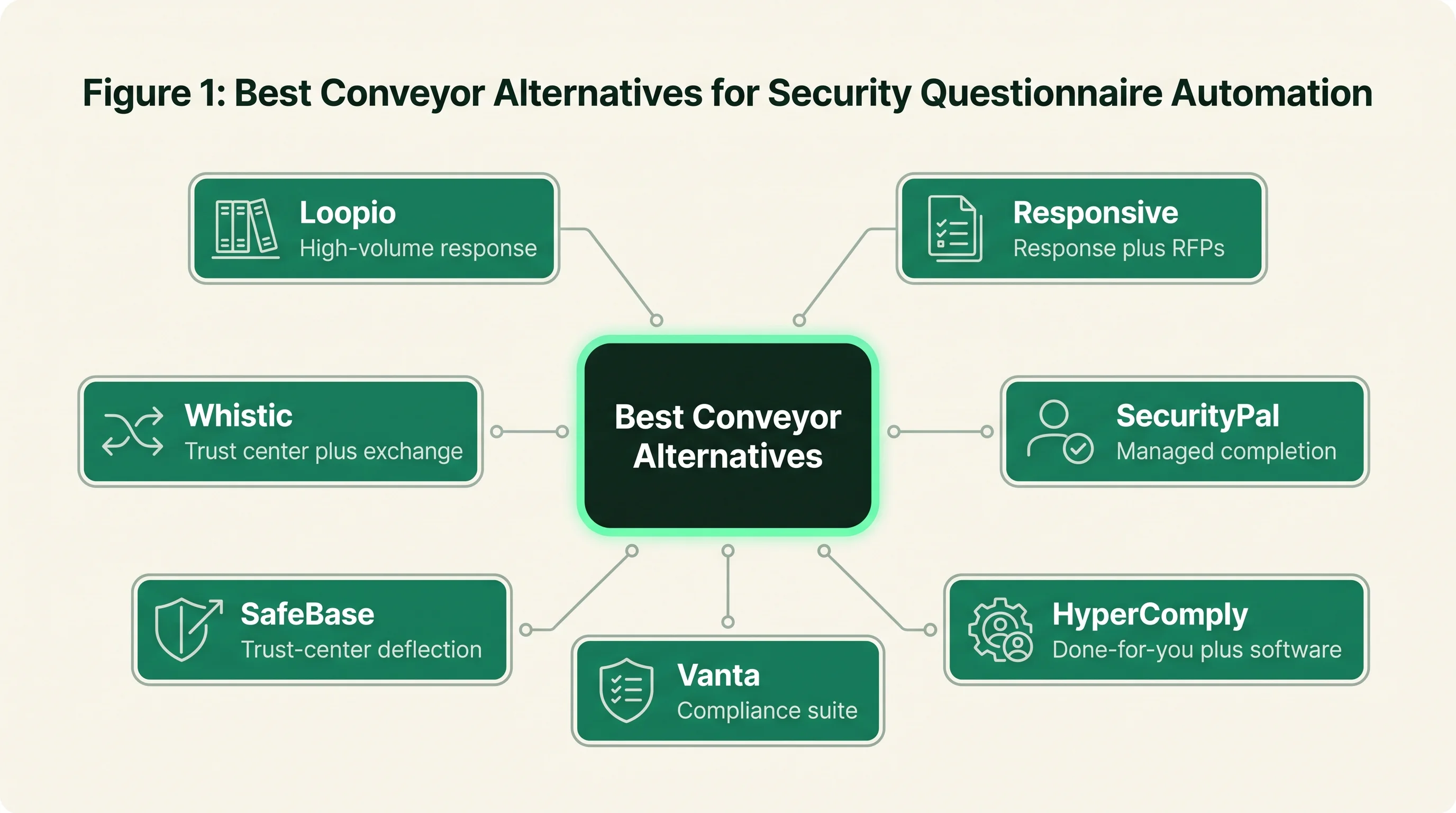
There is no single best Conveyor alternative. The right choice depends on whether you want software your own team operates, a service that completes questionnaires for you, or a trust center that deflects reviews before they reach a person. Conveyor pairs AI-assisted answering with a trust center, so the alternative that wins is usually the one that fixes the specific gap that pushed you to look.
For most teams, the decision sorts into a few clear patterns. Pick a software-only response platform when your GRC and sales-engineering teams want to own the answer library and the workflow. Pick a managed option when you lack internal capacity and want answers delivered. Pick a trust-center-led tool when deflection or a public trust page matters more than raw response speed.
Use this as a starting map, then test the shortlist against real questionnaires.
- Want software you control with your own reviewers: look at Loopio or Responsive.
- Want done-for-you or human-in-the-loop completion: look at SecurityPal or HyperComply.
- Already run a compliance program and want response on top of existing evidence: look at Vanta.
- Want to deflect questionnaires through a public trust center: look at SafeBase or Whistic.
If the category itself is new to you, start with our explainer on what security questionnaire automation is, then return here to shortlist.
Why do buyers look for Conveyor alternatives?
Buyers leave Conveyor for concrete operational reasons, not vague dissatisfaction. Conveyor combines AI-assisted questionnaire answering with a trust center, and that combination fits many teams well. The teams that look elsewhere usually want a different tradeoff on cost, format coverage, accuracy, or the role a service plays in the work.
The most common triggers cluster around a handful of themes. Each maps to a different kind of alternative, which is why the shortlist below spans software-only platforms, managed services, compliance suites, and trust-center tools.
- Price and predictability: some teams want lower entry cost or pricing that scales differently than a combined response-plus-trust-center platform.
- Format coverage: buyers who handle heavy Excel, portal autofill, CAIQ, and SIG volume want to confirm coverage matches their actual inbound mix.
- AI accuracy and citations: teams that lean hard on AI drafting want answers that cite the evidence behind them and abstain when a source is missing.
- Managed versus software: teams without internal capacity may prefer a service that completes questionnaires rather than software they staff themselves.
- Trust-center depth: buyers measured on deflection may want a trust center that does more to reduce inbound volume than a response-first tool provides.
- Lock-in concerns: buyers increasingly want approved answers and evidence to stay portable if they change tools.
None of these makes Conveyor a wrong choice. They are signals that a different model may fit better. If you are weighing response tooling against trust-center deflection, our explainer on where questionnaire automation and trust centers each fit covers the split. The next section names the main alternatives so you can match a trigger to a tool.
The main alternatives, at a glance
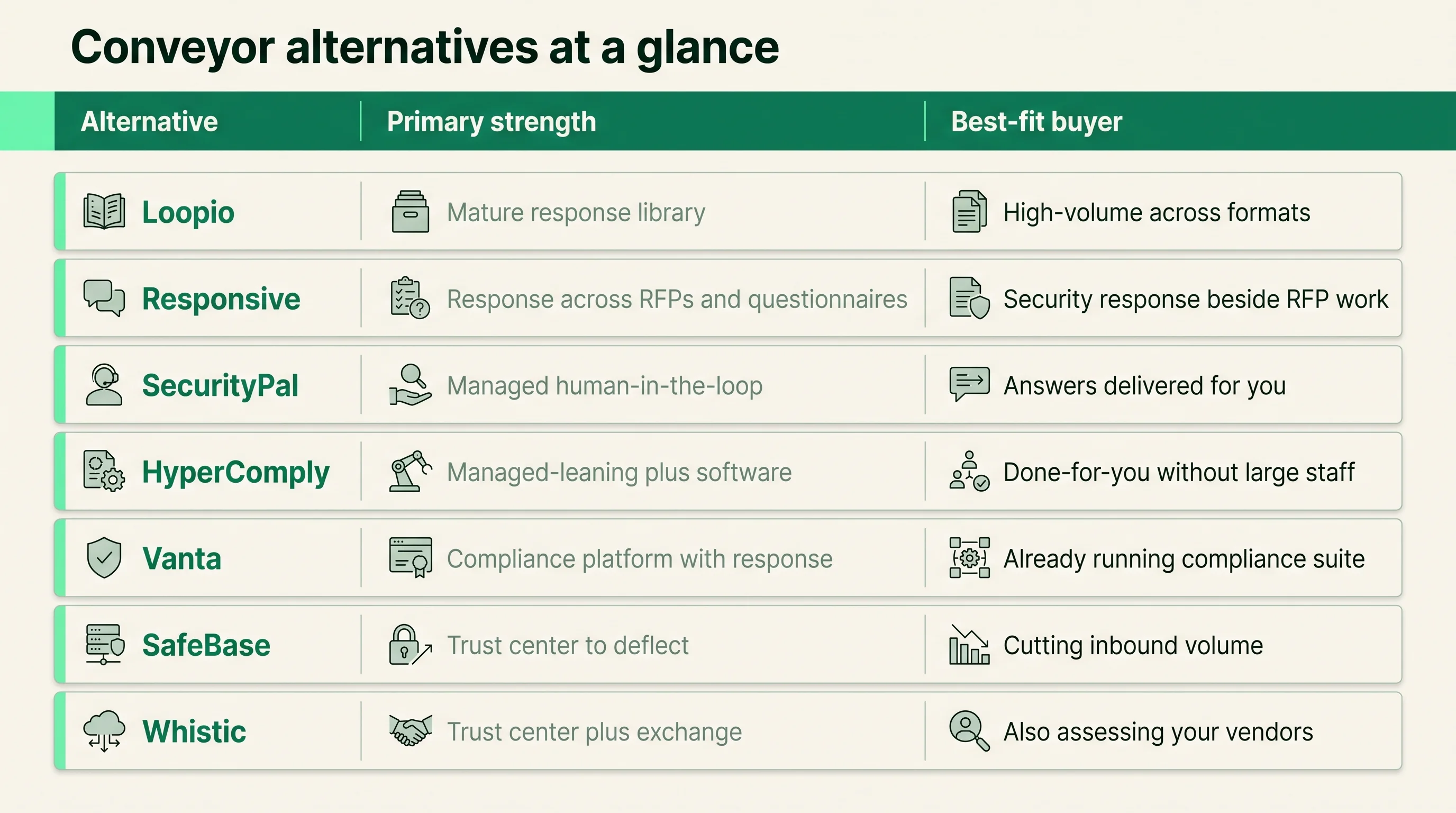
Seven tools cover most Conveyor shortlists, and they split cleanly by model. The table below pairs each with its primary strength and the buyer it fits best, using capability-level distinctions we can defend rather than specific feature claims that change between releases. Treat the strength column as vendor-reported positioning and verify it on each vendor's current docs.
| Alternative | Primary strength (vendor-reported) | Best-fit buyer |
|---|---|---|
| Loopio | Mature response and answer-library management | Teams with high recurring volume across many formats |
| Responsive | Response management across RFPs and questionnaires | Programs where security response sits beside RFP work |
| SecurityPal | Managed, human-in-the-loop completion | Teams that want answers delivered with high accuracy claims |
| HyperComply | Managed-leaning completion plus software | Teams wanting done-for-you answers without a large staff |
| Vanta | Compliance platform with questionnaire response added | Companies already running compliance in one suite |
| SafeBase | Trust center built to deflect questionnaires | Teams measured on cutting inbound questionnaire volume |
| Whistic | Trust center plus a shared assessment exchange | Buyers who also assess their own vendors in the same tool |
A few rows reward a closer read. Loopio and Responsive are the closest software-only substitutes for Conveyor's response side, and they compete on answer-library depth, AI drafting, and format coverage. SecurityPal and HyperComply replace the software-only shape with a managed or human-in-the-loop service, so they suit teams that would rather receive answers than staff a workflow. Vanta approaches the problem from compliance evidence, while SafeBase and Whistic lead with the trust-center surface that Conveyor also offers, which makes them the natural alternatives when deflection is the main goal. For a structured introduction to trust pages, see our trust center glossary entry.
The pattern is consistent: software-only tools overlap heavily on core response, managed services change the model, and trust-center tools compete with Conveyor's deflection layer rather than its answering layer. Hold that split in mind through the criteria section, because it explains most of the fit differences. You can also browse the wider security questionnaire automation category to widen the shortlist.
How do the Conveyor alternatives differ on the criteria that matter?
The shortlist looks similar on the surface, so the deciding lines are in the criteria a shortlister actually scores. We compare the seven on the dimensions that change day-to-day work: answer-library quality, AI accuracy and citations, format coverage, review controls, integrations, and pricing model. Read each row for the distinction, not for a ranking.
The quick comparison below frames each criterion as a buyer question rather than a feature checkbox. All specific capabilities are vendor-reported and should be confirmed on current docs.
| Criterion | What to compare | Why it matters |
|---|---|---|
| Answer library | How approved answers are stored, reused, and kept current | A stale library produces confident wrong answers in any tool |
| AI accuracy and citations | Whether AI drafts cite the evidence behind each answer | Citations let reviewers verify rather than trust blindly |
| Format coverage | Excel, portal autofill, CAIQ, SIG, and custom forms | Coverage gaps push work back to manual completion |
| Review controls | Approval steps, roles, and audit trail | Controls decide who can publish an answer externally |
| Integrations | CRM, SSO, ticketing, knowledge base, and storage | Integrations decide whether the tool fits existing workflow |
| Pricing model | Per-seat, platform, service, or trust-center tiers | The model shapes total cost more than any list price |
On answer library, the software-only tools (Loopio and Responsive) compete hardest, since the library is the product's core, and Conveyor sits in the same group. On AI accuracy and citations, every vendor publishes claims, and these are the most volatile rows; test them on your own questionnaires rather than trusting a headline figure. Our guide on whether AI can safely answer security questionnaires covers what to probe.
Format coverage rarely decides a shortlist on its own, because most tools lean on the answer library to handle CAIQ, SIG, and custom spreadsheets, but portal autofill quality varies and is worth a live test. Review controls separate tools built for regulated teams from lighter ones; managed options like SecurityPal and HyperComply shift some review into the service layer, while software-only tools keep it inside your team. On pricing model, the software tools tend toward per-seat or platform pricing, the managed options layer service cost, Vanta prices as part of a compliance suite, and SafeBase and Whistic price around the trust center. We do not publish dollar figures, because no vendor lists fixed public pricing we can stand behind; confirm current numbers in a quote.
Which alternative fits which buyer
Match the tool to the program you actually run, not to the longest feature list. Each option below fits a specific buyer profile, and the cleanest decisions come from naming your dominant workflow and the team that owns it. The 'choose X when' lines are written to be specific enough to disqualify a wrong fit.
Use these as a fit test against your own situation.
- Choose Loopio when recurring questionnaire volume is high across many formats and a GRC team needs mature library management to keep answers consistent at scale.
- Choose Responsive when security questionnaires sit alongside RFP work and a proposals team and a sales engineer want one response platform spanning both.
- Choose SecurityPal when a CISO wants answers delivered by a managed, human-in-the-loop service and would rather buy capacity than staff a full internal review process.
- Choose HyperComply when you want done-for-you completion plus software but prefer a different scope or cost than a fully managed service implies.
- Choose Vanta when your team already runs its compliance program in one suite and wants questionnaire response that reuses the evidence and controls maintained there.
- Choose SafeBase when a customer-trust lead is measured on cutting inbound questionnaire volume and a public trust center that deflects reviews matters more than raw response speed.
- Choose Whistic when you also assess your own vendors and want a trust center paired with a shared assessment exchange in a single tool.
The split is mostly about ownership and deflection. Software-only tools put a sales engineer and GRC analyst in direct control of every answer. Managed options move that load into a service. Compliance platforms fold response into a surface your team already maintains, and trust-center tools aim to stop questionnaires before they reach a person. There is no universal winner, only a better fit for a given program. If trust-center deflection is your goal, our workflow for launching a trust center to reduce questionnaires shows the operational steps.
How should you evaluate Conveyor alternatives yourself?
The reliable way to pick a Conveyor alternative is to test the shortlist against a real questionnaire, not a vendor demo script. Score each tool on the same criteria, check references, and confirm that the model fits how your team works. A short, disciplined trial beats a long feature comparison.
Work through this checklist with two or three finalists.
- Run a real questionnaire end to end: pick a recent Excel, portal, CAIQ, or SIG review and complete it in each tool, timing the work and noting where it stalls.
- Score on the criteria table: rate answer library, AI accuracy and citations, format coverage, review controls, integrations, and pricing model, and weight the rows that matter most to you.
- Test the AI honestly: check whether drafted answers cite evidence you trust and whether the tool abstains rather than guessing when it lacks a source.
- Confirm review controls: verify that approval steps, roles, and audit trails match what your security and legal teams require before an answer goes out.
- Evaluate the trust center separately: if deflection is a goal, measure how much inbound volume a public trust page actually removes, not just how it looks.
- Map the real owner: decide which team will maintain the answer library and run the workflow, since that team, not the license, is the true cost center.
- Check references and data portability: ask for customers with your profile, and confirm you can export approved answers and evidence if you change tools later.
Keep the trial scoped to one or two questionnaires so you can compare cleanly. The goal is a defensible decision your security, sales, and procurement stakeholders all accept, grounded in your own data rather than vendor claims. To compare specific pairs, we publish head-to-head records such as Conveyor vs Loopio, Conveyor vs Whistic, and Conveyor vs Responsive. To browse trust-center tools, see the trust center software category.
How this article was reviewed
Sources reviewed
- Conveyor product pages and documentationVendor-reported. Conveyor's AI answering, trust-center, and pricing claims should be verified on the vendor's current docs, not treated as independent fact.
- Loopio, Responsive, SecurityPal, HyperComply, Vanta, SafeBase, and Whistic product documentationVendor-reported. Capability, integration, AI accuracy, and pricing claims for each alternative should be verified on the vendor's current docs and confirmed in a quote.
- AICPA - SOC 2Primary source for what a SOC 2 report attests, commonly cited as evidence in questionnaire answers across these tools.
- ISO/IEC 27001Primary source for the information security management standard referenced in answer libraries and reviews.
- Cloud Security Alliance - CAIQPrimary source for the CAIQ format, one of the standardized questionnaires the alternatives support through their libraries.
- Shared Assessments - SIGPrimary source for the SIG questionnaire format referenced in the format-coverage comparison.
FAQ
What is the most direct competitor to Conveyor?
It depends on which part of Conveyor you want to replace. For software-only questionnaire response, Loopio and Responsive are the closest substitutes. For Conveyor's trust-center side, SafeBase and Whistic compete most directly. If you want a service rather than software, SecurityPal and HyperComply are the closer match. There is no single competitor that matches every dimension, so map the alternative to the specific reason you are leaving.
Why do security teams switch away from Conveyor?
Teams usually switch over price, format coverage, AI accuracy, or model fit. Some want lower or more predictable cost, some want a managed service instead of software they staff themselves, and some want a stronger trust center for deflection. The switch is rarely about quality; it is about wanting a different balance of cost, ownership, and deflection. Test any replacement on your own questionnaires before committing.
What are the top complaints buyers have about Conveyor?
Common buyer concerns center on fit rather than specific defects. Teams cite cost relative to point tools, a wish for broader or better-tested format coverage, questions about AI accuracy and citation quality, and a preference for either a managed service or a deeper trust center. These are fit signals, not universal flaws, and Conveyor still suits teams that want AI-assisted response paired with a trust center in one tool. Treat any comparison of cost or accuracy as vendor-reported and verify it directly.
What Conveyor alternative works best for small security teams?
Small teams usually fit either a managed option or a lighter software tool. SecurityPal or HyperComply suit a small team that lacks capacity to staff a full review process and wants answers completed for them. A trust-center tool like SafeBase fits a small team measured on deflecting inbound questionnaires rather than answering each one. Run a real questionnaire through each to confirm the workload matches your headcount.
What Conveyor alternative is designed for enterprise questionnaire volume?
For high recurring volume across many formats, Loopio and Responsive are built for scale through mature answer-library management. Loopio fits teams whose main challenge is keeping a large library consistent, while Responsive fits programs where security questionnaires sit alongside RFP work in one platform. SecurityPal can also suit enterprises that want a managed service to absorb peak volume. Confirm format coverage and review controls against your actual volume in a trial.