

Best Vanta Questionnaire Automation Alternatives
Vanta is a broad GRC and compliance platform, and its questionnaire automation is one feature inside that suite. Buyers who need deeper, focused questionnaire answering, wider format coverage, or higher AI accuracy often shortlist a specialist instead. This independent comparison covers the main alternatives, how they differ, and which fits which buyer.
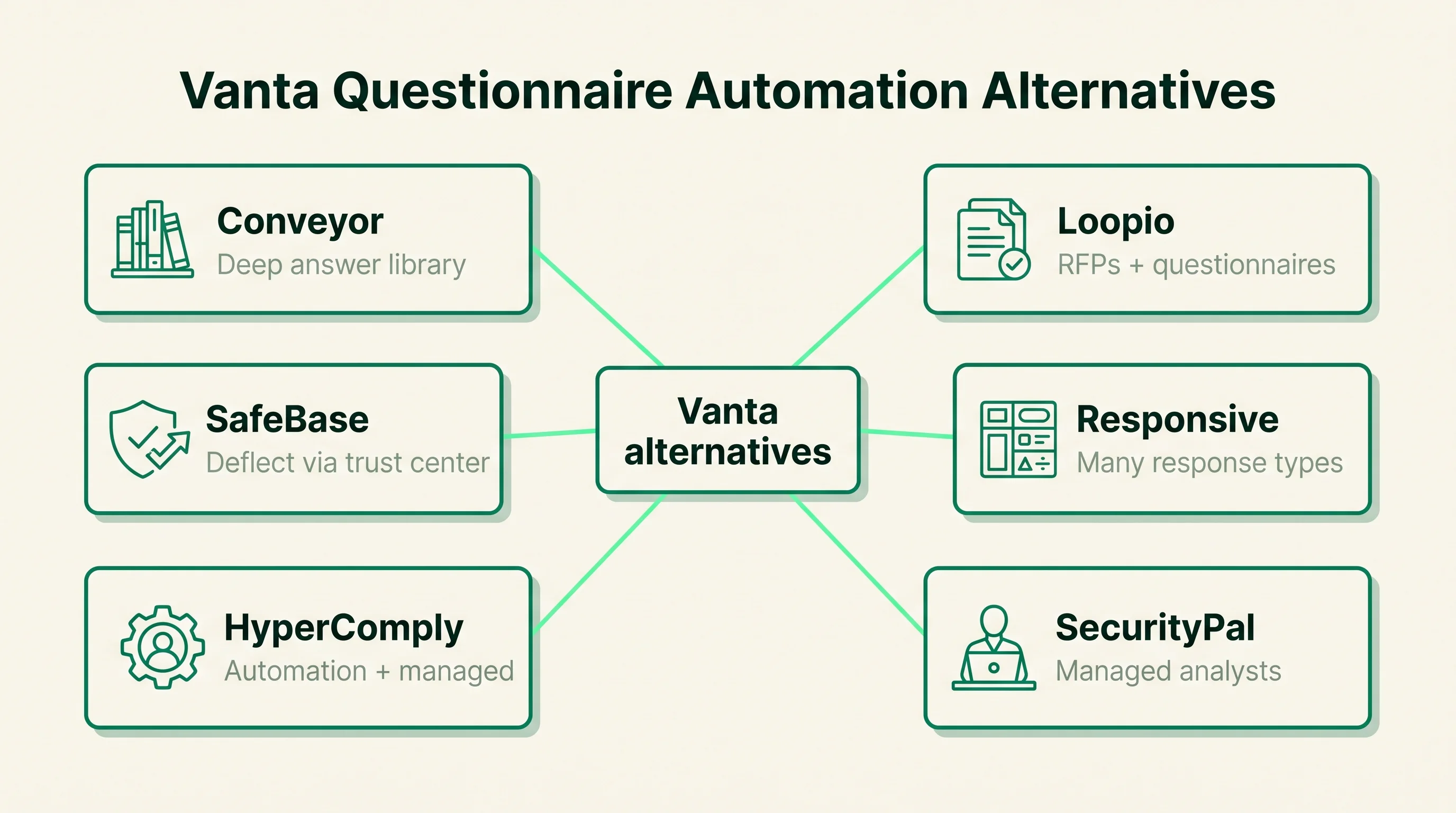
Quick answer: which should you choose?
Stay with Vanta if you want compliance automation, evidence collection, and questionnaire response in one platform and your questionnaire volume is moderate. Move to a focused alternative when answering questionnaires is a primary, high-volume workflow and you need deeper format coverage, stronger AI accuracy, or a dedicated answer library rather than a bundled feature.
There is no single best tool here. Vanta is a broad GRC and compliance platform, and its questionnaire automation is one capability inside that suite. The specialists in this guide build their products around questionnaire answering first, so they tend to go deeper on the response workflow while doing less of the wider compliance work.
The right choice depends on three things: how many questionnaires you answer, which formats your buyers send, and whether you want software, a managed service, or both.
- Want compliance plus questionnaires in one suite, with moderate volume: Vanta tends to fit.
- Want a deep answer library and response workflow as the core product: Conveyor, Loopio, or Responsive tend to fit.
- Want analysts to handle the response work for you: SecurityPal or HyperComply tend to fit.
- Want to deflect questionnaires before they arrive: SafeBase tends to fit.
If the category itself is new to you, start with our explainer on what security questionnaire automation is, then return to compare the options below.
Why buyers look for alternatives to Vanta questionnaire automation
Buyers look past Vanta's questionnaire feature when the response workflow becomes a primary job rather than an occasional task. Vanta's center of gravity is compliance automation and continuous evidence collection; questionnaire answering is one feature attached to that suite. For teams that mostly need that compliance work, the bundled feature is convenient. For teams drowning in inbound security reviews, a feature can feel shallow next to a tool built for the job.
The most common triggers are concrete and repeatable across shortlists.
- Depth of questionnaire features: a specialist answer library, response editor, and reviewer workflow that goes beyond a compliance suite's questionnaire module.
- Format coverage: handling Excel uploads, buyer portals, CAIQ, SIG, and custom spreadsheets without manual reformatting for each one.
- AI accuracy and citations: drafting that points to approved evidence a sales engineer or GRC analyst can trust, rather than confident text with no source.
- Not needing the full GRC suite: a team that already runs compliance elsewhere may not want to buy or relearn an entire platform to answer questionnaires.
- Volume and throughput: when annual questionnaire counts climb, teams want either deeper automation or analysts who absorb the work.
None of this means Vanta is weak at compliance. It means questionnaire response is a specialized workflow, and Vanta's questionnaire features evolve, so a buyer should test the current version against a focused tool rather than assume parity. For the underlying distinction, see our comparison of security questionnaire automation versus GRC software.
The main alternatives, at a glance
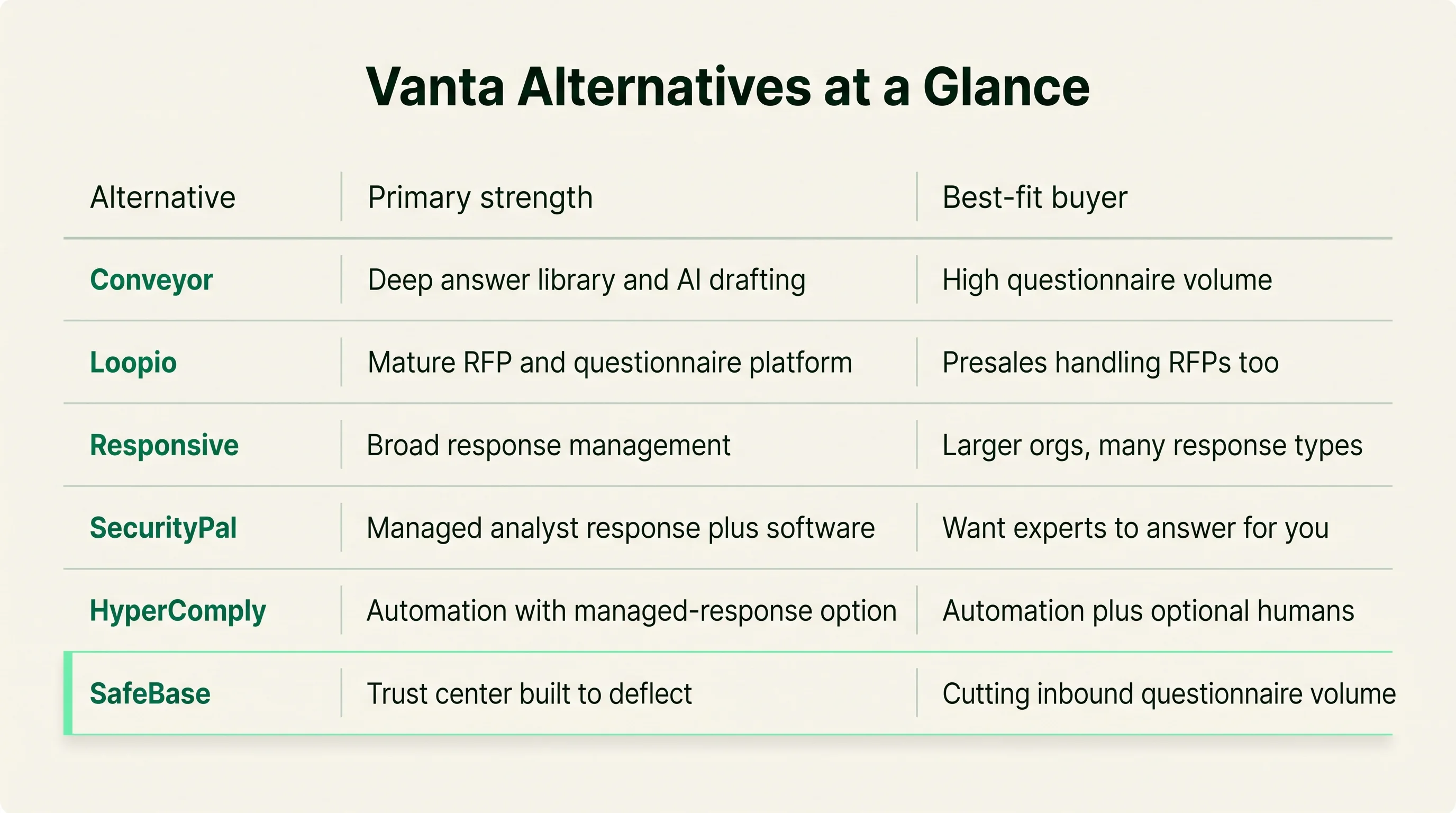
The fastest way to scan the field is by primary strength and best-fit buyer. The table below maps each alternative to what it leads with and the buyer it suits, using capability-level distinctions rather than feature claims that shift between releases. Treat every capability as vendor-reported and verify it on each vendor's current docs.
| Alternative | Primary strength | Best-fit buyer |
|---|---|---|
| Conveyor | Deep answer library and response workflow with AI drafting | Security and GRC teams answering high questionnaire volume |
| Loopio | Mature RFP and questionnaire response platform with library | Proposal and presales teams handling RFPs alongside security |
| Responsive | Broad response management across RFPs and questionnaires | Larger orgs standardizing many response types in one tool |
| SecurityPal | Managed analyst response plus software | Teams that want experts to complete questionnaires for them |
| HyperComply | Questionnaire automation with managed-response option | Teams wanting automation plus optional human completion |
| SafeBase | Trust center built to deflect questionnaires | Customer trust teams cutting inbound questionnaire volume |
A few rows deserve a closer read. Conveyor, Loopio, and Responsive are software-first response platforms where you and your team do the answering with AI and library support. SecurityPal and HyperComply add a managed-service angle, where analysts complete questionnaires on your behalf, which changes both the workflow and the cost model. SafeBase sits slightly apart: instead of answering faster, it tries to reduce how many questionnaires arrive by letting buyers self-serve evidence from a trust center.
The pattern is consistent. The specialists overlap on answer libraries and response workflows, and diverge most on what surrounds that core, whether that is RFP breadth, managed analysts, or deflection. Hold that distinction in mind through the rest of this comparison.
How do the Vanta alternatives differ on the criteria that matter?
The alternatives separate most clearly on a handful of buyer criteria, not on a single overall score. Vanta competes on breadth across these; the specialists compete on depth in the response workflow. Score each tool against the criteria that map to your own program rather than a generic ranking.
The criteria below are the ones shortlisters weigh in practice.
- Answer library quality: how cleanly approved answers stay current, who governs edits, and how well the library reuses across formats. Conveyor, Loopio, and Responsive center on this; Vanta provides it as part of a wider suite.
- AI accuracy and citations: whether drafted answers point to approved evidence. All vendors publish AI-assisted drafting; accuracy and citation behavior are vendor-reported and worth testing on your own questionnaires.
- Format coverage: support for Excel, buyer portals, CAIQ, SIG, and custom spreadsheets. Portal autofill in particular is where teams lose hours, so confirm it directly.
- Review and approval controls: how the tool gates what gets sent, tracks reviewer sign-off, and keeps a single reviewed source of truth.
- Integrations: connectors to CRM, SSO, document storage, and compliance tools. Specific connector lists change often, so verify them on current docs.
- Pricing model: whether you buy software, a managed service, or both, and whether pricing is per-seat, platform-style, or volume-based.
Two criteria deserve emphasis because they drive most regret. AI accuracy is only as good as the answer library behind it, so a tool that drafts from stale or thin content will produce confident but wrong answers regardless of brand. Format coverage decides how much manual reformatting survives automation, especially for portal-based reviews. For more on the AI question specifically, see our piece on whether AI can safely answer security questionnaires.
Which alternative fits which buyer
Match the tool to the workflow you run most and the team that owns it. The specialists overlap on core response, so the deciding factor is what surrounds that core: library depth, RFP breadth, managed analysts, or deflection. The fit lines below are written for the buyer profile each option suits.
Choose by your dominant need.
- Choose Conveyor when answering security questionnaires is a high-volume, security-owned workflow and you want a deep answer library, AI drafting, and a response editor as the core product.
- Choose Loopio when a presales or proposal team handles RFPs alongside security questionnaires and wants one mature library serving both response types.
- Choose Responsive when a larger organization wants to standardize many response formats, including RFPs, RFIs, and security questionnaires, in a single response-management platform.
- Choose SecurityPal when you would rather have analysts complete questionnaires for you, and you want managed throughput without growing internal headcount.
- Choose HyperComply when you want questionnaire automation but also value an optional managed-response path for overflow or complex reviews.
- Choose SafeBase when the goal is deflection: a customer trust team wants a public trust center so buyers self-serve evidence and send fewer questionnaires.
- Stay with Vanta when compliance automation and evidence collection are the main job, questionnaire volume is moderate, and one platform for both is worth more than maximum response depth.
These are starting points, not verdicts. A team with heavy portal volume and a strong existing GRC stack might pick a specialist purely for format coverage, while a smaller team might keep Vanta to avoid running two tools. Map your real volume and owners first. For a related decision, see our comparison of managed-service versus software-only questionnaire automation.
How should you evaluate Vanta questionnaire automation alternatives yourself?
Run your own evaluation instead of trusting any roundup, including this one. Vendor capabilities, AI accuracy, and pricing change between releases, and Vanta's questionnaire features evolve, so the only reliable comparison is one you run on a real questionnaire with your own evidence. A short, structured trial beats a feature-list checklist every time.
Use this checklist to keep the comparison honest and repeatable.
- Trial with a real questionnaire: take a recent buyer questionnaire, ideally one with portal and spreadsheet sections, and run it through each shortlisted tool.
- Test AI accuracy directly: check whether drafted answers cite approved evidence you trust, and count how many need heavy edits.
- Score on the criteria table: rate each tool on answer library, AI accuracy, format coverage, review controls, integrations, and pricing model.
- Confirm format coverage: verify Excel, portal autofill, CAIQ, and SIG handling on current docs, not on a sales claim.
- Check references: ask each vendor for customers with your volume and formats, and treat published outcome metrics as vendor-reported, not independent benchmarks.
- Model the real cost: compare software, managed-service, and hybrid pricing against your actual annual volume and the team that will maintain the tool.
The team that maintains the answer library is the real cost center, not the license, so weigh ongoing upkeep as heavily as the contract. When you are ready to shortlist, use the security questionnaire automation category hub to compare records, and our piece on where questionnaire automation and trust centers each fit to decide whether to answer faster or deflect the questions entirely.
How this article was reviewed
Sources reviewed
- Vanta product documentationVendor-reported. Vanta's questionnaire automation capabilities and pricing evolve and should be verified on the vendor's current docs and confirmed in a quote, not treated as independent fact.
- Conveyor, Loopio, Responsive, SecurityPal, HyperComply, and SafeBase product documentationVendor-reported. Capability, integration, AI accuracy, managed-service, and pricing claims for each alternative should be verified on the vendor's current docs and confirmed in a quote, not treated as independent fact.
- AICPA - SOC 2Primary source for what a SOC 2 report attests, commonly cited as evidence in questionnaire answers and answer libraries.
- ISO/IEC 27001Primary source for the information security management standard referenced across questionnaire response tools.
- Cloud Security Alliance - CAIQPrimary source for the CAIQ format, one of the standardized questionnaires referenced in the format-coverage comparison.
- Shared Assessments - SIGPrimary source for the SIG questionnaire format referenced in the format-coverage comparison.
FAQ
Why do security teams switch away from Vanta for questionnaire automation?
Teams switch when answering questionnaires becomes a primary, high-volume workflow rather than an occasional task. Vanta is a broad GRC and compliance platform, and its questionnaire automation is one feature inside that suite, so teams with heavy inbound volume often want a specialist with a deeper answer library, wider format coverage, or stronger AI accuracy. The switch is about depth in the response workflow, not a failure of Vanta's compliance features, which remain its core strength.
What are the top complaints buyers have about Vanta for questionnaire response?
The common buyer concerns are about depth rather than reliability. Some teams find a bundled questionnaire feature shallower than a tool built around response, especially on format coverage for portals and complex spreadsheets, AI citation behavior, and answer library governance at high volume. Others simply do not want the full GRC suite when they already run compliance elsewhere. Vanta's questionnaire features evolve, so test the current version against a specialist rather than assuming these gaps still apply.
What is the most direct competitor to Vanta for questionnaire automation?
There is no single direct competitor, because the comparison depends on which workflow you mean. For deep, software-first questionnaire response, Conveyor, Loopio, and Responsive are the closest specialists. For managed analyst completion, SecurityPal and HyperComply compete more directly. SafeBase competes on a different axis by deflecting questionnaires through a trust center. Pick the comparison that matches your dominant need rather than a blanket rival.
What Vanta alternative works best for small security teams?
Small teams usually fit best with either a focused software tool that minimizes manual reformatting or a managed service that absorbs the work entirely. A specialist like Conveyor can cut repetitive answering for a lean security team, while SecurityPal or HyperComply's managed option lets a small team handle volume without adding headcount. The right pick depends on whether you want to do the answering faster yourself or hand it off, so trial both models on a real questionnaire.
What Vanta alternative is designed for enterprise questionnaire volume?
Enterprise volume points toward platforms built for scale in answer library governance and many response types. Responsive and Loopio are designed for larger organizations standardizing RFPs and security questionnaires across teams, while Conveyor suits high-volume, security-owned response. For enterprises that prefer to offload throughput, SecurityPal's managed analyst model scales response without internal hiring. Confirm scale claims and governance controls on current docs and in a reference call before committing.