What Is External Assurance?
External assurance is independent third-party validation of an organization's security controls, such as a SOC 2 audit by a CPA firm or an ISO 27001 certificate from an accredited body. It is the evidence buyers trust most, because someone other than the vendor checked the work, and it is what sits behind credible questionnaire answers and trust centers.
What is external assurance?
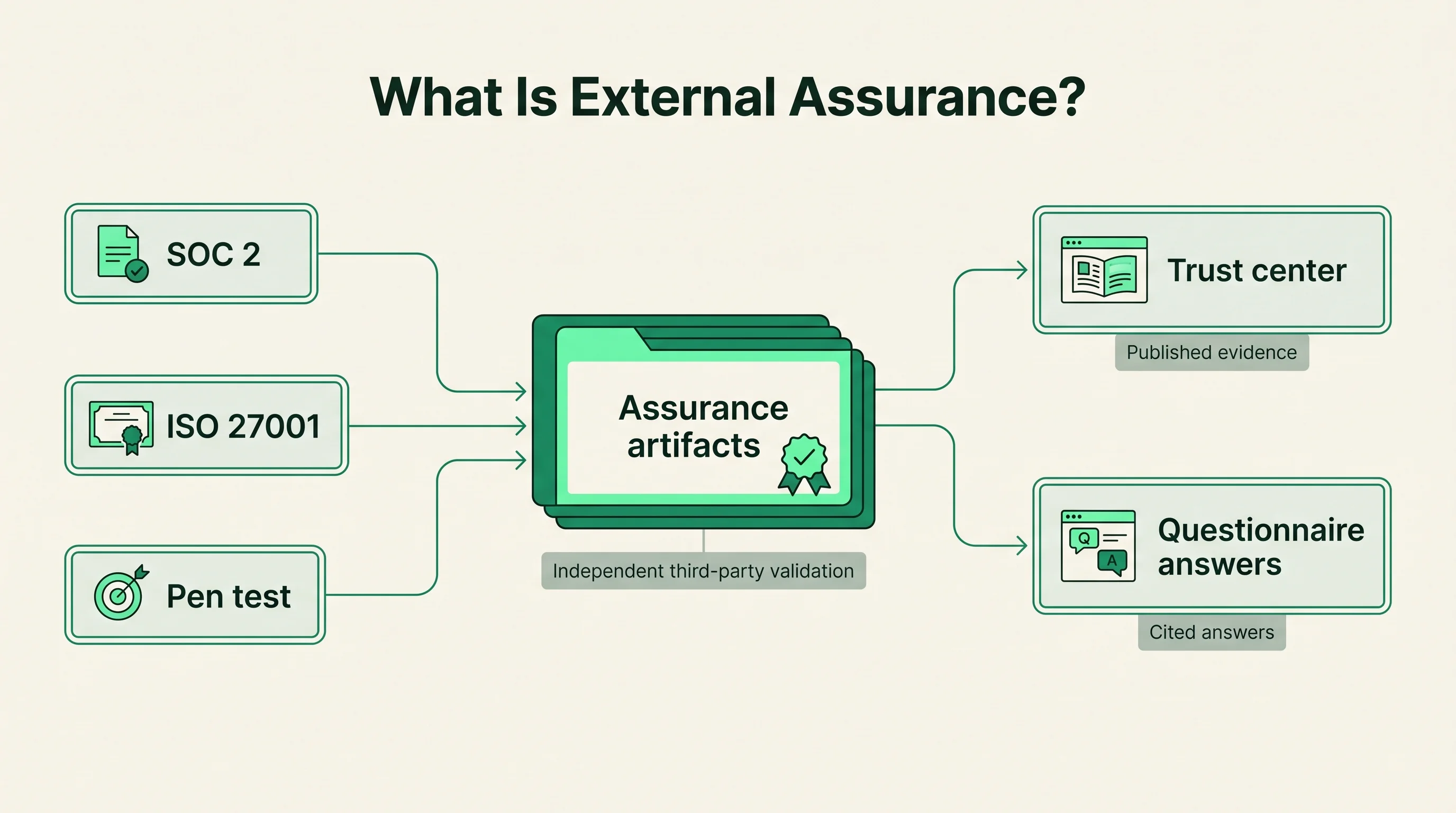
External assurance is independent third-party validation of an organization's security controls. An accredited auditor, certification body, or testing firm examines the controls and issues a report, certificate, or attestation that the organization did not produce itself. The defining feature is independence: someone other than the vendor checked the work and put their own name on the result.
The artifacts most buyers recognize are a SOC 2 report from a CPA firm, an ISO/IEC 27001 certificate from an accredited certification body, and a penetration test report from a security firm. Each is produced by an outside party against a defined standard or scope. That is what separates external assurance from a vendor's own description of its security.
The contrast is self-attestation, where an organization states its own controls without outside review. A completed security questionnaire, a filled CAIQ from the Cloud Security Alliance, or a SIG from Shared Assessments is self-attestation unless it is backed by external evidence. Self-attestation is faster and cheaper, but a buyer has only the vendor's word for it.
Ownership is shared across roles:
- GRC (governance, risk, and compliance) coordinates the audits and manages the evidence the assurance produces
- Security and the CISO own the controls being examined and own remediation when findings appear
- Sales engineering and the sales engineer rely on the artifacts to clear security reviews and unblock deals
- Customer trust, where the role exists, decides what assurance to publish and to whom
External assurance is best understood as the proof layer underneath everything else a security team says. The rest of this article covers how it is produced, why buyers weight it, the main types, where it sits next to adjacent surfaces, and how to evaluate and apply it.
How does external assurance work?
External assurance works by putting a defined set of controls in front of an independent party who tests them against a standard and issues an artifact reporting what they found. The organization does not grade itself. The auditor, certification body, or testing firm does, and their reputation is attached to the result.
The typical flow is consistent across assurance types:
- The organization defines a scope, such as the systems and controls a SOC 2 will cover
- It implements and documents the controls the standard requires
- An independent firm or body is engaged: a CPA firm for SOC 2, an accredited certification body for ISO 27001, a security firm for a penetration test
- The auditor gathers evidence, tests the controls, and notes exceptions or findings
- A report, certificate, or attestation is issued, dated, and scoped to what was examined
- The organization remediates findings and renews on a cycle, since assurance expires
The output is evidence, not a permanent guarantee. A SOC 2 Type II report covers a period and a scope; an ISO 27001 certificate is valid for a fixed term with surveillance audits; a penetration test reflects the state of the systems on the dates it ran. Each artifact says what was true, for what scope, at what time.
That evidence is what flows into the answer library, the trust center, and questionnaire responses. When a buyer asks whether you encrypt data at rest, the credible answer points to the SOC 2 control that was tested, not just a yes. The approved answer that feeds security questionnaire automation should cite the assurance artifact behind it, which is what makes the answer defensible rather than a claim.
External assurance is a cycle, not a one-time event. Scopes change, certificates lapse, and reports age out, so the work is recurring and the evidence has to be kept current to stay useful.
Why buyers weight external assurance more than self-attestation
Buyers weight external assurance more heavily than self-attestation because an independent party with its own reputation at stake examined the controls. A vendor describing its own security has an obvious conflict of interest. An accredited auditor signing a report does not, and that is the difference a buyer is paying attention to.
The concrete pain external assurance solves is trust at scale. A buyer assessing dozens of vendors cannot personally verify each one's security claims. A SOC 2 report or ISO 27001 certificate lets the buyer rely on an auditor's work instead of re-testing the vendor, which is why third-party risk management (TPRM) programs ask for these artifacts first.
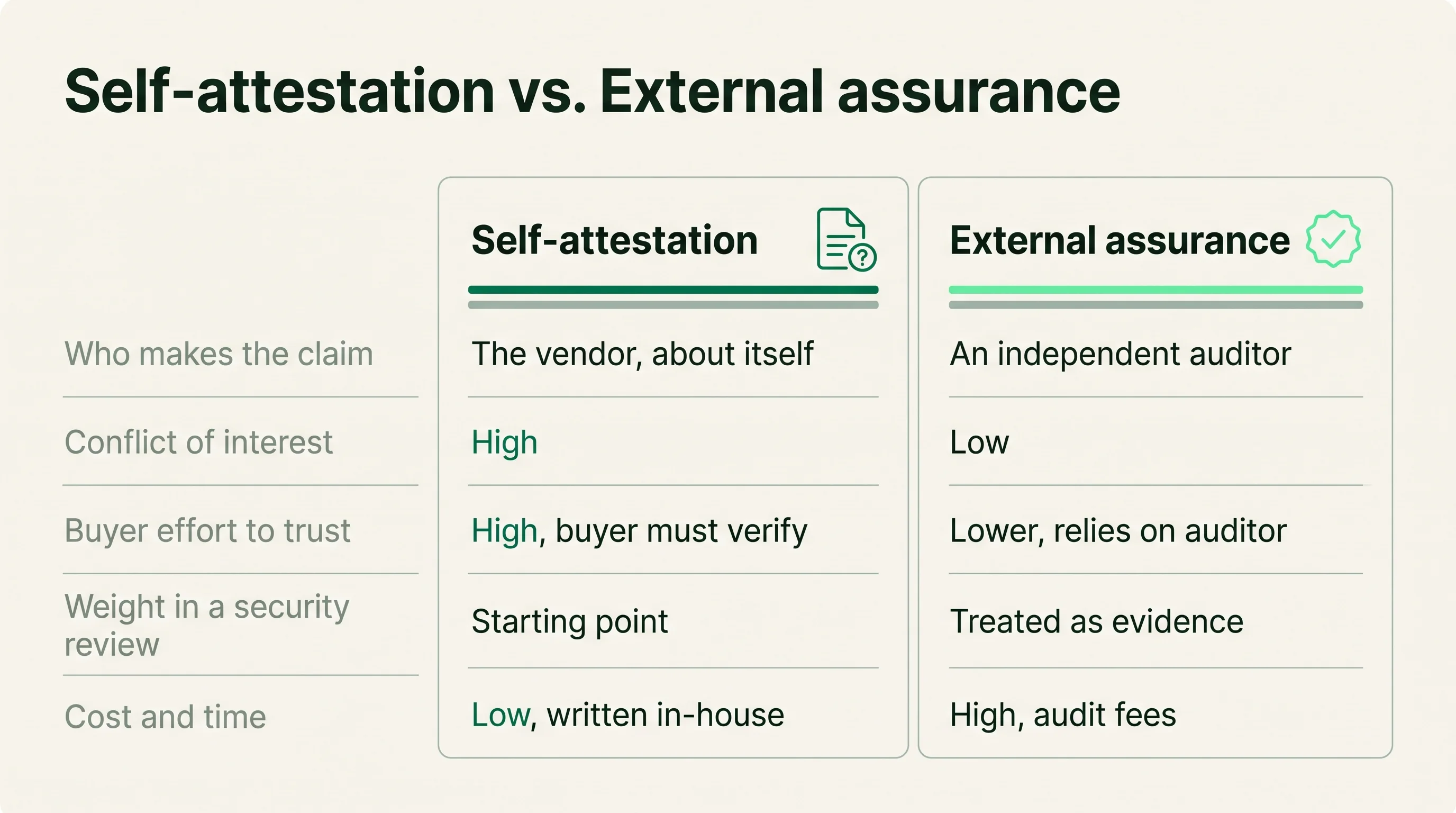
The difference between the two approaches is direct:
| Dimension | Self-attestation | External assurance |
|---|---|---|
| Who makes the claim | The vendor, about itself | An independent auditor or body |
| Conflict of interest | High, the vendor grades itself | Low, the assessor has reputation at stake |
| Buyer effort to trust | High, buyer must verify | Lower, buyer relies on the auditor |
| Weight in a security review | Treated as a starting point | Treated as evidence |
| Cost and time to produce | Low, written in-house | High, audit fees and lead time |
The practical read is that self-attestation answers the question while external assurance proves it. A questionnaire answered without evidence moves a review along, but a regulated or security-conscious buyer will ask for the report behind the answer. External assurance is what lets the answer survive that follow-up.
What are the main types of external assurance?
The main types of external assurance are SOC 2 audits, ISO/IEC 27001 certification, and penetration tests, and each proves a different thing. SOC 2 reports on how controls operate, ISO 27001 certifies that a management system meets a standard, and a penetration test demonstrates whether systems resist real attack. Buyers often want more than one, because they cover different ground.
| Type | Who issues it | What it proves |
|---|---|---|
| SOC 2 (AICPA) | A licensed CPA firm | That defined trust services controls were designed, and for Type II, operated over a period |
| ISO/IEC 27001 | An accredited certification body | That an information security management system meets the standard |
| Penetration test | A security testing firm | That systems were tested against real attack techniques on specific dates |
SOC 2, defined by the AICPA, comes in two forms that buyers treat differently. A Type I report attests that controls were designed appropriately at a point in time. A Type II report attests that those controls operated effectively over a period, usually six to twelve months. Type II carries more weight because it shows the controls worked over time, not just on paper one day.
ISO/IEC 27001 is a certification, not an audit report. An accredited certification body confirms that an organization runs an information security management system meeting the standard, and the certificate is valid for a fixed term with periodic surveillance audits. Accreditation of the body issuing it is what makes the certificate credible; a certificate from an unaccredited issuer carries far less weight.
Penetration tests prove something the other two do not: that someone actively tried to break in. A security firm tests applications or infrastructure against real techniques and reports what they found. The result is point-in-time and scope-bound, so a clean pen test from last year on a different codebase proves little about today.
The practical read is that these are complementary. SOC 2 and ISO 27001 attest to controls and process; a penetration test attests to resistance under attack. Mature programs maintain more than one, because buyers in different industries ask for different artifacts.
Where external assurance sits next to adjacent surfaces
External assurance sits underneath the customer-facing surfaces as the evidence they all draw on. Questionnaire automation, trust centers, and RFP responses are how the assurance is communicated; the assurance itself is the proof being communicated. Confusing the proof with the surface that delivers it is a common mistake.
| Surface | Its specific job | How external assurance relates |
|---|---|---|
| External assurance | Provide independent proof of controls | The evidence layer underneath everything |
| Questionnaire automation | Fill questionnaires with cited answers | Cites the assurance behind each answer |
| Trust center | Let buyers self-serve evidence | Publishes the assurance artifacts |
| Buyer TPRM | Assess and monitor vendors | Consumes the assurance to clear a vendor |
A trust center is the surface where external assurance is published for buyers to review, often under NDA. The SOC 2 report, ISO 27001 certificate, and pen-test summary that a trust center hosts are external assurance artifacts; the trust center is the access layer around them. The glossary entry for a trust center covers that surface, and the workflow for launching a trust center to reduce questionnaires shows how the evidence gets put to work.
Questionnaire automation is where external assurance becomes an answer. When a buyer asks a control question, the cited answer points to the assurance that backs it. Our explainer on security questionnaire automation versus trust centers covers where each surface fits, and the broader guide to security questionnaire automation places both alongside the evidence layer.
The buyer's TPRM program is the consumer of all of it. TPRM is the process a buyer runs to assess and monitor its vendors, and its requirements decide which assurance artifacts you need to clear a review. A buyer whose TPRM accepts a current SOC 2 may never send a questionnaire; one that requires its own form will, regardless of what you hold.
The shared asset across these surfaces is the assurance itself. One current SOC 2 report supports the trust center, the questionnaire answers, and the TPRM review at the same time, which is why keeping the evidence current pays off everywhere.
Benefits and tradeoffs of external assurance
The benefit of external assurance is straightforward: it converts your security claims into evidence a buyer will accept without re-testing you, which clears reviews faster and unblocks deals. The tradeoff is equally clear: it costs real money and lead time, and it proves something narrower than buyers sometimes assume.
What external assurance buys you:
- Credibility a self-attested questionnaire cannot reach, because an independent party signed it
- Faster security reviews, since buyers can rely on the auditor instead of verifying you themselves
- Reusable evidence that feeds the trust center, the answer library, and questionnaire responses at once
- Access to deals that require a specific artifact, such as enterprises that mandate SOC 2 Type II
- A forcing function that keeps controls documented and operating, since the audit will check
What it costs and where it falls short:
- Audit fees, internal preparation time, and lead times measured in months, not days
- A scope and time boundary: a report covers defined systems for a defined period, not everything always
- Recurring renewal work, because certificates lapse and reports age out
- No guarantee against a breach, since assurance attests to controls, not to perfect outcomes
- Diminishing returns past what your buyers actually ask for
External assurance is not always worth it yet. An early-stage company with no enterprise buyers asking for a SOC 2 will spend scarce time and money on an artifact no one is requesting. The signal to invest is buyer demand: when questionnaires and TPRM reviews start asking for a specific report, the assurance pays for itself by unblocking those deals. Before that point, self-attestation backed by good documentation is often the right call.
How to evaluate or implement external assurance
Decide what external assurance to pursue by working backward from what your buyers actually ask for, then scope it to the systems that matter and choose accredited assessors. Do not pursue a certificate no buyer has requested, and do not let a vendor's headline automation claim decide your audit scope for you.
Use a short checklist to scope the work:
| Criterion | What good looks like |
|---|---|
| Buyer demand | A clear pattern of questionnaires or TPRM reviews asking for a specific artifact |
| Assurance type | SOC 2 Type II for control operation over time, ISO 27001 for a certified management system, a pen test for attack resistance |
| Scope | The systems and data buyers care about, not the whole company by default |
| Assessor accreditation | A licensed CPA firm for SOC 2, an accredited certification body for ISO 27001, a reputable security firm for pen tests |
| Renewal plan | A cycle that keeps the report or certificate current before it lapses |
The artifacts themselves are produced by auditors and certification bodies, but the tooling around them is where vendors compete. Conveyor, Vanta, Drata, Secureframe, SafeBase, and Whistic sit at different angles. Vanta, Drata, and Secureframe focus on compliance automation that helps you reach and maintain SOC 2 or ISO 27001 readiness. Conveyor and SafeBase center on putting the resulting evidence to work in trust centers and questionnaire responses. Whistic emphasizes the buyer-vendor exchange. Each names its own capabilities, and those figures are vendor-reported; test them against your own audit timeline and buyer mix rather than accepting the marketing.
To turn assurance into cleared reviews once you have it, connect the evidence to the surfaces that use it:
- Publish current artifacts in a trust center so buyers can self-serve before sending a questionnaire
- Cite the assurance behind each approved answer, so questionnaire responses point to evidence, not claims
- Keep one canonical copy of each report and certificate, and update every surface when it renews
- Gate sensitive artifacts, such as the full SOC 2 report, behind an NDA rather than publishing them openly
- Track which artifacts buyers ask for, and stop maintaining ones no one requests
When you are ready to put the evidence to work, start from the trust center software category, then compare it against security questionnaire automation to size what each surface should carry. The vendor profile for Conveyor is a useful reference point for how trust center and questionnaire features are packaged around the assurance you hold.
How this article was reviewed
Sources reviewed
- AICPA - SOC 2Primary source for SOC 2 reports, including the distinction between Type I and Type II, issued by licensed CPA firms.
- ISO/IEC 27001Primary source for the information security management standard certified by accredited certification bodies.
- Cloud Security Alliance - CAIQPrimary source for the CAIQ self-attestation format that external assurance is used to back.
- Shared Assessments - SIGPrimary source for the SIG questionnaire format that buyers use during third-party risk management reviews.
- NISTReference framework buyers cite when defining the control areas external assurance is expected to cover.
- Vendor product documentation (Conveyor, Vanta, Drata, Secureframe, SafeBase, Whistic)Compliance automation and trust center capability claims are vendor-reported and should be verified against your own audit timeline and buyer mix, not treated as independent fact.
FAQ
What is external assurance in security?
External assurance is independent third-party validation of an organization's security controls, such as a SOC 2 report from a CPA firm or an ISO 27001 certificate from an accredited certification body. The defining feature is independence: an outside party examines the controls and issues an artifact the organization did not write itself. It is the evidence buyers trust behind questionnaire answers and trust centers, because someone other than the vendor checked the work.
What are the most common mistakes when relying on external assurance?
The most common mistakes are misreading scope and time. Buyers and vendors both treat a SOC 2 or ISO 27001 artifact as proof of security everywhere and always, when each one covers a defined scope for a defined period. Other frequent errors include letting a certificate lapse, accepting an ISO 27001 certificate from an unaccredited issuer, and treating a year-old penetration test of a different codebase as current evidence. Always check the scope, the dates, and the accreditation of the issuer.
How does external assurance compare to self-attestation in a questionnaire?
Self-attestation is the vendor describing its own controls, while external assurance is an independent party validating them. A questionnaire answered without evidence is self-attestation, and it moves a review along, but a regulated or security-conscious buyer will ask for the report behind the answer. External assurance carries more weight because the assessor has its own reputation at stake, which removes the conflict of interest in a vendor grading itself. The two work together: assurance is the evidence that makes a self-attested answer defensible.
How do you get leadership buy-in to invest in external assurance?
Tie the investment to deals, not to compliance for its own sake. Show the pattern of questionnaires and TPRM reviews asking for a specific artifact, and quantify the deals stalled or lost without it. A SOC 2 Type II or ISO 27001 certificate is most defensible to leadership when it is framed as a revenue unblocker for buyers who require it, with a clear scope and renewal cost. Avoid pursuing assurance no buyer has asked for, since that spends budget without unblocking anything.
What is the typical timeline to obtain external assurance?
Plan in months, not weeks. A SOC 2 Type II audit covers an observation period that commonly runs six to twelve months, plus preparation and the audit itself, so the first report often takes the better part of a year from a standing start. ISO 27001 certification and penetration tests are usually faster but still involve preparation, the assessment, and remediation of findings. Treat these as recurring programs with renewal cycles, since certificates expire and reports age out.