

What Is Evidence Library Sync?
Evidence library sync keeps the artifacts behind your questionnaire answers and trust center automatically current, so an expired SOC 2 report or a superseded ISO 27001 certificate never reaches a buyer.
What is evidence library sync?
Evidence library sync is the practice of keeping the evidence artifacts referenced by your security answers and trust center automatically current across every place they appear. Those artifacts are the documents that back a claim: a SOC 2 report, an ISO 27001 certificate, a penetration test summary, a data processing agreement, or a security policy. Sync makes sure the version a buyer sees today is the version that is valid today.
The word evidence is specific here. An answer in a security questionnaire states a fact; the evidence is the document that proves it.
- The answer says the company maintains audited controls; the evidence is the SOC 2 report
- The answer says an information security management system exists; the evidence is the ISO 27001 certificate
- The answer says the company tests for vulnerabilities; the evidence is the penetration test summary
- The answer references a written policy; the evidence is the policy document itself
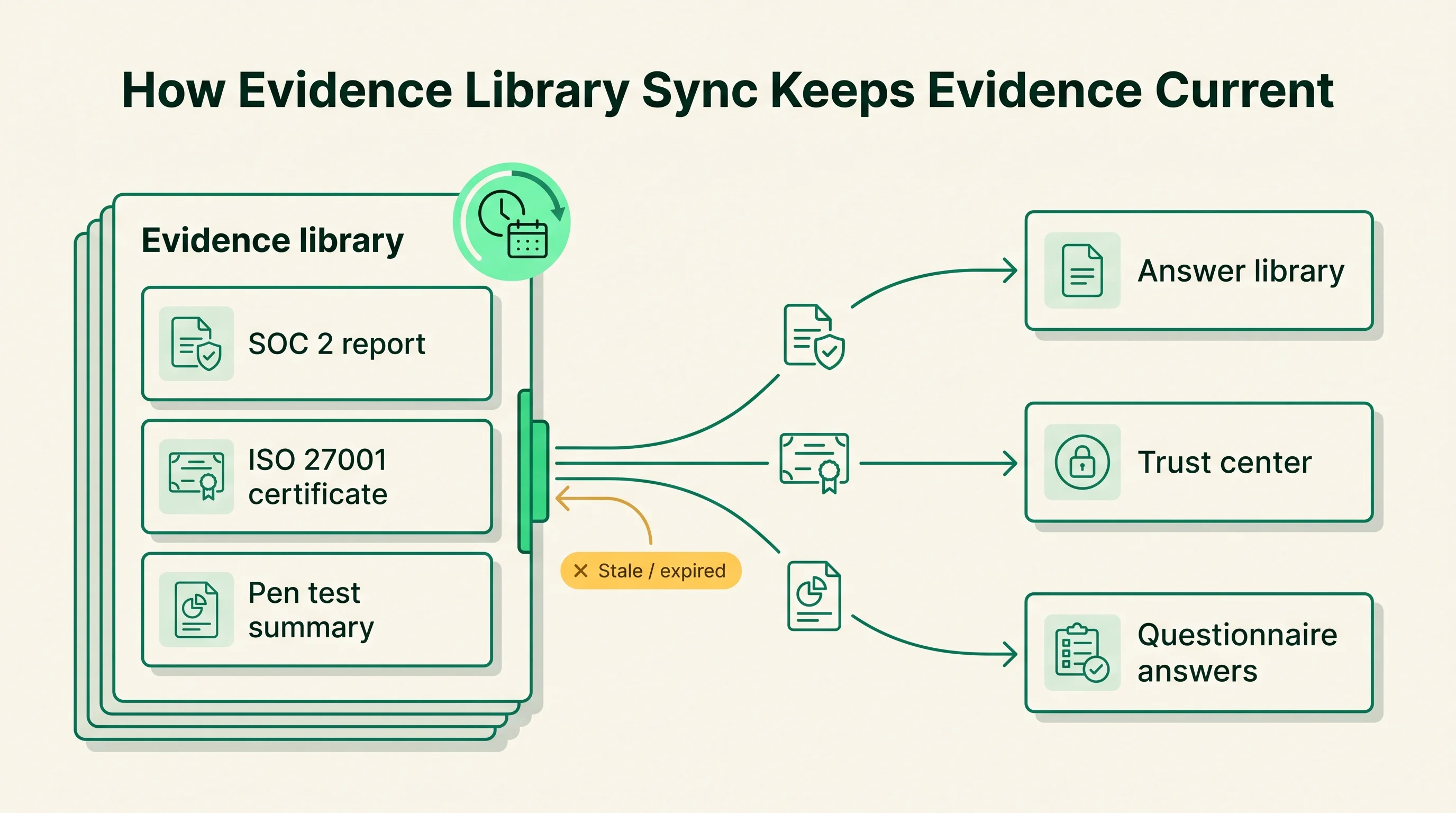
Without sync, each artifact lives in several places at once. The same SOC 2 report may be linked inside the answer library, posted on the trust center, and attached to a half-finished questionnaire. When the report is reissued, those copies do not update themselves. Sync is the layer that makes one current version flow everywhere it is cited.
Ownership usually sits with GRC (governance, risk, and compliance) or a dedicated security team, because they hold the artifacts and know when each one expires. A sales engineer or customer trust lead depends on the sync working, since they serve evidence to buyers during live deals. A CISO owns the standard the evidence must meet. The library is shared, but the security side owns what is in it.
How does evidence library sync work?
Evidence library sync works by connecting the evidence library to the systems that produce the artifacts, tracking each artifact's expiry, and propagating the current version wherever it is referenced. The system holds one canonical copy of each artifact and treats every other appearance as a reference to it, not a separate file.
The mechanism runs in a repeatable loop:
- Integrations connect the library to GRC and compliance platforms, document storage, and certificate sources
- Each artifact is registered with its issue date, validity period, and expiry date
- The system pulls the current version of an artifact when the source updates it
- Version control replaces the old version and keeps a history of what changed and when
- The new version propagates to every surface that cites it: the answer library, the trust center, and any active questionnaire
Expiry tracking is the part that prevents the quiet failures. A SOC 2 report covers a defined audit period and ages out; an ISO 27001 certificate has a fixed validity window; a penetration test reflects a point in time. The system watches those dates and flags an artifact before it expires, so GRC can request the next one rather than discover the gap from a buyer.
Integrations with GRC and compliance platforms such as Vanta, Drata, and Secureframe are what make the pull automatic rather than manual, because those platforms already hold or generate many of these artifacts. The trust center is the most visible downstream surface, since it serves evidence directly to buyers. Our explainer on security questionnaire automation covers how the answer library consumes the same evidence.
Why does evidence library sync matter?
Evidence library sync matters because stale evidence fails security reviews and damages trust at the worst possible moment. A buyer who downloads an expired SOC 2 report, or reads an answer that cites a certificate that lapsed last quarter, has a concrete reason to slow or stop the deal. The cost is not abstract; it lands in the middle of a live procurement cycle.
The failure mode is specific. Evidence does not break loudly. It sits there looking correct until a buyer checks the date.
- A trust center serves last year's penetration test because no one swapped the file
- An answer references a sub-processor list that changed after a vendor migration
- A questionnaire goes out citing an ISO 27001 certificate that expired during the sales cycle
- Two surfaces serve two different versions of the same policy, and a sharp reviewer notices
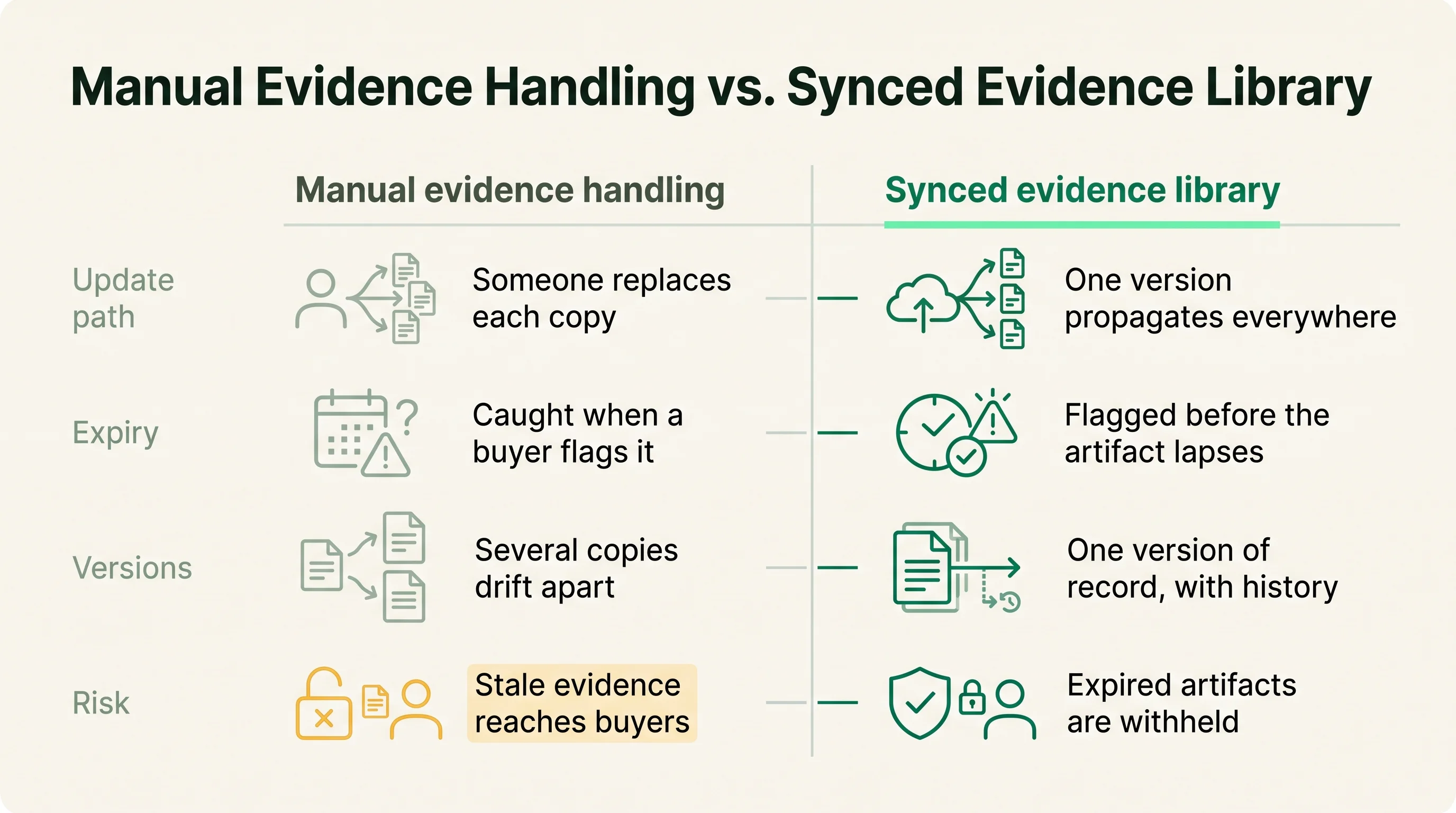
The contrast with manual upkeep is stark across the dimensions that decide whether evidence stays current.
| Dimension | Manual evidence handling | Synced evidence library |
|---|---|---|
| Update path | Someone remembers to replace each copy | One canonical version propagates everywhere |
| Expiry | Caught when a buyer flags it | Flagged before the artifact lapses |
| Versions | Several copies drift apart | One version of record, with history |
| Risk | Stale evidence reaches buyers | Expired artifacts are withheld or refreshed |
The deeper point is reviewer trust. A security reviewer who finds one expired document starts doubting the rest, and a deal that was moving on evidence now moves on suspicion. Keeping evidence current is cheaper than rebuilding credibility after it slips.
Where does evidence library sync sit next to adjacent surfaces?
Evidence library sync is the maintenance layer underneath the surfaces buyers and reviewers actually touch. Questionnaire automation, the trust center, and third-party risk management all reference the same artifacts, so sync is what keeps those references honest. It is plumbing, not a destination.
| Surface | Its specific job | How sync serves it |
|---|---|---|
| Questionnaire automation | Draft answers to inbound reviews | Keeps the evidence each answer cites current |
| Trust center | Publish proof for buyer self-service | Replaces expired artifacts before buyers see them |
| TPRM response | Satisfy a buyer's vendor assessment | Supplies the valid version on request |
A trust center is a published page where a company posts its certifications, reports, and common answers so buyers can self-serve. It is the surface where stale evidence is most exposed, because buyers download files directly without a human in the loop. Our glossary entry on the trust center covers the concept, and the workflow for launching a trust center to reduce questionnaires shows how it cuts inbound volume when the evidence behind it stays fresh.
Third-party risk management (TPRM) is the same exchange from the buyer's side. TPRM is the program a company runs to assess the vendors it buys from, and requesting current evidence is a routine part of it. Sync is what lets your team answer a TPRM request with the valid artifact instead of scrambling to find it.
The distinction worth keeping straight is between sync and continuous compliance monitoring. Monitoring watches whether your controls are operating; sync watches whether the documents proving those controls are current and visible. They are related, and platforms like Drata and Vanta touch both, but they answer different questions. For where these surfaces divide, see our explainer on security questionnaire automation versus trust centers.
What are the benefits and tradeoffs?
The payoff is that buyers and reviewers always receive current evidence without anyone manually chasing files. The cost is that sync only protects what it can reach, and integration coverage is never total. Both are real, and a buyer should weigh them before assuming the capability solves the whole problem.
The benefits are concrete:
- Expired artifacts are withheld or refreshed before they reach a buyer, which protects deals in flight
- One version of record removes the drift between the trust center, the answer library, and active questionnaires
- GRC gets advance warning of expiry instead of discovering a gap during a review
- The audit history shows which evidence version was served when, which helps during the company's own audits
The tradeoffs deserve equal weight:
- Sync depends on integrations, so any artifact maintained outside a connected source still drifts silently
- A penetration test summary or a custom policy that lives in a folder, not a connected platform, is exactly the kind of evidence that slips
- Setup requires mapping every artifact to a source and every reference to that artifact, which is real work
- Automation can create false confidence: a team assumes everything is current when only the connected subset actually is
There is a point where dedicated sync is not worth it. A company with two evidence artifacts, a single trust center page, and low questionnaire volume can keep things current with a calendar reminder and a careful owner. The economics favor real sync when the same artifacts are cited across many answers and surfaces, and when expiry dates are frequent enough that manual tracking starts failing. Below that threshold, the integration setup outweighs the saved effort.
How do you evaluate evidence library sync?
Evaluate evidence library sync on five things: integration depth, expiry tracking, version control, propagation across surfaces, and access control. Do not judge it by how many artifacts the library can store. Storage capacity is the easiest number to advertise and the least predictive of whether evidence stays current.
Score each tool against the same criteria.
| Criterion | What good looks like |
|---|---|
| Integration depth | Connects to your GRC platform, document storage, and certificate sources |
| Expiry tracking | Flags each artifact before its validity window closes |
| Version control | One version of record per artifact, with a full change history |
| Propagation | A new version reaches the answer library, trust center, and live questionnaires |
| Access control | Evidence is served only to approved buyers, not exposed publicly by default |
Vanta, Drata, Conveyor, SafeBase, Whistic, Secureframe, and TrustCloud are common reference points, and they reach evidence sync from different angles. Vanta, Drata, and Secureframe come from compliance automation, so they often generate and hold the artifacts directly. SafeBase and Whistic come from the trust center and questionnaire side, so their strength is serving evidence to buyers under access control. Conveyor spans questionnaire automation and trust centers, and TrustCloud connects GRC to customer-facing surfaces. Each names its own integration set and expiry features, and those claims are vendor-reported. Verify them against your actual artifacts rather than the feature list. Our profile of Conveyor covers one of these in depth.
The most reliable test is to map your real evidence and trace it end to end.
- List every artifact you serve, from the SOC 2 report to each policy and the penetration test summary
- Confirm the tool can connect to where each one actually lives
- Expire a test artifact and watch whether the change reaches every surface that cites it
- Check that nothing sensitive is exposed without buyer access control
A trace through your own evidence tells you more than any capability grid. When you are ready to shortlist, start from the trust center software category and compare the leading tools side by side.
How this article was reviewed
Sources reviewed
- AICPA - SOC 2Primary source for what a SOC 2 report attests and the audit period it covers as evidence.
- ISO/IEC 27001Primary source for the information security management standard and certificate validity window.
- Cloud Security Alliance - CAIQPrimary source for the CAIQ format referenced by many evidence artifacts.
- Shared Assessments - SIGPrimary source for the SIG and SIG Lite questionnaire definitions.
- NIST Cybersecurity FrameworkReference framework cited in many security questionnaire controls and evidence claims.
- Vendor product documentation (Vanta, Drata, Conveyor, SafeBase, Whistic, Secureframe, TrustCloud)Integration coverage and expiry-tracking claims are vendor-reported and should be verified against your own evidence, not treated as independent fact.
FAQ
What is evidence library sync?
Evidence library sync is the practice of keeping the evidence artifacts referenced by your security answers and trust center automatically current across every surface that cites them. It connects the library to GRC and compliance platforms, tracks each artifact's expiry, and propagates the current version to the answer library, trust center, and active questionnaires. The point is that a buyer never receives an expired SOC 2 report or a lapsed ISO 27001 certificate.
What are the most common mistakes when implementing evidence library sync?
The biggest mistake is assuming sync covers everything when it only covers connected sources, leaving artifacts in folders or email to drift silently. The second is skipping expiry mapping, so the system never knows when a SOC 2 report or certificate ages out. The third is exposing evidence publicly instead of behind buyer access control, which turns a sync feature into a disclosure risk.
How does evidence library sync compare to handling evidence manually or with spreadsheets?
Manual handling stores evidence but adds no propagation, so each copy on the trust center, in the answer library, and in questionnaires must be replaced by hand. A spreadsheet of expiry dates helps but still relies on someone acting on it before a buyer notices. Sync replaces the canonical version everywhere at once and flags expiry in advance. For very low volume a spreadsheet and a diligent owner can work; above that, manual upkeep starts failing quietly.
How do you get leadership buy-in for investing in evidence library sync?
Frame it in deal terms a CISO and a sales leader both recognize: an expired artifact found mid-review stalls a signed contract and erodes reviewer trust across the whole submission. Show how many artifacts are cited across the trust center, answer library, and questionnaires, and how often expiry dates pass unnoticed. Sync converts that scattered manual tracking into one version of record with advance expiry warnings, which is the case that moves budget.
What is the typical implementation timeline for evidence library sync?
Connecting the integrations and registering each artifact with its expiry date commonly takes a few weeks, depending on how many systems hold your evidence and how scattered it is. The integration setup is usually fast; the work is mapping every reference to its source and confirming propagation reaches each surface. Plan for ongoing upkeep, because new artifacts and renewal cycles keep arriving after launch.