

What Is an Approved Answer Library?
An approved answer library is the curated, reviewed, versioned set of approved responses, each linked to evidence and given an expiry date, that a team reuses to answer security questionnaires. It is the core asset that makes questionnaire automation accurate rather than just fast.
What is an approved answer library?
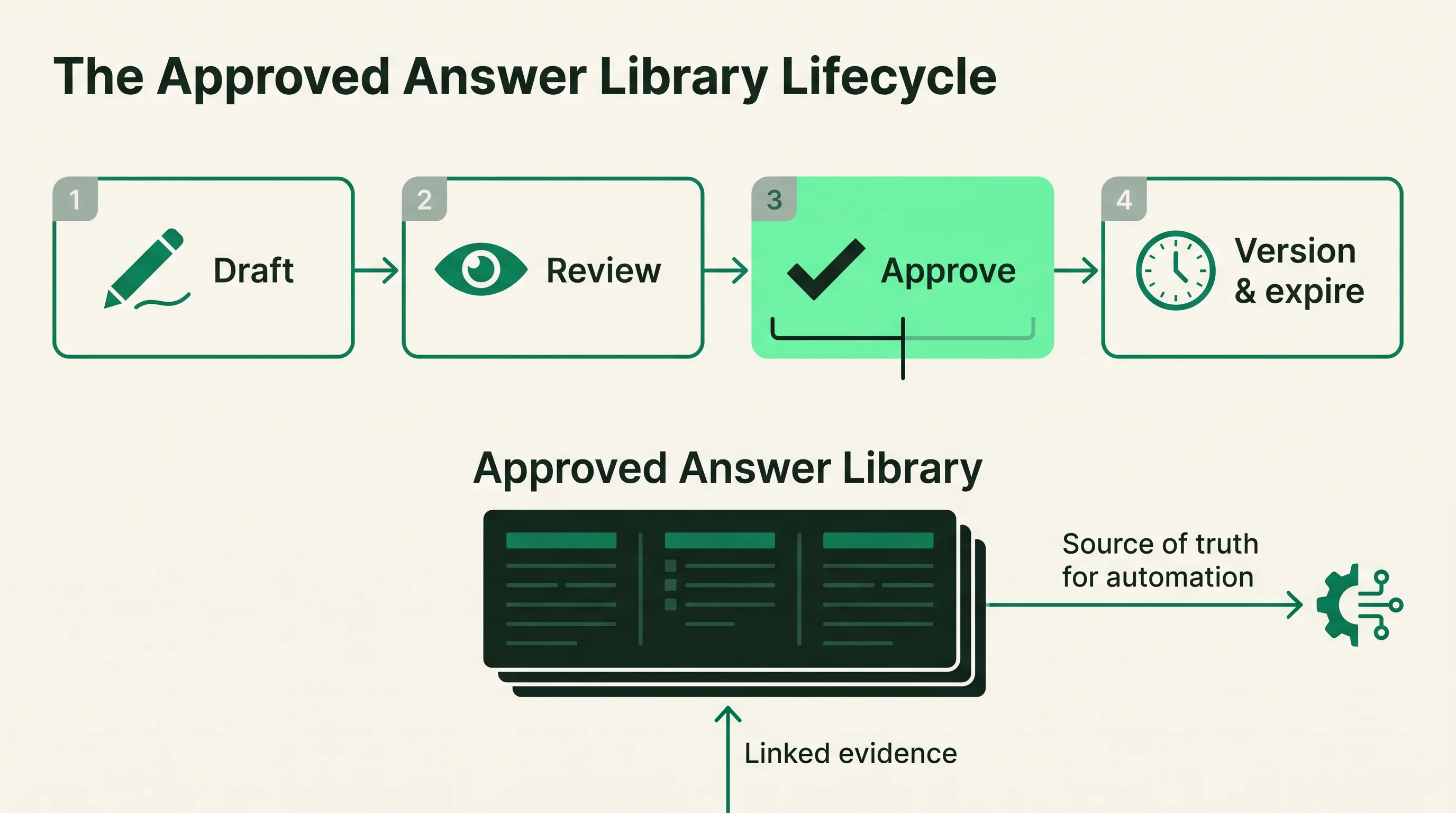
An approved answer library is the curated, reviewed, versioned set of approved responses that a team reuses to answer security questionnaires. Each entry is an answer that the right owner has signed off on, linked to the evidence that proves it, and stamped with a date by which it must be reviewed again. The library holds the approved answers; questionnaire automation tools retrieve and reuse them.
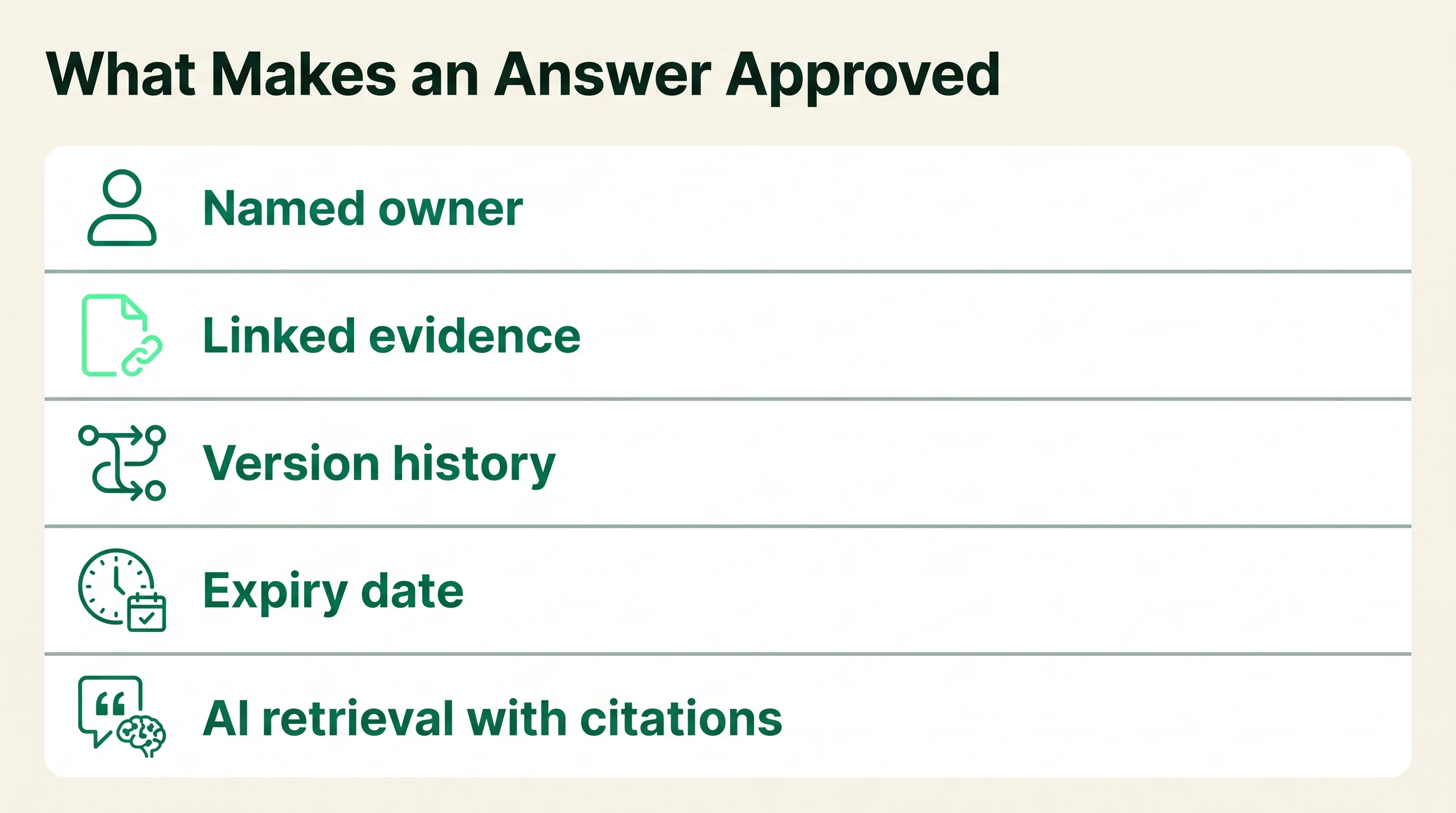
The word that matters in the name is approved. A line of past text is not an approved answer until it has passed through control. An approved answer carries four things that a raw past response does not.
- A named owner who wrote it and is accountable for it
- A link to supporting evidence, such as a SOC 2 report or an ISO 27001 certificate
- A version history showing what changed and when
- A review or expiry date, after which the answer is no longer trusted on sight
Ownership is what keeps the library worth trusting. At most B2B SaaS companies the answers are owned by GRC (governance, risk, and compliance) or a dedicated security function, who write and approve them. A subject-matter expert (SME) supplies the technical detail, a sales engineer or customer trust lead drives the deals those answers unblock, and a CISO owns the standard the answers must hold to. The library is shared across these roles, but the security side owns the truth in it. For the formal definition, see the approved answer library glossary entry.
How does an approved answer library work?
An approved answer library works by capturing an answer once under review, then matching it to every future question that asks the same thing. The team writes an answer, links its evidence, and approves it. From then on, the automation tool retrieves that approved entry whenever a buyer asks the same question in any format or wording.
The flow runs in six steps:
- A buyer sends a questionnaire in some format, such as Excel, a portal, a PDF, a CAIQ, or a SIG
- The tool matches each incoming question to entries in the library
- It drafts a response from the best-matched approved answer
- A reviewer checks the draft against the linked evidence and approves or edits it
- The completed questionnaire ships to the buyer
- Any new approved answer feeds back into the library for next time
Matching is where modern tools differ from a plain document. Older approaches used keyword search, which broke the moment a buyer rephrased a familiar question. Current tools use AI semantic matching, comparing the meaning of the incoming question to the meaning of stored answers, so "do you encrypt data at rest" and "is stored customer data encrypted" resolve to the same approved entry.
The approval step is what separates a library from a folder of past answers. An answer enters the library only after its owner signs off and links the evidence behind it. That gate is also what makes the answer safe to reuse without re-checking it every time. The full capture-and-refresh loop is documented in the workflow on building and maintaining an approved answer library.
Why an approved answer library matters
An approved answer library matters because it converts repeated security-review work into a review-and-approve cycle instead of a re-typing cycle. Without it, the same SMEs answer near-identical questions over and over, answers drift out of sync, and a stalled review holds up a signed contract. The library is the asset that fixes all three at once.
The pain it removes is concrete. The same questions arrive in different formats, the people who can answer them are scarce, and a single stale answer can embarrass the company in front of a buyer. The contrast below shows what changes when the work moves into a library.
| Dimension | Manual, ad hoc answers | Approved answer library |
|---|---|---|
| Source of an answer | Search old emails and past files | One canonical approved entry |
| Consistency | Same control described several ways | One reviewed wording reused |
| SME load | Pulled in for every questionnaire | Pulled in once, then on review |
| Staleness control | None, until a buyer notices | Expiry date forces a recheck |
| Audit trail | Scattered or absent | Who approved what, and when |
The quieter benefit is consistency. A sharp buyer notices when one questionnaire says data is encrypted with one standard and the next says something different. A library makes the company speak with one reviewed voice, which is itself a signal of operational maturity to the team assessing you.
Where it sits next to adjacent surfaces
The approved answer library is the shared answer asset; the surfaces around it are the channels that reuse it. Questionnaire automation, the trust center, RFP response, and third-party risk management all draw on the same approved answers, which is why they are easy to confuse. The library is the layer underneath all of them.
| Surface | Its specific job | How it uses the library |
|---|---|---|
| Questionnaire automation | Answer inbound security reviews | Retrieves approved answers to draft responses |
| Trust center | Publish proof, deflect repeat requests | Surfaces a curated subset of answers and evidence to buyers |
| RFP response | Answer revenue proposals | Pulls the security section from the same approved entries |
| TPRM | Assess the vendors you buy from | Sends questionnaires the other side answers from their library |
A trust center is a published page where a company posts its certifications, documentation, and common answers so buyers can self-serve. It runs on the same library, surfacing a curated public subset. A strong trust center reduces how many questionnaires arrive, because a buyer who finds the SOC 2 report and a completed CAIQ may never send a spreadsheet.
The distinction worth holding onto is library versus knowledge base. The two terms are often used interchangeably, and the overlap is real. The library is the catalog of approved answers; a security questionnaire knowledge base is that library plus the surrounding evidence and governance that make the answers safe to reuse. In practice many vendors brand the same surface either way. The library is the narrower, more precise idea: the approved answers themselves.
How is an approved answer library built and governed?
A library is built by seeding it with curated approved answers and governed by reviewing them on a schedule. The build is a project; the governance is permanent. Teams that treat the library as a one-time import are the ones whose answers quietly go stale and surface as wrong in front of a buyer.
The build follows a clear sequence:
- Gather the questionnaires the team has already answered
- Deduplicate near-identical responses into one canonical answer
- Have the right owner approve each canonical answer
- Link each answer to its supporting evidence
- Tag entries by topic so the tool can match them
Governance is the part that decides long-term accuracy. Three disciplines keep a library trustworthy over time.
- Review answers on a schedule, not only when one breaks in front of a buyer
- Expire answers tied to certifications, sub-processors, or controls that change
- Capture new approved answers from each questionnaire back into the library
The evidence map is worth getting right at build time, because it is what reviewers and buyers lean on later.
| Claim in an answer | Backing evidence |
|---|---|
| Audited controls | SOC 2 report |
| Information security management system | ISO 27001 certificate |
| Standardized control coverage | Completed CAIQ or SIG |
| Control framework alignment | NIST mapping |
The single most common build mistake is loading volume without curation. A library full of unreviewed past answers is a liability, because the tool will confidently retrieve the wrong one. Fewer, cleaner, owned answers beat a large pile every time.
What are the benefits and tradeoffs?
The payoff is reuse under control: an answer written and approved once is matched to thousands of incoming questions, so the team reviews instead of re-types. The cost is governance, which never ends. Both are real, and a buyer should weigh them honestly before committing.
The benefits are concrete:
- Faster turnaround, because a stalled security review can hold up a signed contract
- Consistent answers, because the company speaks with one reviewed voice
- Lower SME load, because the same experts stop answering near-identical questions
- An audit trail of who approved what and when, useful for the company's own audits
The tradeoffs deserve equal billing:
- The initial build is a project, and the library is only as good as the curation in it
- Governance is a standing cost, not a one-time spend
- Over-trust is the subtler risk: a polished approved answer can lull a reviewer into rubber-stamping, and a stale entry then ships as a confident wrong response
There is a point where a dedicated library is not worth it. A company that receives a handful of questionnaires a year does not need structured software; a careful shared document and a diligent reviewer will do. The economics favor a real approved answer library when volume is high enough that the same SMEs are pulled into repeated near-identical work. Below that threshold, the setup and upkeep outweigh the saved time.
How do you evaluate an approved answer library?
Evaluate a library on what makes an answer approved, not on how many answers it holds. Entry count is the easiest number to inflate and the least predictive of accuracy. Score each tool against the controls that keep an answer trustworthy.
| Criterion | What good looks like | Why it matters |
|---|---|---|
| Ownership | A named owner per entry, usually in GRC | No owner means no one catches a changed control |
| Evidence links | Each answer points to a SOC 2, ISO 27001, CAIQ, or policy | A reviewer and a buyer can verify the claim fast |
| Version history | Every answer shows what changed and when | You can trust an answer because you can audit it |
| Expiry dates | Answers tied to certs and controls auto-flag for review | Staleness is caught by the system, not by a buyer |
| AI retrieval with citations | Drafts cite the source entry | A reviewer verifies the match in seconds |
Conveyor, Loopio, Responsive, Vanta, SafeBase, and Whistic are common reference points, and they reach the library from different angles. Conveyor centers on security questionnaires and trust centers; Loopio and Responsive came from RFP response; Vanta, SafeBase, and Whistic reach the same surface from compliance automation and trust centers. Vendors such as HyperComply, SecurityPal, and Drata also operate in this category. Each names its own library and AI capabilities, and those claims are vendor-reported. The point of evaluating is to test them on your own questions, not to take the marketing at face value.
The most reliable test is to run a real, recent questionnaire through a trial of each tool.
- Use one you have already answered, so you know the correct responses
- Watch how each tool matches, drafts, cites, and routes for approval
- Compare drafted answers against your approved versions for accuracy
A trial on your actual questions tells you more than any feature grid. When you are ready to shortlist, start from the security questionnaire automation category hub and compare the leading tools, including profiles of Conveyor and Loopio, side by side. For the wider context, the explainer on security questionnaire automation covers how the library fits the whole workflow.
How this article was reviewed
Sources reviewed
- AICPA - SOC 2Primary source for what a SOC 2 report attests as evidence behind an approved answer.
- ISO/IEC 27001Primary source for the information security management standard used as evidence.
- Cloud Security Alliance - CAIQPrimary source for the CAIQ format definition and structure.
- Shared Assessments - SIGPrimary source for the SIG and SIG Lite questionnaire definitions.
- NISTReference framework cited in many security questionnaire controls.
- Vendor product documentation (Conveyor, Loopio, Responsive, Vanta, SafeBase, Whistic)Capability claims are vendor-reported and should be verified in a trial, not treated as independent fact.
FAQ
What is an approved answer library?
It is the curated, reviewed, versioned set of approved responses that a team reuses to answer security questionnaires. Each entry pairs an approved answer with a named owner, a link to its supporting evidence, and an expiry date, so the team reviews matches instead of re-typing answers. It is the core asset that decides whether questionnaire automation is accurate or just fast.
What are the most common mistakes when building an approved answer library?
The biggest mistake is loading volume without curation, which leaves the tool confidently retrieving the wrong answer. The second is treating the library as a one-time import and skipping the review and expiry cycle, so entries quietly go stale. The third is leaving entries without a named owner, which means no one catches a control or certification that has changed.
How does an approved answer library compare to spreadsheets?
A spreadsheet of past answers stores text but adds no governance, so duplicates pile up and stale answers look correct until someone sends one. An approved answer library adds ownership, evidence links, version history, expiry dates, and AI matching. For low questionnaire volume a spreadsheet and a careful reviewer can work; above that, the lack of approval and expiry control becomes a liability.
How do you get leadership buy-in for an approved answer library?
Frame it in terms a CISO and a sales leader both recognize: stalled security reviews delay signed contracts, and repeated SME pulls are a hidden cost. Show how often the same questions recur and how long current turnaround takes. A library converts that repeated manual work into a review-and-approve cycle, which is the case that moves budget.
What is the typical implementation timeline for an approved answer library?
Seeding an initial curated library commonly takes a few weeks, depending on how many past questionnaires need deduplicating and approving. Tools can import answers quickly, but the curation, evidence-linking, and sign-off are the work that takes time. Plan for ongoing governance after launch, because the review and expiry cycle is permanent, not a closeout task.