

Security Questionnaire Automation vs. Customer Trust Automation
Security questionnaire automation answers inbound reviews fast; customer trust automation works upstream to publish proof so fewer reviews arrive. One is reactive, the other proactive, and most teams need both in sequence.
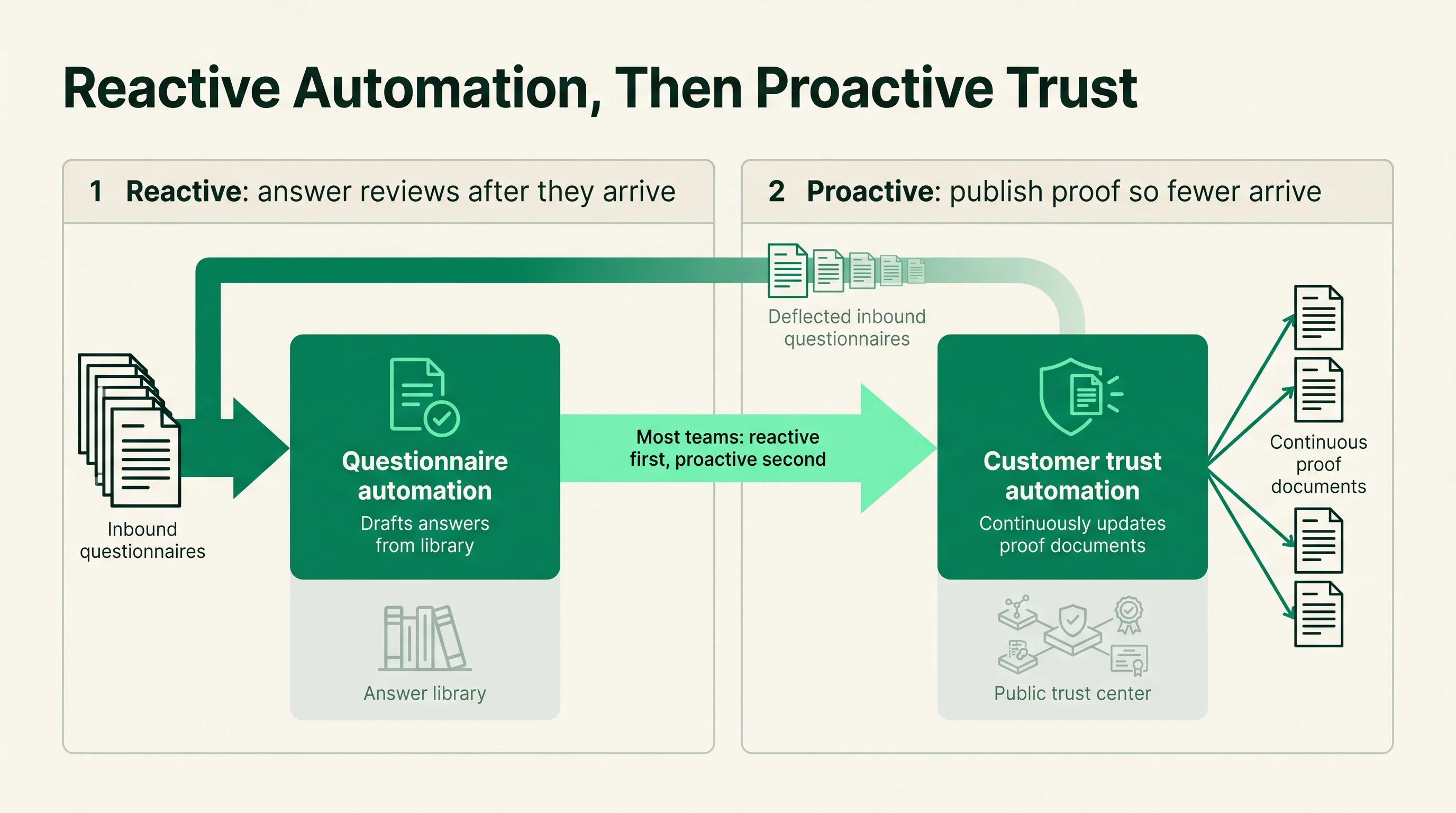
Quick answer: questionnaire automation vs. customer trust automation
Security questionnaire automation is the right first investment when your immediate problem is answering inbound security reviews fast and consistently. Customer trust automation is the right first investment when your problem is the volume of repeat questions and a sales motion that would move faster if buyers could verify your security themselves. The two solve different halves of the same workflow, and the better choice depends on your formats, your inbound volume, and how your team is staffed.
The split is reactive versus proactive. Questionnaire automation acts after a review lands: it drafts answers from an approved library, handles multiple formats, and routes drafts for review. Customer trust automation acts before a review lands: it publishes proof in a trust center, keeps evidence current, and lets buyers self-serve, which deflects some questionnaires entirely.
Neither category replaces the other. For background on the inbound side, see our explainer on what security questionnaire automation is. For the upstream side, see our glossary entry on the trust center. Most mature programs run both, and the only real question is sequence.
- Pick questionnaire automation first to cut response time and clear a backlog
- Pick customer trust automation first to reduce how many questionnaires arrive at all
- Plan to add the second once the first is stable
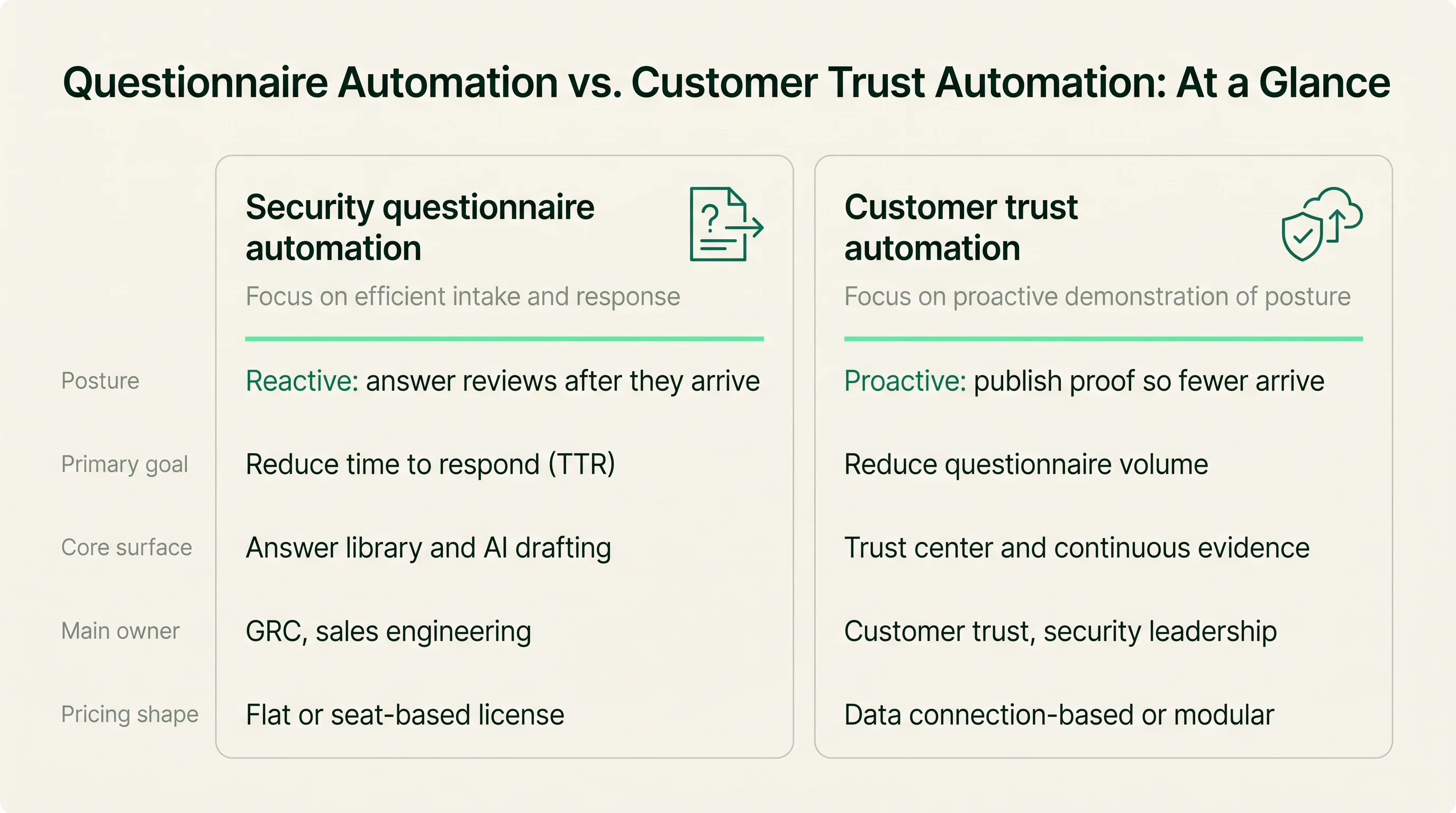
Questionnaire automation vs. customer trust automation: at a glance
The two categories differ on posture, what they optimize, who owns them, and how they are priced. The table below compares them across the criteria a buyer weighs during a shortlist. Read it as a fit map, not a scorecard, because the right column depends on which constraint is hurting you now.
| Criterion | Security questionnaire automation | Customer trust automation |
|---|---|---|
| Posture | Reactive: answer reviews after they arrive | Proactive: publish proof so fewer arrive |
| Primary goal | Faster, consistent questionnaire responses | Deflection and self-serve verification |
| Core surface | Answer library and AI drafting | Trust center and continuous evidence |
| Format coverage | CAIQ, SIG, custom spreadsheets, portals | SOC 2, ISO 27001 reports, policies, real-time controls |
| AI role | Draft answers, cite sources for review | Trust agent answers buyer questions from approved content |
| Main owner | GRC, sales engineering | Customer trust, security leadership |
| Pricing shape | Seats, questionnaire volume, or AI usage | Tiered platform bundle with trust center |
The pattern is consistent. Questionnaire automation is measured by how fast and accurately you respond; customer trust automation is measured by how much inbound work you avoid. Example vendors split the same way: Conveyor, Loopio, and Responsive are commonly associated with questionnaire response, while Vanta, SafeBase, and Whistic are commonly associated with trust centers and continuous proof. Several of these vendors span both surfaces, so treat the labels as center of gravity, not hard boundaries.
Where security questionnaire automation is stronger
Security questionnaire automation is stronger whenever a review has already landed and the clock is running. It turns a manual copy-and-reformat task into a drafting task: the tool matches incoming questions to approved answers, drafts responses, and routes them for human review before export. When a deal is waiting on a completed CAIQ or SIG, this is the surface that moves it.
Its strengths cluster around speed, consistency, and format handling.
- Format coverage handles the messy reality of inbound reviews: CAIQ, SIG, vendor-specific spreadsheets, and buyer portals that each want a different layout
- An approved answer library keeps responses consistent across questionnaires so different reviewers do not contradict each other
- AI drafting with citations lets a sales engineer or GRC analyst accept, edit, or reject each answer against its source
- Review and approval controls keep a subject-matter expert in the loop before anything leaves the building
- Portal autofill and export reduce the manual work of pushing answers into a buyer's required format
Vendors report large reductions in response time from AI drafting and answer reuse; treat those figures as vendor-reported until you test them on your own questionnaires. The honest framing is that questionnaire automation removes repeat effort on questions you have answered before, and the size of the gain depends on how much your inbound reviews overlap. For a deeper look at the inbound workflow, see our piece on where questionnaire automation and trust centers each fit.
Where customer trust automation is stronger
Customer trust automation is stronger when the problem is upstream of any single questionnaire. Instead of answering faster, it works to make the questionnaire unnecessary by publishing proof a buyer can verify on their own. A trust center hosts your SOC 2 report, ISO 27001 certificate, policies, and security posture behind access controls, so a buyer's first move is to self-serve rather than send a spreadsheet.
Its strengths cluster around deflection, freshness, and the buyer's experience.
- A trust center gives buyers controlled, self-serve access to evidence, which deflects some questionnaires entirely
- Continuous proof keeps evidence current by syncing live control status instead of relying on a point-in-time export
- AI trust agents answer a buyer's specific questions from approved, published content, extending self-serve beyond static documents
- Gated document access and NDA workflows let you share sensitive reports without a manual email chain
- Deflection metrics show how many reviews a trust center prevented, which ties the tool to a measurable sales outcome
Vendors report meaningful questionnaire deflection from trust centers and continuous monitoring; treat deflection rates as vendor-reported and verify them against your own inbound trend. The core value is that proactive proof compounds: a well-maintained trust center reduces inbound volume month over month, which is leverage that reactive answering cannot produce. To see how teams stand one up, see our workflow on launching a trust center to reduce questionnaires.
How do questionnaire automation and customer trust automation complement each other?
The two categories complement each other because they cover opposite ends of the same review. Customer trust automation reduces how many questionnaires arrive, and security questionnaire automation handles the ones that still do. A team running both deflects the routine reviews with a trust center and answers the remaining custom ones quickly, instead of choosing between speed and prevention.
Most teams reach this in a predictable order, driven by where the pain shows up first.
- Stage 1, reactive: inbound reviews pile up, so the team buys or builds an answer library and questionnaire automation to respond faster
- Stage 2, foundational proof: the team publishes a basic trust center with core reports and policies so some buyers self-serve
- Stage 3, proactive deflection: continuous proof and access controls turn the trust center into a real deflection layer that shrinks inbound volume
- Stage 4, AI self-serve: a trust agent answers buyer-specific questions from approved content, extending deflection to non-standard questions
The sequence is usually reactive first, proactive second, because a backlog of inbound reviews is the loudest problem and the easiest to justify fixing. Proactive deflection pays off later and compounds, but it rarely gets funded while the team is still drowning in same-week deadlines. The practical read is that questionnaire automation buys you the breathing room to build the trust surface that eventually lowers your questionnaire volume.
Pricing and implementation differences
The two categories differ in how they bill and how heavy the rollout is. Questionnaire automation is often priced on the units of inbound work, while customer trust automation is more often a tiered platform fee that bundles a trust center and continuous proof. Implementation effort tracks the same split: one depends on the quality of your answer library, the other on the quality and freshness of your published evidence.
The pricing models compare cleanly without inventing figures.
| Factor | Security questionnaire automation | Customer trust automation |
|---|---|---|
| Common pricing model | Per-seat, per-questionnaire, or AI usage | Tiered platform bundle |
| Cost driver | Reviewers, questionnaire volume, AI activity | Platform tier and feature set |
| Main setup work | Build and curate the answer library | Publish, gate, and keep evidence current |
| Time to first value | Fast once the library is seeded | Slower, but deflection compounds |
| Ongoing work | Approve and update answers as products change | Keep proof fresh and access controls correct |
The hidden cost on the questionnaire side is library maintenance: stale or contradictory answers degrade the AI's drafts, so someone has to own approval. The hidden cost on the trust side is evidence freshness: a trust center with an expired report or a broken control feed erodes the buyer confidence it is meant to build. Many vendors bundle both surfaces into one platform, so a single quote may cover questionnaire automation and a trust center together; confirm the exact scope and which modules are gated to a higher tier. These pricing shapes are vendor-reported positioning and a starting point for negotiation, not fixed rates.
Which one should you invest in first?
Invest in the category that relieves your dominant constraint first, then add the other. If inbound reviews are missing deadlines and pulling experts off their work, fund questionnaire automation. If buyers keep asking the same questions and your sales motion would move faster with self-serve proof, fund customer trust automation. The verdict is sequence, not exclusion, because mature programs run both.
Invest in security questionnaire automation first when:
- Inbound questionnaires are backing up and answers go out late or inconsistently
- Your reviews span many formats, such as CAIQ, SIG, custom spreadsheets, and portals
- Sales engineers or GRC staff lose hours to copy-and-reformat work
- You need a faster, more consistent response process before you can think upstream
- A signed contract is regularly waiting on a completed security review
Invest in customer trust automation first when:
- The same questions arrive over and over and could be answered by published proof
- Your sales motion would benefit from buyers verifying security without a meeting
- You already answer reviews acceptably but want to lower how many you receive
- Buyers increasingly ask for a trust center or continuous evidence before they engage
- Leadership wants deflection and self-serve as a measurable sales outcome
To pressure-test either choice, see how enterprise buyers evaluate security questionnaire automation tools, and browse the security questionnaire automation category hub and the trust center software category for vendors on each side. The decision is rarely permanent; most teams revisit it once the first investment is stable and the next constraint becomes the loud one.
How this article was reviewed
Sources reviewed
- AICPA SOC 2 reporting frameworkStandards body reference for SOC 2; independent fact
- ISO/IEC 27001 information security standardStandards body reference for ISO 27001; independent fact
- CSA Consensus Assessments Initiative Questionnaire (CAIQ)Standards body reference for CAIQ; independent fact
- Shared Assessments SIG questionnaireStandards body reference for the SIG; independent fact
- Questionnaire automation vendor product pages (Conveyor, Loopio, Responsive)Capability and pricing-model claims are vendor-reported, not independently verified
- Customer trust platform vendor product pages (Vanta, SafeBase, Whistic)Trust center, deflection, and continuous-proof claims are vendor-reported, not independently verified
FAQ
Is security questionnaire automation better than customer trust automation?
Neither is universally better; they solve different halves of the security review workflow. Security questionnaire automation is better when the constraint is answering inbound reviews fast and consistently. Customer trust automation is better when the constraint is the volume of repeat questions and a need for buyers to self-serve proof. Most mature teams run both and only differ on which they fund first.
Can I use a trust center and questionnaire automation together?
Yes, and most teams eventually do. A trust center deflects routine reviews by letting buyers self-serve evidence, while questionnaire automation answers the custom reviews that still arrive. Several vendors bundle both surfaces into one platform, so confirm whether your quote covers questionnaire automation, a trust center, or both, and which features are gated to a higher tier.
Which should a team buy first, reactive or proactive?
Most teams start reactive and add proactive later. A backlog of inbound questionnaires is usually the loudest, most time-sensitive problem, so questionnaire automation tends to get funded first to clear it. Proactive deflection through a trust center pays off over time and compounds, but it is easier to justify once response speed is no longer a fire. Buy for your dominant constraint.
Does a trust center actually reduce the number of questionnaires?
It can, by letting buyers verify your security posture themselves before sending a spreadsheet. Vendors report meaningful deflection from trust centers and continuous proof, but treat those rates as vendor-reported and measure your own inbound trend after launch. Deflection depends on how complete, current, and accessible your published evidence is, since a stale trust center deflects far less.
How does an AI trust agent differ from AI questionnaire drafting?
An AI trust agent answers a buyer's specific questions from approved, published content, extending self-serve proof beyond static documents on the proactive side. AI questionnaire drafting works on the reactive side, matching incoming questions to an approved answer library and drafting responses for a human to review before export. One reduces inbound volume; the other speeds up the responses that remain.