

Vanta vs. Drata Questionnaire Automation
Vanta and Drata are both broad GRC and compliance automation platforms that have added trust center and questionnaire features on top of their controls, evidence, and audit core. This comparison looks only at how each handles security questionnaire automation, and which buyer each side fits.
Quick answer: Vanta vs. Drata Questionnaire Automation
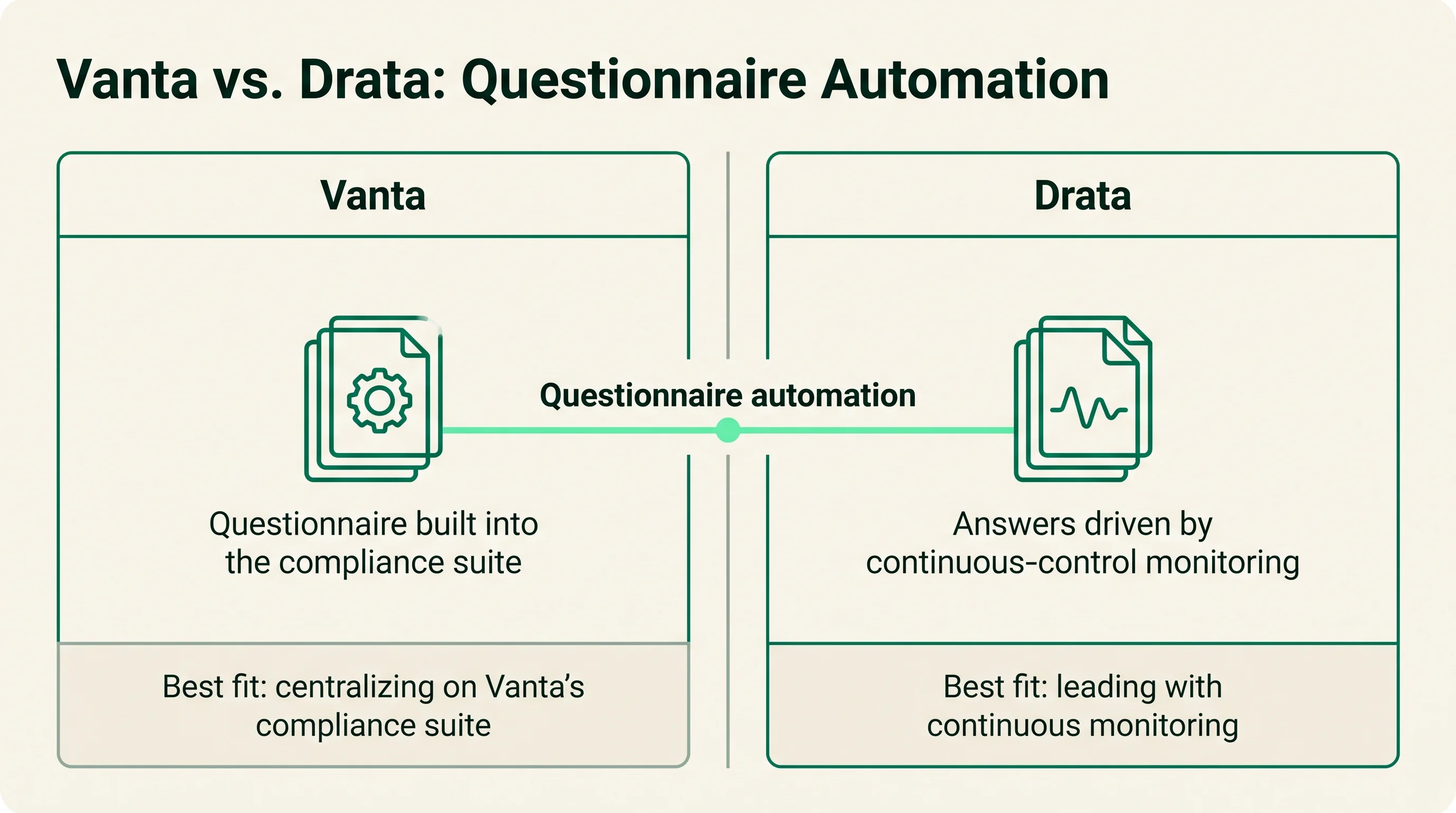
Choose Vanta if you want questionnaire response built into a compliance platform you already use to manage SOC 2, ISO 27001, and audit evidence, with questionnaire answering drawing from that same source of truth. Choose Drata if you want the same suite consolidation but value continuous-control monitoring and a tightly governed evidence base as the engine that feeds your answers.
Both are established GRC and compliance automation platforms. Their core is controls, evidence collection, and audit readiness. Questionnaire automation and a trust center sit on top of that core as additional modules, not as the original product. That shapes everything about how each handles security questionnaires.
The questionnaire features themselves overlap heavily. Both offer an answer library, AI-assisted drafting from your evidence, a trust center, and review controls. The right choice usually comes down to which compliance suite you already run, the formats your buyers send, and your annual response volume.
- Already standardized on one platform's compliance suite: its questionnaire module is the natural path.
- Lead with continuous monitoring and a strict evidence base feeding answers: Drata tends to fit.
- Very high questionnaire volume as the primary pain: compare both against a dedicated response tool, because suite breadth is not the same as response depth.
If the category itself is new to you, start with our explainer on what security questionnaire automation is, then return to compare these two.
Vanta vs. Drata Questionnaire Automation: at a glance
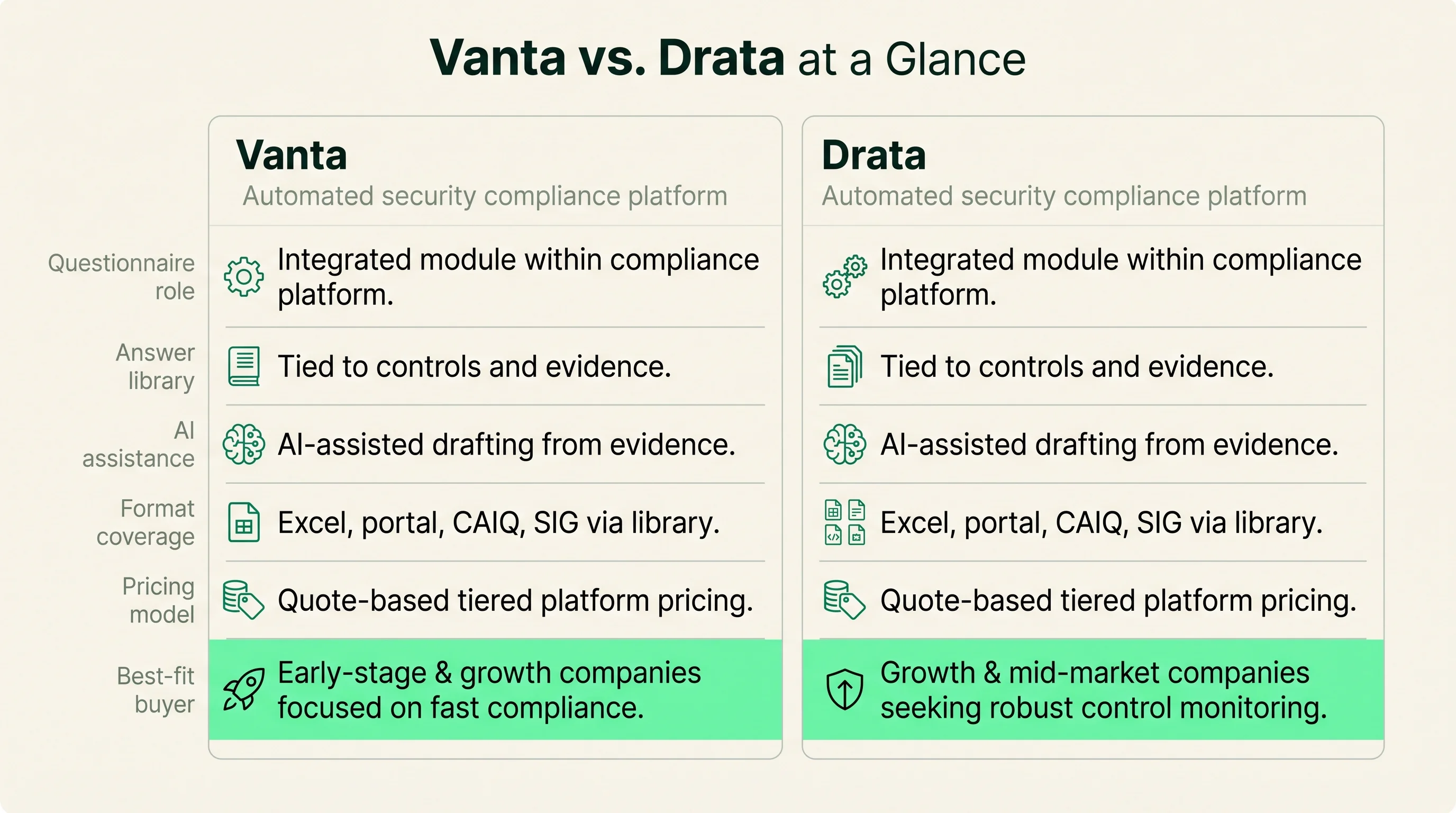
The fastest way to see the difference is side by side. The table below compares the two across the criteria most shortlisters weigh, using capability-level distinctions we can defend rather than specific feature claims that shift between releases.
| Criteria | Vanta | Drata |
|---|---|---|
| Core product | GRC and compliance automation suite | GRC and compliance automation suite |
| Questionnaire role | Module within the compliance platform | Module within the compliance platform |
| Answer library | Library tied to controls and evidence | Library tied to controls and evidence |
| AI assistance | AI-assisted drafting from evidence (vendor-reported) | AI-assisted drafting from evidence (vendor-reported) |
| Format coverage | Excel, portal, CAIQ and SIG via library | Excel, portal, CAIQ and SIG via library |
| Review and approval | Approval workflow on answers and trust center | Approval workflow on answers and trust center |
| Integrations | Broad cloud, HR, identity and ticketing connectors | Broad cloud, HR, identity and ticketing connectors |
| Pricing model | Quote-based, tiered platform bundle | Quote-based, tiered platform bundle |
| Best-fit buyer | Teams centralizing on Vanta's compliance suite | Teams leading with continuous monitoring |
Treat the AI and integration rows as directional. Both vendors publish specific connector lists and accuracy figures on their own sites, and those are the rows most likely to change, so verify them on each vendor's current docs.
A few rows deserve a closer read. On answer library, both products tie answers back to controls and collected evidence, so the question is not whether the library exists but how cleanly it stays current as your controls change and who governs edits. On format coverage, both lean on the answer library to handle CAIQ, SIG, and custom spreadsheets, so coverage is rarely the deciding line. On integrations, both connect deeply to cloud infrastructure, identity, and HR systems because that is what their compliance core needs, which is a genuine difference from questionnaire-first tools.
The pattern is consistent: these two overlap heavily on questionnaire response and diverge most on the wider compliance platform and how it is positioned. The deciding factor is rarely the questionnaire feature in isolation. It is which suite you want to standardize on. Hold that in mind through the rest of this comparison.
Where Vanta is stronger
Vanta is strongest when you want questionnaire response to draw from the same compliance platform you already run for audits and evidence. Its center of gravity is the broad compliance suite, and the questionnaire module benefits from sitting next to a maintained, audit-ready set of controls and evidence. For a team that already lives in Vanta for SOC 2 or ISO 27001, that proximity is the main reason to use its questionnaire feature rather than buying a separate tool.
The concrete strengths cluster around suite breadth and the evidence base that feeds answers.
- A wide compliance automation suite, so questionnaire answers can reference live controls and evidence already maintained for audits.
- An answer library and trust center that share a source of truth with your compliance program, reducing duplicate upkeep.
- AI-assisted drafting that pulls from your evidence base, which can speed first-draft answers (accuracy is vendor-reported; verify on the vendor's current docs).
- Broad integrations into cloud, identity, and HR systems, useful because questionnaire answers often depend on the same data your controls monitor.
- A familiar single platform for teams that want compliance, trust center, and questionnaire response under one vendor and one login.
The consolidation payoff is the underlying advantage: one maintained evidence base feeds audits, the trust center, and questionnaire answers, so you are not reconciling three separate sources. For more on why that surface matters, see our piece on what a buyer-ready trust center is.
Where Drata Questionnaire Automation is stronger
Drata is strongest when continuous-control monitoring and a tightly governed evidence base are the engine you want behind your answers. Its compliance suite emphasizes ongoing checks against your controls, and the questionnaire module draws from that continuously tested evidence. For a team that treats current, monitored evidence as the foundation of trustworthy answers, that discipline is the differentiator.
The concrete strengths follow from that monitoring-and-evidence starting point.
- Continuous-control monitoring as the platform core, so the evidence feeding answers is checked on an ongoing basis rather than gathered once for an audit.
- An answer library tied to that monitored evidence, which helps answers stay aligned with your current control state.
- AI-assisted drafting and a trust center built on the same governed source (AI accuracy is vendor-reported; verify on the vendor's current docs).
- Approval workflow over answers and published content, keeping a single reviewed source for what gets shared with buyers.
- Deep integrations into cloud, identity, and HR systems, supporting both the monitoring engine and the data that questionnaire answers reference.
The governance angle is the real edge: answers are only as good as the evidence behind them, and a platform built around continuous monitoring aims to keep that evidence current. Whether that discipline outperforms in practice depends on how your controls map to the questions you receive, which is worth testing directly. Our explainer on whether AI can safely answer security questionnaires covers what to probe.
Pricing and implementation differences
Both Vanta and Drata use quote-based, platform-style pricing rather than a published per-seat or per-questionnaire rate, so the real comparison is scope, not list price. Each sells a tiered suite, typically scaled by company size and the bundle of modules you take, where questionnaire response sits next to controls, evidence, audit support, a trust center, and integrations. We do not publish specific dollar figures because neither vendor lists fixed public pricing we can stand behind; confirm current numbers in a quote.
The models differ less than the implementation effort behind them.
| Dimension | Vanta | Drata |
|---|---|---|
| Pricing shape | Quote-based tiered platform (vendor-reported) | Quote-based tiered platform (vendor-reported) |
| What you are buying | Compliance suite plus questionnaire module | Compliance suite plus questionnaire module |
| Main rollout work | Connecting systems and seeding the evidence and answer base | Connecting systems and configuring continuous monitoring |
| Ongoing upkeep | Keeping controls, evidence, and answers current | Keeping monitored evidence and answers current |
Implementation reality matters more than the price label. Because the questionnaire feature is one module inside a wider compliance platform, rollout effort centers on the platform itself: connecting your cloud, identity, and HR systems, mapping controls, and building the evidence base that answers draw from. Standing up the questionnaire module on a healthy compliance program is a smaller add-on. Standing it up while you are also implementing the whole platform is a larger project.
For both, the hidden cost is library and evidence quality. Neither AI layer outperforms the answers and evidence behind it, so plan for the work of curating and maintaining that source. A tool that drafts from stale or thin content will produce confident but wrong answers, and that risk is identical across both vendors.
There is also a fit question that shapes total cost: these are compliance platforms first. If your main pain is very high questionnaire volume rather than audit readiness, you may be buying a broad suite to get a response feature. In that case, weigh both against a dedicated questionnaire tool. Map your owners and your dominant workflow before you buy, because the team that maintains the platform is the real cost center, not the license. To compare cost structures across the wider market, see our breakdown of where questionnaire automation and trust centers each fit.
Which one should you choose?
Choose by your existing stack and your dominant workflow. The two products overlap on core questionnaire response, so the deciding factor is which compliance suite you want to standardize on and how that suite feeds your answers. Match the platform to the program you actually run.
Choose Vanta when:
- You already run, or plan to run, Vanta for SOC 2, ISO 27001, or wider compliance, and want questionnaire response to draw from that same evidence base.
- One vendor for compliance, trust center, and questionnaire answers is worth more to you than a specialized response tool.
- GRC and security own the work and prefer a single platform feeding audits, the trust center, and questionnaires.
- Your questionnaire answers depend heavily on the cloud, identity, and HR data the platform already monitors.
Choose Drata Questionnaire Automation when:
- Continuous-control monitoring is central to how you want to keep answers current and defensible.
- You value a tightly governed, continuously tested evidence base as the engine behind your responses.
- A CISO or GRC lead wants questionnaire answers anchored to monitored controls rather than periodically gathered evidence.
- You want compliance and questionnaire response consolidated under one vendor with a monitoring-first posture.
Both handle the everyday work of answering reviews in Excel, portals, and standardized formats like CAIQ and SIG through an answer library tied to evidence, so for that baseline, test execution rather than relying on positioning. Run a real questionnaire through each, check whether AI citations point to evidence you trust, and confirm format and integration scope on current docs. If questionnaire volume is your primary problem rather than audit readiness, also compare both against a dedicated tool. For a structured shortlist, use the security questionnaire automation category hub to score both against your own program.
How this article was reviewed
Sources reviewed
- Vanta product documentationVendor-reported. Questionnaire, integration, AI accuracy, and pricing claims evolve quickly and should be verified on the vendor's current docs and confirmed in a quote, not treated as independent fact.
- Drata product documentationVendor-reported. Questionnaire, integration, AI accuracy, and pricing claims evolve quickly and should be verified on the vendor's current docs and confirmed in a quote, not treated as independent fact.
- AICPA - SOC 2Primary source for what a SOC 2 report attests, the evidence both platforms manage and reference in answers.
- ISO/IEC 27001Primary source for the information security management standard both platforms support and cite as evidence.
- Cloud Security Alliance - CAIQPrimary source for the CAIQ format, one of the standardized questionnaires both tools support through their libraries.
- Shared Assessments - SIGPrimary source for the SIG questionnaire format referenced in format-coverage comparison.
- NISTPrimary source for control frameworks frequently mapped in both platforms' compliance suites and referenced in answers.
FAQ
Which is better, Vanta or Drata, for security questionnaire automation?
Neither is universally better; the right pick depends on which compliance suite you run. Vanta fits teams that already use its platform for SOC 2 or ISO 27001 and want questionnaire answers drawn from that evidence base. Drata fits teams that lead with continuous-control monitoring and want answers anchored to a governed, continuously tested evidence base. Both handle everyday questionnaire response from an answer library, so test execution on your own reviews before deciding.
How does Vanta pricing compare to Drata pricing?
Both use quote-based, tiered platform pricing rather than published per-seat or per-questionnaire rates, so the comparison is about scope, not list price. Each bundles questionnaire response with controls, evidence, audit support, a trust center, and integrations, usually scaled by company size and module mix. Pricing details are vendor-reported and change, so model your real volume and confirm current numbers in a quote with each vendor.
What does Vanta do better than Drata for customer trust teams?
Vanta's advantage for trust teams is consolidation: questionnaire answers, the trust center, and your audit evidence share one maintained source on a platform many teams already run for SOC 2 or ISO 27001. For a team that lives in Vanta, the questionnaire module is the path of least resistance and reduces duplicate upkeep across audits and responses. The payoff is one evidence base feeding several customer-facing surfaces.
What does Drata do better than Vanta for customer trust teams?
Drata leans on continuous-control monitoring, so the evidence feeding questionnaire answers is checked on an ongoing basis rather than gathered once for an audit. For trust teams that want answers anchored to current, monitored control state, that governed evidence base is the differentiator. It suits programs where keeping answers aligned with live controls matters more than any single questionnaire feature.
When should you choose Vanta over Drata?
Choose Vanta when you already run, or plan to run, its compliance suite for SOC 2 or ISO 27001 and want questionnaire response folded into that same platform and evidence base. It also fits when one vendor for compliance, trust center, and questionnaires is worth more than a specialized response tool. Choose Drata instead when continuous-control monitoring and a tightly governed evidence base matter more to how you keep answers current.