

Security Questionnaire Automation Software Comparison
A neutral, criteria-first comparison of the main security questionnaire automation software. Start with the evaluation framework, use the comparison table to match tools to your buyer profile, then run a structured trial. There is no single best tool, only the best fit for your formats, volume, and team.
Quick answer: how to compare security questionnaire automation software
There is no single best security questionnaire automation software. The right choice depends on the formats your buyers send, your annual questionnaire volume, and which team owns the response work. Compare tools on a fixed set of criteria first, then match those criteria to your situation, rather than starting from a ranking.
The main tools fall into a few groups. Response platforms like Conveyor, Loopio, and Responsive center the answer library and the drafting workflow. Trust-center platforms like SafeBase and Whistic center buyer self-service and questionnaire deflection. Compliance suites like Vanta bundle questionnaire response with evidence and audit readiness. SecurityPal adds a managed service where a vendor team answers for you.
- If your problem is recurring questionnaires and a messy answer library, look first at response platforms.
- If your problem is buyers asking the same things repeatedly, look first at trust-center deflection.
- If you also need SOC 2 or ISO 27001 evidence in one place, look first at a compliance suite.
- If you lack headcount to staff the work, look first at a managed service.
This guide is a criteria-driven comparison, not a leaderboard. The next section sets out the evaluation framework, then a comparison table maps each tool to a best-fit buyer, and the closing sections explain how to shortlist and trial. For the category basics, see our explainer on what security questionnaire automation is.
What criteria should you use to compare questionnaire automation software?
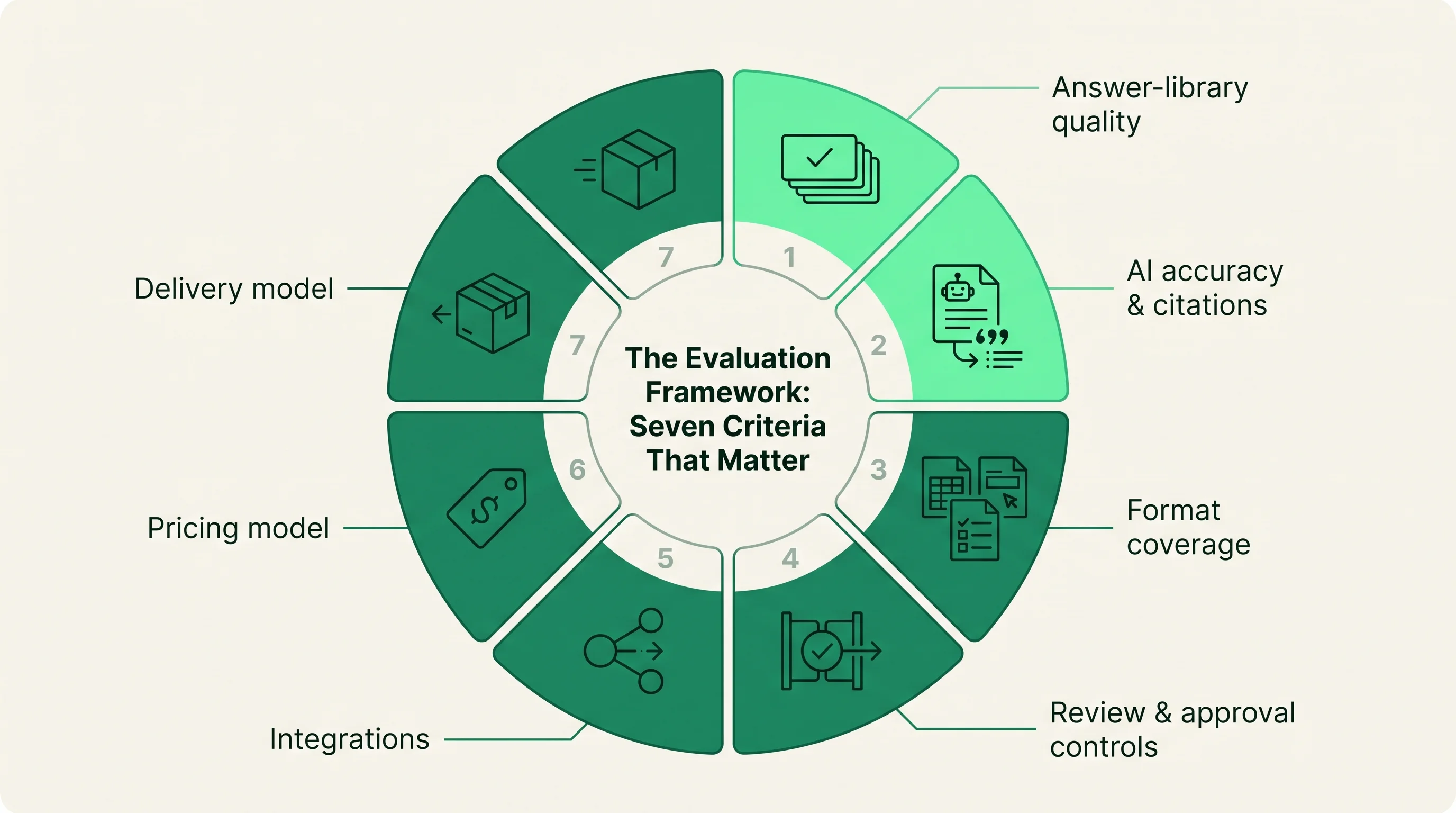
Score every tool on the same seven criteria before you compare names. A fixed framework keeps the comparison honest, because each vendor leads with the dimension it is strongest on. Weight the criteria for your own situation, since a heavy-volume GRC team and a sales-engineering team optimizing deflection will rank them differently.
The seven criteria are:
- Answer-library quality: how the tool stores, versions, and surfaces approved answers, and how easily you keep them current as policies and evidence change.
- AI accuracy and citations: whether AI-drafted answers cite the source they came from, and whether the tool abstains rather than guessing when it lacks a grounded answer.
- Format coverage: support for Excel uploads, buyer portals, CAIQ, SIG, and custom forms, since the format you cannot handle is the one that costs you hours.
- Review and approval controls: roles, approval steps, audit trails, and who can publish a final answer to a buyer.
- Integrations: connections to your CRM, document storage, knowledge base, evidence sources, and single sign-on.
- Pricing model: per-seat, per-questionnaire, tiered, or platform bundle, and how that scales with your volume.
- Delivery model: self-serve software, a trust center, a compliance suite, or a managed human-in-the-loop service.
Two criteria separate strong tools from weak ones in practice: answer-library quality and AI accuracy with citations. A large library is worthless if answers are stale, and AI drafting is a liability if it cannot show where an answer came from. A GRC reviewer, a sales engineer, or a CISO who signs off on a final answer needs to trace it to an approved source, not trust a black box. Test both on your own data, not on a demo deck.
The remaining five criteria are where most shortlists are actually won or lost, because they decide whether the tool fits how your team already works. Format coverage determines whether a buyer portal or a SIG eats your week. Review and approval controls decide whether the wrong person can publish an answer to a buyer. Integrations decide whether the answer library stays in sync with your CRM, your document storage, and your evidence sources, or drifts out of date. Pricing model and delivery model decide what you pay for and who does the work. Weight these against the two accuracy criteria for your own situation. For how AI accuracy holds up under scrutiny, read our analysis of whether AI can safely answer security questionnaires, and for the tools that lead on AI, see the ai security questionnaire tools category hub.
Security questionnaire automation software compared
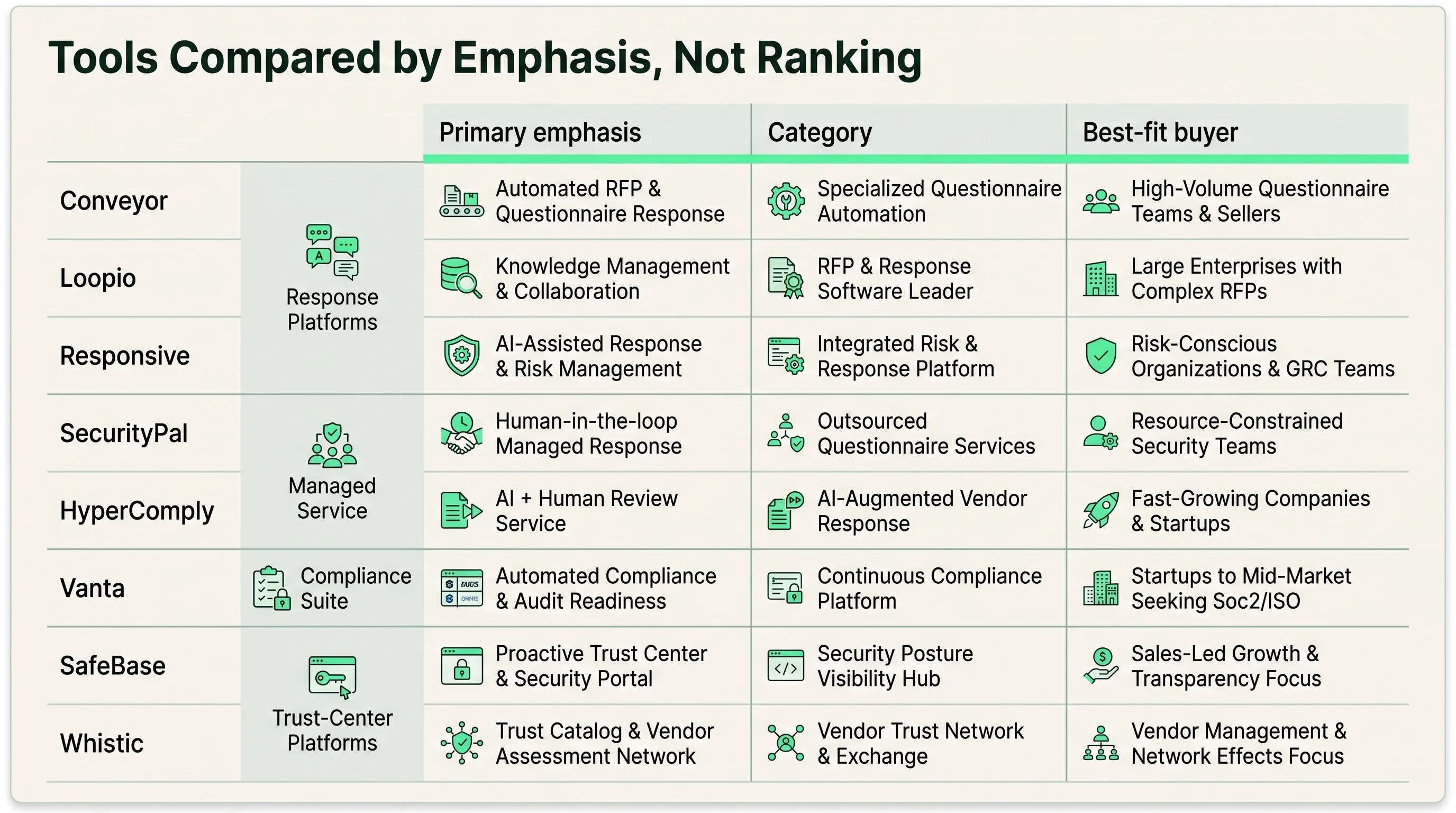
The clearest way to compare the main tools is by what each one centers and which buyer it fits. The table below maps eight tools to a primary emphasis and a best-fit buyer across the framework criteria. Capability descriptions reflect how each vendor positions itself and are vendor-reported; verify specifics on current product documentation before you shortlist.
| Tool | Primary emphasis | Best-fit buyer |
|---|---|---|
| Conveyor | Answer library plus trust center and portal handling | GRC or security teams with recurring questionnaires and buyer portals |
| Loopio | Response library and collaborative drafting workflow | Larger response teams managing RFPs alongside security questionnaires |
| Responsive | Response management across RFP, RFI, and security forms | Enterprises that want one platform for all response types |
| SecurityPal | Managed human-in-the-loop answering service | Thin teams with heavy or spiky volume and little headcount |
| HyperComply | Questionnaire automation with AI drafting and trust profile | Mid-market teams wanting fast questionnaire turnaround |
| Vanta | Compliance suite bundling evidence with questionnaire response | Teams already running SOC 2 or ISO 27001 evidence in one tool |
| SafeBase | Trust center and buyer self-service deflection | Sales-led teams reducing inbound questionnaires through self-service |
| Whistic | Trust profile, questionnaire exchange, and assessment | Teams on both sides of assessments wanting a shared exchange |
Read the table as a map of emphasis, not a scorecard. Several tools overlap: response platforms increasingly add trust centers, and trust-center tools add AI drafting. The category boundaries are blurring, so confirm current scope rather than assuming a tool only does what its origin suggests. For published head-to-head detail, see records like our Conveyor vs. Loopio comparison, and for the wider field, our security questionnaire automation vendor landscape.
How do the questionnaire automation tool categories differ?
The biggest differences between these tools are structural, not feature-by-feature. Each category solves a different version of the questionnaire problem, so the category you pick matters more than any single capability. Match the category to your dominant pain before you compare individual products.
The practical distinctions break down by what each category optimizes:
- Response platforms (Conveyor, Loopio, Responsive) optimize the answer library and the drafting loop, so a reviewer who knows your environment can turn a buyer's form around quickly.
- Trust-center platforms (SafeBase, Whistic) optimize deflection, letting buyers self-serve standard documentation so fewer full questionnaires reach your queue.
- Compliance suites (Vanta) optimize evidence reuse, connecting your SOC 2 or ISO 27001 controls to questionnaire answers so the same fact is not maintained twice.
- Managed service (SecurityPal) optimizes capacity, putting a vendor team between your security facts and the buyer so your staff only approve final output.
The tradeoffs follow from the emphasis. A response platform gives you control and library ownership but needs a dedicated operator. A trust center reduces inbound volume but does not answer the bespoke questions that still arrive. A compliance suite reduces duplicated evidence work but may be lighter on response-specific features than a dedicated platform. A managed service buys capacity but adds a third party to your accuracy chain. None of these is a flaw; each is the cost of the thing the category does well.
Many teams need more than one category. A sales-led organization might pair a trust center for deflection with a response platform for the questionnaires that still arrive, while a security-led team running SOC 2 and ISO 27001 might lean on a compliance suite and only add a dedicated response tool as volume grows. Procurement should map your dominant pain first, then decide whether a second category is worth the added cost and integration work. To see how buyers weigh these structural choices, read our guide on how enterprise buyers evaluate security questionnaire automation tools.
How do questionnaire automation pricing and delivery models differ?
Pricing differs by category more than by individual vendor, and the model tells you what you are actually buying. Response platforms tend to price per-seat or in tiers, managed services price per-questionnaire or by retainer, and compliance suites bundle questionnaire response into a broader platform fee. No list price is universal, so model each quote against your real annual volume rather than comparing headline numbers. All pricing here is vendor-reported.
The pricing models and rollout effort line up with delivery:
| Category | Common pricing model | Rollout effort |
|---|---|---|
| Response platform | Per-seat or tiered license | Build library, connect evidence, train operators |
| Trust-center platform | Tiered by usage or buyer access | Publish documents, configure access, set deflection |
| Compliance suite | Platform bundle including evidence | Connect controls, map evidence, enable response module |
| Managed service | Per-questionnaire or retainer | Onboard vendor to your posture and prior answers |
Implementation effort is where buyers underestimate cost. A response platform front-loads internal work: someone has to curate the answer library, link evidence, and drive adoption, and the tool answers nothing on its own until that happens. A compliance suite front-loads evidence mapping but reuses what you already maintain for audits. A managed service front-loads vendor onboarding, since a vendor team needs your policies and prior answers before its output is reliable. Treat any figure you see as a starting point for a quote against your volume. For a deeper breakdown, see our guide to security questionnaire automation pricing models.
How do you shortlist and trial security questionnaire automation software?
Shortlist three tools that match your top two framework criteria, then trial them on your own questionnaires before you decide. A demo shows the tool at its best; a trial on your real forms shows how it behaves on the questions that are hard for you. The shortlist narrows the field, and the trial settles it.
Use this sequence to shortlist:
- Rank the seven framework criteria for your situation and pick your top two.
- Map each tool's primary emphasis against those two criteria using the comparison table.
- Keep three candidates, ideally including one from a different category to test your assumptions.
- Confirm current pricing model, format coverage, and integrations on each vendor's documentation, since these change.
Then run a structured trial on each shortlisted tool:
- Load a real questionnaire you have already answered, so you can compare AI output to known-good answers.
- Check whether AI-drafted answers cite their source and whether the tool abstains when it lacks a grounded answer.
- Measure review effort: how long it takes a reviewer to verify and approve a full questionnaire.
- Test your hardest format, whether that is a buyer portal, a CAIQ, or a SIG, not just an Excel upload.
- Confirm the review and approval controls match who is allowed to publish answers to buyers.
The trial answers the only question that matters: does this tool reduce work on your questionnaires without lowering accuracy. Score each candidate on the same framework you started with, then choose by fit. To go deeper on evaluation criteria, start from our buyer-evaluation guide on how enterprise buyers evaluate security questionnaire automation tools, then browse the security questionnaire automation category hub to build your shortlist.
How this article was reviewed
Sources reviewed
- AICPA - SOC 2Primary source for what a SOC 2 report attests, a control framework that questionnaire answer libraries reference.
- ISO/IEC 27001Primary source for the information security management standard referenced in security answer libraries.
- Cloud Security Alliance - CAIQPrimary source for the CAIQ format, one of the standardized questionnaire types referenced in format coverage.
- Shared Assessments - SIGPrimary source for the SIG questionnaire format referenced in format coverage.
- NISTPrimary source for security control and risk frameworks referenced when buyers map questionnaire answers to evidence.
- Vendor product and positioning documentation (Conveyor, Loopio, Responsive, SecurityPal, HyperComply, Vanta, SafeBase, Whistic)Capability, format-coverage, and pricing-model claims are vendor-reported and should be confirmed against current product documentation, not treated as independent fact.
FAQ
What is the best security questionnaire automation software?
There is no single best tool; the best fit depends on your formats, volume, and which team owns the work. Response platforms like Conveyor, Loopio, and Responsive fit teams whose main problem is recurring questionnaires and a messy answer library. Trust-center platforms like SafeBase and Whistic fit sales-led teams reducing inbound volume through self-service. A managed service like SecurityPal fits thin teams that cannot staff the work. Score each on the same framework and choose by fit rather than by a ranking.
What criteria should I use to compare security questionnaire automation tools?
Compare every tool on seven criteria: answer-library quality, AI accuracy and citations, format coverage across Excel, portals, CAIQ, and SIG, review and approval controls, integrations, pricing model, and delivery model. Answer-library quality and AI accuracy with citations separate strong tools from weak ones in practice, because a large library is worthless if answers are stale and AI drafting is a liability if it cannot show its source. Weight the criteria for your own situation, then test the top two on your real questionnaires.
Do security questionnaire automation tools support Excel, portals, CAIQ, and SIG?
Most leading tools support Excel uploads and standardized formats like CAIQ and SIG, and many handle buyer portals, but coverage varies by vendor and changes over time. Buyer portals and custom forms are where teams lose the most hours, so confirm portal autofill and your specific formats on current product documentation before shortlisting. Treat format claims as vendor-reported and test your hardest format during a trial rather than assuming support.
How do pricing models differ across these tools?
Pricing differs by category. Response platforms tend to price per-seat or in tiers, managed services price per-questionnaire or by retainer, and compliance suites bundle questionnaire response into a broader platform fee. The model tells you what you are buying: access to a tool your team runs, delivered answering capacity, or a wider compliance platform. All pricing is vendor-reported, so model each quote against your real annual volume rather than comparing headline figures.
How should I run a trial before choosing a tool?
Trial each shortlisted tool on a questionnaire you have already answered, so you can compare AI output against known-good answers. Check whether drafted answers cite their source and abstain when there is no grounded answer, measure how long a reviewer needs to verify a full questionnaire, and test your hardest format rather than a simple Excel upload. Score every candidate on the same framework you used to shortlist, then choose by fit, since the trial reveals how each tool behaves on the questions that are hard for you.