

Strategic Response Management vs. Security Questionnaire Automation
Strategic Response Management is the umbrella category for answering RFPs, RFIs, security questionnaires, and DDQs from one shared answer library. Security questionnaire automation is the focused slice that handles security reviews. The right choice depends on how many response types your team owns.
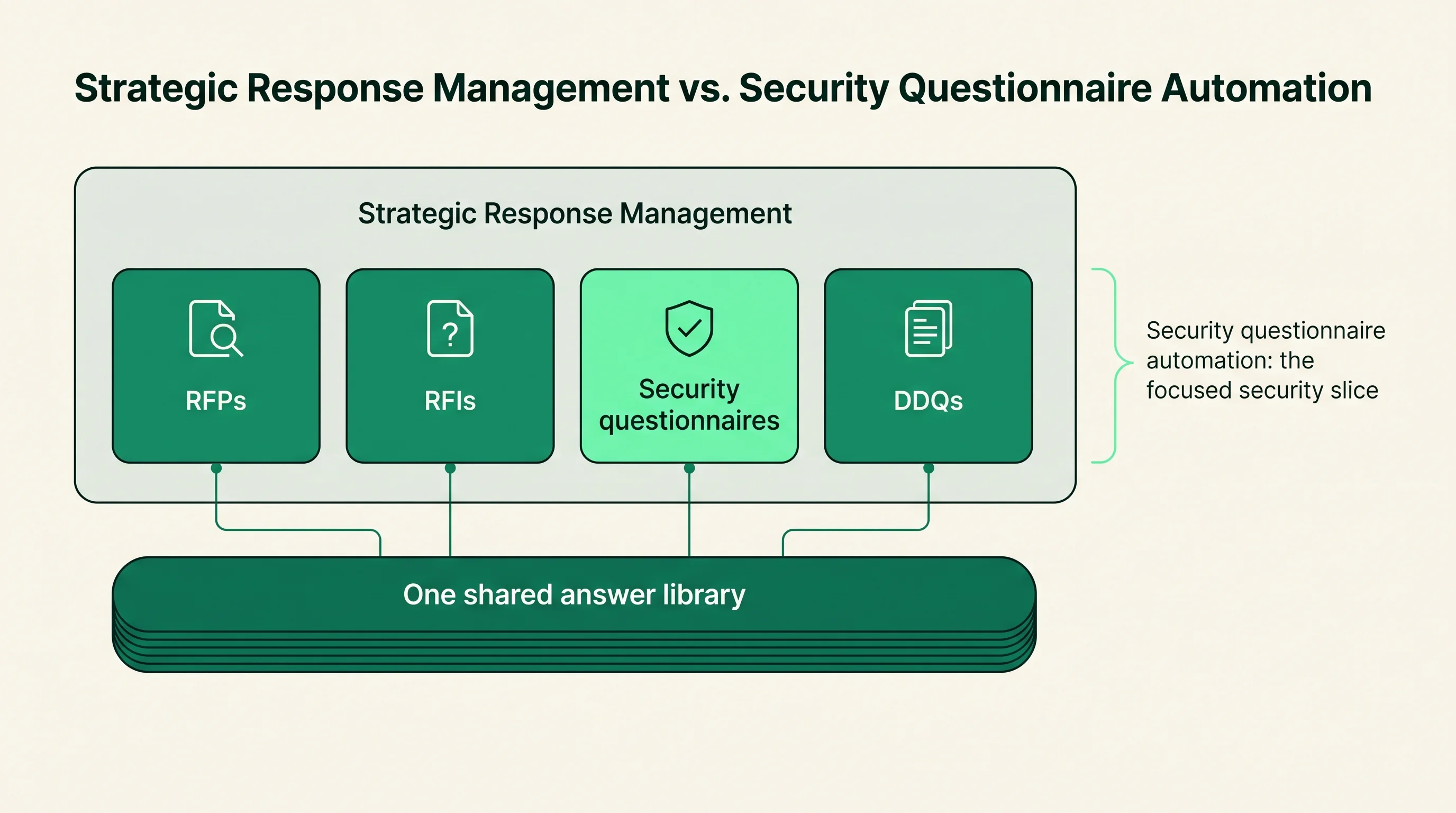
Quick answer: Strategic Response Management vs. security questionnaire automation
Strategic Response Management (SRM) is the broad platform category for answering every inbound request type from one shared answer library, while security questionnaire automation is the focused tooling built specifically for security reviews. SRM fits teams that own RFPs, RFIs, security questionnaires, and due-diligence questionnaires together and want one system for all of them. Security questionnaire automation fits teams whose dominant workload is security reviews and who want depth on technical controls, evidence, and trust centers rather than breadth across response types.
Neither is universally better. The right choice depends on three things: how many response formats your team handles, how much of your volume is security-specific, and which team owns the work.
- If a proposal or revenue team answers many request types, a broad SRM platform usually fits.
- If a GRC team or security function mostly answers security questionnaires, a focused tool usually fits.
- If you do both at scale, the decision turns on whether shared-library efficiency or security-review depth matters more.
This comparison treats the two as a category relationship, not as competing products. SRM is the umbrella; questionnaire automation is one focused use case inside it. Some SRM platforms market a security questionnaire module of their own, and some focused tools extend toward adjacent formats over time, so the line between the two can blur at the edges. The useful distinction is where each one starts: SRM starts from the full response motion and works inward, while focused automation starts from the security review and works outward. For the foundational definition, see our explainer on what security questionnaire automation is, then use the at-a-glance table below to map each option to your team.
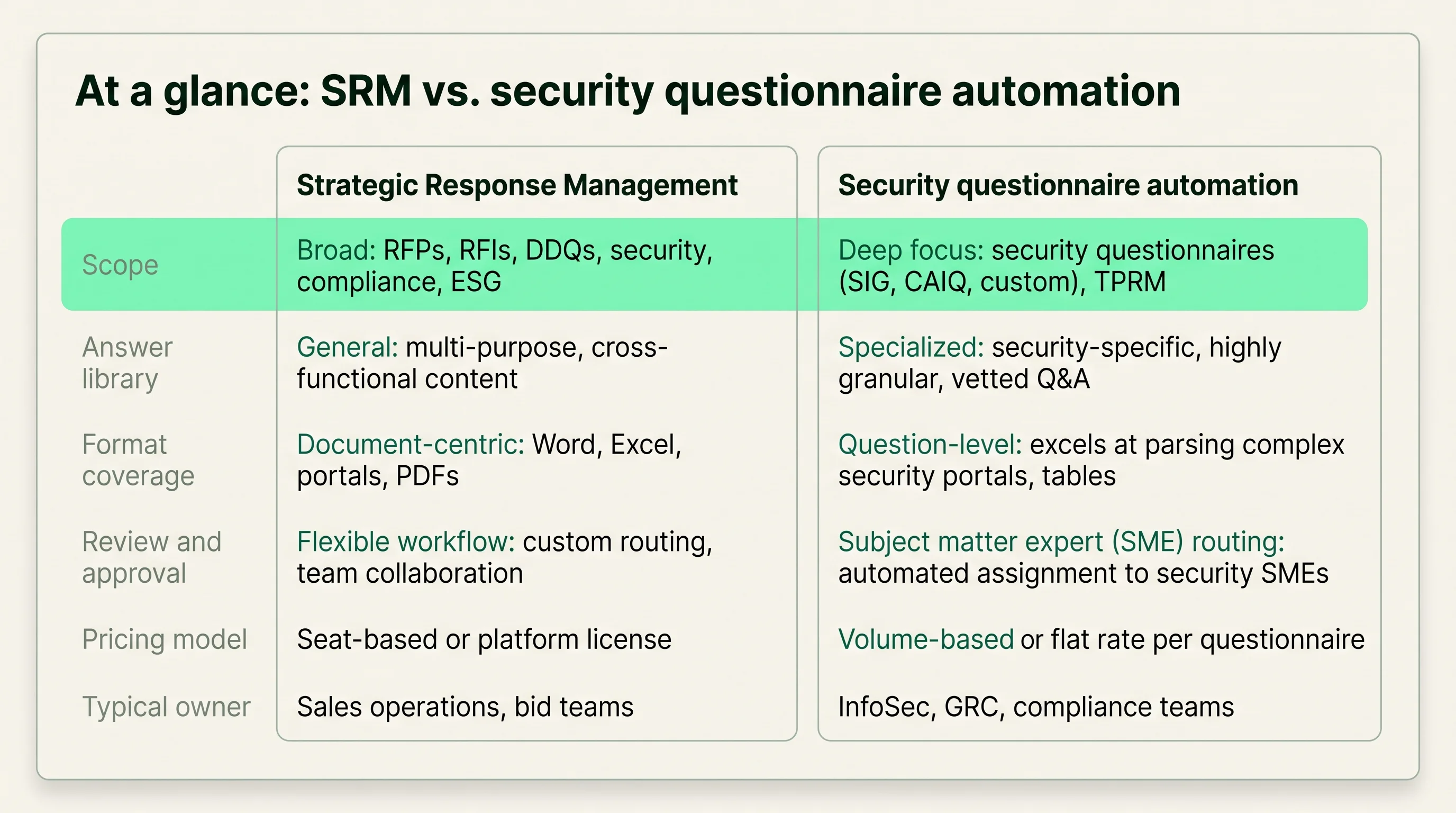
Strategic Response Management vs. security questionnaire automation: at a glance
The clearest way to separate the two is by scope: SRM spans the full response motion across many formats, while questionnaire automation concentrates on security reviews. The table below compares them across the criteria buyers shortlist on. Capability descriptions reflect how vendors position each category and should be confirmed against your own requirements.
| Criteria | Strategic Response Management | Security questionnaire automation |
|---|---|---|
| Scope | RFPs, RFIs, security questionnaires, DDQs in one platform | Security questionnaires and trust reviews |
| Answer library | One shared library across all response types | Library tuned to security controls and evidence |
| AI accuracy and citations | Broad content matching across formats (vendor-reported) | Security-specific drafting with evidence linking (vendor-reported) |
| Format coverage | Proposal documents, spreadsheets, portals, questionnaires | SOC 2, ISO 27001, CAIQ, SIG, custom security forms, portals |
| Review and approval | Multi-team workflows across sales and security | Security and GRC review with subject-matter routing |
| Integrations | CRM, proposal tools, content stores, collaboration | CRM, trust center, evidence stores, security tooling |
| Pricing model | Platform bundle or per-seat suite across formats | Per-seat or per-questionnaire, often with a trust center |
| Typical owner | Proposal or revenue operations team | GRC team, sales engineering, or security |
Read this table as a spectrum, not a scorecard. SRM trades depth on any single format for breadth across all of them. Focused automation trades breadth for depth on the security review. A team that scores rows by which category checks more boxes will miss the point, because the rows are not equally weighted for every buyer. A revenue team weights scope and answer-library reuse heavily; a security team weights format coverage, evidence, and review routing heavily. Score the rows that match your own workload, then read the next two sections, which explain where each advantage actually shows up in the work.
Where Strategic Response Management is stronger
Strategic Response Management is stronger when one team answers several request types and wants a single source of approved answers behind all of them. The category exists to consolidate the response motion, so its advantages cluster around breadth, reuse, and cross-functional workflow. Responsive and Loopio frame their platforms this way, positioning one answer library as the system of record for every inbound request.
The concrete strengths show up when response types overlap:
- One answer library serves RFPs, RFIs, security questionnaires, and DDQs, so an approved answer written once is reused everywhere (vendor-reported).
- Proposal and revenue teams keep their RFP workflow and pick up security questionnaires in the same tool, instead of running two systems.
- Content governance is centralized, which reduces the risk of a sales answer and a security answer drifting out of sync.
- Cross-format reporting shows response volume and win-rate context across the whole motion, not just security reviews.
- A single procurement relationship and renewal covers the full response stack.
The tradeoff is depth. A broad platform spreads its product investment across many formats, so its security-specific features (evidence linking, control mapping, security portal coverage) may be shallower than a tool built only for that job. The reuse advantage also depends on real overlap between formats. If your RFP answers and your security answers rarely share content, the single-library benefit shrinks, and you are mostly paying for two workflows that happen to live in one tool. For a proposal or revenue team where security questionnaires are one stream among several and answers genuinely overlap, the breadth is usually worth it. For more on the pricing side of this breadth, see our breakdown of security questionnaire automation pricing models.
Where security questionnaire automation is stronger
Security questionnaire automation is stronger when security reviews are the dominant workload and accuracy on technical controls matters more than breadth across formats. A focused tool concentrates its entire product on one job, so its advantages cluster around security depth, evidence, and the trust workflow. Conveyor and SecurityPal position their products around exactly this slice rather than the wider response motion.
The concrete strengths show up where security reviews get hard:
- The answer library is tuned to security controls, so answers map to SOC 2, ISO 27001, CAIQ, and SIG framing rather than generic content blocks.
- Evidence linking ties answers to the underlying reports and policies, which a security reviewer or CISO can verify (vendor-reported).
- A trust center lets buyers self-serve standard documentation, which can deflect questionnaires before they arrive.
- Subject-matter routing sends technical questions to the right security or engineering owner instead of a generalist proposal writer.
- Coverage of security-specific portals and custom security forms tends to be deeper, because that is the product's only target.
The tradeoff is breadth. A focused tool will not manage your RFP narrative content or your DDQ workflow, so a team with heavy non-security response volume would still need a separate system for those. That can mean running two tools and two libraries, which reintroduces the content-drift risk that a single platform is meant to solve. The counterweight is that a security team often does not want sales-owned content in its workflow at all, because security answers carry different review and accuracy stakes. For a GRC team or security function whose inbound is mostly security questionnaires, the narrow focus is the point, and the cleaner ownership boundary is a feature rather than a gap. To see how enterprise buyers weigh these criteria, read our guide on how enterprise buyers evaluate security questionnaire automation tools.
Pricing and implementation differences
Pricing differs mainly in scope: SRM platforms price for the full response motion, while focused tools price closer to the security workflow alone. This affects both the model you are quoted and the rollout work required to get value. No specific figures are universal, so model each quote against your own volume rather than comparing list prices.
The pricing models and rollout effort break down along category lines:
| Dimension | Strategic Response Management | Security questionnaire automation |
|---|---|---|
| Common pricing model | Platform bundle or per-seat suite across all response types | Per-seat or per-questionnaire, often with a trust center add-on |
| What you pay for | Breadth across RFPs, RFIs, questionnaires, and DDQs | Depth on the security review workflow |
| Implementation scope | Migrate and structure a library covering many formats | Build a security-focused library and connect evidence |
| Rollout owner | Proposal or revenue operations leads the setup | GRC or security leads the setup |
| Time-to-value driver | Adoption across multiple teams and formats | Quality of the security answer library and evidence links |
The implementation difference is real. An SRM rollout touches more teams, because the library has to serve sales, security, and compliance at once, which raises coordination cost but spreads the benefit wider. Getting multiple teams to agree on a shared library structure and approval flow is the hidden work, and it is often the slowest part of an SRM deployment. A focused tool has a narrower rollout: the main work is curating accurate security answers and linking evidence, which a GRC team can often own end to end without waiting on sales or proposal stakeholders. That narrower path tends to reach a usable state faster, though it delivers value only for the security slice. Treat any pricing you see, in either category, as vendor-reported and a starting point for a quote against your real annual volume, and ask each vendor to scope implementation against the response types you actually run.
Which one should you choose?
Choose by counting your response types and the team that owns them. If many formats flow through one team, the breadth of SRM pays off. If security reviews dominate, the depth of focused automation pays off. The deciding factor is rarely a single feature; it is the shape of your inbound and who answers it.
Choose Strategic Response Management when:
- A proposal or revenue team answers RFPs, RFIs, security questionnaires, and DDQs together.
- You want one shared answer library so an approved answer is reused across every format.
- Non-security responses make up a meaningful share of your volume.
- Centralized content governance across sales and security matters more than security-specific depth.
- You prefer one platform relationship and renewal for the whole response stack.
Choose focused security questionnaire automation when:
- A GRC team or security function owns most of the response work.
- Security questionnaires are your dominant or only inbound format.
- Accuracy on SOC 2, ISO 27001, CAIQ, and SIG controls is the priority.
- You need evidence linking and a trust center to support security reviewers and a CISO.
- You want a narrow rollout that a security team can own without cross-functional coordination.
Many teams land in the middle, with real RFP volume and real security volume. In that case, weigh whether shared-library efficiency or security-review depth removes more friction from your specific workflow. A useful test is to look at where time is actually lost: if your bottleneck is reusing the same proposal and questionnaire content across many requests, the shared library of an SRM platform earns its cost; if your bottleneck is producing accurate, evidence-backed security answers and routing them to the right reviewer, the depth of a focused tool earns its cost. Volume direction matters too: a team whose security questionnaire load is growing faster than its RFP load may outgrow an SRM module and want the focused depth, while the reverse pushes toward consolidation. To go deeper on evaluation, start from our buyer-evaluation guide on how enterprise buyers evaluate security questionnaire automation tools, then browse the security questionnaire automation category hub to build a shortlist.
How this article was reviewed
Sources reviewed
- AICPA - SOC 2Primary source for what a SOC 2 report attests, a control framework both categories answer against.
- ISO/IEC 27001Primary source for the information security management standard referenced in security answer libraries.
- Cloud Security Alliance - CAIQPrimary source for the CAIQ format, one of the standardized security questionnaire types referenced in format coverage.
- Shared Assessments - SIGPrimary source for the SIG questionnaire format referenced in format coverage.
- Vendor product and positioning documentation (Responsive, Loopio, Conveyor, SecurityPal)Category positioning and capability claims are vendor-reported and should be confirmed against current product scope, not treated as independent fact.
FAQ
Is Strategic Response Management or security questionnaire automation better for a security team?
For a security or GRC team whose inbound is mostly security reviews, focused security questionnaire automation is usually the better fit. It concentrates on SOC 2, ISO 27001, CAIQ, and SIG accuracy, evidence linking, and trust centers rather than spreading across RFPs and DDQs. Strategic Response Management becomes the better fit only when that same team also owns a meaningful volume of non-security responses and wants one shared library for all of it.
What is the difference between Strategic Response Management and security questionnaire automation?
Strategic Response Management is the umbrella category for answering every inbound request type, including RFPs, RFIs, security questionnaires, and DDQs, from one shared answer library. Security questionnaire automation is the narrower slice focused only on security reviews. SRM optimizes for breadth across formats; focused automation optimizes for depth on the security workflow.
Can security questionnaire automation handle RFPs and DDQs?
Focused security questionnaire automation is built for security reviews, so it is not designed to manage RFP narrative content or due-diligence questionnaire workflows. A team with heavy RFP or DDQ volume would still need a separate system or a broader Strategic Response Management platform for those. If most of your inbound is security questionnaires, the focused tool covers the workload that matters; if it is not, weigh an SRM platform instead.
How do the pricing models compare between SRM and focused questionnaire tools?
Strategic Response Management platforms tend toward platform bundles or per-seat suites priced across all response types, while focused security questionnaire automation prices closer to the security workflow alone, often per-seat or per-questionnaire with a trust center attached. The practical difference is scope: SRM charges for breadth across formats, and the focused tool charges for depth on security reviews. All pricing is vendor-reported, so model each quote against your own annual volume rather than comparing list prices.
Which vendors represent each category?
Responsive and Loopio are commonly associated with Strategic Response Management, framing one answer library that serves RFPs, RFIs, security questionnaires, and DDQs. Conveyor and SecurityPal are commonly associated with focused security questionnaire automation, concentrating on security-review accuracy, evidence, and trust centers. These are positioning distinctions rather than rigid boundaries, and several vendors overlap, so confirm current scope against your own requirements during evaluation.