

Security Questionnaire vs. Due Diligence Questionnaire
A security questionnaire assesses one thing: a vendor's information-security controls. A due diligence questionnaire, or DDQ, is broader and covers financial, legal, operational, ESG, and often security risk together. The two overlap because security is usually one section of a DDQ, but they answer different questions for different people.
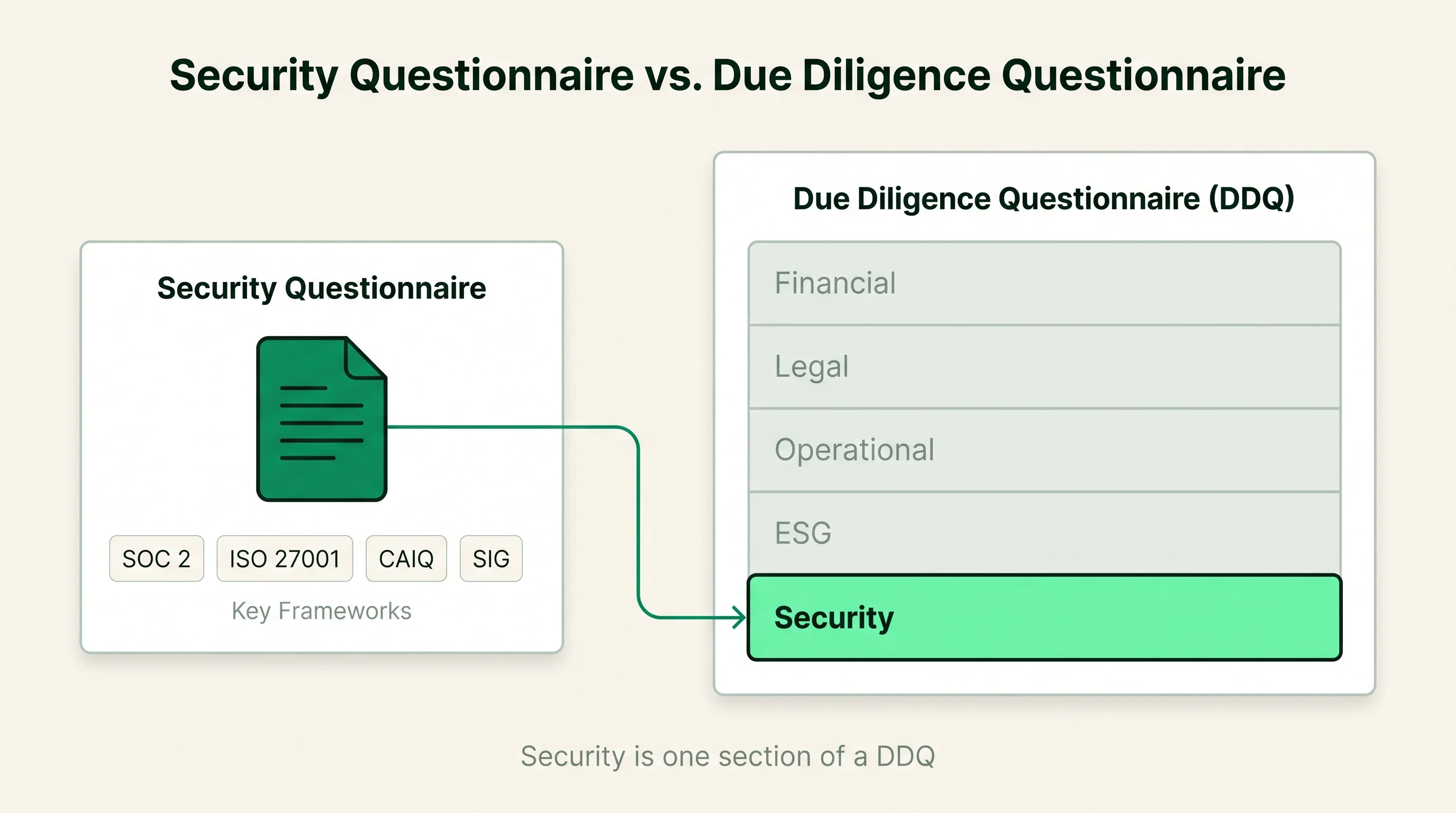
Quick answer: security questionnaire vs. due diligence questionnaire
A security questionnaire assesses a vendor's information-security controls and nothing else. A due diligence questionnaire, or DDQ, is a broader assessment that covers financial, legal, operational, ESG, and often security risk in a single document. If the form only asks how you protect data, it is a security questionnaire. If it also asks about your finances, contracts, ownership, and operations, it is a DDQ.
The two are not competing tools, and you do not pick one over the other. They are different documents sent by different people for different reasons. A vendor-risk team sends a security questionnaire to clear a software purchase. An investor or acquirer sends a DDQ to understand a whole company before putting money or a contract on the line.
They overlap in one important place: security is usually a section of a DDQ. That means the answers you maintain for security questionnaires feed directly into the security part of any due diligence. Knowing which document you are holding tells you who to involve, how deep to go, and how much of your existing answer library you can reuse.
The rest of this article breaks down what each covers, who sends them, where they overlap, how automation helps each one, and how to identify which you are actually facing.
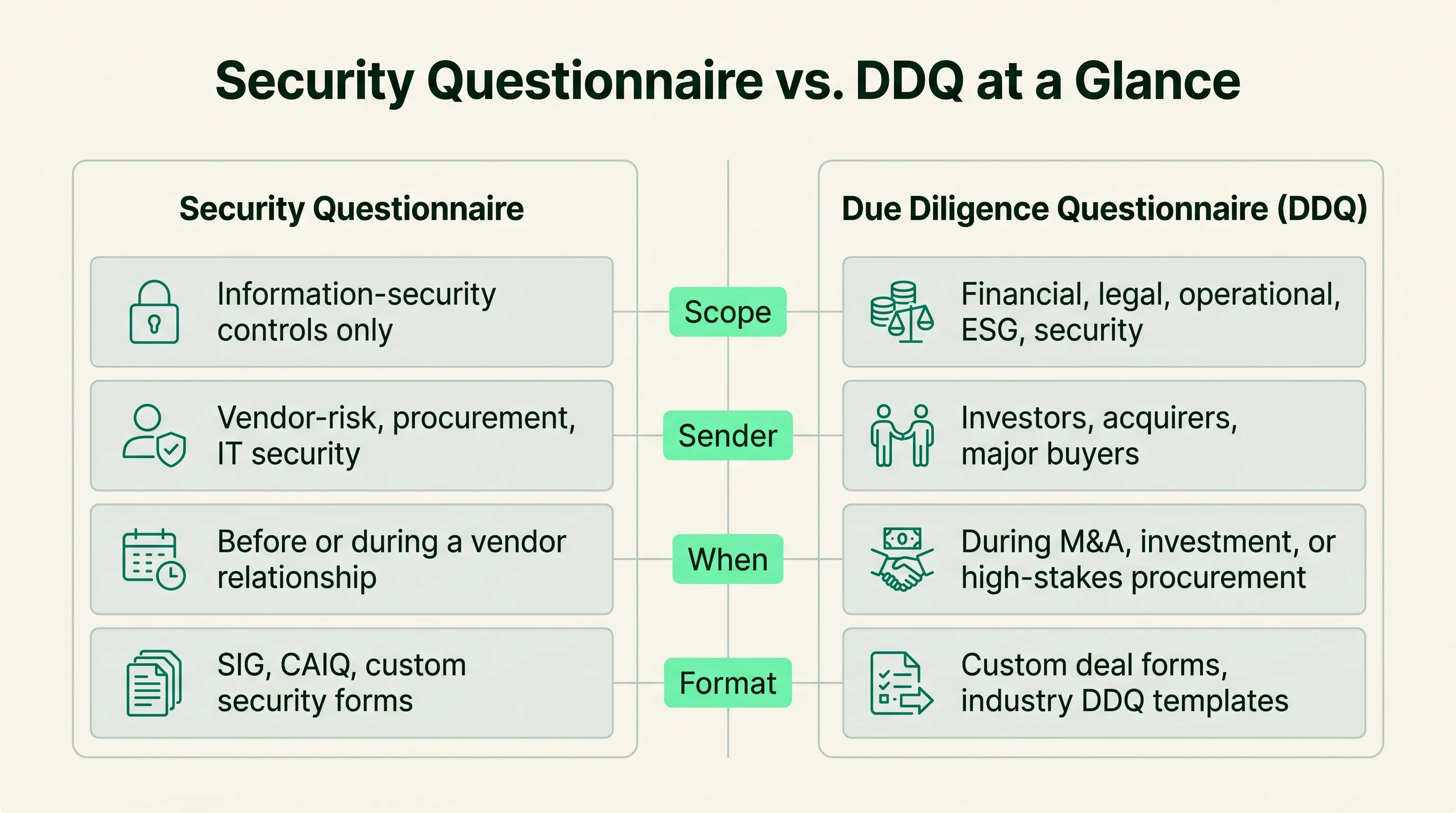
Security questionnaire vs. due diligence questionnaire: at a glance
The fastest way to tell the two apart is scope and sender. A security questionnaire is narrow and technical; a DDQ is wide and cross-functional. The table below compares them across the criteria that decide how you respond.
| Criterion | Security questionnaire | Due diligence questionnaire (DDQ) |
|---|---|---|
| Scope | Information-security controls only | Financial, legal, operational, ESG, and security |
| Typical sender | Vendor-risk, procurement, IT security | Investors, acquirers, fund allocators, major buyers |
| When sent | Before or during a vendor relationship | During M&A, investment, or high-stakes procurement |
| Frequency | Recurring, often many per quarter | Occasional, tied to a specific deal |
| Common formats | SIG, CAIQ, custom security forms | Custom deal forms, industry DDQ templates |
| Backing standards | SOC 2, ISO 27001, CAIQ, SIG | Varies by domain; security section maps to the above |
| Who answers | Security, GRC, sales engineering | Multiple owners across security, finance, legal, ops |
The pattern in the table is the core difference. A security questionnaire stays inside one discipline and recurs often, which is why a reusable answer library matters so much for it. A DDQ spans many disciplines and shows up around a single event, which is why coordination across teams matters more than raw answer volume.
Use the sender and the table of contents as your first signal. If one risk team is asking only about controls, treat it as a security questionnaire. If several risk domains appear in one form attached to a transaction, treat it as a DDQ.
What a security questionnaire covers and who sends it
A security questionnaire assesses how an organization protects information. It asks about access control, encryption, data handling, incident response, business continuity, vendor management, and the certifications that back those claims. The goal is a single judgment: is this vendor safe enough to handle our data and connect to our systems?
The people who send them are consistent:
- Vendor-risk and third-party risk management (TPRM) teams assessing a new or existing supplier
- Procurement teams gating a software or service purchase on a security review
- IT security and the CISO's organization validating technical controls before integration
- Compliance teams confirming a vendor meets a regulatory or contractual requirement
Security questionnaires map to recognized frameworks, which is what makes them comparable across vendors. SOC 2, defined by the AICPA, reports on security controls. ISO/IEC 27001 certifies an information security management system. The CAIQ from the Cloud Security Alliance and the SIG from Shared Assessments are standardized questionnaire formats buyers send so they can compare answers on a common structure.
The defining trait of a security questionnaire is repetition. The same vendor answers similar questions for buyer after buyer, in slightly different formats each time. That is the problem an answer library and a trust center are built to solve, and it is covered in our explainer on what security questionnaire automation is and the security questionnaire automation category hub.
In short, a security questionnaire is deep on one topic and sent often. Treat it as a recurring operational load, not a one-time project.
What a due diligence questionnaire covers and who sends it
A due diligence questionnaire assesses a whole organization, not just its security. A DDQ asks about financials, corporate structure, legal exposure, contracts, operations, key personnel, ESG practices, and, in most modern versions, information security. The goal is to let someone with money or reputation at stake understand the full risk of a relationship before they commit.
The senders are different from those behind a security questionnaire:
- Investors and fund allocators evaluating a company or a fund before they invest
- Acquirers running pre-deal diligence during a merger or acquisition
- Major customers conducting deep procurement on a strategic or high-spend supplier
- Partners assessing a counterparty before a long-term commercial agreement
DDQs are less standardized than security questionnaires. Some industries use shared templates, such as the institutional investment DDQs many fund managers respond to, but many DDQs are custom forms built around a specific transaction. There is no single standards body for a DDQ the way the AICPA backs SOC 2, because a DDQ spans domains that each have their own rules.
The defining trait of a DDQ is breadth and stakes. It usually appears once per deal, demands input from multiple internal owners, and feeds a decision that is hard to reverse. Where a security questionnaire is a recurring gate, a DDQ is an event.
The practical read is that a DDQ is a coordination problem more than a content problem. The security section may be familiar, but finance, legal, and operations each have to supply and stand behind their own answers.
Where they overlap and where they differ
The two documents overlap because security is usually a section inside a DDQ. When an acquirer or investor runs due diligence, information security is one of several risk domains they examine, and the questions in that section look a lot like a standalone security questionnaire. So the work you do to answer security questionnaires directly supplies the security portion of any DDQ.
Where they differ is everything around that section:
- A security questionnaire is entirely security; a DDQ is security plus finance, legal, operations, and ESG
- A security questionnaire is owned by security and GRC; a DDQ pulls in finance, legal, and leadership
- A security questionnaire recurs across many buyers; a DDQ is tied to one deal or investment
- A security questionnaire maps cleanly to SOC 2, ISO 27001, CAIQ, and SIG; a DDQ has no single standard
- A security questionnaire clears a vendor relationship; a DDQ informs an investment or acquisition decision
The relationship is one of containment, not competition. A DDQ can include a security questionnaire inside it, but a security questionnaire never includes financial or legal diligence. This is why a strong security answer library pays off in both places, while a DDQ still needs owners outside security to be complete.
The takeaway: maintain your security answers once, and they serve both surfaces. But do not assume the rest of a DDQ is the security team's job, because most of it is not.
How automation helps with each one
Automation helps both documents, but the leverage is different. A security questionnaire is a content-reuse problem, so the biggest wins come from a reusable answer library and a trust center. A DDQ is a coordination problem, so the biggest wins come from routing questions to the right owners and keeping a single source of truth across teams.
For security questionnaires, automation tools focus on reuse and speed:
- An approved answer library stores vetted responses so the same control question is answered once and reused
- A trust center lets buyers self-serve evidence and certifications before a questionnaire is even sent
- Portal autofill and format mapping move answers across SIG, CAIQ, and custom forms without re-keying
- AI drafting suggests answers from past responses, with citations back to source evidence
Vendors in this space, including Conveyor, Vanta, SafeBase, and Whistic, report meaningful time savings on repeat security questionnaires. Those figures are vendor-reported and should be tested against your own answer mix and buyer formats rather than taken as independent fact. Our guide to how enterprise buyers evaluate security questionnaire automation tools covers what to verify in a trial.
For DDQs, automation helps less with drafting and more with orchestration. The security section can be populated from the same answer library, but the financial, legal, and operational sections need their owners. Tools that route questions, track who answered what, and lock a single approved version reduce the version-control chaos that makes DDQs painful. AI-assisted answering applies to a DDQ too, but only where the content is structured and reusable, which is mostly the security and standard-template sections.
The practical read: invest in an answer library and trust center to handle the recurring security questionnaire load, and lean on workflow and coordination features when a DDQ lands. Both benefit from the same underlying security answers, which is the real reason to keep that library current. See the third-party risk management glossary entry and the TPRM software category for the buyer-side context these tools operate in.
Are you facing a security questionnaire or a due diligence questionnaire?
Identify which document you have before you start answering, because the right response process is different for each. The fastest tell is the sender plus the scope: who asked, and how many risk domains the form covers.
You are facing a security questionnaire when:
- A vendor-risk, procurement, or IT security team sent it
- Every question is about controls, data handling, certifications, or incident response
- It references SIG, CAIQ, SOC 2, or ISO 27001
- It is gating a software or service purchase, and similar forms arrive regularly
You are facing a due diligence questionnaire when:
- An investor, acquirer, or strategic buyer sent it, often through legal or corporate development
- It asks about financials, ownership, contracts, and operations alongside security
- It is attached to a specific deal, investment, or acquisition
- It expects input from finance and legal, not just security
The response process follows from that. For a security questionnaire, route it to security and GRC, draft from your approved answer library, point buyers to your trust center for evidence, and treat it as recurring operational work. For a DDQ, assign a coordinator, pull the security section from the same library, and route finance, legal, and operations questions to their owners with a clear deadline and a single approved version.
The common mistake is treating a DDQ like a big security questionnaire and leaving it with the security team, or treating a security questionnaire like a one-off deal document and not reusing the answers. Read the sender and the table of contents, then respond accordingly. To go deeper on the security-questionnaire side, start with the security questionnaire automation category and the pricing models explainer, then bring the relevant teams in for whatever sits outside security.
How this article was reviewed
Sources reviewed
- AICPA - SOC 2Primary source for SOC 2 reports on information-security controls, commonly referenced in the security section of both security questionnaires and DDQs.
- ISO/IEC 27001Primary source for the information security management system standard a security questionnaire maps to.
- Cloud Security Alliance - CAIQPrimary source for the CAIQ standardized security questionnaire format.
- Shared Assessments - SIGPrimary source for the SIG questionnaire format used in third-party risk reviews and inside the security section of many DDQs.
- Vendor product documentation (Conveyor, Vanta, SafeBase, Whistic)Time-savings and capability claims for security questionnaire automation are vendor-reported and should be verified against your own answer mix and buyer formats, not treated as independent fact.
FAQ
Is a security questionnaire the same as a due diligence questionnaire?
No. A security questionnaire assesses only information-security controls and maps to frameworks like SOC 2, ISO 27001, CAIQ, and SIG. A due diligence questionnaire, or DDQ, is broader and covers financial, legal, operational, ESG, and often security risk in one document. They overlap because security is usually a section inside a DDQ, but a DDQ asks far more than a security questionnaire does.
What are the most common mistakes when responding to a security questionnaire vs. a due diligence questionnaire?
The most common mistake is mismatching the document to the process. Teams treat a DDQ like an oversized security questionnaire and leave it entirely with security, when it actually needs finance, legal, and operations to supply their own answers. The reverse mistake is treating a recurring security questionnaire as a one-off, so the answers never get added to a reusable library. Read the sender and the scope first, then route each document to the right owners.
How does answering these compare to doing it manually or with spreadsheets?
Spreadsheets work for a first questionnaire and break down as volume grows. For security questionnaires, manual copy-paste across SIG, CAIQ, and custom forms wastes hours and lets stale answers slip through, which is why an approved answer library and trust center help. For a DDQ, the harder problem is coordination across teams, where spreadsheets create version-control chaos. Tooling helps both, but the security-questionnaire reuse case is where automation pays back fastest.
Do I need different tools for security questionnaires and due diligence questionnaires?
Not necessarily, because the security section of a DDQ draws on the same answer library as your security questionnaires. A security questionnaire automation tool with a strong answer library and trust center covers the recurring security load and feeds the security part of any DDQ. The rest of a DDQ, covering finance, legal, and operations, needs coordination and document workflow more than security-answer drafting, so the value of the tool is mostly in that shared security content.
Where does security fit inside a due diligence questionnaire?
Security is usually one section of a DDQ, sitting alongside financial, legal, operational, and ESG sections. The questions in that security section closely resemble a standalone security questionnaire, often referencing SOC 2, ISO 27001, or a SIG-style structure. That overlap is why a maintained security answer library serves both surfaces: you answer the security questions once and reuse them whether they arrive as a standalone questionnaire or as part of a DDQ.