

Security Questionnaire Automation vs. GRC Software
Security questionnaire automation answers inbound security reviews fast from an approved answer library. GRC software runs your governance, risk, and compliance program, and some platforms now bundle a questionnaire module. The right choice depends on whether your bottleneck is answering questionnaires or managing controls.
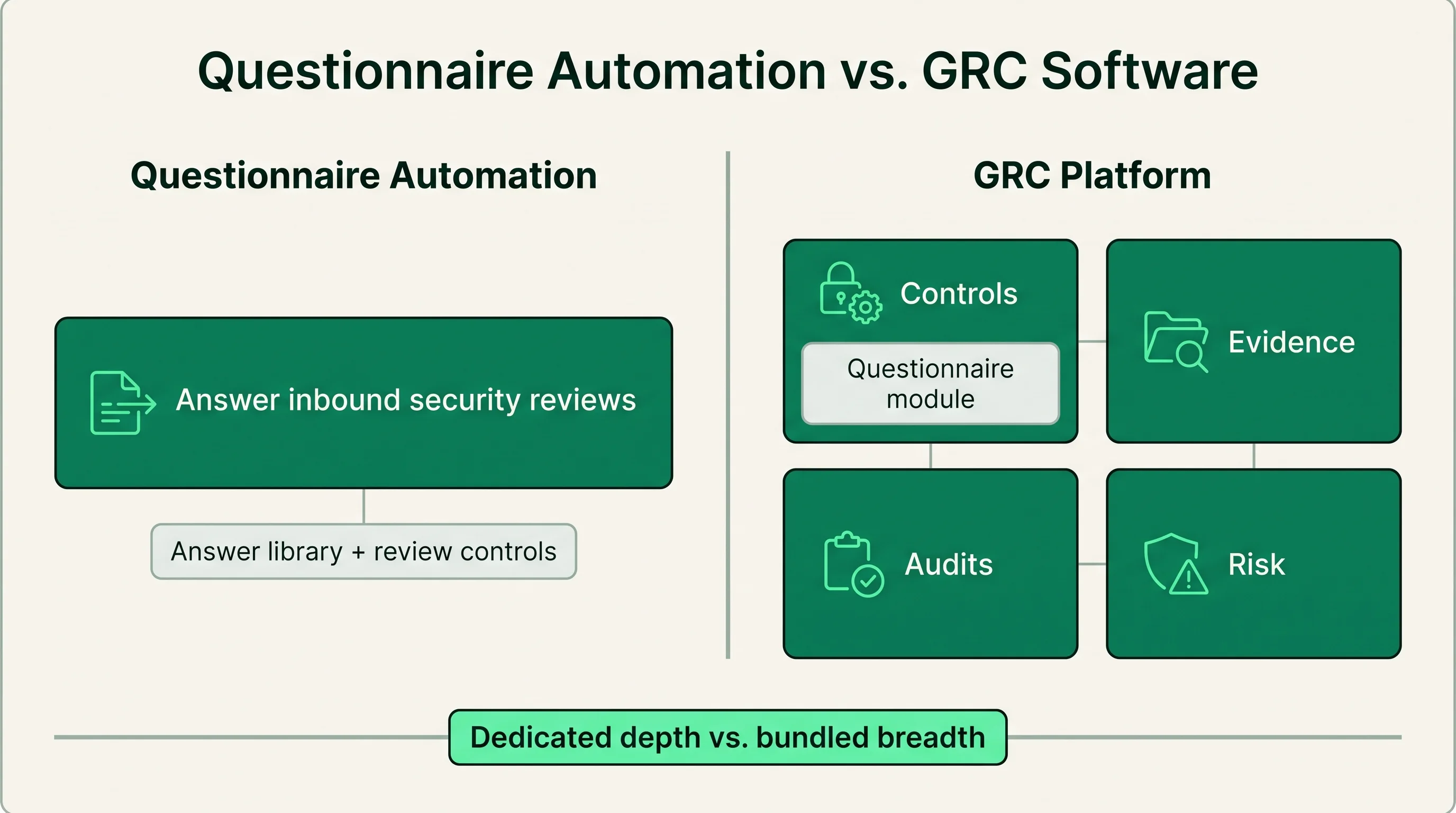
Quick answer: Security Questionnaire Automation vs. GRC Software
Security questionnaire automation fits teams whose bottleneck is answering inbound security reviews fast, while GRC software fits teams whose larger job is managing controls, evidence, and audits across the whole security program. They solve different problems, and many companies eventually use both. The deciding factor is which problem costs you the most time today.
A security questionnaire is the structured set of security questions a buyer sends a vendor before a deal. Dedicated automation answers it from a maintained answer library, drafting responses, citing approved evidence, and routing answers for review. GRC stands for governance, risk, and compliance, and GRC software runs the program behind those answers: it tracks controls, collects evidence, monitors risk, and prepares for audits against frameworks like SOC 2 and ISO 27001.
The choice depends on your formats, your volume, and your team. A company drowning in inbound CAIQ and SIG questionnaires needs response speed. A company preparing for its first SOC 2 audit needs control and evidence management. Some GRC platforms now bundle a questionnaire module, which makes the real question buy-versus-bundle rather than one-or-the-other.
Keep three questions in front of you while you read. Which work consumes more of your team's time today, answering reviews or running the program? How varied are the formats you receive? And do you already own one side of this, so you are really shopping for the other? For the core concept, see our explainer on what security questionnaire automation is.
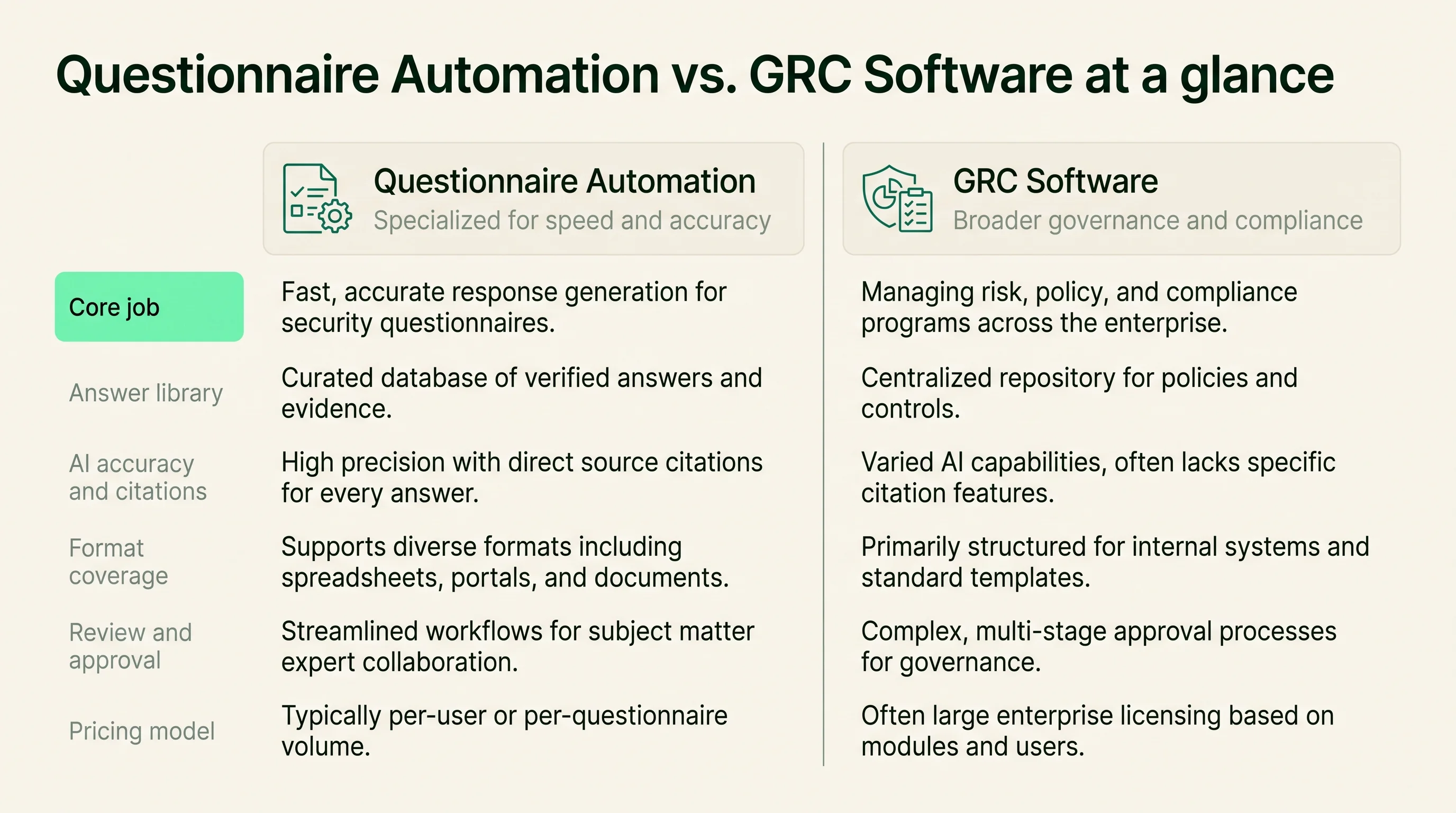
Security Questionnaire Automation vs. GRC Software: at a glance
The two categories differ most on their core job, and that difference cascades through every other criterion. Dedicated questionnaire automation optimizes for answering reviews; GRC software optimizes for running the compliance program. The table below compares them on the criteria buyers shortlist on.
| Criterion | Questionnaire Automation | GRC Software |
|---|---|---|
| Core job | Answer inbound security reviews fast | Manage controls, evidence, and audits |
| Answer library | Central feature, deep and tuned for responses | Present in some platforms, often newer or lighter |
| AI accuracy and citations | Specialized, tuned for drafting cited answers | Varies by platform, evolving capability |
| Format coverage | Broad: CAIQ, SIG, custom, portal autofill | Narrower, focused on common formats |
| Review and approval | Granular response workflows and SME routing | Tied to broader control and evidence workflows |
| Integrations | CRM, knowledge bases, trust center, portals | Cloud infrastructure, ticketing, HR, identity |
| Pricing model | Per-seat, per-questionnaire, or tiered | Platform bundle with questionnaire as a module |
Read this table as a starting point, not a verdict. The questionnaire module inside a GRC platform is evolving quickly, so any single row can shift between vendors and releases. Confirm current scope in a demo against your own formats. For a deeper look at the criteria enterprise buyers weigh, see our guide on how enterprise buyers evaluate security questionnaire automation tools.
Where Security Questionnaire Automation is stronger
Dedicated questionnaire automation is stronger wherever response speed and answer quality are the job. The whole product is built around one workflow: take an inbound questionnaire, draft accurate answers from approved content, route them for review, and return them in the buyer's format. That focus shows up in depth a general platform rarely matches.
The concrete strengths cluster around the response workflow:
- Answer-library depth: a library tuned for reuse, with approved answers linked to evidence and kept current, so the same subject-matter experts are not pulled into near-identical questions repeatedly.
- Format coverage: handling for CAIQ, SIG, custom spreadsheets, and buyer portals, including portal autofill that maps stored answers into third-party systems. Vendors report broad format support, which you should test on your own files.
- AI accuracy with citations: drafting tuned to ground answers in approved content and cite the source, which matters more for outbound responses than for internal control tracking.
- Response review controls: granular routing, SME assignment, and approval steps designed around questionnaire answers rather than compliance evidence.
- Throughput at volume: the workflow is built to absorb spiky, deal-driven inflow without stalling a signed contract.
There is also a sales-cycle argument. A stalled security review can hold up a signed contract, so the team that shortens that review is working on revenue, not just paperwork. Dedicated tools are built for that pressure, with throughput and routing tuned to clear inbound work before it blocks a deal.
The honest limit is scope. A questionnaire tool answers reviews well, but it does not run your control framework, collect audit evidence, or monitor risk posture. If answering questionnaires is genuinely your bottleneck, that narrow focus is the advantage, not a gap. Capability claims here are vendor-reported and worth confirming against your real questionnaires in a trial.
Where GRC Software is stronger
GRC software is stronger wherever the larger job is running the security and compliance program rather than answering questions about it. Platforms such as Vanta, Drata, Secureframe, and OneTrust manage controls, automate evidence collection, monitor risk, and prepare organizations for audits. When that program is your main work, a questionnaire is just one output of a system the GRC platform already governs.
The strengths sit in program management:
- Control monitoring: continuous checks that map your environment to framework requirements for SOC 2, ISO 27001, and NIST, flagging drift before an auditor finds it.
- Evidence collection: automated pulls from cloud infrastructure, identity, and HR systems, so evidence stays current without manual screenshots.
- Audit readiness: structured workflows that organize controls and evidence the way an auditor expects to review them.
- Risk management: registers, scoring, and reporting that give security leaders and the CISO a program-level view.
- Single source of truth: controls, evidence, and policies in one place, which the bundled questionnaire module can draw on when answering reviews.
The questionnaire module inside a GRC platform is the part to scrutinize. Several platforms now offer one, and it can be convenient because answers can reference evidence the platform already holds. These modules are evolving fast, so their depth, format coverage, and AI quality vary by vendor and release. Treat any questionnaire feature here as vendor-reported and verify its current scope against a focused tool before assuming parity.
Pricing and implementation differences
The two categories price and deploy differently because they sell different scopes. Dedicated questionnaire automation prices around response volume and the team that answers reviews. GRC software prices as a broader platform, where questionnaire response is one module inside a compliance suite. Neither model is cheaper in the abstract; the cost depends on what you actually use.
The pricing models break down cleanly:
- Questionnaire automation: commonly per-seat, per-questionnaire, or tiered around response volume, so cost tracks how many people answer reviews or how many reviews you process.
- GRC software: usually a platform bundle priced on company size, framework count, or monitored assets, with the questionnaire module included in a tier or sold as an add-on.
Implementation effort splits the same way. A questionnaire tool's rollout centers on one task: importing and curating your answer library, connecting a CRM or knowledge base, and tuning review routing. Teams can often start answering real questionnaires quickly once the library is loaded. A GRC platform's rollout is heavier because it connects to cloud infrastructure, identity, and HR systems to monitor controls and collect evidence, then maps everything to framework requirements. That work pays off in audit readiness, but it is a larger project than standing up a response workflow.
The buy-versus-bundle math turns on overlap. If you need control monitoring and audit readiness anyway, a GRC platform's questionnaire module can be efficient, since the answers reuse evidence the platform already holds. If you only need to answer reviews, paying for a full GRC suite to get a questionnaire feature is overspend. Without inventing figures, the rule is to price each option against your real usage. For the underlying models, see our breakdown of security questionnaire automation pricing models.
Which one should you choose?
Choose based on which job is your bottleneck, not on which category sounds more complete. If answering inbound security reviews is what slows your deals, a dedicated tool wins. If managing controls, evidence, and audits is the larger program, a GRC platform wins, and its questionnaire module may be enough. Many growing companies end up running both and connecting them.
Choose dedicated questionnaire automation when:
- Inbound questionnaires are stalling signed contracts and pulling SMEs off other work.
- You face many formats, including CAIQ, SIG, custom spreadsheets, and buyer portals that need autofill.
- Answer-library depth, AI citation accuracy, and response review controls are your top criteria.
- Your compliance program is already handled elsewhere, or is light enough not to need a platform.
- Response speed and throughput at volume matter more than program management.
Choose a GRC platform's questionnaire module when:
- Managing controls, evidence, and audits is the bigger job, and questionnaires are a smaller part of it.
- You are preparing for SOC 2, ISO 27001, or NIST and want monitoring, evidence collection, and responses in one place.
- A single source of truth across controls and answers outweighs best-in-class response depth.
- Your questionnaire volume is moderate and your formats are common rather than varied.
- Consolidating vendors and contracts is a priority for the CISO and procurement.
Verify before you commit. GRC questionnaire modules are evolving quickly, so test the module against your real formats and volume in a demo rather than assuming it matches a focused tool. To build a shortlist, start from the security questionnaire automation category hub and weigh each option against your actual questionnaire workload.
How this article was reviewed
Sources reviewed
- AICPA - SOC 2Primary source for what a SOC 2 report attests, the program GRC platforms help manage and questionnaires reference.
- ISO/IEC 27001Primary source for the information security management standard cited in answer libraries and tracked by GRC controls.
- Cloud Security Alliance - CAIQPrimary source for the CAIQ format, one of the standardized questionnaire types format coverage is measured against.
- Shared Assessments - SIGPrimary source for the SIG questionnaire format referenced in format coverage and volume considerations.
- NISTPrimary source for the cybersecurity framework GRC platforms map controls to during audit preparation.
- Vendor product and documentation (Vanta, Drata, Secureframe, OneTrust, and dedicated questionnaire tools)Capability and questionnaire-module claims are vendor-reported and evolving; confirm current scope in a demo against your own formats and volume.
FAQ
Is security questionnaire automation or GRC software better for answering security reviews?
Neither is universally better; the right choice depends on your bottleneck. A dedicated questionnaire automation tool is better when answering inbound reviews fast is the core problem, because it offers a deeper answer library, broader format coverage, and response-tuned AI. A GRC platform is better when managing controls, evidence, and audits is the larger job and questionnaires are a smaller part of the work.
Do GRC platforms like Vanta and Drata include questionnaire automation?
Several GRC platforms now offer a questionnaire module, and it can reference evidence the platform already holds. These modules are evolving quickly, so their depth, format coverage, and AI quality vary by vendor and release. Treat any questionnaire feature as vendor-reported and verify its current scope against a dedicated tool before assuming the two are equivalent.
Should I buy a dedicated questionnaire tool or use my GRC platform's add-on?
The decision turns on overlap. If you already need control monitoring and audit readiness, the GRC platform's questionnaire module can be efficient because answers reuse existing evidence. If you only need to answer reviews fast, a dedicated tool usually offers more depth, and paying for a full GRC suite to get a questionnaire feature is overspend.
What is the difference between security questionnaire automation and GRC software?
Security questionnaire automation answers inbound security reviews from an approved answer library, drafting and citing responses for buyers. GRC software governs the security program behind those answers by managing controls, collecting evidence, monitoring risk, and preparing for audits. One responds to questions about your security; the other runs the program your answers describe.
How do the pricing models compare between questionnaire automation and GRC software?
Questionnaire automation tends to price per-seat, per-questionnaire, or tiered around response volume, so cost tracks how many reviews you process. GRC software prices as a broader platform bundle based on company size, framework count, or monitored assets, with the questionnaire module included in a tier or sold as an add-on. Price each option against your real usage rather than comparing list prices.